AI is launching a fierce assault on cancer, conducting virtual killing efficacy tests on 4,000 anti-cancer drugs, and the total number of downloads of Google Gemma has exceeded 1 billion.
Another new milestone!
Just today, Google DeepMind officially announced the latest achievement of Gemma's open-source "full suite" —
The cumulative downloads have exceeded the 1 billion mark for the first time.

First launched in February 2024, it took a full two and a half years to grow from 0 to 1 billion downloads.
Today, global developers have "radically modified" more than 100,000 derivative variants based on Gemma, which have been deployed on NASA satellites and accessed by 100 million users on their mobile phones.......
The massive ecosystem boom belonging to the Gemmaverse has truly arrived!
AI identifies anti-cancer pathways, 4000 drugs undergo virtual killing tests
Now, AI has officially launched a general offensive against cancer!
Among the numerous use cases of Gemma, the truly stunning part is that AI has begun to deeply participate in exploring new mechanisms for cancer treatment.
Just yesterday, global mRNA giant Moderna and Merck used AI to treat cancer, causing a sensation worldwide.

In fact, as early as January this year, Google quietly entered this field with Gemma.
Teams from Google DeepMind, Google Research and Yale University developed a 27B parameter model based on Gemma:
Cell2Sentence-Scale 27B, referred to as C2S-Scale.
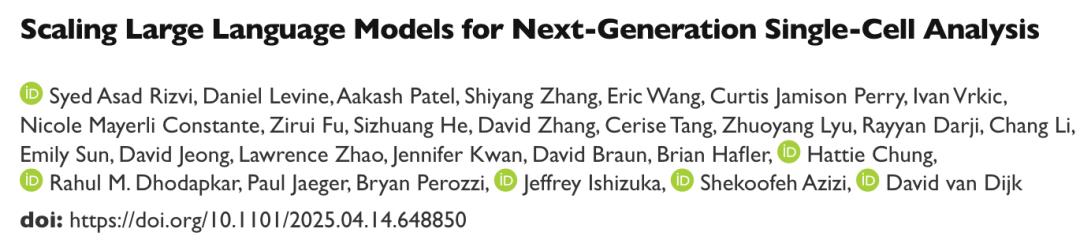
Paper link: https://www.biorxiv.org/content/10.1101/2025.04.14.648850v4
C2S-Scale only does one thing: describe a cell in one sentence.
For a long time, cancer immunotherapy has faced a bottleneck that has persisted for many years, called "cold tumors".
In layman's terms, the immune system identifies bad cells by the cells actively "holding up a sign" —
hanging fragments of their internal proteins on the surface, which is equivalent to telling immune cells: Something is wrong here, come and check me.
The technical term for this action is "antigen presentation", and the scaffold used to hang the "sign" is called "MHC-I".
The problem with "cold tumors" is that they do not hold up any signs.
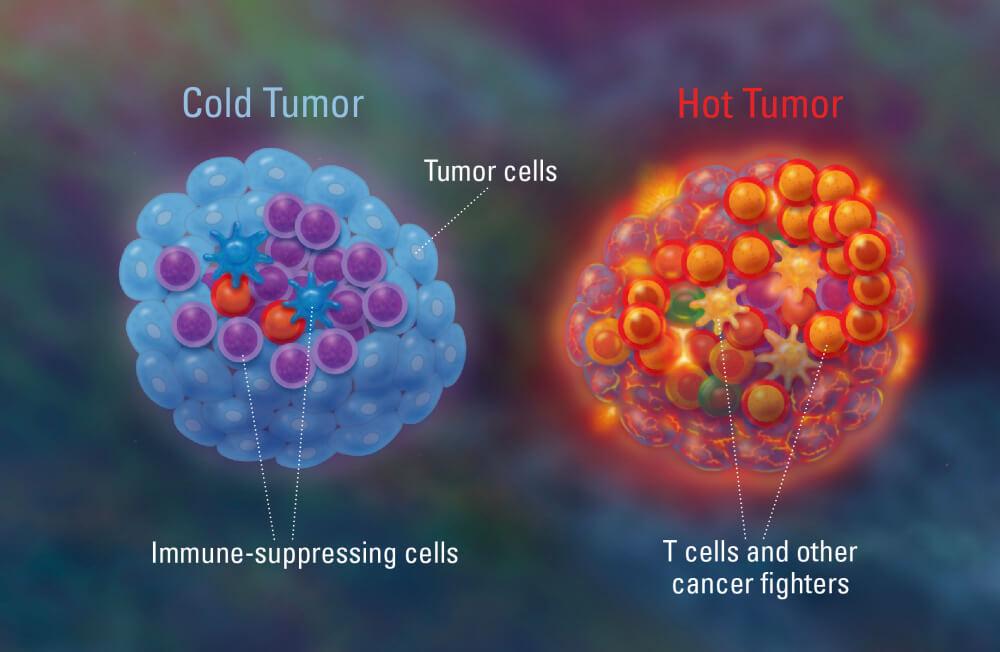
Immune cells walk right past them and see nothing. No matter how good the immunotherapy drug is, it cannot hit an invisible target.
Interferon is the "alarm signal" of the immune system. But in real tumors, its level is usually very low, almost non-existent.
Therefore, the research team set a task for C2S-Scale:
Find a drug that does not trigger the alarm itself, but as long as there is a faint alarm sound in the environment, it can amplify this sound enough to make the cells hold up their signs.
This requirement of "taking effect only under specific conditions" is the most difficult part of the entire experiment.
Turn a cell into a sentence
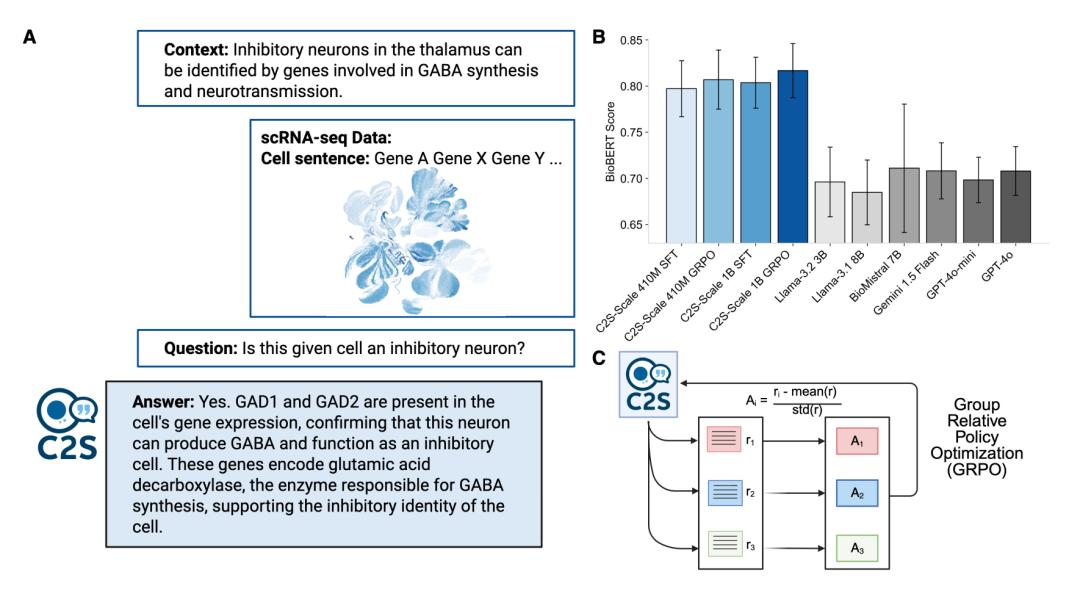
The smartest part of C2S-Scale is that it implements a very simple transformation.
The data from single-cell sequencing used to be a large mass of high-dimensional vectors that are incomprehensible to humans, let alone language models.
Its specific approach is to arrange gene names in a string from highest to lowest activity level, with the most active ones at the front to form a sequence.
One cell is transformed into a sentence composed of "gene names".
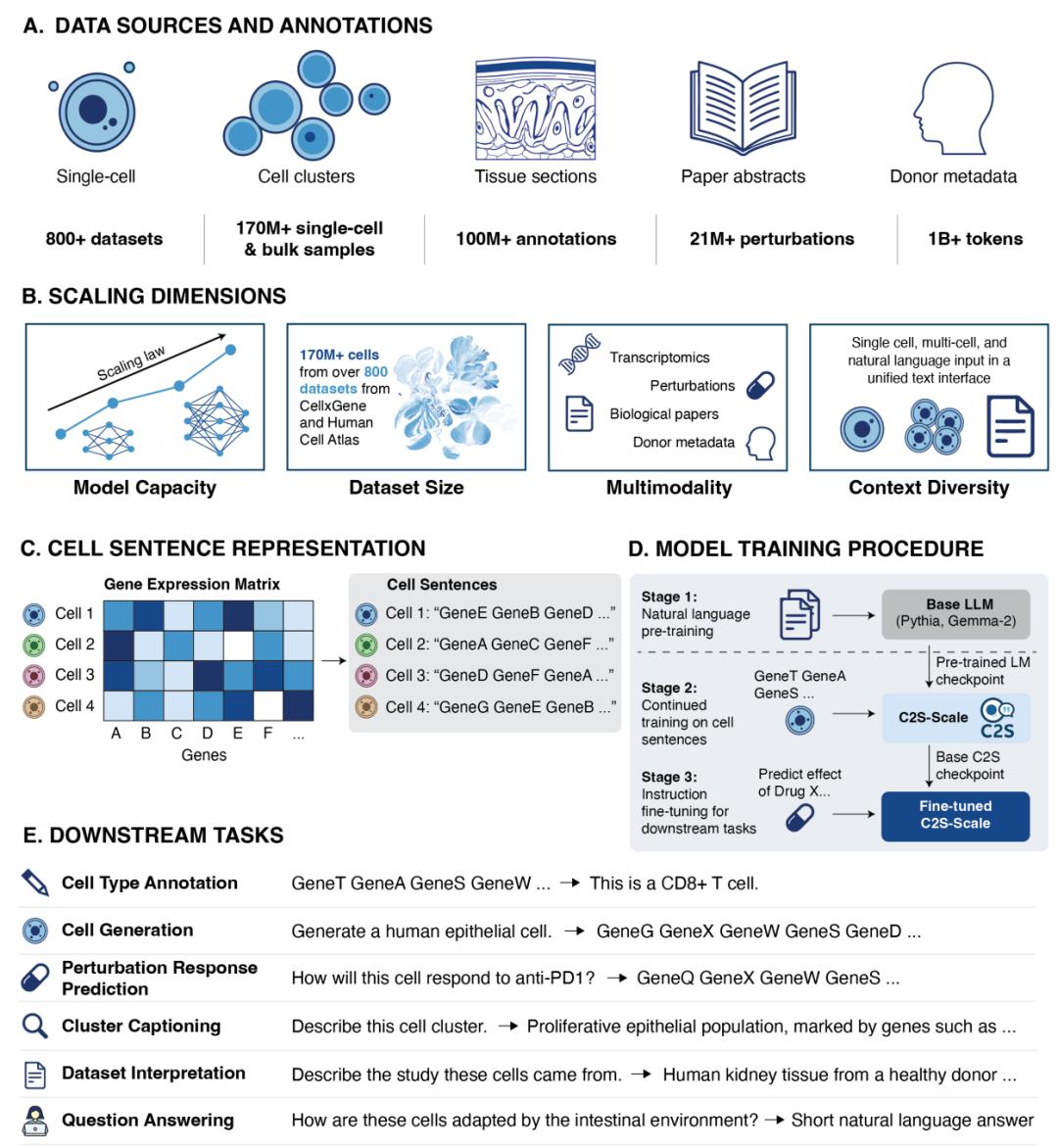
With this transformation, Gemma can directly "read" cells without any modification to its architecture.
Moreover, it can also process pure text content such as paper abstracts and cell metadata at the same time, all processed by the same set of mechanisms in the same model for the first time.
Next comes the core design of the paper — the dual-context virtual screen.
Let C2S-Scale run the same experiment in two "parallel worlds" at the same time.
World A (positive immune context): primary tumor samples from real patients, with faint interferon signals in the environment.
World B (neutral immune context): cultured cell line data with no interferon activity at all.
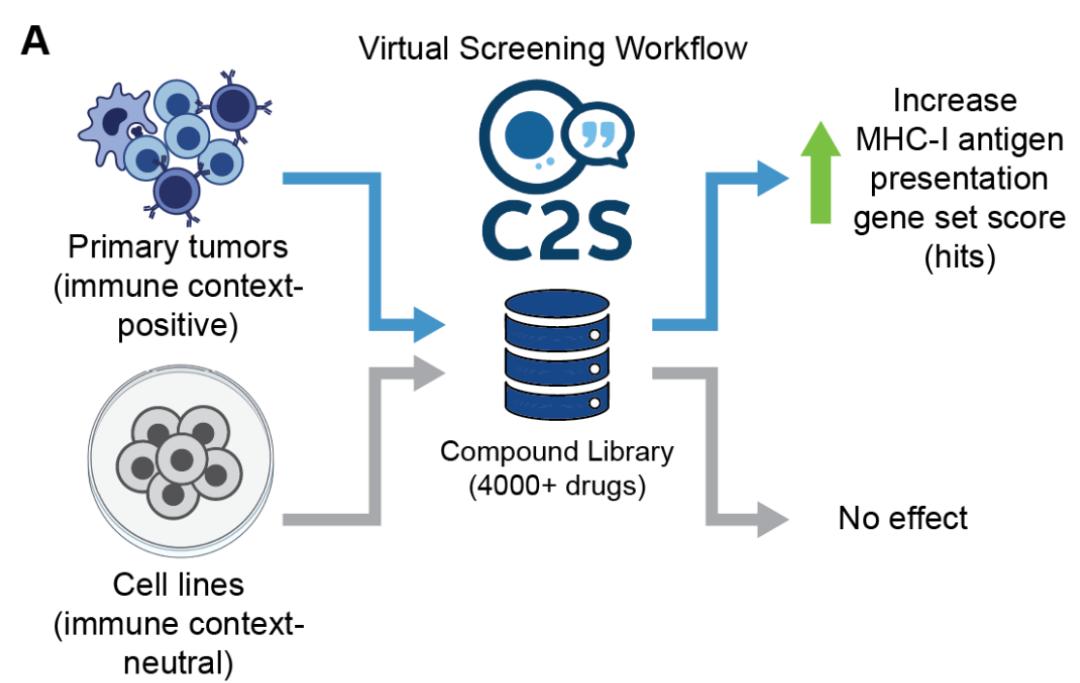
Then more than 4,000 drugs are put into these two worlds one by one to run the test.
The target to be found is very strict: drugs that only take effect in World A and have no effect at all in World B.
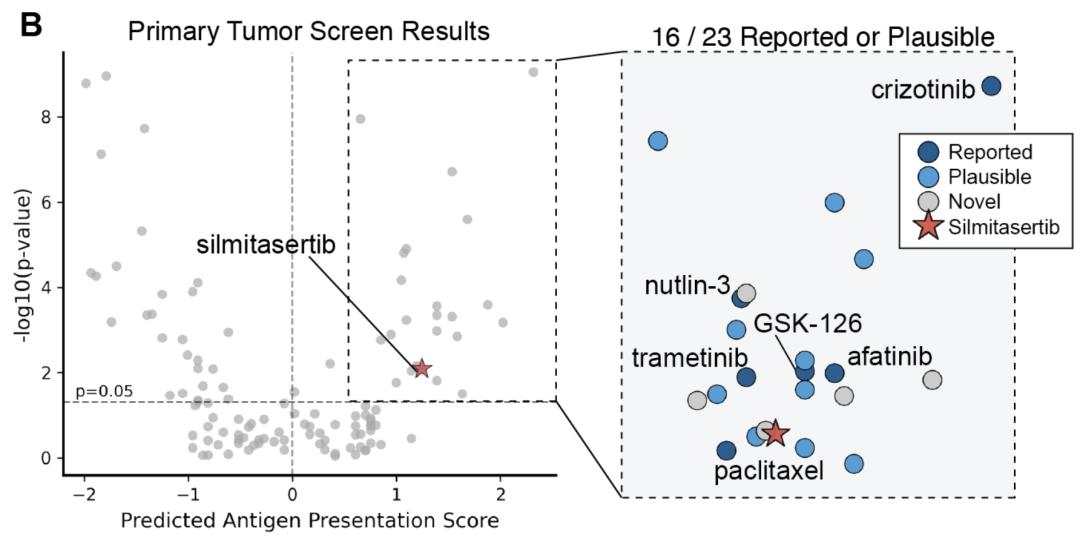
Among the candidate drugs identified by C2S-Scale, only 10%-30% have been mentioned in previous literature.
More than 70% of the rest have no known association with this screening target.
The final selected candidate is silmitasertib (code name CX-4945), a CK2 kinase inhibitor.
The label the model assigns to it is "context split" — it shows strong effect in World A, and almost zero effect in World B.
In the paper, the team states that C2S-Scale truly proposes a new, falsifiable hypothesis.
Live cell experiments successfully verified
Hypothesis is just hypothesis, and its authenticity must be verified by live cell experiments.
The team adopted a human neuroendocrine cell model, the key point being that these cell models never appeared in the model training process.
The results of the three control groups are as follows: using silmitasertib alone: no change in antigen presentation; using low-dose interferon alone: a slight improvement.
Only when the two are used together: antigen presentation increases by about 50%.
This is the first time that AI has proposed a brand new mechanistic therapeutic pathway and verified it in living cells.
Google Gemma, the 1 billion milestone
The last time an open-source AI model hit 1 billion downloads was back in the Llama era.
When Google first released Gemma, the first batch of models only had two sizes: 2B and 7B.
It shares the same origin with Gemini, but follows a completely different path: the flagship Gemini focuses on cutting-edge model capabilities, while Gemma is designed as a lighter open model that is easier to deploy locally.
Developers can directly obtain the weights and run them on their own computers, mobile phones and edge devices.
Since 2024, the growth rate of Gemma has become increasingly staggering.
In March 2025, on the first anniversary of Gemma's release, the number of downloads just exceeded 100 million; by December 2025, this number had exceeded 300 million. When Gemma 4 was released in April 2026, the cumulative downloads exceeded 400 million;
By the second quarter of this year, downloads had exceeded 900 million.
Now, after about another month, the number has officially exceeded 1 billion. At the same time, a huge Gemma ecosystem has been born.
In addition to cancer treatment research, Google Gemma has also been sent into space, sending its first message to Earth: "Hello, people on Earth"!
This is the first time in history that a large model has run on a high-performance GPU in space.
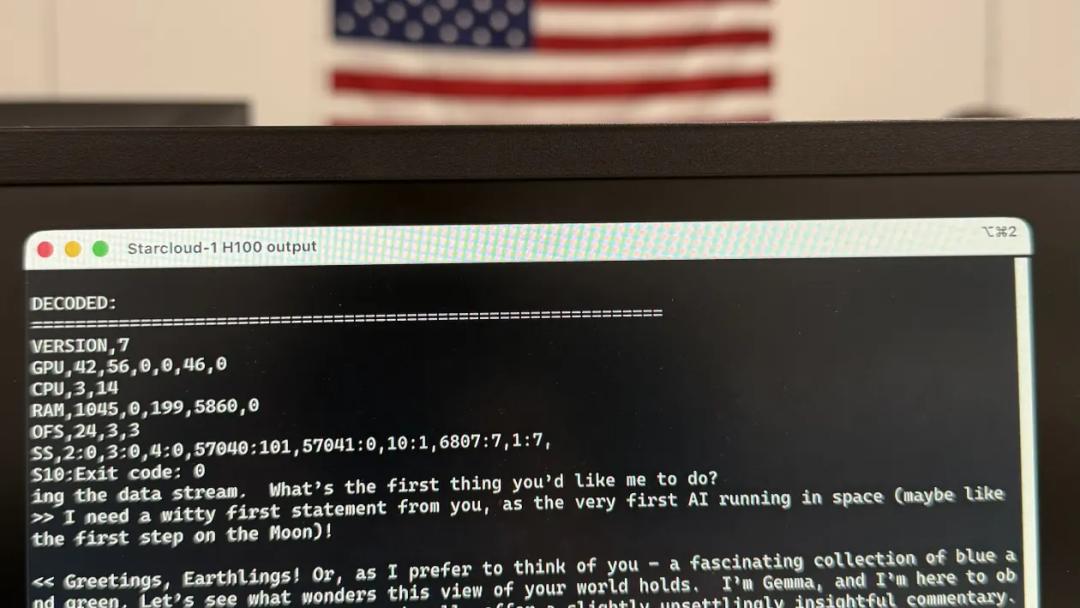
Not only that, Gemma has also dived into the ocean to decode the sounds of dolphins.
This model is called DolphinGemma.
It directly receives dolphin sounds, searches for recurring patterns and sequences in them, and tries to predict: what will the next dolphin call be.

Gemmaverse, massive boom
Today, while announcing the 1 billion download milestone, Google has also officially launched a new official GitHub repository.
Awesome Gemma, which is equivalent to the official directory of the Gemmaverse.
GitHub link: https://github.com/google-gemma/awesome-gemma
This repository centrally collects fine-tuned models, tutorials, developer tools from the AI community, as well as various Gemma applications.

The large model war in the past two years is easily understood as a competition of "who has the smartest model".
But the 1 billion downloads of Gemma demonstrate another dimension:
The more disruptive path for AI is to quietly integrate into every piece of hardware.
References:
https://blog.google/innovation-and-ai/technology/developers-tools/gemma-one-billion-downloads/
https://github.com/google-gemma/awesome-gemma
This article is from the WeChat official account "AI Era", author: ASI Revelation, published with authorization from 36Kr.