Models no longer compete on parameter specifications but on closed-loop capabilities, and focus on implementation in household scenarios. This year's conference is no longer "sexy" | Live coverage of WRC2026
Text | Qiu Xiaofen, Huang Nan
Edited by | Yuan Silai
On August 20, the World Robot Conference (hereinafter referred to as WRC) was held at the Yizhuang Guochuang Convention and Exhibition Center in Beijing. The event coincided with the listing of Unitree, whose market value exceeded 400 billion yuan at its peak, adding new fuel to the already booming industry.
This year's WRC attracted more than 300 exhibitors, a 40% surge compared to last year, with as many as 3,000 robot products on display.
Among the new participants, in addition to a new batch of embodied AI startups, there are also real end customers — according to official data, 49 central state-owned enterprises organized a delegation to attend the event, bringing 12 real engineering scenarios (power grid, aerospace, mining and metallurgy, etc.) to seek robotic solutions.
WRC is divided into four pavilions A, B, C and D, one more than last year. The entire visiting route starts from the humanoid complete machines in Pavilion C, passes through complete landing scenarios arranged in Pavilions A and D, and ends at Pavilion B which is dominated by upstream industrial chain manufacturers, forming a complete industrial chain for embodied intelligence.
It is worth noting that a number of international chip giants have also appeared as new faces in Pavilion B, such as AMD, Infineon, Realtek and so on, trying to grab customers from the rising new robot enterprises.
As the most important annual event in the robotics field, WRC serves as a critical observation window for the industry vane.
After walking through the 52,000 m² venue, 36Kr found that people no longer want to pay for visions and stories. At this WRC, companies must answer sharp questions: whether their models are closed-loop, and whether robots can complete real work.
With the listing of Unitree and the emergence of many companies valued at over 10 billion yuan, embodied intelligence has entered the deep-water zone. The 2026 WRC is an outpost window that represents the return of commercial value: no matter how attractive the final outcome is, enterprises must first generate revenue in the present.
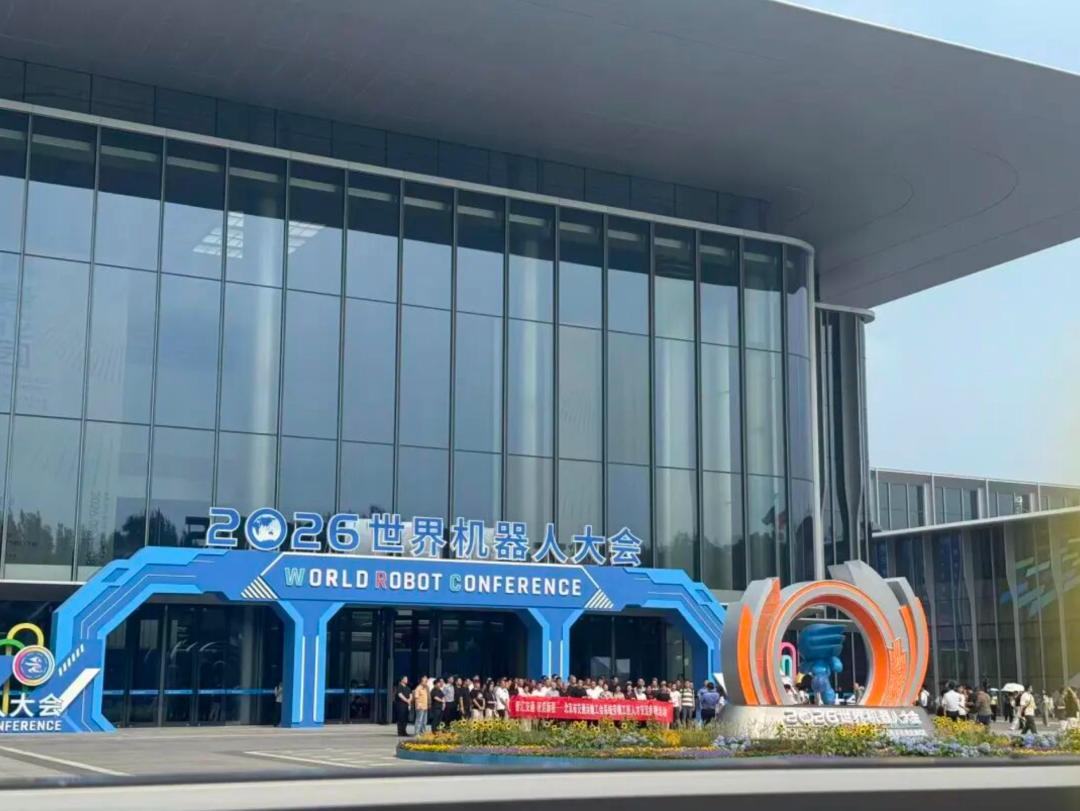
Photo source / taken by 36Kr
Models are truly put into use, with competition shifting from intelligence level to closed-loop capability
36Kr has participated in multiple WRC events. In previous years, all companies competed on "how smart the model is" or "how large my parameters are", but this year is more pragmatic. Everyone is talking about the same question: how to connect models, data and actual tasks into a closed loop, so that the model can serve real scenario implementation.
However, a new technical change is that last year the whole venue was labeled with VLA, while this year no one talks about VLA, but almost all solutions have a world model built on top of it.
A single VLA model can perceive scenarios, understand instructions and generate actions, which is sufficient for short-range closed scenarios, but it does not know what the environment looks like or the causal relationship. Therefore, as the task extends, errors will accumulate increasingly, and it will fail when transferred to an unfamiliar environment. The world model exactly makes up for this shortcoming — it allows the robot to deduce several possible outcomes in its mind before taking action, think first and then act, instead of making mistakes while moving.
However, when it comes to how to integrate VLA and the world model, different companies have taken different paths.
36Kr's observation at WRC shows that the current representative path is to directly "embed" the world model into the model itself, so that action generation is no longer a simple end-to-end mapping, but completed on the basis of predicting the dynamic changes of the world.
Yu Chao, founder of LuMing Robotics, explained to 36Kr that their idea of building the embodied brain Prime R0 is to directly integrate the prediction capability of the world model into the decision-making framework of VLA, forming a closed loop of semantic understanding, behavior execution and situation prediction.
"We do not treat the world model simply as an external plug-in, but allow it to learn the changes of the world after actions while learning to perform actions," said Yu Chao.
The robot skill evolution engine NexCore released by LuMing at the same time is also built for such a closed loop: starting from real industrial tasks, collect real world data, form robot skills through model training, and then deploy them to robots to complete tasks. New feedback and data will be generated during robot operation, which will then be fed back to the model and skill system for continuous iteration.
Stardust Intelligence has taken another path, introducing explainable, inspectable and intervenable reasoning inside the model, evolving from the explicit text reasoning of Lumo-1 to the implicit modeling of the dynamic world changes in Lumo-2.
The essential difference between the two paths is: one exposes the reasoning process for inspection, and the other compresses the reasoning process into the latent space to pursue higher efficiency.
In short, the reasoning process of Lumo-1 is readable: the AI will first organize ideas in language and then perform actions, which is equivalent to "writing out" the thinking process. It splits tasks into three independent modules: planning, prediction and control, with the world model as a separate intermediate prediction layer. The advantage of this architecture is that it is stable for long-range tasks, while the disadvantage is that data is transferred back and forth between modules at a low speed, making it difficult to adapt to real scenarios with high-frequency interactions.
This year, Stardust Intelligence made adjustments on Lumo-2. With the help of the world action model framework, it completes the prediction of world changes in the "latent space" and directly generates actions, which runs faster, but the reasoning process can no longer be directly viewed as text. This modification makes the independent modules lighter and faster, and the reasoning speed is 2.71 times faster than the standard autoregressive scheme.
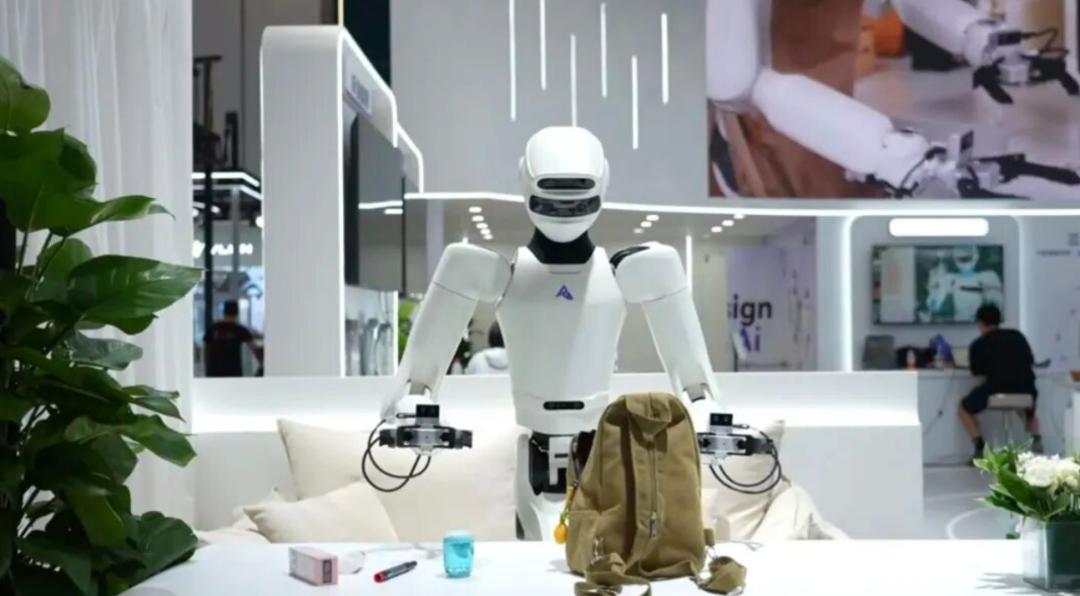
Stardust Intelligence T1 organizes schoolbags at WRC (Photo source / the enterprise)
However, no matter how divergent the technical routes are, everyone has to answer a practical question in the end: how can the model create value in real scenarios?
In this regard, 36Kr's intuitive feeling is: robots move faster than before this year, and the speed improvement is visible to the naked eye. Many exhibitors said that a large number of model engineering optimization work is behind this change.
A staff member told 36Kr that one of the pain points of robot implementation in the past was the interface problem — whether the model developer purchased different robot bodies, or the body manufacturer purchased models, they needed to write interface programs one by one, and there was a huge gap between hardware and models.
To solve this problem, Fourier Robotics focused on promoting a framework at this WRC, which connects functional modules such as large language models, embodied models, navigation planning, and underlying motion control. For model developers, they can verify their models as soon as they are imported into the framework, without starting adaptation from scratch. It is like building a set of "nervous system" for robots.
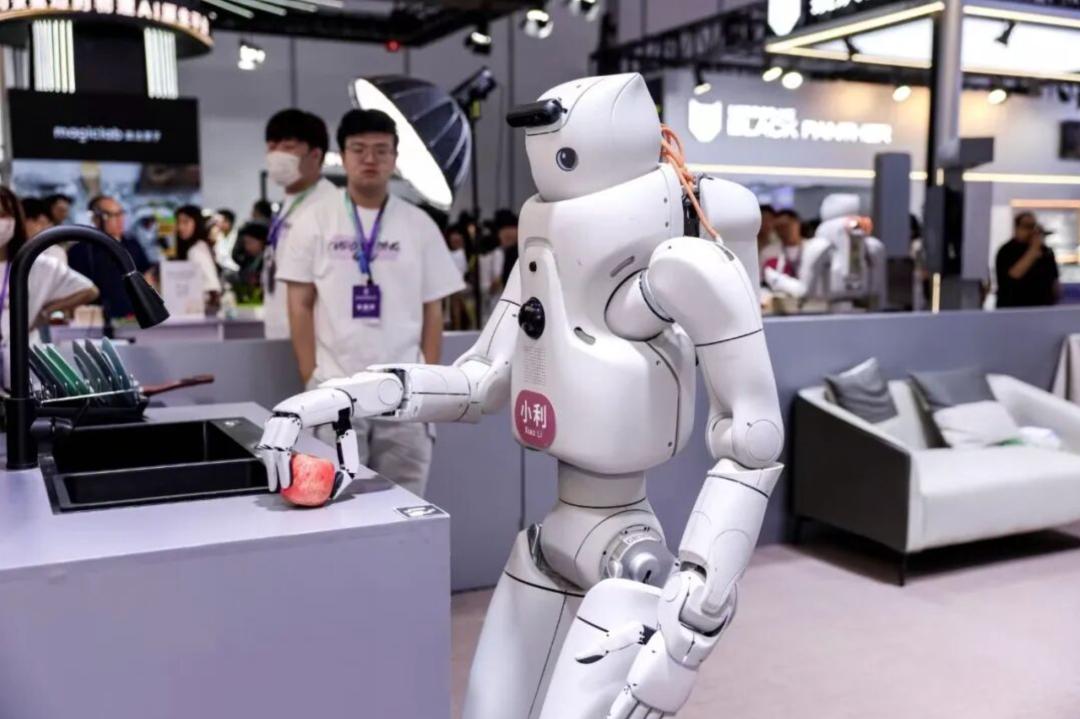
Fourier Robotics (Photo source / official)
Xu Shichao, technical director of Xixi Intelligence, told 36Kr that behind the faster movement, there is also a trade-off logic for models — in the process of industrial implementation, the industry has generally demystified large models. If every step is left to the large model to figure out before taking action, the robot will never move fast, and the power consumption will also be huge.
Therefore, the industry has reached an engineering consensus this year to adopt the "fast-slow brain" architecture with the coordination of large brain and small brain: the large brain is responsible for deep reasoning, and the small brain is responsible for fast execution, so as to solve the comprehensive problems of models in computing power, cost, heat dissipation and response time. Specifically, high-frequency and repetitive actions are first split out and handed over to small models with lower computing power, without calling the large model every time.
Xu Shichao said that the industry generally also assists with physical world simulation, advance reasoning and other work, so that the model does not need to calculate while moving, and the overall efficiency is improved. This enables robots to meet the factory capacity requirements in food processing and improve the actual benefits of factories.
Zhang Xiaoming, Executive Vice President of COWAR Robot, also pointed out the uniqueness of embodied models in communication with 36Kr: large language models are usually "trained well in the laboratory first, and then deployed on a large scale", while robot models do not need to be trained to perfection before being put into use — they can be put into real scenarios first, accumulate data during operation, and then use the data to feed back the model.
Taking COWAR Robot as an example, its robots have achieved normalized operation of ten thousand units in multiple urban scenarios in more than 50 cities and regions around the world, accumulating more than 50PB of real scenario data, which will continue to be used to polish the decision-making and generalization capabilities of the model. "Model improvement and scenario implementation are parallel, not sequential," said Zhang Xiaoming.
The reason why robots run faster this year is not a revolutionary breakthrough in a certain model technology, but that the industry pays more attention to closed loops — finding an engineering trade-off solution in the contradiction of "the big brain thinks slowly while the limbs move quickly".
It is undeniable that although embodied models have had a few successful cases, there is still a long way to go before industrial implementation. Jiao Jichao, Vice President of UBTECH and Dean of the Institute of Embodied Intelligence and Humanoid Robots, told 36Kr that at the level of cutting-edge technology exploration, the industry is faced with insufficient volume of real interactive data and scarce high-quality data. Moreover, the industry has not formed a unified understanding of the data types and training standards required for embodied models.
In this case, some teams have chosen a more practical approach. They do not dwell on whether the model can complete real tasks, but verify to what extent it can complete tasks and at what difficulty level it will fail.
Their testing methods are also quite interesting. For example, Muka Robotics built a capability boundary test bench with three interactive game demos: curling, magic guessing and maze.
These three games have different focuses. Curling verifies the adaptation speed of the world model in a dynamic environment. Magic guessing tests the "multi-path deduction" capability of the world model: the audience randomly hides a small ball under one of the three cups and swaps the positions of the cups. Although the robot does not know where the ball is, it can deduce every possible future state one by one, and then select the optimal path to execute. The maze is a classic stress test. As the number of curves increases, the model needs to continuously reason under pure visual conditions, maintain consistency in long-sequence decision-making without accumulating errors, and push the model to the upper limit of handling complex planning problems.
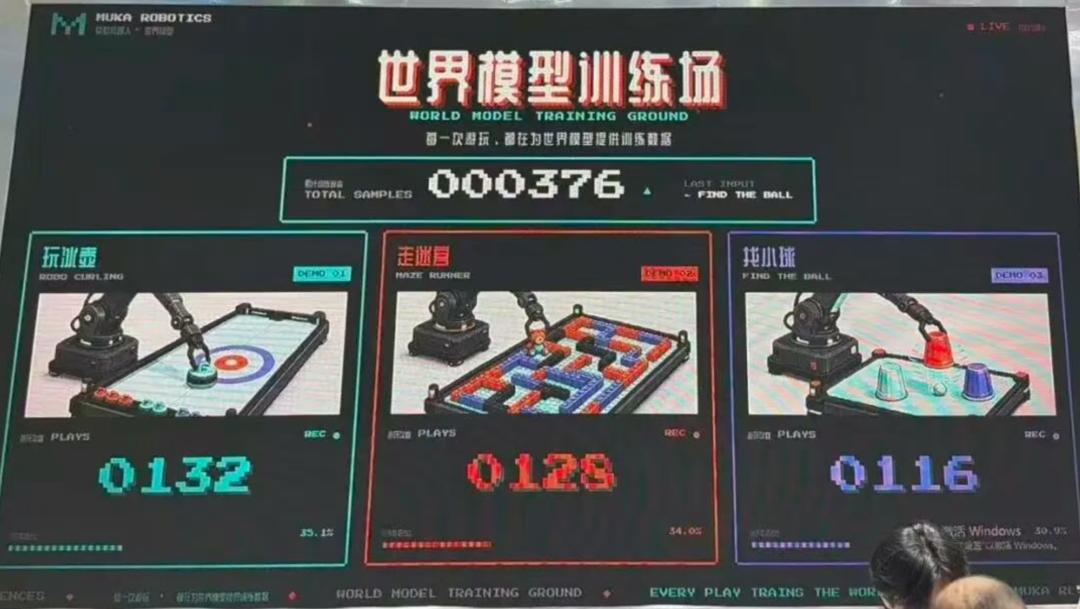
World model training ground exhibited on site by Muka Robotics (Photo source / the enterprise)
Of course, such experiments also prove conversely that embodied models are still in a very early stage, and it is even difficult to use random scenarios for testing.
"The direct result of the improvement of model capability is that scenarios that could not be implemented based on rules and planning in the past can now be delivered. But there is still a distance between 'deliverable' and 'large-scale delivery'," Fu Qiang, partner and product lead of Galaxy Universal, told 36Kr.
For ordinary audiences, how to tell whether a robot is pre-programmed with algorithms in advance or actually uses a large model? An embodied intelligence model manufacturer gave 3 tips to 36Kr:
1. Check if there is a staff member holding a remote control or computer to trigger actions behind the scene;
2. Check if the robot only shuttles back and forth between point A and point B, or simply repeats the same task;
3. Try to suddenly move the items in the task, and see if the robot will continue to place the items in the original position. A robot supported by a model will generally stop immediately and re-plan.
Household robots are booming, and other scenarios are stepping into the real world
After visiting the four pavilions A, B, C and D, another obvious feeling of 36Kr is the explosive growth of household scenarios.
According to incomplete statistics, enterprises demonstrating household scenarios include Qiansun, Star Era, Stardust Intelligence, Moqi Intelligence, Haier Robotics, Yunji, Fourier Robotics, Future Not Far, Independent Variable, Galaxy Universal, Extreme Vision and so on.
However, no robot company stays on the old story of family companionship. Instead, they built living rooms and laundry rooms on site, letting robots do actual work directly.
For example, Qiansun demonstrated the function of "tidying the living room with one sentence". When you give the robot a rough instruction "help me tidy the living room", the robot will split it into multiple subtasks — put the dishes into the dishwasher, put the coke on the table back in place, put the dolls into the basket, throw the garbage into the trash can, then recognize the map, sort the tasks, and complete them one by one.
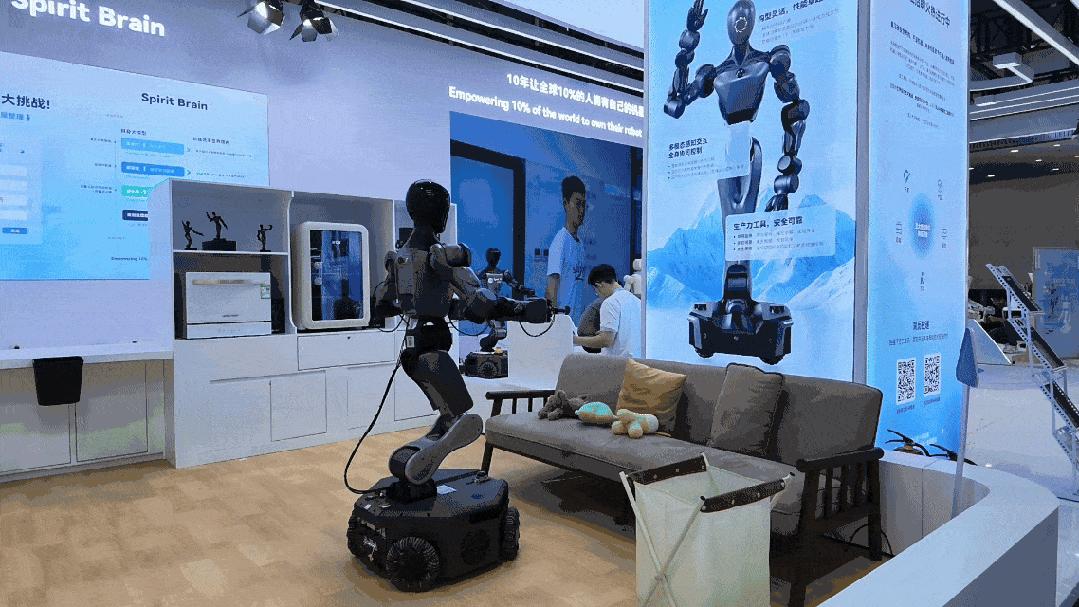
Qiansun demonstrates tidying the living room with one sentence
The boom of household scenarios at this year's WRC is mainly driven by the application of world models and the gradual accumulation of data.
A staff member at the booth of Moqi Intelligence told 36Kr that on the one hand, the world model solves the problem of robots "predicting future changes", and on the other hand, with the popularization of first-person data collection methods, daily household data has become cheap and massive. He said that the current industry consensus is that tens of thousands of hours of pre-training followed by subsequent fine-tuning can achieve relatively good results. "Now you will be embarrassed to release your product publicly if you don't have tens of thousands of hours of data."
In addition to technology, the more important logic is whether the embodied intelligence industry can succeed in the end depends on whether robots can truly enter households. "Only when robots enter every household, the bubble of this industry will not burst. The narrative of 'one robot per person' is the ultimate and most attractive vision of this industry," a booth staff member said bluntly.
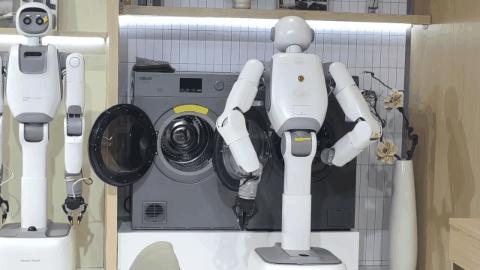
Moqi robot does