The video generation sector has ushered in the "Claude Code Moment", as MiniMax Design breaks into the traditional core market territory of Adobe and Canva.
The Hidden Hidden Bill of AI Video Generation
On Monday morning, a consumer brand made a last-minute decision to add a new round of short video placements for its upcoming promotional campaign.
The requirement sounds not that complicated: centered on the same new product, create a batch of short videos with a style close to real user sharing for different age groups, consumption scenarios and platforms. The content roughly includes: someone using the product in the office, someone experiencing it at home; some highlighting the price, others emphasizing the functions. The overall requirement is that the tone should not be too much like a hard-sell advertisement, and the footage needs to adapt to the specifications of multiple platforms.
What really gave the content team a headache was the last sentence: "Make 100 pieces first, and check the effect of the first round in the afternoon."
According to the past working methods, it is almost impossible to complete this work on the same day.
The team needs to first break down a business requirement into several scripts, then design storyboards one by one, prepare characters, products and scene materials, and then enter the stages of shooting or generation, editing, dubbing, subtitles and packaging.
Even with AI tools already in use, creators still have to switch back and forth between multiple tools: one tool generates images, one tool animates the images, and other software handles dubbing, subtitles and editing. Each additional version means recombining the materials and processes.
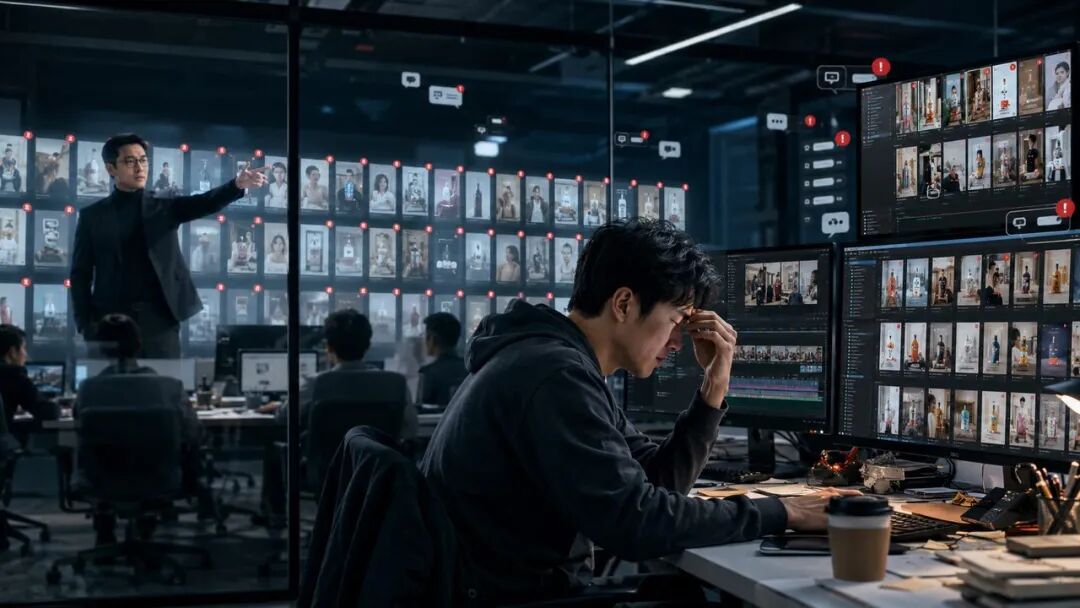
The problem is that this kind of requirement of "making 100 videos and getting them done in the afternoon" is changing from an ad-hoc task to the daily routine of commercial content teams.
This is not the anxiety of a few individual teams. A 2025 Adobe survey shows that more than 60% of marketers believe that content demand has increased to 5 times or more than before, and this pressure is expected to continue to rise.
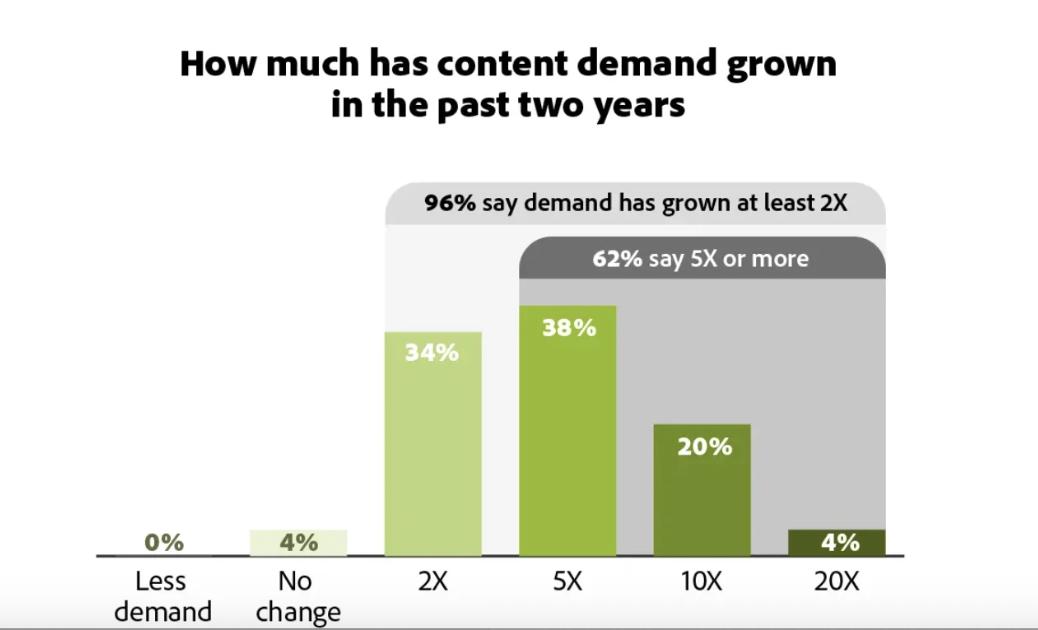
Image source: Adobe official website
WPP Media's *Mid-2026 Global Ad Forecast* shows that global ad revenue is expected to reach $1.3 trillion in 2026, up 8.9% year on year, higher than the 7.1% forecast in December 2025.
The higher the proportion of digital advertising, the stronger the brand's demand for short, fast, multi-version materials.
The growth of video demand and the popularization of AI generation capabilities are pushing content teams to a new bottleneck at the same time.
This bottleneck is: it is getting easier and easier to generate 10 or 100 versions of videos, but figuring out which ones are usable, keeping certain elements consistent, deciding which version to modify, and how to submit for review and delivery will not automatically become simpler.
The same product needs to cover Douyin, Kuaishou, Xiaohongshu, e-commerce platforms and overseas social media, and also adapt to different crowds, scenarios, languages, sizes and communication contexts. Ad placements also require constant testing of different openings, characters, selling points and expression methods, and quickly replacing materials based on click-through rate, completion rate and conversion performance.
After the generation cost drops, human time starts to be consumed in screening, proofreading, modification and version management. This hidden bill has become the core proposition that the whole industry must face up to in the "post-generation era".
So how should this hidden bill be settled?
In fact, there is no shortage of generation tools on the market now. A large number of AI products or functions have emerged in links such as image, video, dubbing, digital human, subtitles, translation, editing and size adaptation.
But the problem is that simply stacking these AI generation tools will only give the team more disconnected capabilities.
One tool writes scripts, one generates images, one produces videos, and then people import the materials into editing software to add voiceover, subtitles and packaging.
The generation link is getting faster and faster, but requirement decomposition, storyboard production, asset sorting, version screening and final delivery still require manual work. A set of video production tool platforms that can undertake complete commercial tasks is what paid enterprise users really need.
The "Last Mile" of Commercial Video Generation
So what players are there on platforms that can directly undertake commercial video generation tasks?
Some relatively mature solutions have already appeared on the market.
Adobe is extending from professional creative software to AI workflows, while Canva is moving further from templated design to Agent. Both are trying to embed generation capabilities into existing design and content production systems.
But MiniMax design has taken a differentiated path: starting from the native multi-modal model, MiniMax Design reorganizes the production process of commercial videos.
This difference directly affects the working mode of the product.
Traditional creative software usually starts with canvas, timeline and materials, and users need to clearly know which functions to call. MiniMax Design starts with requirements. Users only need to describe the product, audience, platform, selling points and content style, and the system can continue to complete creative decomposition, scripts, storyboards, material generation, dubbing, subtitles and finished films.
Now that everyone is starting to make video generation Agents, whoever's Agent is closer to commercial video production itself will have more initiative.
However, as more and more products begin to provide video generation Agents, the key to competition has also changed: whoever understands commercial requirements better, can reduce manual decomposition and cross-tool splicing, and can stably deliver usable materials in batches, will be closer to real commercial video production.
Why does MiniMax Design think it is closer to this goal? The answer ultimately lies in the real generation results.
After the product was launched, it quickly triggered a round of concentrated experience in creator communities at home and abroad. Overseas users showed particularly obvious creative enthusiasm, and many creators began to try to use it to make animations, film trailers and visual packaging, and shared the generation process and usage experience on social platforms.
On the X platform, a user with the ID Ai Bella used MiniMax Design to complete a zombie-themed suspense trailer.
He said he wanted to test how far AI could develop a complete film concept, so he handed a zombie film creative idea to MiniMax Design. From the story outline, film scenes and overall atmosphere, to visual effects, font design and the ending twist, the entire trailer was gradually completed in the Agent-driven workflow.
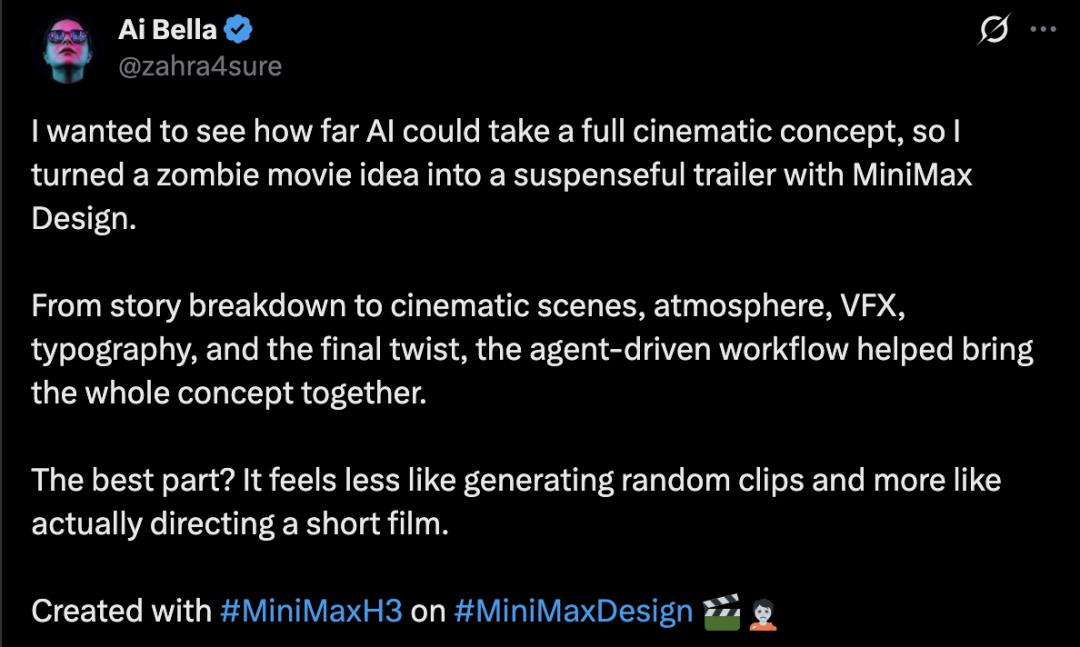
In his opinion, this experience is different from generating a set of disconnected video clips in the past. Different shots and visual elements are organized around the same story goal, and the whole process "feels more like actually directing a short film".
In the past, to make such a piece of content, you might have to first determine the characters, scenes and scripts, then prepare reference materials and copy, and then complete shooting or generation, editing and other work. But with MiniMax Design, users can directly dictate requirements, and even a one-sentence prompt can get a similar video as follows.
Also on the X platform, SEIIIRU, a Japanese video creator, after experiencing MiniMax H3 and MiniMax Design, described it as a case that might make practitioners feel a sense of professional crisis.
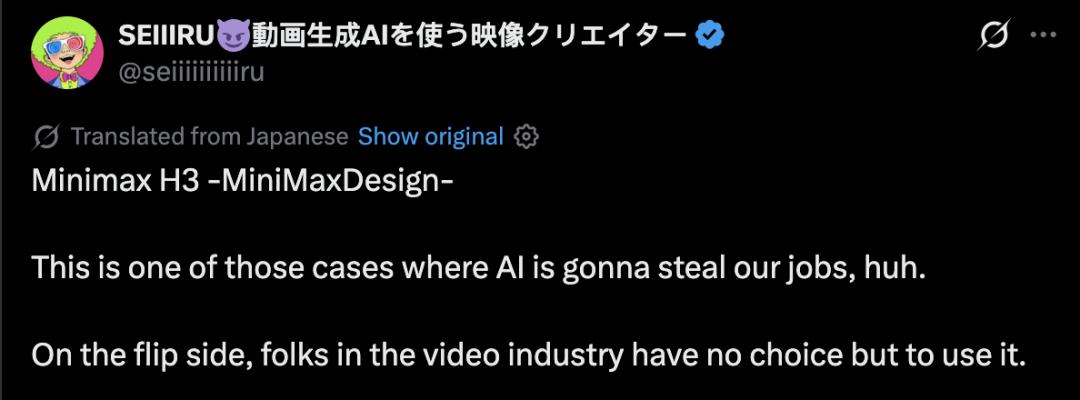
He used Design to make a soda ad video, and then wrote: "This is the kind of situation that makes people feel that AI is really coming to take our jobs, right."
But he immediately gave another judgment: from the perspective of video industry practitioners, in the face of such tools, it is already difficult to choose not to use them at all.
Another creator tried to use H3 in MiniMax Design to explore different animation styles.
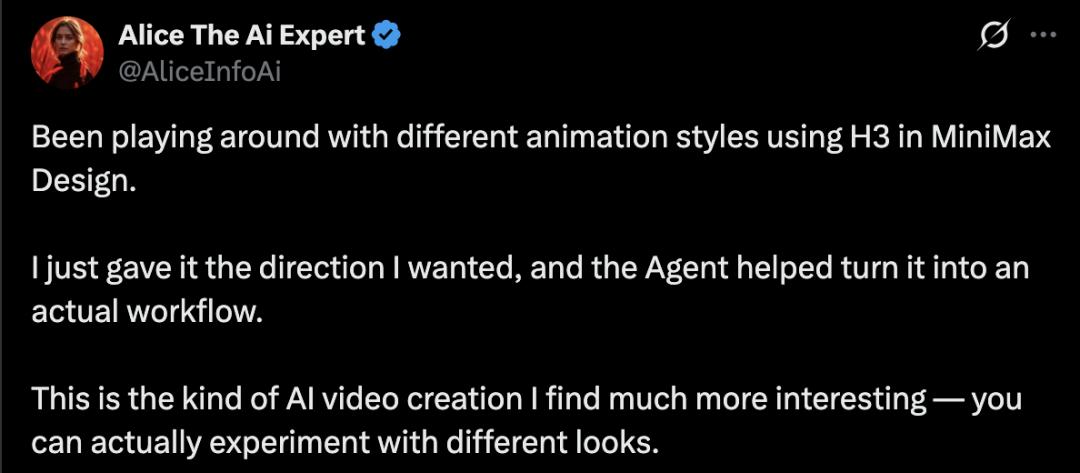
He said that he only needs to give a general direction, and the Agent will further break down the idea into a practically executable workflow, and then gradually generate the corresponding video. This creative method makes AI video more interesting: creators do not need to determine all production details at the beginning, they can constantly try different styles in the generation process, and continue to adjust the direction according to the results.
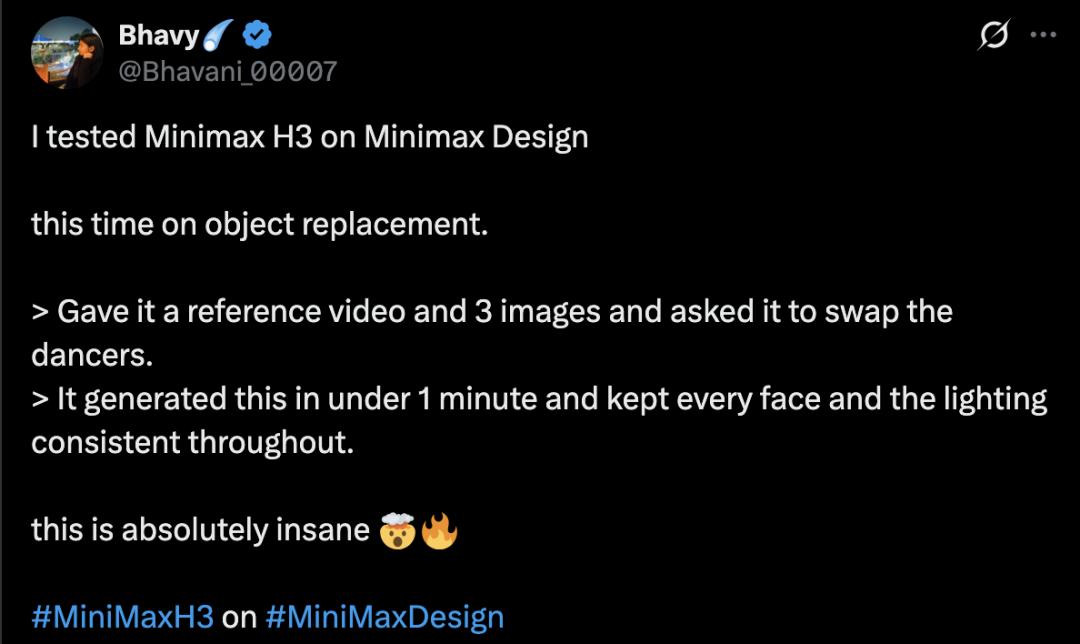
Another user with X ID Bhavy used Design for object replacement. The user said that he gave Design a reference video and 3 pictures, and asked it to swap the dancers. As a result, it generated this video in less than 1 minute, and always maintained the consistency of each face and lighting.
He couldn't help but sigh, "This is absolutely crazy".
Another user said that after trying it, he was completely obsessed with MiniMax Design. With just one prompt, after waiting for a while, you can get a complete video in the style of a retro Japanese travel poster.
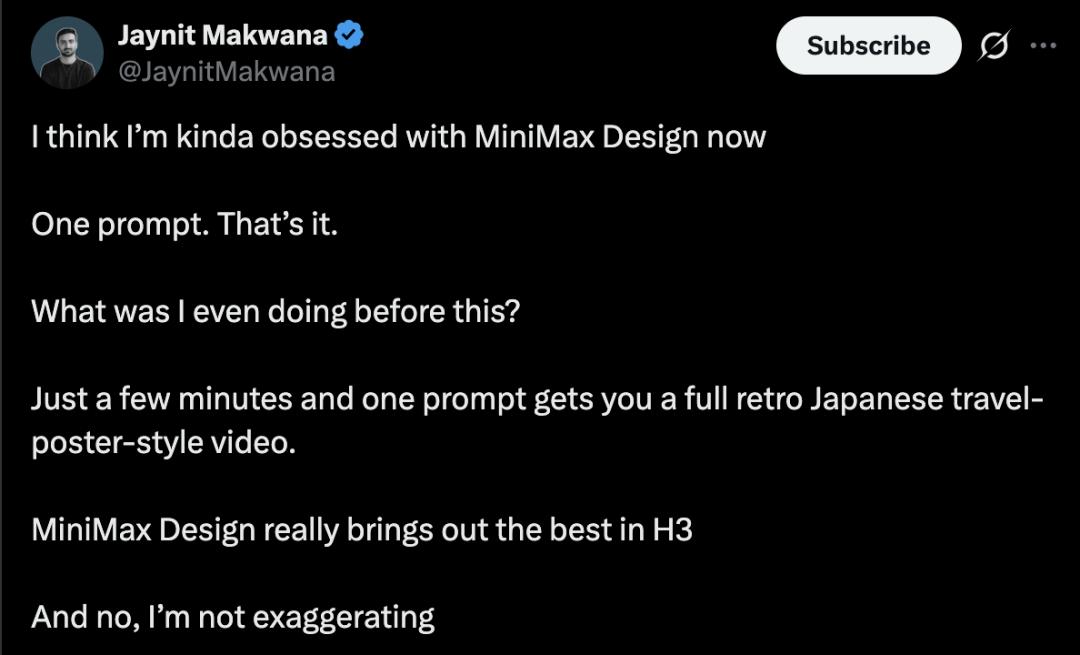
It can be seen from the videos shared by these users that MiniMax Design has a good overall understanding of film genres, visual styles and atmospheres. With sufficiently specific prompts and clear story and shot planning, it can generate opening sequences or trailer samples with strong cinematic feel and high picture quality.
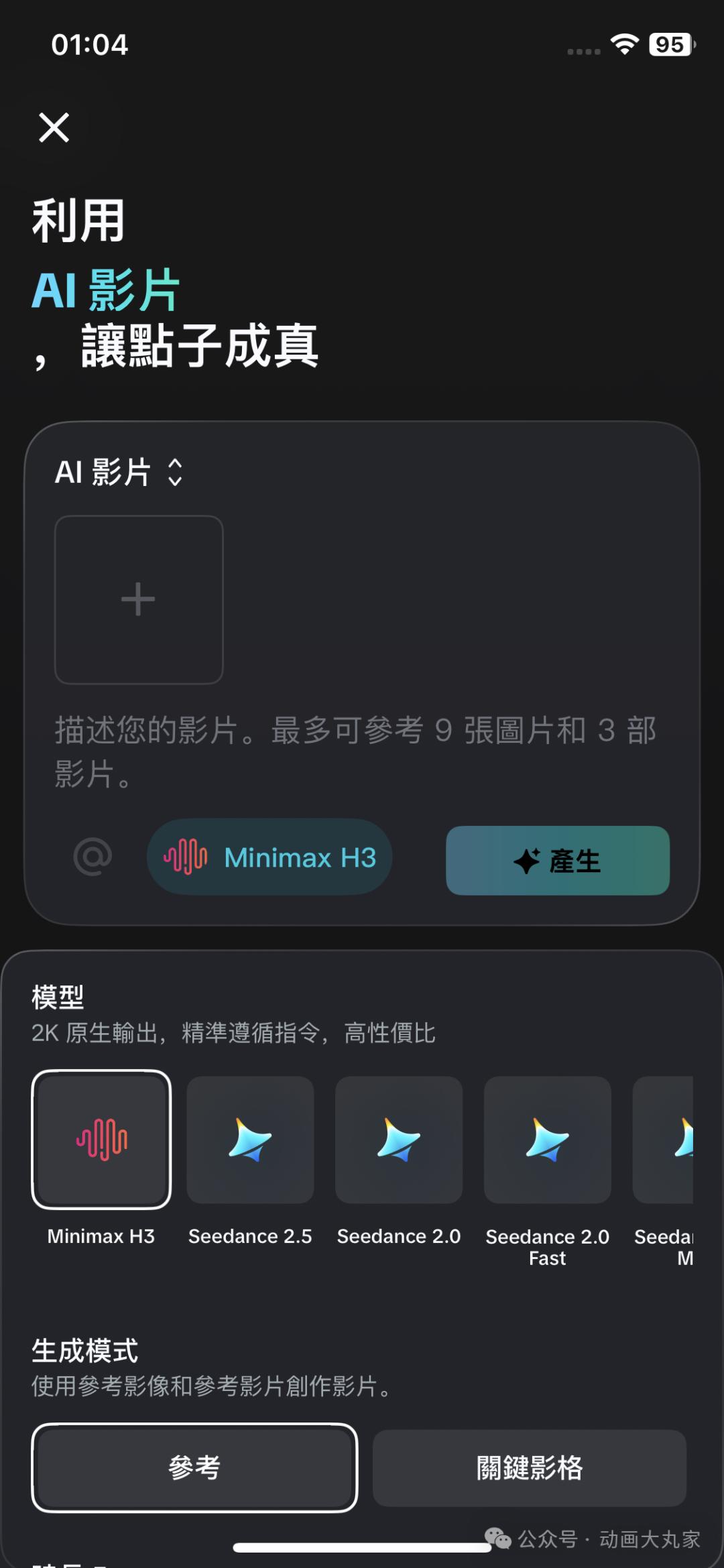
It is worth mentioning that beyond these cases, MiniMax H3 has also begun to access more mature creative platforms.
CapCut, the international version of Jianying, has integrated MiniMax H3, and users can directly try it on CapCut App, Web and desktop clients.
How are the differences reflected?
From the above actual test cases, we can see that the advantages of MiniMax Design are not only reflected in the generation effect of a single video. It presents a different product logic from other video Agents in links such as requirement understanding, professional effect invocation, complex task execution and commercial finished video delivery.
To achieve these, several differentiated features of MiniMax Design are indispensable behind it:
First, it is not adding an Agent to old software, but redesigning the production interface around the Agent.
Adobe's advantages come from its mature software system such as Photoshop, Premiere, Illustrator, AEM and Workfront, while Canva's foundation lies in its template, canvas and collaboration ecosystem.
Both companies are gradually embedding Agents into their existing products: Adobe brings Creative Agent into Firefly, Photoshop and Premiere, and Canva AI also begins to generate and modify designs through conversation.
The biggest difference between MiniMax Design and them is that it directly takes Agent as the creative entry. After users describe their ideas or upload briefs, the main Agent understands the goals, decomposes tasks and matches models, and then Agents for copywriting, images, videos and audio collaborate to complete the tasks.
Its workflow can be summarized as:
Understand creative goals → Intelligently decompose tasks → Multi-Agent collaborative processing → Merge, edit and export
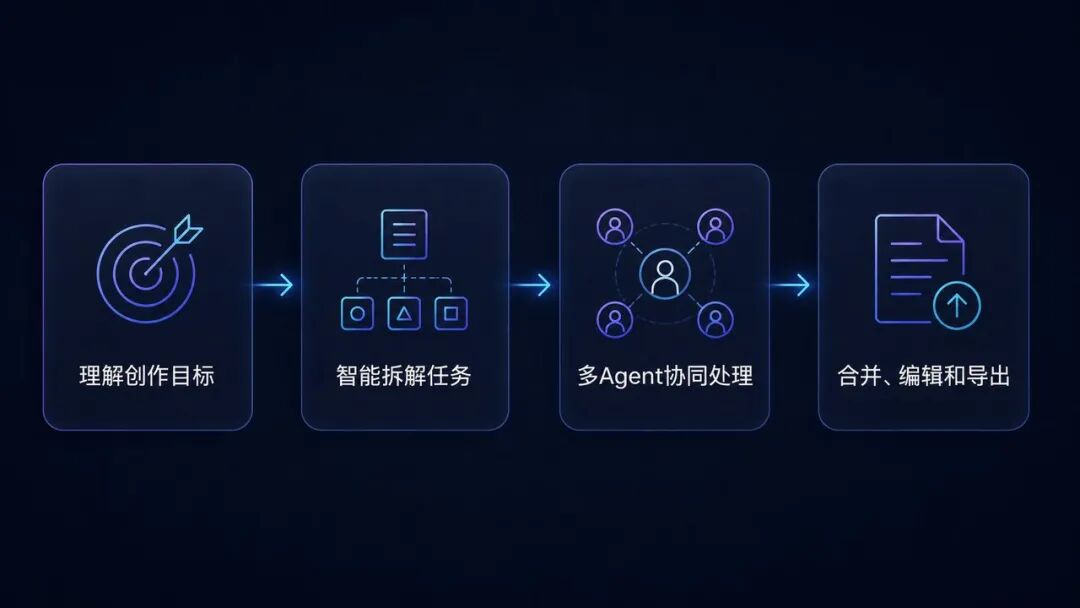
Adobe brings Agents into software, while MiniMax Design takes Agent as the entry point and incorporates software capabilities into the complete chain from requirement to delivery.
Second, it is more focused on "video-native" multi-modal production.
MiniMax Design puts scripts, storyboards, images, videos, dubbing, music and editing on the same Canvas, with different nodes connected automatically. It goes from pre-research, script planning to final editing, reducing repeated material uploading and context rebuilding across multiple tools.
These capabilities are ultimately organized around the finished video. Users only need to describe the product, audience, channel, selling points and content style, and the system will continue to complete the script, storyboard, picture, sound and editing. The adapted key scenarios include short dramas, e-commerce content, brand TVC and advertising materials, and the product's focus is more concentrated on commercial short video production than general design platforms.
Third, encapsulating "successful methods" into Skills is more suitable for mass production than rewriting Prompts every time.
Another noteworthy capability of MiniMax Design is custom Skills and plugins.
Users can create their own Skills through conversation, or directly call the workflows that have been deposited in the Skill Plaza. The adaptation scope covers short dramas, storyboards, commercial advertisements, e-commerce, audio and music, etc., and can use professional plugins to handle film special effects and other complex production tasks.
Why is this important?
This starts with the difference between Skill and ordinary Prompt.
The difference between Skill and ordinary Prompt is that what it saves is not just a piece of natural language instruction. A complete production method often also includes task decomposition sequence, node relationships