Yaole Technology Releases Integrated Knitted Data Gloves, Enabling Tactile Collection to Return to Real Human Hand Movements | Frontline
Author | Huang Nan
Editor | Yuan Silai
Embodied intelligence is moving from demo demonstrations to real-world scenario deployment. The capability boundaries of vision and language models keep expanding, but the shortage of tactile data supply in the physical interaction dimension has become a core constraint on the improvement of robots' fine operation and scenario generalization capabilities.
At present, the mainstream tactile acquisition solutions in the industry all have their respective bottlenecks: thin-film piezoresistive gloves have slip pseudo-signals and data drift, exoskeleton-style gloves restrict natural grasping postures and introduce noise, and visuo-tactile solutions are difficult to achieve full coverage of the palm area. Lab-level equipment has excellent performance but is expensive, making it difficult to support large-scale data acquisition; simulation data can never bridge the reality-virtuality gap.
How to balance lightweight design, full-area perception, long-term stability and scalable cost has become a practical proposition facing the industry.
Recently, flexible fabric sensing enterprise Yaole Technology has launched the Tacknit Glove G1 deep tactile data glove, which relies on the integrated knitting forming process and full-area deep tactile perception capability to target the large-scale real tactile data acquisition scenarios for embodied intelligence.
Different from the multi-layer composite stacking sensing idea commonly adopted in the industry, Tacknit Glove G1 adopts fabric flexible sensing technology, which directly mixes and weaves induction yarn and basic yarn. The sensing points are integrated while the glove body is knitted and formed, eliminating the multi-layer bonding structure and fundamentally avoiding the data distortion problem caused by interlayer slip. The weight of a single glove body is about 60g, which minimizes the interference of wearable devices on the natural movements of human hands and reduces the artificial noise introduced during the acquisition process.
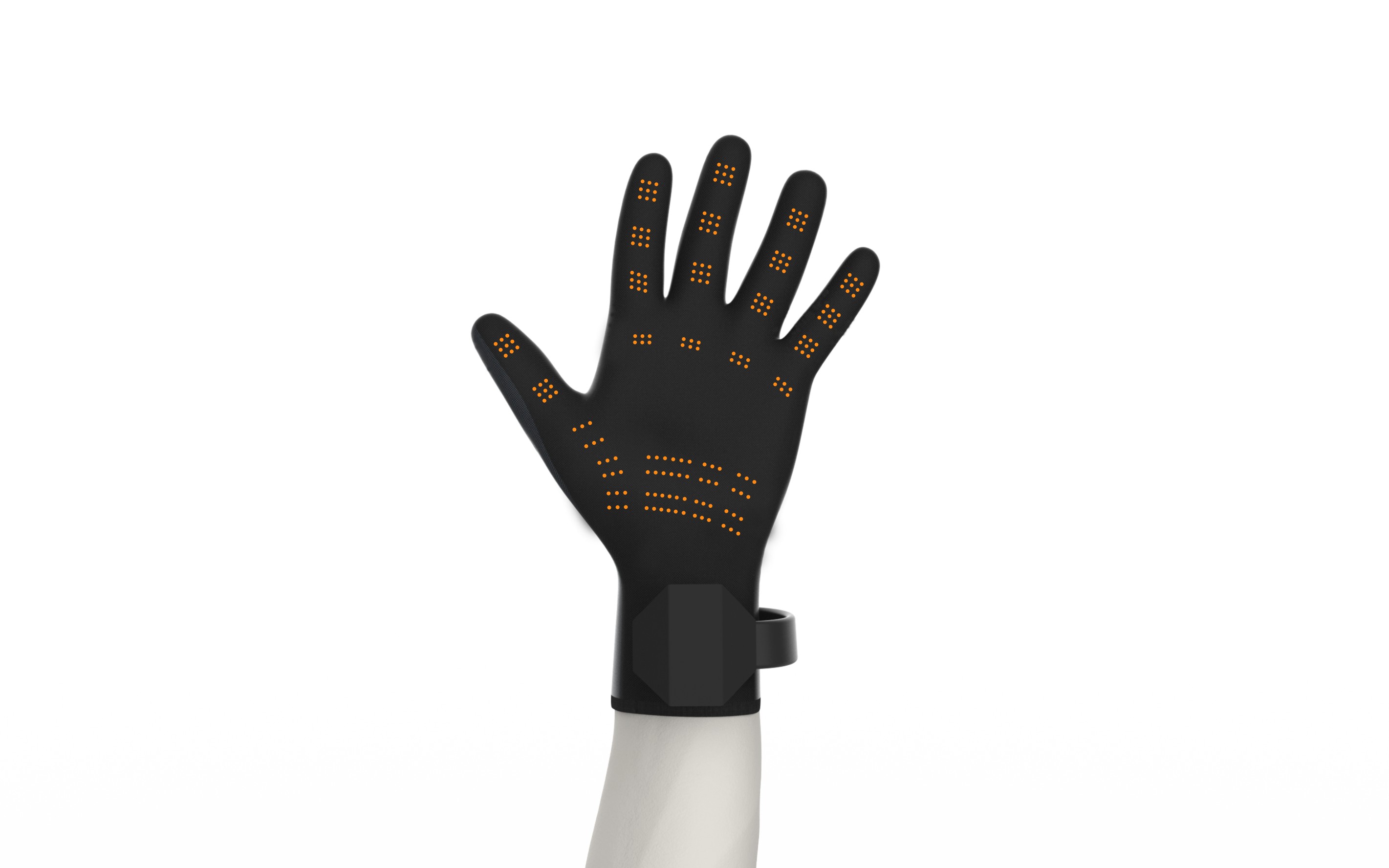
Schematic diagram of the distribution of tactile sensing points of Yaole Technology's data glove
From the perspective of product capability, large-scale data acquisition scenarios impose multiple constraints on equipment. It is necessary to ensure unnoticeable wearing experience without distorting the movements of human hands; at the same time, full-palm tactile coverage and data stability for long-term acquisition are required; it is also necessary to take into account continuous operation by multiple personnel, consumable replacement cost, multi-modal data alignment, and reliability under repeated high-intensity use.
Tacknit Glove G1 has 216 effective sensing points built into a single glove, which fully covers the core tactile areas of fingertips and palms to capture subtle force changes; the glove is washable, which reduces data drift caused by sweat stains and oil stains. Equipped with ergonomic versions of multiple sizes, it is not easy to shift after long-time wearing, ensuring the data consistency of long-cycle acquisition.
Its hardware adopts a split design, the main control box is connected to the glove body through magnetic attraction, and one main control unit can be compatible with multiple pairs of gloves for alternate operation, adapting to multi-person continuous acquisition tasks; the glove body is replaced as an independent consumable, reducing the marginal cost of large-scale data acquisition. The wrist main control box integrates an ultra-wide-angle camera to realize synchronous multi-modal acquisition of tactile sense, hand posture and images; standardized pre-calibration is completed before leaving the factory, and the time axes of tactile sense and images are accurately aligned, opening up the "acquisition - cleaning - training" link.
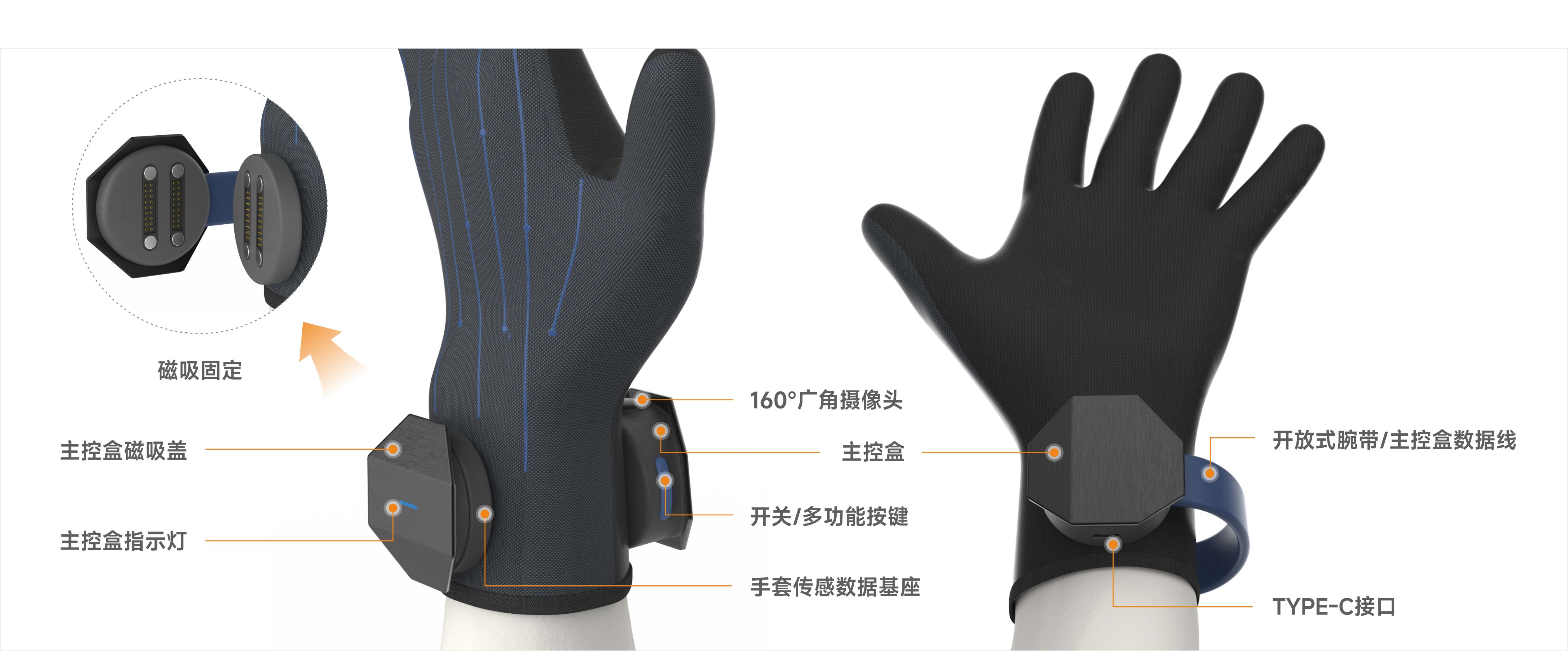
Structure of Yaole Technology's data glove
Different from most hardware manufacturers that focus on component assembly, Yaole Technology has full independent R&D capabilities covering conductive yarn solutions, customized textile transformation equipment, weaving structures, and signal processing algorithms. On the one hand, it iterates the conductive yarn material system independently to ensure long-term signal stability; on the other hand, it transforms textile equipment for precision sensing requirements, integrates the two processes of electronic sensing and traditional weaving, and realizes the simultaneous implementation of flexibility, high precision and mass production.
In terms of commercialization paths, most of the current tactile acquisition hardware is biased towards highly customized projects, which pushes up the overall acquisition cost and restricts the scale expansion of data sets. Yaole Technology positions the G1 as a standardized industrial consumable. Relying on its own production base, it applies the mature quality control system of the automotive sensing production line to tactile gloves. The core yarn preparation and integrated weaving are automatically and independently produced, aiming to lower the threshold for embodied enterprises to obtain tactile data through large-scale mass production. At present, this product has entered the supply chain of leading dexterous hand manufacturers for deployment testing.
In addition to hardware, Yaole Technology plans to build a closed loop of "hardware sales + tactile data service platform". In addition to the delivery of software and hardware packages, it also provides value-added services such as original data cleaning, calibration and classification, to deliver a complete tactile acquisition solution for the industry.
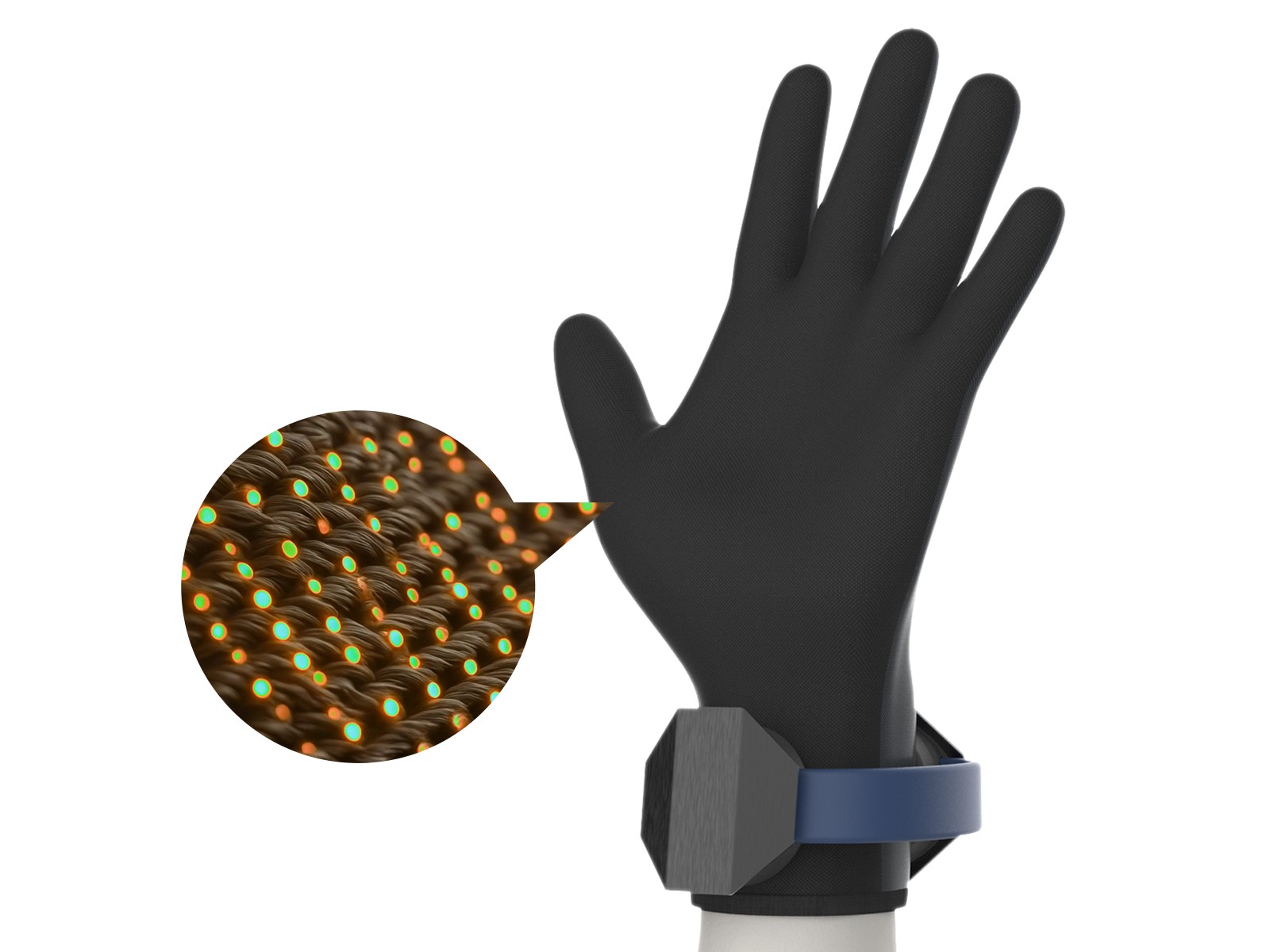
Yaole Technology's data glove
At present, the tactile perception track is in a stage where multiple technical routes coexist. Solutions such as piezoresistive, capacitive, and visuo-tactile have their own advantages and disadvantages. A unified industry test standard has not yet been established, and the proportion of customized development is too high, which pushes up the overall deployment cost. The fabric knitting route data acquisition glove provides an implementation path, transforming tactile acquisition from expensive laboratory equipment to mass-deployable standardized tools.
With the large-scale rollout of low-cost, high-consistency tactile acquisition terminals, the precipitation of real tactile samples will be accelerated, which will in turn support the iteration of models related to dexterous hand force control and object interaction, promoting humanoid robots and dexterous hands to move from laboratory demonstrations to real scenarios such as industrial assembly and domestic services.
In the future, Yaole Technology will continue to iterate its fabric tactile perception products, accelerate the expansion of domestic and overseas markets, and cooperate with industry-university-research institutions to participate in the co-construction of tactile acquisition industry standards, providing independent and controllable flexible tactile perception infrastructure services.