The fourth trillion-yuan urban district is coming.
When mid-tier cities are all setting the goal of becoming trillion-yuan GDP cities, top-tier economically strong cities are already preparing to welcome their own trillion-yuan GDP districts.
As the number of trillion-yuan GDP cities keeps rising, the threshold for measuring a city's comprehensive strength at present must be raised, and 2 trillion yuan can be regarded as the threshold for the current period and the next decade.
The logic goes as follows: First, as Xuzhou joins the trillion-yuan GDP club at the end of this year, the number of trillion-yuan GDP cities will reach 30, and subsequent cities including Shenyang, Xiamen, Shaoxing, Shijiazhuang, Kunming, Weifang, Nanchang and Yangzhou will join the rank one after another.
Trillion-yuan GDP cities will no longer be a novelty in the future.
Second, Shanghai's GDP will hit 6 trillion yuan by the end of the year, Beijing is also advancing towards the 6-trillion-yuan mark, and Shenzhen will reach 4 trillion yuan. With the rapid growth of trillion-yuan GDP cities, the label of "trillion-yuan GDP city" is far from enough to describe the economic strength of top-tier strong cities.
Third, trillion-yuan GDP districts are emerging one after another. Chaoyang District of Beijing will most likely cross the trillion-yuan threshold by the end of this year, becoming the fourth trillion-yuan GDP district in the country.
By the end of 2025, there have been three trillion-yuan GDP districts across China, namely Pudong in Shanghai, Haidian in Beijing, and Nanshan in Shenzhen. Pudong New Area of Shanghai was promoted to the trillion-yuan GDP rank in 2018, becoming the first trillion-yuan administrative region in the country, and now Pudong is marching towards the 2-trillion-yuan mark. Haidian District of Beijing became the second trillion-yuan administrative region in the country and the first one in northern China in 2022. Nanshan District of Shenzhen joined the trillion-yuan GDP club last year.
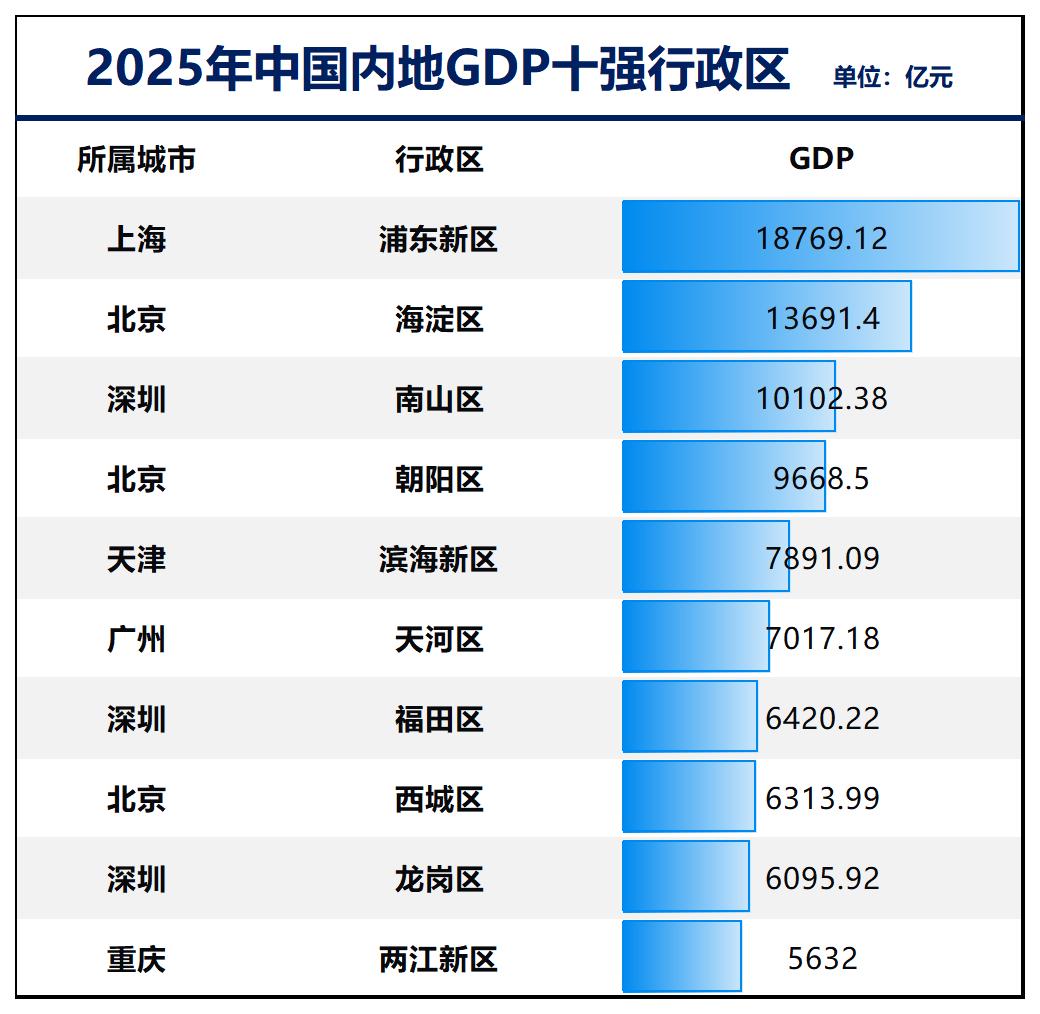
Graphics: Urban Finance; Data: Statistical bureaus of all districts
Statistics show that the GDP of Chaoyang District, Beijing was only 33.15 billion yuan short of 1 trillion yuan at the end of last year.
In the first half of this year, the GDP of Chaoyang District has reached 485.87 billion yuan, up 5.1% year on year, with an increment of 23.87 billion yuan compared with the same period of last year.
This means that as long as Chaoyang District's GDP in the second half of the year is 9.28 billion yuan higher than that of the same period last year, it will successfully cross the trillion-yuan mark. At that time, Beijing will become the only city in the country that owns two trillion-yuan GDP districts.
The Underpinning Strength of Pudong, Haidian and Nanshan for Trillion-yuan GDP
As the saying goes, behind all economic issues lie industrial issues. What supports a trillion-yuan GDP district is naturally its industries.
But the situations vary from district to district.
Shanghai Pudong New Area: As the first trillion-yuan GDP district in China, Pudong New Area relies mainly on the injection of national policies, which brings about a large concentration of industries, making it one of the administrative regions with the highest policy density.
Lujiazui is responsible for the financial sector while Zhangjiang Science City focuses on scientific and technological innovation. With these two trump cards, Pudong New Area has no rival across the country. Most importantly, Pudong is not only strong in finance and scientific innovation, but also in shipping, trade and advanced manufacturing.
In 2025, the scale of Pudong New Area's three leading industries including integrated circuits, biomedicine and artificial intelligence reached 350 billion yuan, 440 billion yuan and 180 billion yuan respectively, with the total scale growing by 8.3%.
Bringing together a variety of top-level production factors across the country, Pudong New Area has gone beyond the scope of an ordinary urban district and become the core engine driving Shanghai's development. In other words, it is not Shanghai that empowers Pudong, but Pudong that empowers Shanghai.
Statistics show that Pudong New Area covers an area of 1210.41 square kilometers, accounting for 19% of Shanghai's total area. It contributes 33% of Shanghai's GDP, 23.3% of the permanent resident population, 33% of the total industrial output value, 32% of the industrial revenue, 24.5% of the fiscal revenue, and 21% of the service industry revenue.
Beijing Haidian District: If the country's top financial enterprise headquarters are gathered in Pudong, then the country's top Internet enterprises and the highest-quality educational resources are all gathered in Haidian. Baidu, ByteDance, Tencent Beijing Headquarters, Kuaishou, NetEase, Xiaomi, Didi, Lenovo, Sohu, Sina and many other enterprises are all located here.
In addition, in the 2025-2026 academic year, Haidian District has 183 general primary and secondary schools and 213 kindergartens, with a total of 417,000 students, accounting for about 1/5 of Beijing's total. It is home to 37 universities including Tsinghua University and Peking University, as well as 92 national key laboratories and 96 national-level scientific research institutions. 692 academicians of the Chinese Academy of Sciences and the Chinese Academy of Engineering work or reside in the district, accounting for 36.23% of the country's total. The total talent resource of the whole district reaches 2.0058 million, which has increased year by year for ten consecutive years, and its talent innovation and development index ranks first in the country.
Such a district is unique across the country, and naturally it also has one of the strongest industrial strengths in China.
In 2025, Haidian District's GDP reached 1.37 trillion yuan, up 7.2% year on year, of which the added value of the tertiary industry reached 1.27 trillion yuan, accounting for 92.6% of the GDP.
Within the tertiary industry, the information transmission, software and information technology services sector remains the absolute core.
From January to November 2025, the enterprises above designated size in the information transmission, software and information technology services sector of Haidian District achieved a revenue of 2.12 trillion yuan, up 16.9% year on year; the scientific research and technical services sector achieved a revenue of 255.84 billion yuan. In the same period, the key enterprises above designated size in Haidian Park achieved a total revenue of 4.07 trillion yuan, of which the technology revenue reached 1.72 trillion yuan, up 15.4% year on year.
That means the industrial logic behind Haidian is very clear:
Universities are responsible for providing talents, scientific research institutions are responsible for providing technologies, Zhongguancun is responsible for achievement transformation, and technology enterprises including Baidu, Xiaomi, Lenovo and ByteDance are responsible for turning technologies into industries.
Even in the manufacturing sector, Haidian does not have a blank layout.
In 2025, the total industrial output value of enterprises above designated size in Haidian District reached 289.76 billion yuan, of which the output value of the computer, communication and other electronic equipment manufacturing sector reached 188.71 billion yuan, up 7.7% year on year.
Therefore, Haidian's real advantage does not lie in how strong a single enterprise is, but in gathering China's top talents, scientific research resources, capital, enterprises and technological innovation capabilities into a 430-square-kilometer urban district.
This is also why Haidian's trillion-yuan GDP achievement does not follow the traditional path of "expanding the scale of the district", but comes from thickening the innovation economy.
Shenzhen Nanshan District: China's scientific and technological innovation looks to Shenzhen, and Shenzhen's scientific and technological innovation looks to Nanshan. It is the district with the highest innovation density across the country, without exception. The saying "Zhongguancun (Haidian District) in the north, Science Park (Nanshan District) in the south" is the best footnote to Nanshan District's status.
With a land area of only 185 square kilometers, less than one tenth of Shenzhen's total area, Nanshan District contributes more than a quarter of the city's economic output. Its GDP per unit land area and GDP per capita both take the lead, ranking first among the top 100 districts in China for nine consecutive years, and first among the top 100 innovation districts for eight consecutive years. The density of 218 listed companies ranks first across the country, and the total number of national-level manufacturing single champion enterprises and "little giant" enterprises ranks first in the city.
Most importantly, the district gathers the top scientific and technological innovation enterprises across the country. Official data shows that more than 70% of the listed enterprises in Nanshan District are scientific and technological innovation enterprises, covering many high-tech fields including information technology, biomedicine, new energy and new materials.
According to the 2025 statistical bulletin of Nanshan District, there were 5348 national-level high-tech enterprises in the district by the end of 2025, accounting for 20.4% of Shenzhen's total. The total annual patent authorization volume reached 44516, including 23351 invention patents, 11645 utility model patents and 9520 appearance design patents.
Nanshan has not only won in the past, but will also win in the future, as emerging industries have thrived here.
In the artificial intelligence track, Nanshan gathers more than 1300 AI enterprises above designated size, and the added value of the AI industry cluster accounts for about 60% of Shenzhen's total. According to the plan, by 2030, Nanshan will strive to make the added value of the artificial intelligence industry exceed 70 billion yuan, the total schedulable computing power scale exceed 40000P, and build no less than 100 benchmark AI application scenarios with national demonstration value.
In the robotics field, Shenzhen "Robot Valley" is rooted in Nanshan, gathering more than 200 upstream and downstream enterprises including UBtech, Dobot, Qlean, Z Square, Hesai Technology and so on. The district has successively spawned leading listed humanoid robot enterprises, listed collaborative robot enterprises, and embodied intelligence unicorns with a valuation of 20 billion yuan, with industrial benchmarks emerging continuously.
The mature venture capital ecosystem is also Nanshan's trump card: the regional sub-fund of the national venture capital guiding fund with a scale of over 50 billion yuan has settled here; among the first 7 investment projects of the Guangdong-Hong Kong-Macao "super fund", 3 enterprises are from Nanshan. The plan proposes that before 2030, the accumulated scale of newly filed private equity investment funds in the region will reach 100 billion yuan.
The R&D end maintains high investment continuously. During the 14th Five-Year Plan period, the proportion of Nanshan's total social R&D investment in GDP has reached 7.87%; the target for the 15th Five-Year Plan period is further raised to 8.3%, and this investment intensity will be significantly higher than that of most developed countries and global benchmark metropolises.
Chaoyang District: Why It Is About to Cross the Trillion-yuan GDP Threshold
The key question arises: what supports Chaoyang District, which is about to enter the trillion-yuan GDP club?
If Pudong relies on finance and advanced manufacturing, Haidian relies on universities, scientific research and technology enterprises, and Nanshan relies on scientific and technological innovation and advanced manufacturing, then Chaoyang takes a completely different path: supporting a super urban district with headquarters economy, finance, business services and consumption.
In 2025, Chaoyang District's GDP reached 966.85 billion yuan, up 5.2% year on year, only 33.15 billion yuan short of the trillion-yuan mark.
Moreover, this trillion-yuan GDP is not propped up by a single industry. In 2025, the added value of the tertiary industry in Chaoyang District reached 925.53 billion yuan, accounting for 95.7% of the GDP. This means that Chaoyang has become a highly service-oriented urban district.
Within the service industry, what really supports Chaoyang's economy are finance, business services, information services, cultural consumption and headquarters economy.
First, let's look at the finance sector. The financial industry is the largest pillar industry of Chaoyang District. It is home to the golden sign of Beijing CBD, and it is also one of the regions with the most concentrated international financial resources in Beijing.
In 2025, the revenue of financial enterprises above designated size in Beijing CBD reached 494.41 billion yuan, up 16.8% year on year; among them, the revenue of financial enterprises above designated size in Beijing Central Business District reached 349.21 billion yuan, up 18.6% year on year. (People's Government of Chaoyang District, Beijing)
More importantly, the financial sector is connected to the headquarters economy. By the end of 2025, the number of regional headquarters of multinational companies in Chaoyang District has reached 177, ranking first among all districts in Beijing.
What does this mean? Many global enterprises will choose to settle in Chaoyang first when entering China; Chinese enterprises that go global also need Chaoyang to provide professional services including finance, law, accounting, consulting and trade.
Therefore, what makes Chaoyang really outstanding is not just how many enterprises it owns, but its complete set of capabilities to serve global enterprises. In 2025, the total import and export volume for the whole year reached 1259.76 billion yuan, accounting for 39.5% of Beijing's total import and export trade. Among them, the export volume reached 163.72 billion yuan, accounting for 26% of Beijing's total export volume.
By November 2025, 2556 new foreign-funded enterprises had been established in Chaoyang District, accounting for 27.8% of Beijing's total; the actual utilized foreign capital reached 18.23 billion US dollars, accounting for 30.2% of Beijing's total.
This forms a very special industrial closed loop: When multinational company headquarters come, financial institutions come, trade comes, professional services come, talents come, and consumption will naturally follow.
This is also Chaoyang's second trump card: consumption. Sanlitun, CBD, Liangma River, Blue Harbor, SKP... Behind these commercial landmarks are actually the strongest international consumption resources in Beijing.
In the first half of 2026, the total retail sales of consumer goods in Chaoyang District reached 120.39 billion yuan. Meanwhile, nearly 500 international performances, exhibitions and events were held here, and Chaoyang was also selected as a national pilot for the integrated "film +" consumption program.
However, if you only regard Chaoyang as a "financial district + consumption district", you will underestimate it.
Because in recent years, Chaoyang has been making up for the short board of scientific and technological innovation. In 2025, the revenue of artificial intelligence enterprises above designated size in Chaoyang District increased by 11.5% year on year; the total revenue of enterprises in Zhongguancun Chaoyang Park from January to November increased by 8.9% year on year, R&D expenditure increased by 3%, and technology revenue increased by 12.9%.
By the end of 2025, Chaoyang District had 3613 national-level high-tech enterprises, 96 national-level "little giant" enterprises, 1225 Beijing-level specialized and sophisticated enterprises, and 25 unicorn enterprises. (Chaoyang Video, Beijing)
More importantly, Chaoyang does not simply copy the technology industry model of Haidian and Nanshan, but tries to combine technology with its own traditional advantages.
Artificial intelligence can empower finance, advertising, culture and medical care; digital technology can empower consumption, trade and business