The latest ranking of the world's top 10 beauty brands for the first half of 2026 has been released.
On August 20, with the release of Coty's latest financial report, all leading global cosmetics groups have delivered their performance reports for the first half of 2026 (January to June). Based on this information, Qingyan has sorted out the list of the world's top 10 beauty groups in the first half of this year.
So, what changes have taken place in the ranking of the world's top 10 beauty enterprises in the first half of 2026? What kind of new pattern has emerged in the global beauty market?
7 enterprises saw growth, 1 recorded decline
According to statistics from Qingyan, after stripping non-cosmetics businesses, the total sales revenue of the world's top 10 beauty groups in the first half of 2026 reached about 5435.57 billion yuan, an increase of 191.7 billion yuan from 5243.87 billion yuan in the same period of 2025, with a year-on-year increase of 3.66 percentage points.
Data released by the National Bureau of Statistics shows that the total retail sales of cosmetics in China from January to June this year was 2442.45 billion yuan. That is to say, the total sales revenue of the world's top 10 beauty groups is more than twice the total retail sales of cosmetics in China in the same period.
On the whole, among the 10 listed enterprises, 7 recorded year-on-year sales growth from January to June this year, 2 were basically flat with the same period of the previous year, and 1 saw a decline. It is worth mentioning that this overall pattern has changed significantly compared with the same period last year. According to previous sorting by Qingyan, 7 of the world's top 10 beauty enterprises in the first half of 2025 recorded declining sales, reflecting that the global beauty market at that time was relatively sluggish.
While the performance of global beauty enterprises is collectively picking up, new changes have also taken place in the ranking of the world's top 10 cosmetics groups in the first half of 2026.
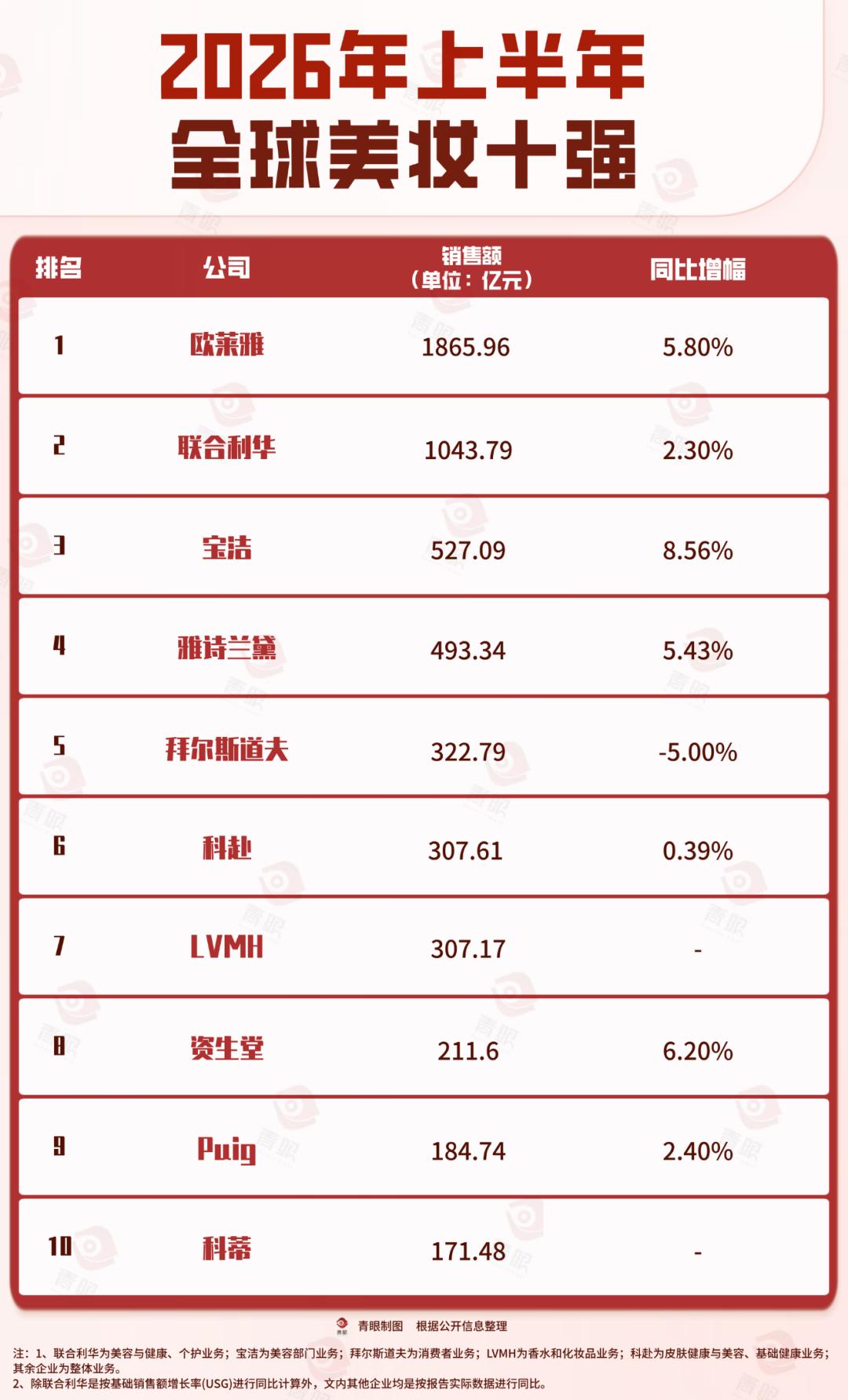
Specifically, L'Oréal remains the world's largest beauty group, leading by a large margin with sales of 1865.96 billion yuan, about 822 billion yuan higher than the second-ranked Unilever (with sales of 1043.79 billion yuan).
Among the 10 enterprises, only L'Oréal and Unilever achieved sales exceeding 1000 billion yuan. Among the enterprises with a scale below 1000 billion yuan, only Procter & Gamble broke through the 500 billion yuan mark with 527.09 billion yuan, and The Estée Lauder Companies' sales (493.34 billion yuan) were close to 500 billion yuan. The remaining 6 enterprises including Beiersdorf, Kenvue, LVMH, Shiseido, Puig and Coty all recorded sales below 400 billion yuan.
In terms of performance growth rate, among the 7 enterprises that recorded year-on-year sales growth, Procter & Gamble had the highest growth rate of 8.56%. In addition, L'Oréal, Shiseido and The Estée Lauder Companies also maintained growth of over 5%. While Unilever, Kenvue and Puig recorded a slight growth of no more than 3%. Besides, LVMH and Coty were basically flat with the same period last year. Among the 10 enterprises, only Beiersdorf recorded a 5% year-on-year decline in sales.
In addition, due to the high proportion of oral care business, the Colgate-Palmolive Group did not enter the list of the world's top 10 cosmetics enterprises only by calculating personal care business. It is understood that Colgate's business is divided into two major sectors: oral, personal and home care, and pet nutrition. Its beauty and personal care business is mainly in the personal care segment. Estimated based on the 20% proportion of its personal care business in the previous annual report, the sales of Colgate's personal care business in the first half of this year was about 111 billion yuan, which is less than that of Coty, the 10th-ranked enterprise.
The ranking pattern of the top 10 has become relatively stable
Qingyan sorted out the rankings of the world's top 10 beauty groups in the first half of the past 5 years (2022 to 2026), and found that after the "scramble" in the middle tier and the rise of new forces, the pattern of the world's top 10 beauty groups has gradually become fixed. Especially in the first half of this year, only 2 enterprises have changed their rankings.
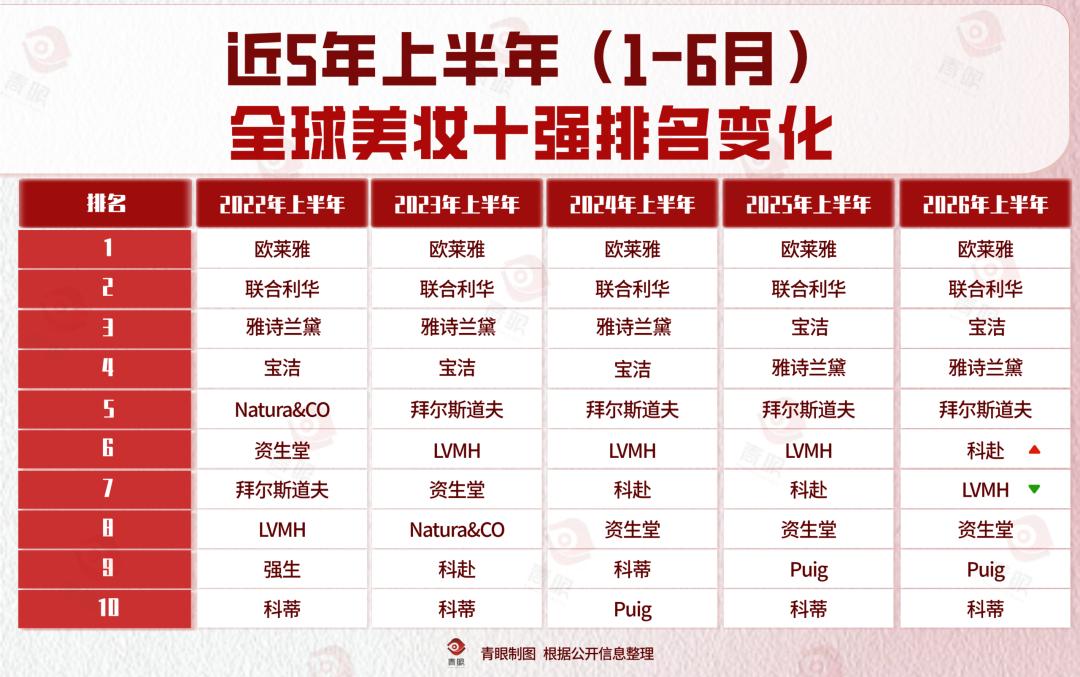
Specifically, in the rankings of the first half of the past 5 years, the first and second positions have always been firmly occupied by L'Oréal and Unilever. While Procter & Gamble and The Estée Lauder Companies compete for the 3rd and 4th places. It can be seen that in the first three years, The Estée Lauder Companies had the upper hand and firmly ranked 3rd. However, in the first half of 2025 and 2026, Procter & Gamble took the lead, ranking 3rd for two consecutive years, and The Estée Lauder Companies dropped to 4th.
It is worth mentioning that Beiersdorf has maintained its position at 5th for 4 consecutive years since it jumped from 7th to 5th in the first half of 2023.
On the whole, the listed enterprises and rankings of the top 5 in the global top 10 have been relatively stable, while the rankings from 6th to 10th have changed greatly. First of all, Natura&CO has never appeared on the list since it was squeezed out by Puig in the first half of 2024; in addition, Shiseido also dropped from 6th in the first half of 2022 to 7th in the first half of 2023, and the group has been ranked 8th in the following 3 years.
Kenvue, which was spun off from Johnson & Johnson, gradually rose from 9th in the first half of 2023 to 6th in the first half of 2026. LVMH, which had been ranked 6th from the first half of 2023 to the first half of 2025, dropped to 7th in the first half of this year.
Since Puig was first listed and ranked 10th in the first half of 2024, the group rose to 9th in the first half of 2025 and maintained this ranking in the first half of this year. Coty ranked 9th in the first half of 2024, and ranked 10th in the other 4 years.
It is worth noting that compared with the first half of last year, among the world's top 10 beauty groups in the first half of this year, only Kenvue and LVMH swapped their positions, and the rankings of other enterprises have not changed. This to some extent also shows that the pattern of the global top 10 has gradually become fixed.
Premium beauty and perfume segments delivered outstanding performance
Although the performance of the above 10 enterprises varies, Qingyan found that most of the premium beauty businesses and perfume segments under each company performed well, becoming the engine driving the growth of the enterprises.
For example, Unilever specifically pointed out in its financial report that since the beginning of this year, the group has actively promoted the high-end layout of its brand matrix and achieved remarkable results. Among them, the ultra-premium hair care brand K18 achieved impressive double-digit growth relying on biotechnology innovation; Paula's Choice, Hourglass and Tatcha performed particularly well in the second quarter.
At the same time, Shiseido also stated that in the second quarter of this year, the overall premium beauty market grew steadily, and both offline channels and e-commerce channels achieved double-digit growth, with its two core brands Clé de Peau Beauté and NARS delivering strong performance.
The L'Oréal's Luxury Products Division recorded a year-on-year increase of 4.4% in the first half of 2026, and a 5.4% LFL year-on-year growth. L'Oréal also specifically pointed out that North Asia is the region that contributed the most to the growth of the Luxury Products Division. "Driven by double-digit growth in China, this division outperformed in a still challenging market."
As we all know, in July this year, L'Oréal also obtained an exclusive 50-year licensing agreement signed with Kering Group one year in advance. L'Oréal will be fully responsible for the creative development, R&D and global distribution of Gucci brand fragrance and beauty products starting from July next year. There is no doubt that this also confirms the continued optimism of beauty giants for the premium beauty market.
As for the perfume category, L'Oréal stated in its financial report for the first half of this year that the fragrance category under the Luxury Products Division continued to maintain double-digit growth, consolidating L'Oréal Luxury Products Division's position as the world's number one.
In addition, the importance of perfume to The Estée Lauder Companies is even more self-evident. According to the latest financial report released by the group, in fiscal year 2026 (from July 2025 to June 2026, the same below), the perfume segment was the business unit with the highest growth rate under the group, with a year-on-year increase of 12%. In addition, from April to June 2026, The Estée Lauder Companies' perfume division also achieved 10% growth, which was also the division with the highest growth rate recorded by the group in this quarter.
The Estée Lauder Companies said that in fiscal year 2026, all brands under the perfume business division achieved growth, led by three brands: Le Labo, TOM FORD and KILIAN PARIS.
At the same time, the perfume and fashion segment is also the absolute revenue and profit pillar of Puig. The net revenue of this division in the first half of this year was 134.75 billion yuan, with a year-on-year increase of 3.8%. Specifically, in the niche perfume sector, the group as a whole achieved double-digit growth, significantly outperforming the market; in the premium perfume sector, Carolina Herrera led the growth, and this brand also achieved double-digit growth.
The Chinese market returns to the core of growth
Another point that cannot be ignored is, looking at the performance of the world's top 10 cosmetics groups in the first half of this year, the Chinese market or the Asia-Pacific region where China is located all performed well, and once again became the core driving force for the growth of global beauty enterprises.
A typical example is that mainland China became the region with the highest growth rate for The Estée Lauder Companies in fiscal year 2026. Financial report shows that the net sales of The Estée Lauder Companies in mainland China was 206.05 billion yuan, with a year-on-year increase of 12%. Specifically from January to June this year, the net sales of The Estée Lauder Companies in mainland China was 107.67 billion yuan, an increase of 12.1% compared with 96.05 billion yuan in the same period last year.
Stéphane de La Faverie, President and Chief Executive Officer of The Estée Lauder Companies, has publicly stated on many occasions that the breakthrough point of The Estée Lauder Companies in the Chinese market comes from Douyin, and Douyin has become the core position for the group to acquire new customers in China and achieve business breakthroughs.
Not only The Estée Lauder Companies recorded double-digit growth in mainland China, in the first half of this year, Shiseido's Chinese market and travel retail business also achieved net sales of 81.89 billion yuan, with a year-on-year increase of 10%, and core operating profit was 20.38 billion yuan, with a year-on-year increase of 22.7%. Shiseido clearly stated that "in the first half of this year, relying on the recovery of the Chinese market, the group achieved a substantial increase in profitability, and further increased its market share with the help of the 618 shopping festival".
For LVMH, the market in Asia (excluding Japan) including the Chinese market is also the core cornerstone supporting the group's performance growth. In the first half of this year, the organic growth rate of LVMH in the Asian region reached 6%, outperforming the group's overall growth rate.
In addition, L'Oréal also emphasized that in the first half of this year, China was the main driving force for growth in the North Asian region, which was mainly benefited from the recovery of selected market segments. Financial report shows that L'Oréal's sales in the North Asian region in the first half of 2026 was 427.77 billion yuan, with a year-on-year increase of 2.3%, and both LFL growth and adjusted year-on-year growth were 4.6%.
For the Puig group, which achieved an overall growth of 2.4% in the first half of this year, its Asia-Pacific region recorded a 20.9% year-on-year increase, once again becoming the region with the strongest growth for the group.
As we all know, due to the weak consumption in the Chinese market in the previous two years, major international beauty groups once generally encountered a cold market in China, and many enterprises even publicly mentioned the Chinese market, saying that their performance there was unsatisfactory. However, since last year, the performance of beauty giants in the Chinese market has gradually picked up. More importantly, judging from the performance in the first half of this year, the strong recovery of the Chinese market has injected a shot in the arm for international beauty groups.
It is foreseeable that with the continuous implementation of innovative products and marketing strategies of various groups, the Chinese market is expected to continue to play the role of "ballast stone" in the second half of this year, boosting the steady development of the global beauty industry.
Note:
1. There is a certain error in the conversion of the sales data of the world's top 10 beauty groups due to exchange rate fluctuations. Unless otherwise specified, the unit in the text is uniformly RMB.
2. Unilever's data covers beauty & well-being and personal care businesses; Procter & Gamble's data covers the beauty segment; Beiersdorf's data covers consumer businesses; LVMH's data covers perfume and cosmetics businesses; Kenvue's data covers skin health & beauty and essential health businesses; the data of other enterprises covers overall businesses.
3. Except that Unilever calculates year-on-year growth based on Underlying Sales Growth (USG), other enterprises in the text calculate year-on-year data based on the actual figures in the report.
This article is from the WeChat official account "Qingyan", author: Cathy, authorized by 36Kr for release.