Baidu is building its "Three New Tigers" entirely in-house to carve out a position in the AI office market.
Over the past six months, Baidu has gradually formed a "New Three Tigers" layout focusing on the AI office era, namely Baidu Buddy, Kuku AI, and Miaoda.
In the previous mobile Internet era, Baidu once suffered a lot from the predicament of "exclusive search but no social connection chain", which made it difficult for many of its products to achieve fission through social channels like Tencent leveraging WeChat and ByteDance leveraging Douyin.
Nowadays, the AI office relationship chain has become a must-win battlefield for major tech giants. Baidu expects the "New Three Tigers" to become the key entry points to penetrate the AI office scenarios. They will face fierce competition from WorkBuddy, Qianwen Office, and Doubao Enterprise Edition. However, an observer said that Baidu can no longer afford to "lose this battle".
Baidu's "New Three Tigers"
In July, during the World Artificial Intelligence Conference in Shanghai, as soon as you walked out of the subway station near the main venue "China Art Museum", you could see advertisements for "Baidu Buddy".
The underlying logic of software like WorkBuddy and Baidu Buddy lies in two aspects: competing for intelligence capability on one hand, and still competing for user volume on the other. Under the circumstance that airports are all "occupied" by advertisements of Doubao and Qianwen, Baidu Buddy has seized the high-demand subway station scenarios with the largest passenger flow.
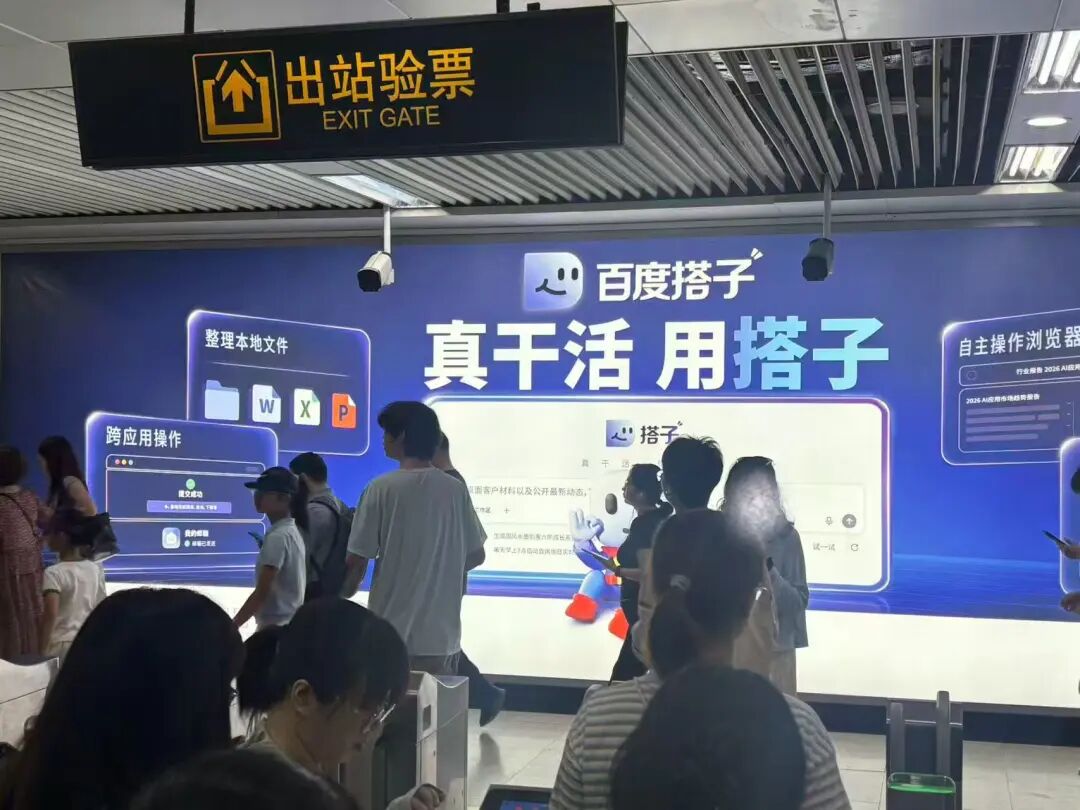
Figure | Advertisement in the subway station. Software competition is a race of both intelligence and user volume.
Baidu Buddy was launched in March this year, under the Baidu Intelligent Cloud Business Group, positioned as a professional office agent platform for individuals and enterprises. Users can collaboratively complete various tasks such as search, coding, in-depth research, data analysis, and application creation in one single system. It follows the same logic chain as WorkBuddy and Qianwen Office.
Previously, Baidu lacked a core entry point in the collaborative office scenario. Now, Baidu Buddy can be regarded as Baidu's first AI version of "Feishu" or "DingTalk" that deeply penetrates enterprises, which has strategic significance for market positioning.
After its launch, Baidu Buddy has reached an artistic SOTA level in a number of internationally authoritative Agent evaluations such as PinchBench (benchmark test for AI agents' capability to operate computers and mobile phones) and DeepResearchBench (benchmark test for AI's in-depth research capability).
However, its performance in indicators such as monthly active users once lagged behind products like WorkBuddy.
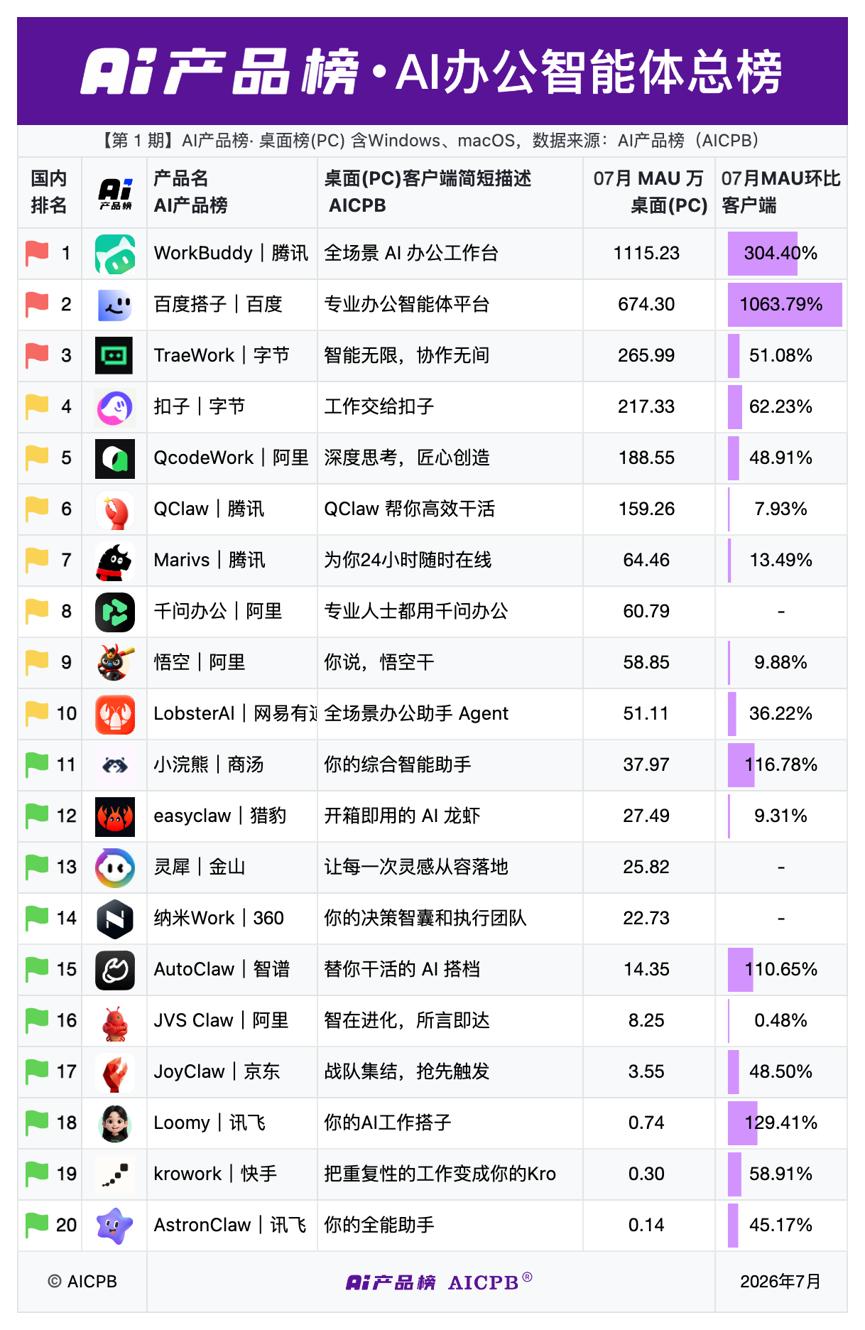
Nevertheless, in the recent July, according to some industry statistics, the monthly active users of Baidu Buddy rapidly increased to 6.743 million, ranking second in the overall list with a growth rate of 1063.79%, the highest growth rate across the entire industry. This is probably closely related to Baidu Buddy's recent increased investment in offline promotion and advertising placement.
Tencent's WorkBuddy has 11.1523 million monthly active users, still ranking first in user scale. ByteDance's TraeWork has 2.6599 million monthly active users, and Qianwen Office has 607,900 monthly active users.
Baidu Buddy is in a standard competitive landscape where "powerful leaders are ahead and chasing competitors are behind".
Baidu's second tiger is GenFlow, a general agent that has just been renamed "Kuku AI". It was launched in April 2025, and was originally embedded in Baidu Wenku and Baidu Netdisk. In January 2026, Baidu reorganized the two business divisions of Wenku and Netdisk to establish the Personal Super Intelligent Business Department, which runs parallel to the Baidu Intelligent Cloud Department.
The renaming helps to create a "memorable brand name". Compared with Baidu Buddy, which is an "incremental rising star", Baidu Wenku and Baidu Netdisk are Baidu's two "stock ace cards". Their advantages lie in the huge number of existing stock users, as well as the database that facilitates the reinforcement learning and capability exertion of agents.
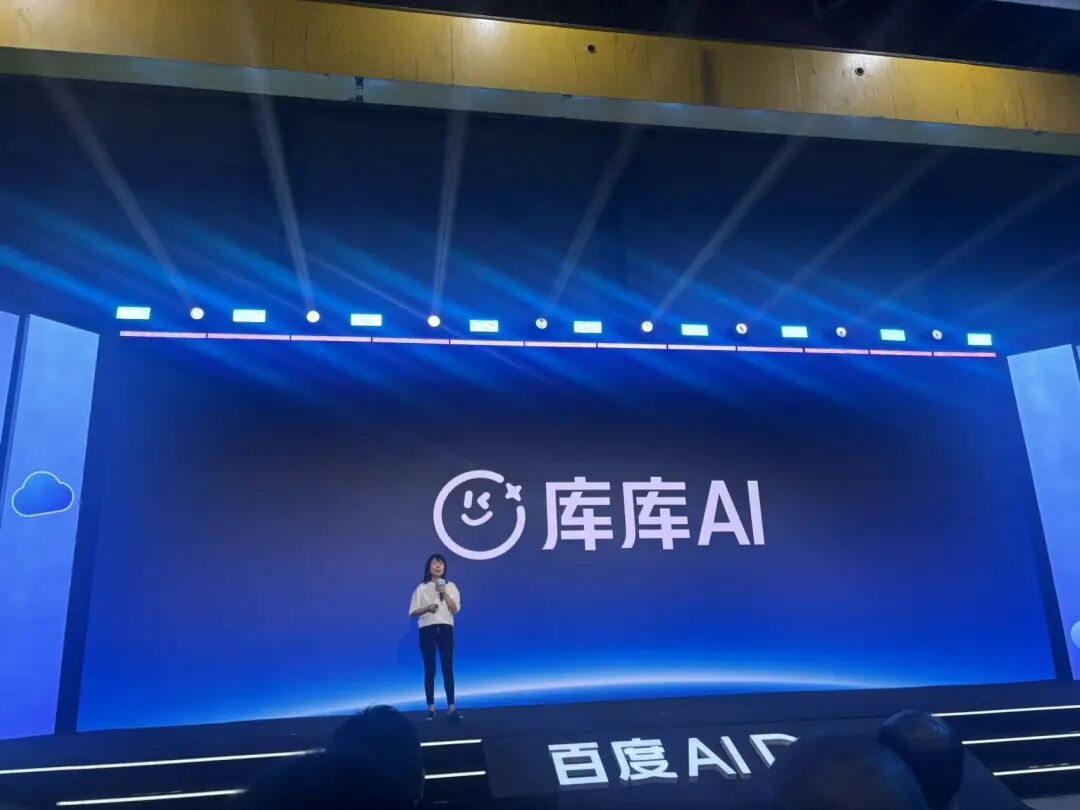
Figure | Kuku AI, an agent that mainly operates based on Netdisk and Wenku
As of January 2026, Baidu Wenku has more than 1.8 billion authoritative professional documents, and Baidu Netdisk serves more than 1 billion users, with a total of nearly 300 million monthly active users. According to industry reports, as of August 2026, Kuku AI's monthly active users in AI office scenarios have exceeded 25 million, ranking first in the general AI office track by virtue of its huge user base.
Kuku AI is similar to Baidu Buddy in capability models, but Kuku AI is currently focusing on vertical fields such as finance and education. The financial sector in particular is considered to have the highest knowledge density and the highest difficulty, which can best exercise and reflect the intelligent level of AI.
As announced, Kuku AI is embedded with global listed company materials, stock quotes, financial reports, research reports and other financial data, and can call on the "expert" skills of stock researchers, quantitative investment managers and other roles. So far, about two to three hundred financial institutions have been invited for trial use. In this track, there are also long-text competitors such as Kimi Work.
Baidu's third tiger is Miaoda, which was officially launched in March 2025. It also belongs to the Baidu Intelligent Cloud Business Group, positioned as an AI-native no-code application building platform.
Miaoda is designed for workplace beginners who do not know how to code, to generate websites, mini-programs, Apps and other products. Even 90% of the code of the Miaoda App itself is generated by Miaoda, without relying on too many programmers.
According to Baidu's disclosure, as of August 2026, Miaoda has cumulatively served more than 40 million users, generated 3.5 million commercial AI applications, and ranked first among domestic AI-native no-code application generation platforms with a market share of 33.4%.
Miaoda also faces challenges: it is more suitable for rapid prototype verification rather than complete business system construction. In addition, large tech giants such as Alibaba and Tencent are also laying out the low-code track, so Miaoda cannot occupy the market alone.
The "New Three Tigers" determine Baidu's future market position
Under what kind of background were the "New Three Tigers" born? What is the difference between its logic and Baidu's largest traditional to C application, search? It can be analyzed in two main parts.
First, if Baidu does not develop products like the "New Three Tigers", the company will face the risk of being eliminated from the market rapidly.
In the first quarter of this year, the revenue of online marketing services (search advertising), which used to be Baidu's "cash cow", reached 12.6 billion yuan, down 22% year-on-year, and its proportion in total revenue fell relatively to 48%, falling below 50% for the first time.
Large models such as DeepSeek, Kimi and even Baidu's own Ernie Bot have gradually become new entry points for users to "search". Traditional search is gradually losing its "entry point" value.
To find a new growth curve in the AI era, we cannot simply complete the simple action of "AI-empowered search", but also need to find multiple core entry points under new AI applications.
After a year of trial and error, the two most verified AI application scenarios in the market are coding, and vibe working.
There is a saying that "who wins programmers and office white-collar workers wins the world". These two groups are not artificially defined as "the protagonists of the AI era", but in the process of market evolution, AI is considered to be able to give full play to its intelligent value in these two relationship chains, and realize AI monetization through membership fees and other methods.
Under this logic, the "New Three Tigers" came into being naturally. Even if they were not named this way, they would appear on Baidu's internal ecological stage under other names, because there is market demand. For Baidu, whose advertising revenue is declining, it needs "momentum transformation" to find a second and third way of survival.
The current market trend has already given Baidu inspiration. In the first quarter of this year, Baidu's AI business revenue reached 13.6 billion yuan, accounting for 52% of general business revenue, exceeding 50% for the first time. The revenue of intelligent cloud infrastructure reached 8.8 billion yuan, up 79% year-on-year, and the revenue of GPU cloud surged 184% year-on-year.
The direction of AI business is definitely correct.
Second, Baidu's "New Three Tigers" must evolve from "entry point logic" to "work capability logic". AI is not only for searching, but more importantly for getting work done and producing results.
Baidu has suffered losses in this regard before.
In the mobile Internet era, Baidu was once a birthplace of various APPs and applications, but unfortunately, in the end it only had search, but no scenarios.
Tieba, Zhidao and Baike all had glorious UGC era, but users "left immediately after searching", and Baidu never managed to precipitate the "relationship chain" and "workflow". If in the AI era, it can only play the value of an "entry point", it will be difficult to lock in users.
The current situation requires the New Three Tigers to continuously improve their intelligence level, so as to generate ultimate attraction for programmers and white-collar workers, and make users willing to build heavy "relationship chains" on the infrastructure of the "New Three Tigers" that are difficult to migrate once established.
In this regard, Baidu almost has no choice but to "win against the enemies" to keep its position in the market.
Therefore, Baidu's New Three Tigers are the core entry points formed under the combined influence of internal and external factors. It can be predicted that Baidu Buddy and Kuku AI will continue to iterate their functions in the future, and take the lead in occupying high ground in some specific business fields. Of course, the New Three Tigers will definitely face head-on competition from WorkBuddy, Qianwen Office, Kimi Work, and the new generation of Doubao products.
Market concentration begins, "one-on-one" fierce competition kicks off
While Baidu is forming its joint force, other major Internet giants are also collectively streamlining their office Agent product lines.
Alibaba integrated QoderWork, Wukong and MuleRun into Qianwen Office, Tencent gathered products such as QClaw under WorkBuddy, and ByteDance is also promoting the integration between Doubao, Feishu and Volcano Engine. Baidu Intelligent Cloud also integrated dodo into Baidu Buddy.
The paths of the giants are highly consistent: in the early stage, multiple teams compete for solutions, and after the direction is clear, they concentrate resources to create a hit product.
Baidu has several ace cards on this battlefield that competitors cannot take away for the time being, but the moat of its rivals cannot be ignored either.
The first ace card is the "data gold mine" formed by Wenku and Netdisk. Tencent has the social relationship chain, Alibaba has e-commerce and enterprise service data, while Baidu has documents and cloud disk assets accumulated by users over more than ten years — that is, it has relatively abundant historical assets.
Wenku, Netdisk and Kuku AI naturally form a continuous cycle of "data - execution - precipitation", with a very clear business logic line.
In contrast, Tencent's WorkBuddy, Qianwen Office, and ByteDance's Doubao Enterprise Edition connect all scenarios of documents, spreadsheets, meetings and group chats in their respective ecosystems, reflecting the advantage of "real-time collaboration with colleagues".
The second ace card is the integration of search and services to build a new entry point. Baidu Buddy has BrowserUse capability, which means it can complete web tasks through browser operations, including search, form filling, data crawling and so on — this is the key feature that distinguishes Baidu Buddy from its competitors.
For example, when a user searches for "Sanya travel guide" on Baidu, Baidu Buddy can directly generate a trip planning Agent floating on the right side of the search page. Stitching "search" and "execution" together is Baidu's unique entry point advantage.
Kimi and Doubao do not have the underlying capability of search engines. Although DeepSeek supports online search, it cannot form a "search and use immediately" closed loop on the search page.
Of course, competitors also have their own advantages. Tencent's WorkBuddy is backed by WeChat and WeCom, Alibaba's Qianwen Office is deeply bound to DingTalk's more than 700 million users, and ByteDance's Doubao Enterprise Edition relies on Feishu's collaborative office ecosystem. If we say Baidu is extending from "search entry point" to "execution capability", these three competitors are extending from "collaboration network" to "AI capability".
The third ace card — the cost base of AI cloud. The AI office industry is a "capital-consuming and cost-intensive" industry — the more users you have, the greater the loss. Every AI service corresponds to rigid computing power consumption.
From this perspective, the commercialization of AI office is currently a war of attrition that "who can hold on longer wins".
Compared with other players, Baidu has the advantage of self-owned cost digestion structure. In the first quarter of this year, Baidu's AI capital expenditure was 5.839 billion yuan, which is only about one fifth of Alibaba and Tencent's respective expenditure, but the marginal cost advantage brought by self-developed Kunlun chips and Qianfan large model platform cannot be ignored. Among them, the revenue of intelligent cloud infrastructure reached 8.8 billion yuan, up 79% year-on-year, and the GPU cloud revenue increased by 184%. It should be noted that AI cloud is not only Baidu's source of revenue, but also the underlying infrastructure supporting the three tiger products.
Generally speaking, Baidu's New Three Tigers have already made their overall debut. But it should be noted that although the month-on-month growth rate is high, the absolute value of the base means it is still in the catch-up stage.
A bigger problem is organizational collaboration. Other major AI manufacturers have broken down departmental barriers, streamlined their product lines and united to fight again, but Baidu Buddy, Kuku AI, Miaoda and other products belong to different business groups. Whether they can be fully integrated or fight separately, Baidu's internal integration is estimated to have just started.
At the same time, whether Baidu can break the curse of "having technology but no strong precipitated products" that existed in the mobile Internet era, the outcome of the New Three Tigers in the market is expected to be clear before the end of 2026.
This article is from the WeChat Official Account "Muhe Business & Finance", Author: Gong Zheng, Editor: Yang Jing, 36Kr publishes it with authorization.