WRC has changed: from the showcase to the market
When visiting WRC, what attracts "Focus One" the most is still humanoid robots. In the front area of the exhibition hall, robot fighting, dancing and backflips are staged in turn, drawing crowds of spectators standing in layers.
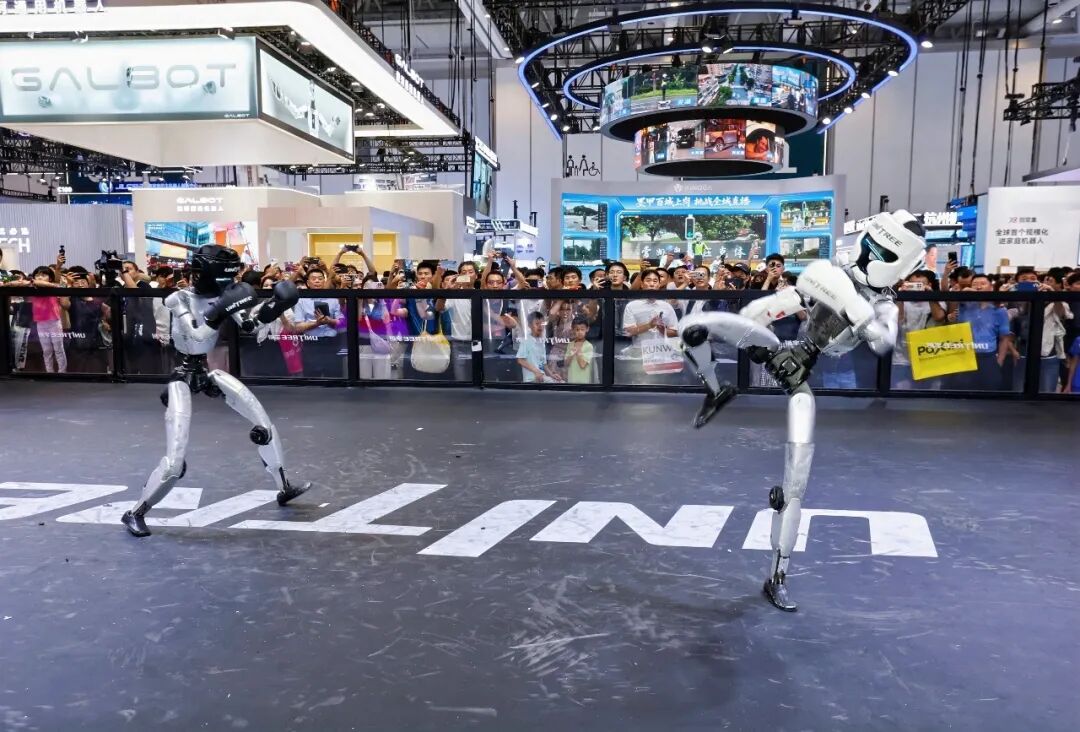
Robot fighting demonstration at WRC Hall C
Walking further inside, the robots on the booths are doing unremarkable but more "worker-like" tasks: the conveyor belts keep running, the robotic arms land in place again and again, some are sorting parcels, some are moving material boxes, and other robots lower their heads, trying to fold clothes neatly and put the sundries on the table back in place.
The highlights of this year are not all at the most lively booths. After making a cup of tea, can the robot pass the cup to the person's hand? After a batch of materials is replaced, can it still find the grasping position? If the box is placed crookedly, will it adjust itself? If someone takes the cup away halfway through the task, can it continue to finish the work? These things are trivial for humans, but for robots, each of them is more difficult than the last.
Complete robots are no longer the only protagonists. Dexterous hands, tactile sensors, joints, motors, reducers, vision modules, data acquisition equipment and models have all moved to the forefront of the stage.
At the forums, entrepreneurs and researchers talk about brain, ontology, world models, developers, open source and data supply chains, as well as home care, safety governance and responsibility boundaries. Despite different topics, all discussions eventually fall on practical usage: after robots leave the exhibition booths, can they perform their tasks stably in real scenarios?
Purchasers care about more straightforward questions: can the robot be integrated into their own business processes, who to turn to when a fault occurs, and whether the total cost of ownership can be justified in the long run.
Looking back after visiting the entire conference, three parallel development lines can be spotted at this year's WRC. The first line is "strengthening the body": components, supply chains and manufacturing capabilities are being optimized to make robots more stable, lighter and more affordable. The second line is "strengthening the brain": models and data are being improved to enable robots to cope with changes, complete a series of continuous actions, and resume work even after making mistakes. The third line is closer to business itself: robots are starting to enter factories, warehouses and stores, and issues including procurement, delivery, maintenance and long-term costs have been put on the table for discussion.
This is a conference that is moving closer from the show floor to the real market. Robots are indeed starting to find real jobs now. As for whether they can stay in these positions for long, it will take a period of actual operation in factories, warehouses and homes to find out.
01. The star of this year is not complete robots, but the "shovel sellers" in the industry
Complete robots are still the most eye-catching part in the exhibition hall. But this year, issues that were rarely noticed in the past, such as service life, adaptation, mass production and cost, have also been brought to the forefront.
Take dexterous hands as an example. This year, the competition is no longer only about how many degrees of freedom the hand has or how human-like its movements are, but focuses on load capacity, weight, tactile precision, service life and cost. For customers, completing a single grasping action is only the first threshold. What matters more is whether the dexterous hand can continuously handle different materials, and adjust itself when encountering slipping, misalignment and soft objects.
For example, when passing a cup to a person, too much force may crush the cup, while too little force may cause it to drop. When loading parts into a fixture, the robot not only needs to find the exact position, but also judge whether the part is stuck or placed stably.
Component enterprises that produce joints, actuators, tactile sensors and other products are also changing the focus of their introductions. In the past, they mainly introduced parameters and performance, but now they start to explain exactly what problems these components can solve after being installed on robots.
Going a step further, some enterprises start to showcase their manufacturing capabilities. Lingxin Qiaoshou demonstrated a production line where dexterous hands assemble other dexterous hands. Compared with simply demonstrating grasping movements, this production line brings the problem to the production end: can dexterous hands be produced stably and in batches? For complete robot manufacturers, moving from prototype to mass procurement not only requires verifying that the product works, but also checking the yield rate, takt time, cost, and whether the supplier has the capability of continuous delivery.
In addition to hardware, data acquisition equipment has started to be discussed as an independent category. Teleoperation, motion capture, teaching and simulation are all solving the same fundamental problem: what kind of data do robots need, and how can enterprises continuously obtain these data. Human movements, positions and materials of objects can all be converted into training data through these methods.
02. Scenarios are shifting from performance to real work, and factories are closest to large-scale orders
More and more "working" robots have appeared at this year's WRC. You can find corresponding demonstrations for sorting, handling, palletizing, loading and unloading, inspection, assembly, logistics, retail, catering and inspection tasks.
Judging from the projects exhibited at WRC and feedback from enterprises, the commercialization stages of different scenarios vary greatly: factories are closest to large-scale orders, followed by logistics; extreme environments have clear willingness to pay, but are more focused on vertical projects; catering and retail are easy to implement, but need to prove that they are more cost-effective than human labor; home scenarios are the farthest from large-scale application.
Tasks in factories are also graded. The tasks that robots usually take on first are those with fixed positions, repeated movements and clear processes, such as handling, palletizing, sorting, loading and unloading, and code scanning, whose input-output ratio is relatively easy to calculate.
Inspection, assembly and flexible loading and unloading are more complex. Robots need to identify differences between materials, adjust movements, and restart after a failed grasping attempt.
More challenging tasks are to connect multiple processes, so that the robot can independently complete the whole workflow from material picking, processing to placing.
Logistics scenarios lie between factories and open environments. Warehousing logistics already have relatively clear operation processes, but the goods, routes and orders in the warehouse are still changing constantly.
At the exhibition, one type of enterprises puts robots into actual operation processes, emphasizing stable task completion. The other type of enterprises demonstrates full-body teleoperation, mapping human actions including turning around, bending over and arm movements to robots, which is mostly used for data collection or remote operation. The former type has been trying to assign tasks directly to robots, while teleoperation reserves the method of human intervention for complex tasks, and can also collect training data at the same time.
The demand in extreme environments is more clear.
Underwater, mines, underground spaces, chemical pipe corridors, substations and fire scenes all have dangerous, harsh or unsuitable jobs that are not fit for humans to enter for a long time. Robots perform inspection, detection, handling and risk elimination here, taking risks instead of humans, which is a very direct value.
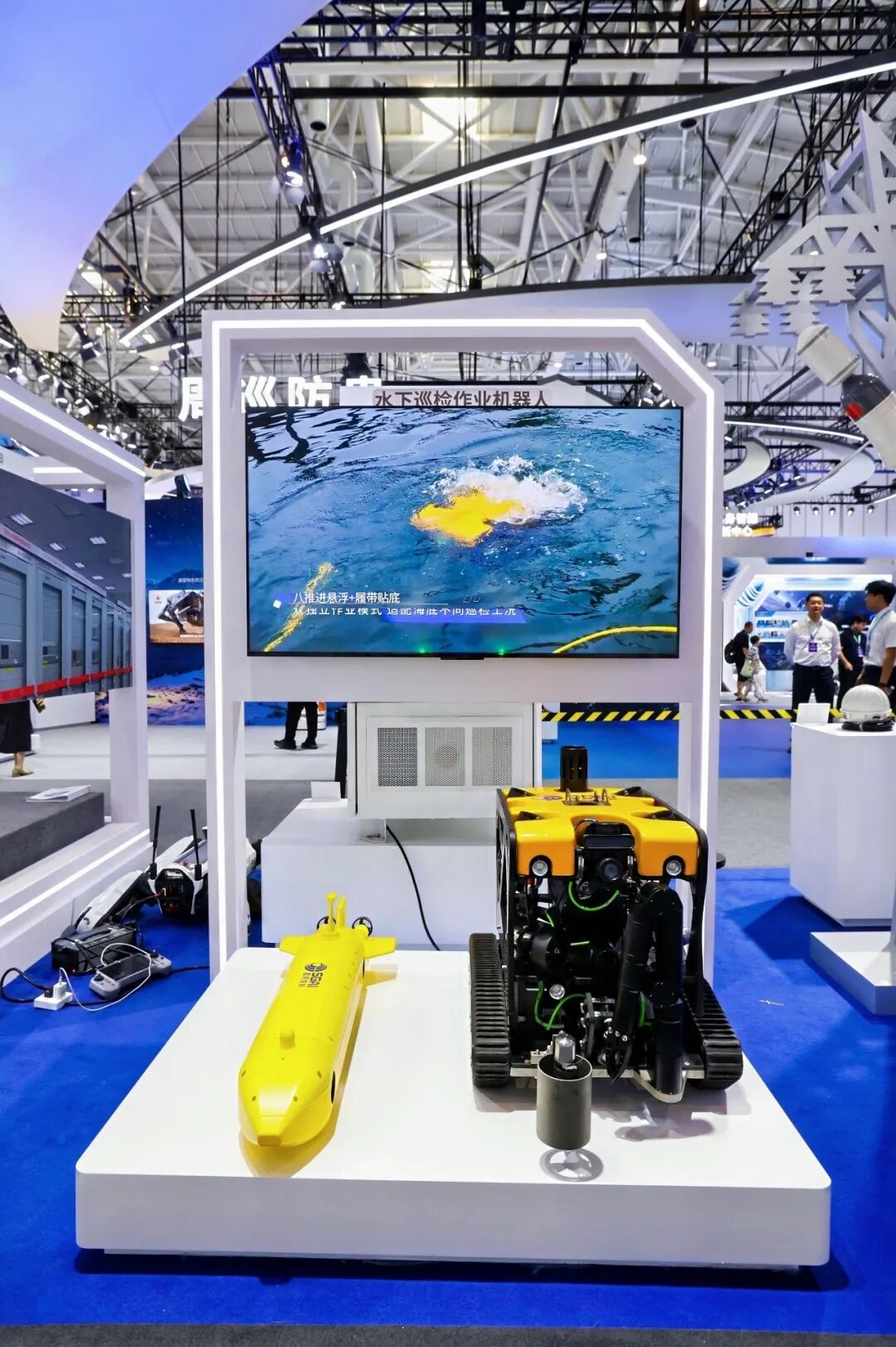
Underwater inspection robot demonstrated at WRC Hall C
Such scenarios are also more application-specific. The terrain and tasks in underwater, mine and fire scenes vary greatly, so different forms of robots such as wheeled robots, tracked robots, wheel-legged robots, quadruped robots, drones and underwater robots have emerged. Protection, communication, battery life, remote control and fault handling also often need to be re-adapted according to specific scenarios.
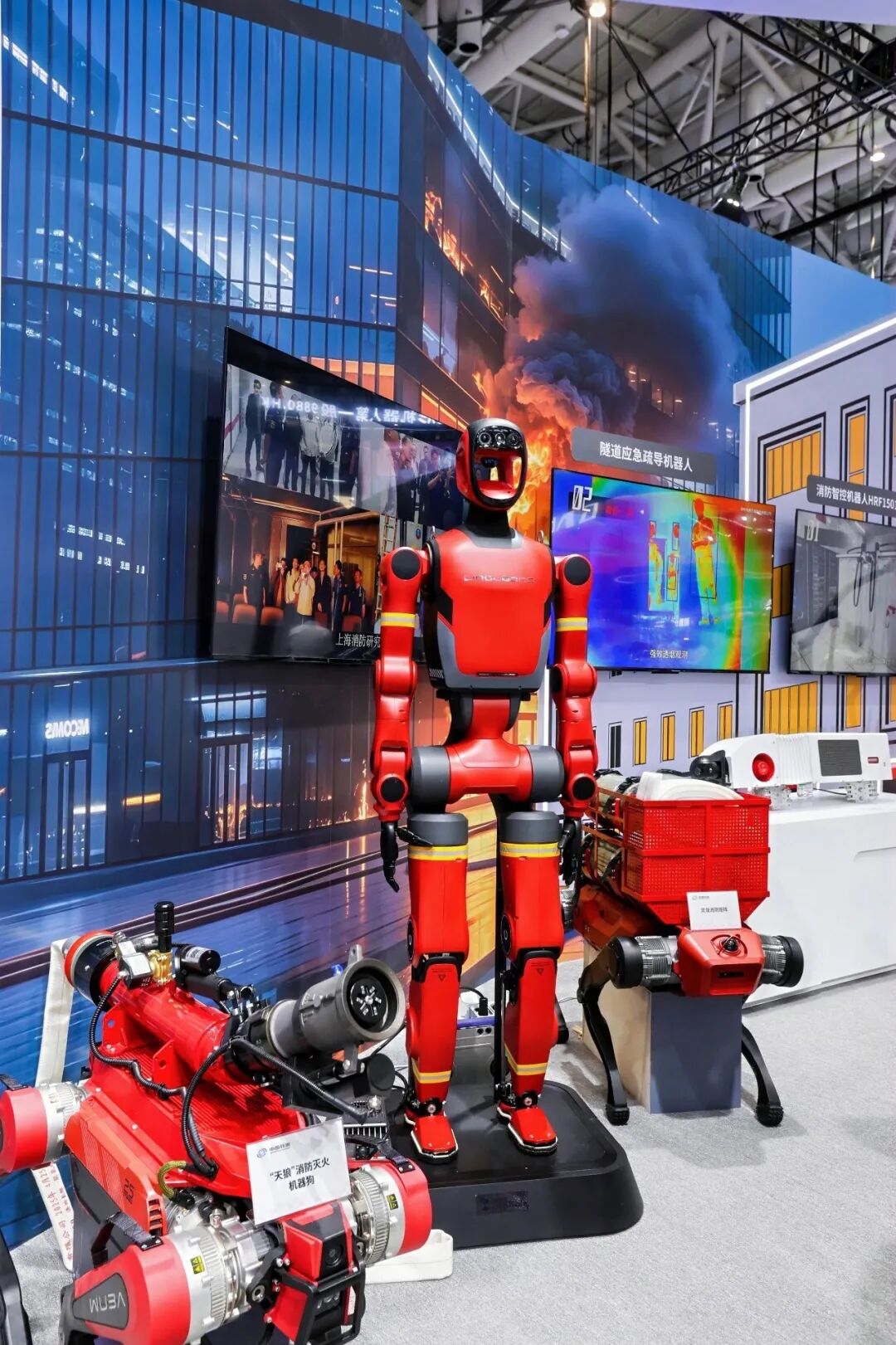
Firefighting robotic dog demonstrated at WRC Hall C
Such projects may generate orders earlier, but it is not easy to scale them up as widely as factory and logistics scenarios.
Emergency rescue also has a feature that usually not a single robot works alone. The WRC Collaborative Robot Challenge simulates accident rescue, where aircraft and unmanned vehicles need to complete reconnaissance, information sharing, material transportation and return. At the same time, the conference also released the "application requirements of embodied intelligence in emergency scenarios". From competitions to actual demands, emergency rescue has become a type of robot application that has been repeatedly mentioned at this year's WRC.
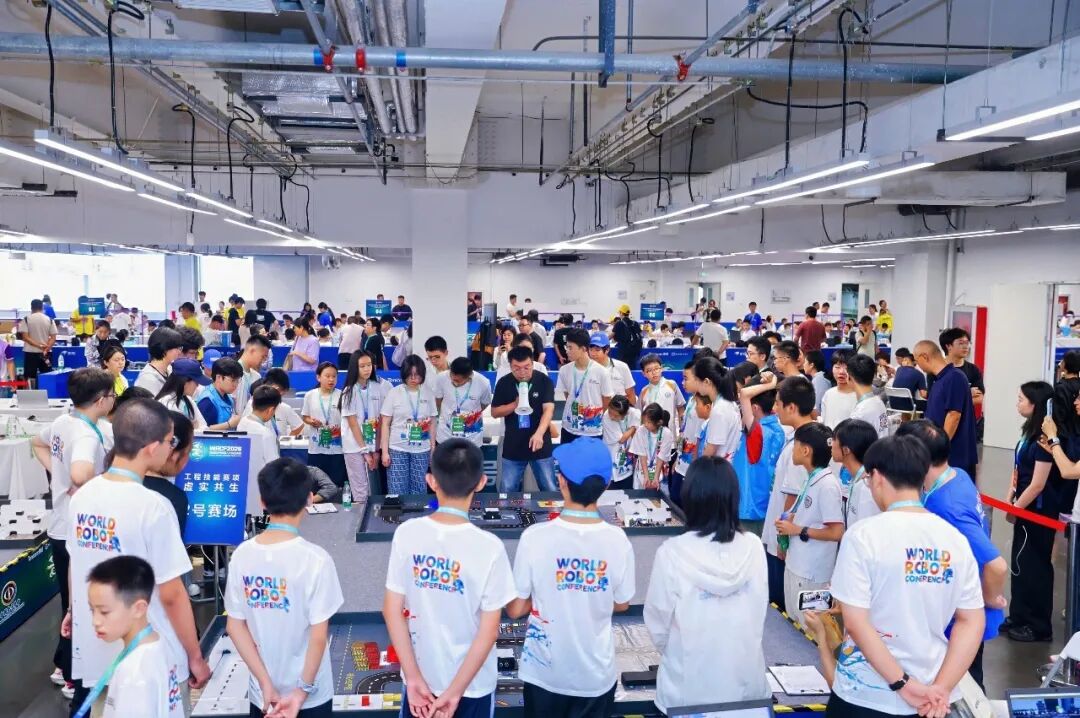
WRC Robot Competition
Catering, retail and tour guide are the scenarios that are most likely to attract crowds on site.
This year, WRC also set up a robot consumer street for the first time. Scenarios such as coffee, ice cream, cocktail making and gift retail are gathered together. Robots start to take cups according to orders, operate equipment and make drinks. Compared with dancing and backflips, these movements are closer to real service scenarios.
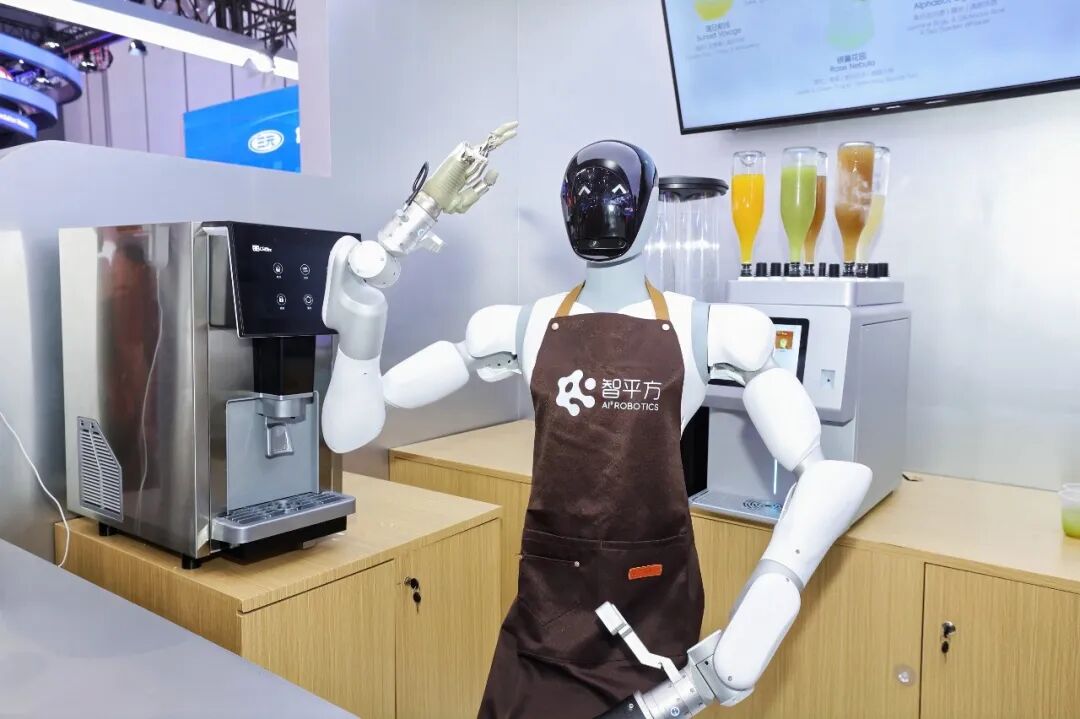
Catering robot demonstrated at WRC Hall C
But merchants will definitely calculate efficiency and cost before purchasing: how many orders the robot can handle per day, how much space the equipment takes up, and whether this solution is more cost-effective than directly hiring human staff.
Home scenarios have the most imagination space, but are the hardest to standardize.
Long-sequence tasks such as tidying up sundries, sorting garbage, folding clothes, watering flowers and arranging flowers can already be seen on the exhibition booths. But after entering real homes, cups change positions, clothes come in different shapes, and the changes robots face are far more than those on the exhibition booths.
Compared with ordinary home services, the demand for elderly care and companionship is more clear. The people's livelihood inclusive session of WRC discussed elderly care, rehabilitation and assistive robots separately. Robots can provide movement assistance, rehabilitation training, reminders and environmental monitoring, and the demand side includes family members, elderly care institutions and nursing staff.
Elderly care scenarios attach more importance to reliability. Whether robots can replace part of the nursing work and respond in time when abnormalities occur will directly affect whether institutions and family members are willing to use them for a long time.
03. Everyone is strengthening the "brain", but no technical route has converged yet
After robots start taking on more complex tasks, the problems that the "brain" needs to solve are also increasing.
At this year's WRC, technical keywords such as VLA, world model, end-to-end, Agent, and brain-inspired architecture are all frequently mentioned, and the problems they solve are not exactly the same. Some focus on how robots generate actions after seeing tasks, some hope that robots can first judge how the surrounding environment will change, and others care whether the same set of capabilities can still work after being transplanted to a different "body" or a different "workstation".
Wang He, founder and CTO of Galaxy Universal, mentioned that robots should not only complete the actions they have been trained for, but also apply the capabilities they have learned to new tasks. Galaxy Universal tries to integrate VLA and world model into the same system with the World-Action Model (WAM). Robots not only need to decide how to move next, but also estimate what changes will happen to the surrounding environment after the action is executed.
In addition to how to make decisions, another issue that has been repeatedly discussed is whether a set of capabilities can continue to work after being transplanted to a different "body".
Ant Lingbo applied the same set of general "brain" to scenarios such as pharmacy sorting, industrial loading and unloading, and warehouse sorting at WRC. On-site staff of the enterprise introduced that this brain has adapted to multiple robot brands and different forms of ontologies during the training phase.
If every time you change to a different robot or a different workstation, you need to collect data, train and debug from scratch, it will be very difficult to replicate a project quickly.
After robots arrive at the customer site, they will constantly encounter situations that they have never seen during training.
Xiao Zhongyang, founder and CEO of Coron Kaimu, mentioned that materials, friction, sensor noise and various long-tail situations in the real environment are very difficult to be fully covered only by laboratory data. He regards product delivery as part of the learning process: after robots arrive on site, data about where they make mistakes and where human intervention is needed can be collected back to train the model further.
Daxiao Robot demonstrated a similar path at WRC. One end is connected to the world model and environmental data collection tools, and the other end is connected to instant retail, hotel services and open outdoor scenarios. The data generated by robots working in these scenarios is fed back to the model for subsequent iterations.
There is also a relatively independent technical branch at WRC: Brain-computer interface.
The BCI Brain-controlled Robot Competition demonstrated projects such as brain-controlled wheelchairs, brain-controlled robotic arms and brain-controlled humanoid robots. It solves another type of problem: how to transmit human intentions to machines more directly, which is also a way of human-robot collaboration in scenarios such as rehabilitation assistance.
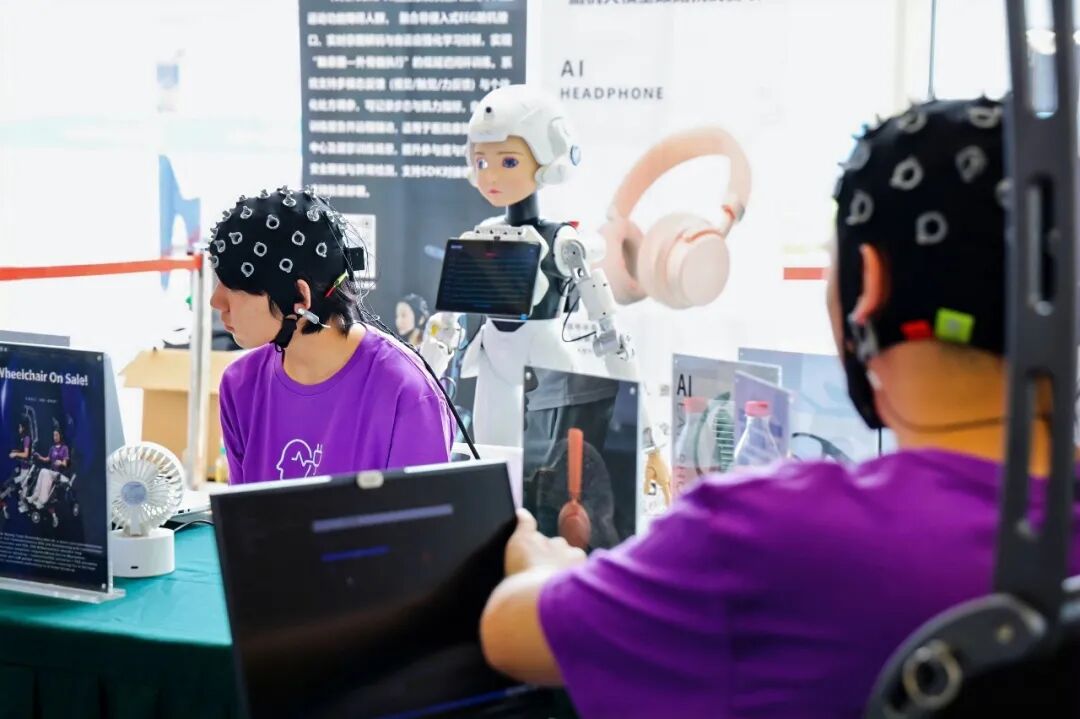
WRC BCI Brain-controlled Robot Competition site
For more robots that hope to work autonomously, the current problems are still very specific: once the object is changed or the environment changes, the performance is easily affected.
Wang Xingxing, founder and chairman of Unitree Robotics, mentioned in his speech at WRC that in a fixed scenario, after sufficient data collection and training, the success rate of some tasks can already be very high; but if the operated object is changed, or the environment changes slightly, the success rate may drop significantly. Sometimes, the problem is only a few centimeters away from success. The robot seems to be about to grasp an object, but the last tiny physical error is not corrected, and the whole task fails.
Wang Xingxing mentioned that if a robot can complete about 80% of tasks through language instructions in about 80% of unfamiliar scenarios, it can be regarded as an important critical point of general capabilities. He estimates that it will take 2-3 years at the fastest, and 5-10 years at the slowest to reach this stage.
At least at this year's WRC, it is not yet clear which solution has solved these problems well enough.
04. Buyers enter the market, and channels are coming
A group of large buyers came to this year's WRC.
The conference set up a Procurement Day for the first