Doubao is about to start operating your computer.
As of August 2026, Doubao has steadily ranked first in the monthly active list of AI-native applications. Some time ago, Doubao implemented independent channel commission for hotel orders, with a comprehensive commission rate of about 12%, which kicked off the "rent collection" era of AI search and sparked widespread debates.
Recently, Doubao has launched new updates, with its work task mode upgraded, the brand-new Doubao virtual desktop has been launched on the Windows version.
In the early days, large language models were only capable of chatting, and later evolved to be able to write and view content. Doubao has gradually developed capabilities such as image understanding, document processing, and information retrieval. Now Doubao starts to "take action": it will help you finish the work in front of the computer, evolving from a conversational assistant to a task execution agent.
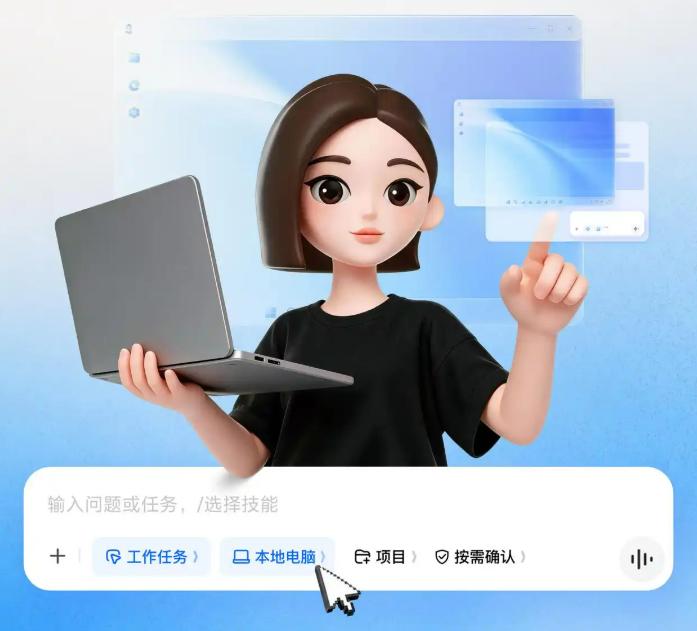
Image source: Internet
Doubao's Virtual Desktop Operation Function
Previously, traditional AI assistants generally stopped at helping users write reports, generate images and other operations, and did not actually enter the user's operating system to perform tasks. Now Doubao's virtual desktop operation function enables AI to "grow hands and feet", after selecting "Work Task Mode" and "Local Computer" on the Doubao desktop client, select "Operate Computer" in the skill bar to complete the authorization, then in the virtual desktop, Doubao can view the computer screen, move the mouse, click buttons and tap the keyboard like a human, to continue advancing complex tasks on the PC end.
It should be noted that to use this function, you need to download the latest Windows "Doubao Desktop Version" from the official Doubao website, complete authorization and initialization according to the system prompts in the work task mode. Users can also use the "Operate Computer" skill to initiate tasks and complete updates under Doubao's guidance.
From the public's perspective, the virtual desktop of Doubao essentially builds a digital body that solves three core problems:
The first is the problem of viewing, that is, visual perception. AI needs to be able to see the content of the computer screen in real time, and understand the meaning of icons, buttons, input boxes and other elements at the same time. Based on more general GUI (Graphical User Interface) capabilities, the Doubao virtual desktop model can understand the interface and complete operations even without MCP, API, plugins or CLI.
The second is the problem of planning, on the basis of understanding the screen content, it formulates operation sequences like a human.
The third is the problem of operation, that is, precise execution. According to the plan, moving the mouse, clicking coordinates, and keyboard input all require precise control.
Of course, users can also view Doubao's operation process in real time, and pause or take over the task at any time when needed. In general, the virtual desktop function of Doubao does not invade the user's real system, but grants AI complete operation permissions, finding a practical balance between security and functionality.
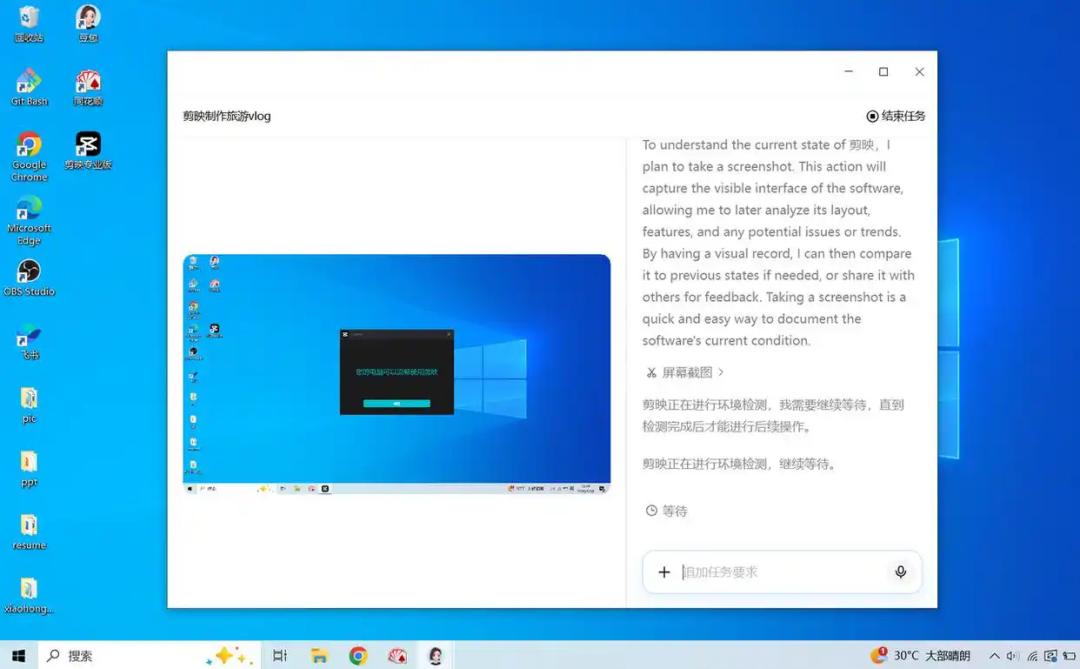
Image source: Shangyou News
Why the Local Windows PC?
At present, the competition for the parameter scale of large models is gradually fading, and "who can implement capabilities into practical scenarios" has become the turning point that truly widens the gap. This time, Doubao chose to launch the virtual desktop function on the Windows version first, emphasizing the phrase "local computer", which is not without strategic considerations.
Looking around, Windows is still the mainstream operating system for office scenarios around the world. For office workers, a large number of core workflows run in the Windows environment. Compared with the mobile end or web end, the PC end still has a richer software ecosystem and is more suitable for complex operation scenarios, which provides the foundation for AI agents to exert their value.
Furthermore, "local computer" often means data security and controllable privacy. The virtual desktop operation is completed in the local environment, users' screen information and operation behaviors do not need to be uploaded to remote servers for processing, and the previous trust foundation can be followed. Compared with cloud remote control, the localized virtual desktop has more advantages in terms of sense of security.
If we take a more macro perspective, this also represents a branching trend in the AI industry: the capabilities of large models are not limited to the cloud, but also need to be sunk to end devices. With the improvement of end-side model capabilities and the maturity of local inference frameworks, more and more AI functions will run on users' own devices in the future. The virtual desktop operation function of Doubao is exactly the experiment of this trend.
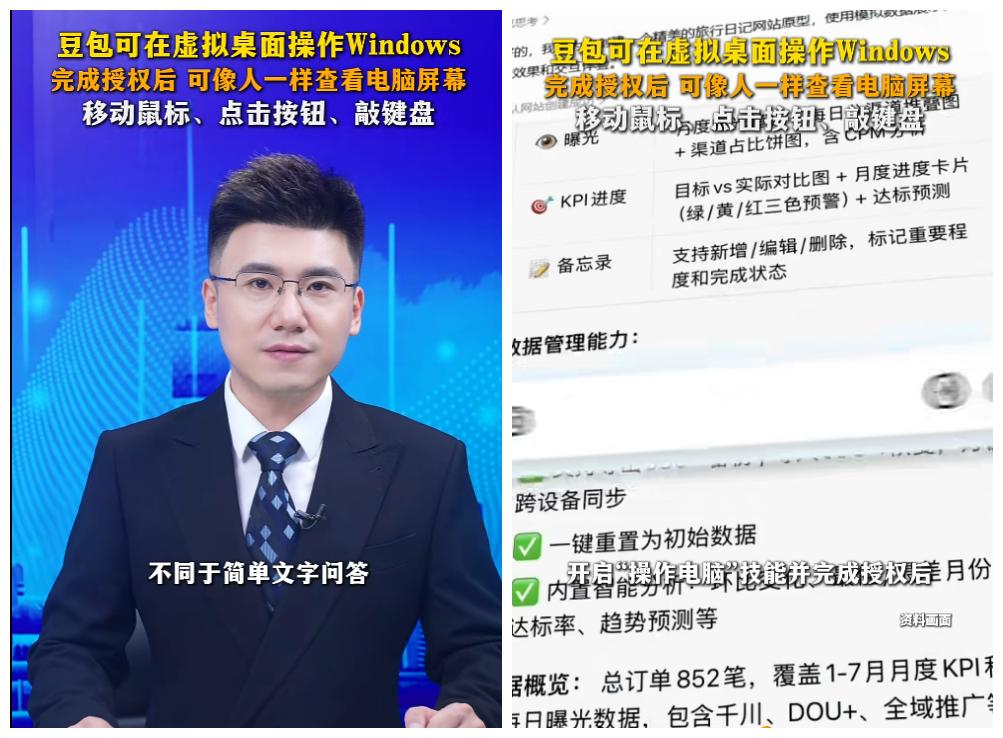
Image source: Fengmeng News
What New Experiences Can Users Get?
The technological progress of all products ultimately serves people, so user experience is particularly important. The virtual desktop function of Doubao redefines the relationship between users and AI, shifting from "giving suggestions" to "doing things for you".
In the past, when users interacted with AI, users usually played the role of commanders: we tell AI our needs, such as writing an event plan or a report, AI presents what we want, but users still need to perform the final operation by themselves.
When a user says "help me make a quotation list", AI will generate a document, but steps including opening Excel, filtering data, inserting charts later, and adjusting formats still require users to do it personally. In this scenario, AI is a consultant, but it can never complete the last mile for users.
With the emergence of Doubao's virtual desktop, users can select "Work Task Mode" on the Doubao desktop client, put forward a complex task, such as "help me sort out the documents on the desktop by category and package them", and then authorize AI to enter the virtual desktop.
Then users do not need to do it themselves. Doubao will view the documents one by one, extract and understand key information, then classify and package them. Users can be completely liberated throughout the process, no need to guide step by step, just set the target demand at the starting point and check the result at the end.
For users, this is a leap in experience. AI is no longer just a tool, but becomes your agent, which is a transition from passivity to initiative. Not to mention other aspects, this is absolutely an efficiency revolution for those boring, highly repetitive and process-oriented tasks in daily work.
Image source: Internet
What Changes Will Happen in the Era of Doubao AI Agents?
Looking further ahead, this product update of Doubao is a landmark node in the era of AI agents, which may bring three major changes.
The first is the change in human-machine division of labor. Over the past decades, the popularization of computers has reshaped people's working methods, but there was a clear division of labor between humans and machines: humans are mainly responsible for decision-making and creativity, while machines are responsible for calculation and execution. Now, the emergence of AI agents is blurring this boundary. Compared with the mechanical operation of computers, AI can understand human intentions and complete tasks by itself. At this time, what humans do and what machines do needs to be re-divided. In the future workplace scenarios, human roles will most likely shift to goal setting, quality control and value judgment, while AI will be responsible for execution, realizing the upward shift of division of labor.
The second is the change in software interfaces. Let's recall, when operating a computer, do you usually follow the steps of opening software, clicking menus, entering text, and saving files? But when AI can automatically complete all operations in the background, we don't need complex menus and various shortcuts anymore, we just need to tell AI "what I want" with language. The software interface will change from "designed for humans" to "designed for AI", and humans only need to see the final result.
The third is the change in the definition of labor. Human power, engine power, now the execution capability of AI agents in the virtual desktop is essentially a kind of digital labor force. It does not need to rest, and can deliver three times the output of traditional labor. For enterprises, this means that the automation of a large number of process-based work becomes possible. For individuals, the upper limit of individual productivity will also be greatly raised.
In fact, in addition to Doubao, Baidu's ERNIE Agent, Alibaba's Tongyi Qianwen and other products are all exploring the path for AI to evolve from conversation to execution. Doubao's first landing on virtual desktop operation has gained a first-mover advantage in the domestic market.
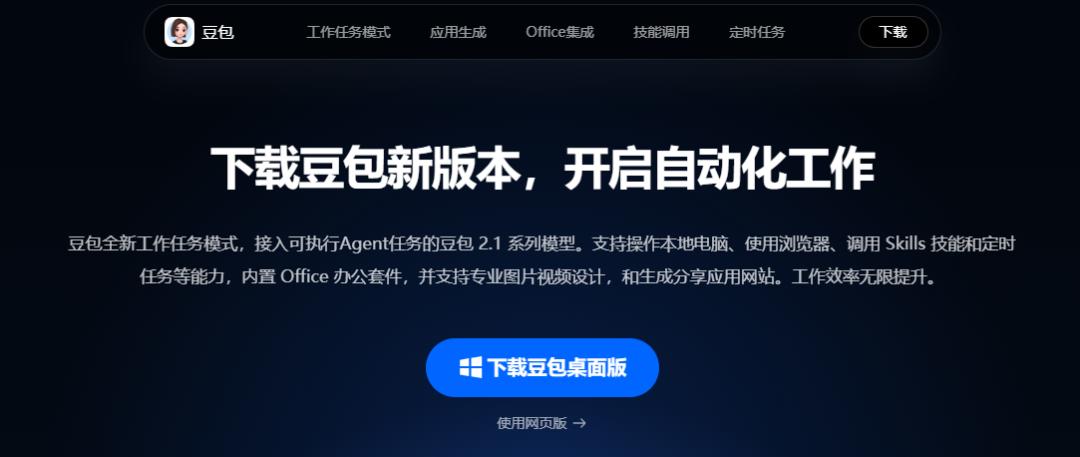
Image source: Screenshot from Doubao official website
It is certainly gratifying that AI agents help us free our hands, but technology has two sides, and we also need to examine the problems that come with it.
For example, the problem of stability. Humans' exploration of local computers is not over yet. Can Doubao fully understand the complexity of the desktop operation environment? Especially the layout of different software interfaces, pop-up logic and exception handling methods vary greatly. The operation of AI in the virtual desktop is mostly trained and adapted for common scenarios, so when encountering rare operation scenarios, the error probability is still not low.
In addition, office work often involves complex cross-system, cross-platform and cross-account collaboration, such as switching information between multiple browser tabs. To truly become a reliable agent under the "Work Task Mode", Doubao still needs to continuously expand in the depth and breadth of scenarios. There is still a long way to go from being usable to being user-friendly.
There are also security and trust issues that the public generally pays attention to. Although local computers guarantee privacy to a certain extent, since authorization is involved, if the authorization mechanism is not fine enough and the behavior of AI lacks sufficient transparency, users' trust will be greatly reduced. What users need is to maintain a sense of control over operations at all times while enjoying sufficient convenience.
Image source: Official website screenshot
Conclusion
The virtual desktop operation function of Doubao completes the transition from assistance to execution, just like AI has grown hands and feet, viewing the computer screen, moving the mouse, clicking buttons and tapping the keyboard like a human, to continue advancing complex tasks on the PC end. This function represents that the capabilities of large AI models are not limited to the cloud, but also need to be sunk to end devices. The reason for choosing local computers is that Windows is still the mainstream operating system for office scenarios around the world.
For users, the virtual desktop function actually reshapes the relationship between AI and users. AI is no longer just a consultant, but also completes the last mile of tasks. When the era of AI agents comes, the human-machine division of labor, the definition of labor, and even the software interface will undergo various changes. AI manufacturers have entered this track one after another, and Doubao is just one step ahead. At the same time, the problems of stability, security and trust brought by AI agent execution cannot be ignored.
From a micro perspective, this is a new product function update of Doubao, which provides users with a new way to collaborate with AI. From a meso perspective, it is a signal of accelerated competition in the AI agent track, shifting from concept to implementation. From a macro perspective, it indicates that AI is evolving from "talking the talk" to "walking the walk".
We may not be able to accurately predict the full picture of the AI agent era, but what is certain is that when AI can see and move, it is no longer just a dialog box on the other side of the screen, but begins to truly step into our digital life and become a partner that can work side by side with us.
This article is from the WeChat official account "Niaoge Notes" (ID: niaoge8), authored by Niaoge Notes, and published with authorization from 36Kr.