Let's talk about data governance assessment and how to put it into practical implementation.
—— Assessment is not scoring, but the mainspring that makes governance operate
In many enterprises, data governance has established systems, released standards, and launched platforms, but finally gets stuck in an awkward situation: all documents are locked in cabinets, while data remains the same as before. What is missing? Assessment. To be precise, it is assessment that can be implemented, honored, and change behaviors. For assessment, if done right, it is the mainspring; if done wrong, it is sheer formalism.
Let's first look at two real comparative cases.
The data governance office of a certain group issued an official red-headed document "Data Governance Assessment Management Measures" at the beginning of the year, organizing scoring once every quarter. After two years, the average score of all departments is above 90, and everyone is happy. However, after a year-end inventory: the null value rate of core fields remains completely unchanged, duplicate customers still exist, and reports still conflict with each other every month. The assessment has become a mutual face-saving ritual.
Another joint-stock bank only did one thing: directly link the accuracy of customer information to the performance of counter tellers at outlets, and deduct performance points if the accuracy fails to meet the standard. What was the result? In three months, the accuracy of customer information increased from 88% to 99.2%.
Both are assessments, one idles in vain while the other delivers tangible results. The difference does not lie in how beautifully the document is written, but in four words: how to implement it. Today we will break down this topic and explain it thoroughly.
I. The Negative Side: Four Fates of Idling Assessment
Before designing how to conduct assessment, we need to figure out why the assessment of most enterprises fails. To sum up, there are four typical failure modes:
Failure Mode 1: Only assess the IT department, not the business departments
This is the most common misalignment. Data is entered by business departments and generated from business processes, but the assessment penalty falls on the IT department. Business departments refuse to fill in what should be filled and refuse to modify what should be modified, yet the IT department has to take the blame for the assessment results — The IT department has no authority to manage the business, but has to take full responsibility for the data quality of the business side. The result is that the IT department is busy "cleaning data" nonstop, while dirty data from the source keeps pouring in.
Failure Mode 2: Only deduct points, no extra points awarded
All items in the assessment form are point deduction items: 1 point deducted for one problem, 25 points deducted for problems with large impact scope. Logically this seems reasonable, but organizational behavior tells us that for assessment that only imposes penalties without rewards, the first lesson it teaches the organization is "don't get caught". As a result, data problems are concealed layer by layer, people only report good news but hide bad news, and the governance team cannot even get the real list of problems in the end — you don't even know where the enemy is, what battle are you going to fight?
Failure Mode 3: Arbitrary indicator setting
Indicators are not set based on baseline data, leaders make a random decision: "The data quality should reach 98% this year!" No one knows what the current value is, no one demonstrates what input is needed to reach 98%, and even the requirement that "indicators can only rise but never fall" is put forward. What can the grassroots do? Either lie low and accept the penalty, or manipulate the figures. Indicators separated from the baseline will not drive improvement, but lead to fraud.
Failure Mode 4: No follow-up after assessment
Quarterly scoring is carried out in a grand manner, after scoring the results are stored in the system, and that's the end of it. The assessment results are not linked to performance bonuses, not linked to departmental budgets, and not linked to cadre promotion — assessment that cannot be honored is essentially an expensive questionnaire survey. Article 34 of the "Guidelines for Data Governance of Banking and Financial Institutions" issued by the China Banking and Insurance Regulatory Commission states very clearly: the data quality assessment results shall be incorporated into the institution's performance appraisal system. The regulator has already made the point crystal clear for you.
One-sentence summary: The root cause of idling assessment is not that there are not enough indicators, but that we assess the wrong people, use the wrong methods, and fail to honor the results.
II. What to Assess: Three-tier Indicator System
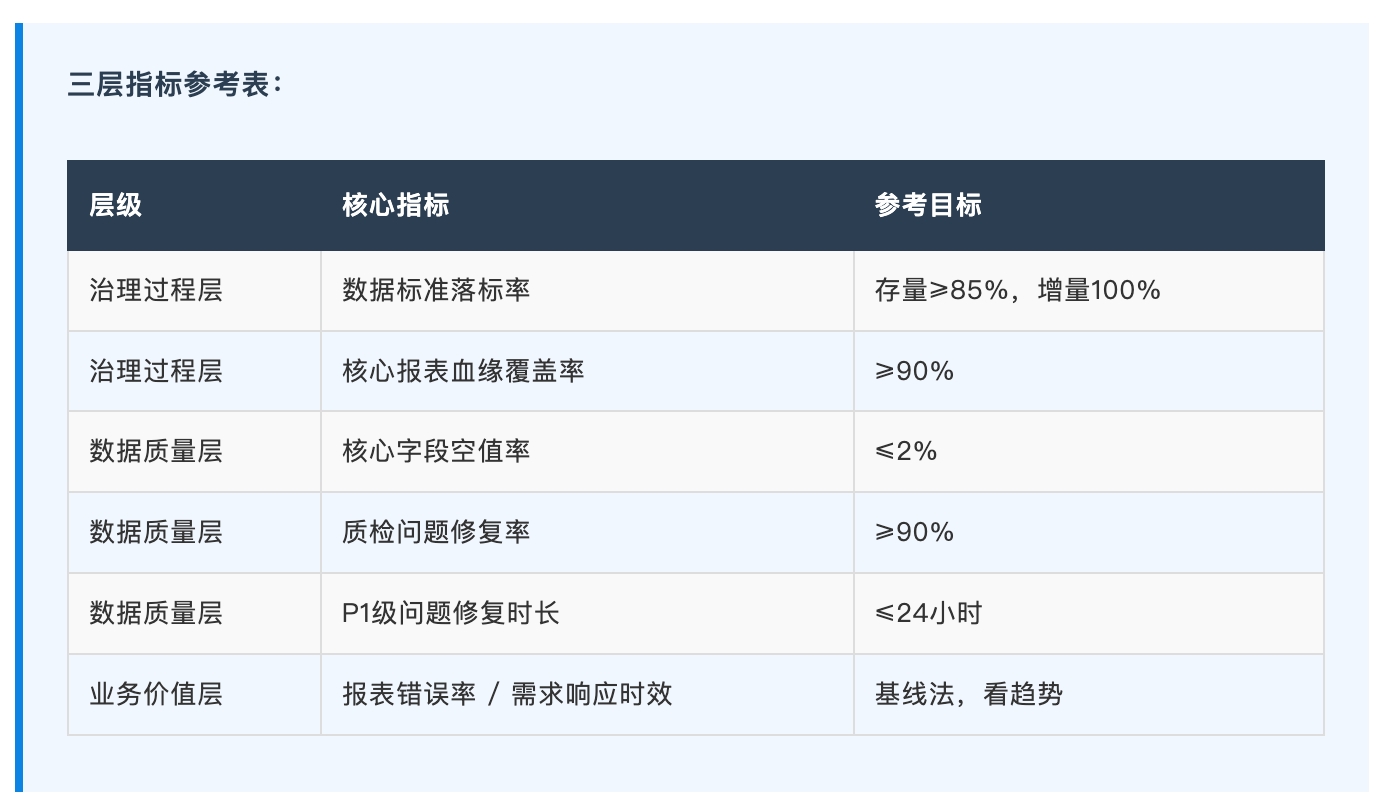
More indicators do not mean better performance, the key is to stratify them. A set of implementable assessment indicator system should be divided into three tiers, answering three progressive questions:
Tier 1: Governance Process Tier — Are the tasks completed?
This tier assesses the execution depth of governance actions. The most representative indicator is the standard compliance rate — the proportion of released data standards that are implemented in the actual system fields.
The case of Ganzhou Bank is very illustrative: before introducing AI governance tools, they faced the standard compliance assessment of 61 existing systems, 8 data themes, 1244 standards and more than 7000 key fields, which cannot be promoted manually at all, and the standard compliance rate was only 20%. After systematic governance, the compliance rate rose to 85%. This span from 20% to 85% shows that the standard compliance rate truly reflects the governance depth — if standards are formulated but not implemented, all the work is done in vain.
Tier 2: Data Quality Tier — Is the data getting better?
This is the most intuitive reflection of governance effect. Core indicators include: Completeness (null value rate of key fields), Accuracy (detection and repair of quality inspection problems), Consistency (caliber difference of the same indicator across systems), Timeliness (problem response duration).
Tier 3: Business Value Tier — What benefits has governance brought?
This is the hardest but most important tier to set. Report error rate, data demand response timeliness, proportion of AI projects hindered by data problems... The indicators of this tier answer "what exactly the business side perceives".
Key methodology: Do not set absolute values for this tier, use the baseline method instead. Select 5 to 10 core reports, record the number of monthly returns starting from this month, keep recording for 3 consecutive months to establish a baseline, and then observe whether the trend narrows. The starting points are different for different teams, there is no point comparing absolute values, only the change trend is persuasive.
III. How to Conduct Assessment: Three Key Designs
Design 1: Stratified and Classified Assessment, Assess People Based on Their Responsibilities
As mentioned earlier, you are doomed to fail if you only assess the IT department. The correct approach is to stratify assessment objects, and assess each group based on their respective duties:
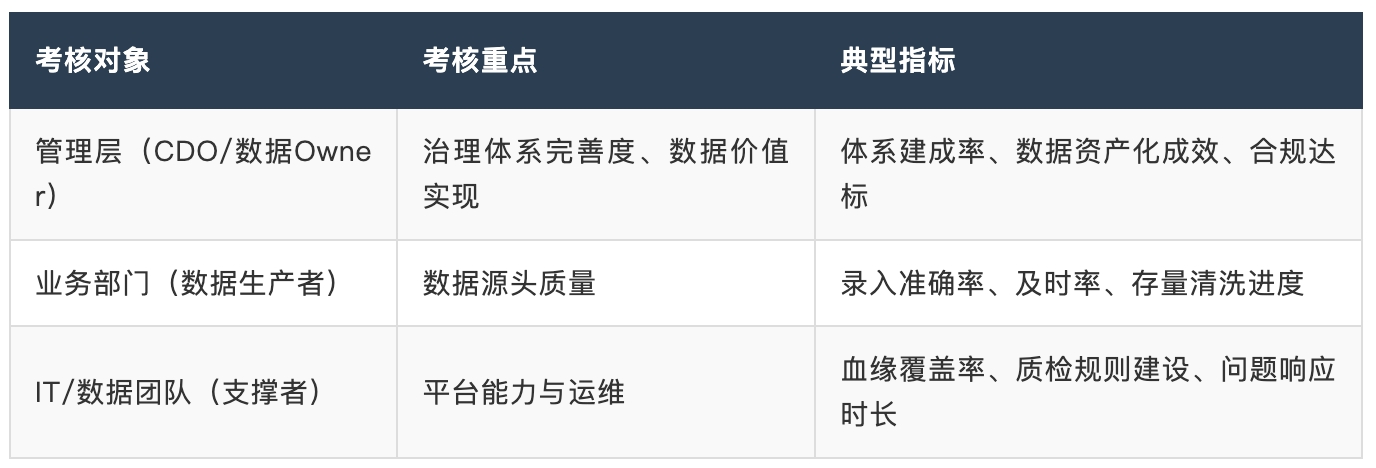
Data is generated by the business side, so the source quality must be the responsibility of the business side; tools are built by the IT department, so the supporting capability is the responsibility of the IT department. Whoever owns the responsibility field shall deliver the grain.
Design 2: Dual-track System of Point Deduction and Extra Point Award
The assessment design of a certain power enterprise is worth referencing: the number of data quality problems and their impact scope are point deduction items (weight 60 points), while "1 extra point will be awarded for solving one problem within the specified time" is the extra point item (weight 35 points). This means it is not a sin to find problems, but a sin to hide problems; you will get rewarded in assessment if you take the initiative to solve problems.
The brilliance of this design lies in changing the game structure: in the past, hiding problems was the optimal strategy, but now timely repair becomes the optimal strategy. Organizational behaviors follow the direction of the assessment baton, which is the power of mechanism design.
Design 3: Indicators Shall Be SMART, Not Empty Slogans
"Improve data quality" is not an indicator, it is just a wish. The SMART principle also applies to data governance assessment:
Specific: Do not say "improve data quality", say "the completeness rate of the customer address field ≥ 95%"; Measurable: Automatically collected through the quality monitoring platform, no need for manual filling; Achievable: The initial target is realistic, and the difficulty is increased gradually; Relevant: E-commerce enterprises focus on assessing order consistency, manufacturing enterprises focus on master data accuracy; Time-bound: Clarify quarterly or annual improvement nodes.
In addition, it should be emphasized that indicator data shall be automatically captured from systems as much as possible — data is taken from the data middle platform, quality probes, and work order systems. Assessment data filled manually is inherently inaccurate with inflated figures.
IV. How to Use Assessment Results: Four Essentials for Assessment Implementation
What to do after the assessment is completed is the full meaning of "implementation". The four essentials are all indispensable:
Essential 1: Link to Performance, Deliver Real Monetary Benefits
Assessment results must be directly linked to departmental budgets, individual performance bonuses, and cadre promotion. The case of the bank mentioned at the beginning delivered results in three months, exactly because the accuracy rate of the tellers directly determines their performance salary. For the same assessment, linking it to monetary benefits and hanging it on the wall lead to two completely different outcomes.
Essential 2: Red and Yellow Card Accountability, Draw a Clear Bottom Line
There shall be a clear red and yellow card mechanism for behaviors such as data fraud, concealing major quality problems, and delaying rectification. The practice of a manufacturing enterprise is: initiate a governance audit for departments that fail to meet the standards for two consecutive quarters. Accountability is not the goal, but assessment without the support of accountability is equivalent to a game without referees.
Essential 3: Monthly Quality Review Meeting, Form a Closed Loop
Led by the special governance team, organize all departments to conduct reviews every month: notify the processing results of quality problems, share excellent cases (such as the practical method of 100% data accuracy at a certain outlet), and jointly discuss solutions for common problems. Form a cycle of "identify problems — solve problems — summarize and optimize" at the mechanism level. Assessment provides pressure, while the review meeting provides methods. If there is only pressure without methods, the pressure will turn into resentment.
Essential 4: Positive Incentives, Make People Willing to Participate
In addition to point deductions, we should also give people tangible benefits. Set up special incentives such as "Data Quality Model" and "Data Governance Innovation Award"; a central SOE has a more mature point system practice: build a data responsibility matrix for more than 2000 core fields, cooperate with point-based assessment, the compliance rate rises from 58% to 92%, saving about 20 million yuan in costs a year. Employees who put forward effective optimization suggestions can redeem training resources and be included in the promotion evaluation — only when people participating in governance gain a sense of achievement, can data governance win popularity.
V. Three Reminders to Avoid Pitfalls
Finally, here are three high-frequency pitfalls to remind you in advance:
1. Prioritize technical indicators while ignoring business value: Only assess how many pieces of data have been cleaned, how many rules have been launched, without assessing business perception. Improvement: include "report error rate" and "data demand response timeliness" in the weight, let business departments vote for the governance effect.
2. Assessment is disconnected from strategy: Equate data governance assessment with the launch progress of the IT system. System launch is only the starting point, the goal is whether the data can support decision-making. Improvement: deduce assessment targets from the enterprise's data strategy, instead of pushing forward from the IT project plan.
3. Excessive and excessive indicators: Launch dozens of indicators at the very beginning, carry out weekly ranking and monthly notification. With too many indicators, the organization can only rush to deal with them, and finally end up with "data meets the standard, but governance fails". Improvement: focus on 8 to 10 core indicators in the first phase, and expand after one cycle runs smoothly.
Final Note
Go back to the two cases at the beginning. They are both assessment, why are the outcomes completely different?
Because the essence of assessment is never scoring work, but reshaping the attention allocation of the organization. What you assess is what the organization will attach importance to; how you honor the results is how the organization will act. Assessment hung on the wall only brings you 90-point reports and data quality that never improves; assessment linked to performance brings you real improvement from 88% to 99.2% in three months.
The most difficult last mile of data governance is never technology, but to make everyone who produces, uses and manages data take responsibility for data quality. And assessment is the rivet that turns this "responsibility" from a moral appeal into a mechanism constraint.
Three takeaways:
First, indicators are divided into three tiers: the process tier checks whether the work is completed, the quality tier checks whether the data is improved, and the value tier checks whether the business side recognizes the results.
Second, three principles for design: conduct stratified and classified assessment, implement dual-track system of point deduction and extra point award, make indicators SMART and automatically collected by systems.
Third, four essentials for implementation: link to performance, implement red and yellow card accountability, hold monthly review meetings, provide positive incentives — missing any one essential, the assessment will idle one more point.
This article is from the WeChat official account "Data Driven Intelligence" (ID: Data_0101), written by Wang Jianfeng, authorized for release by 36Kr.