The logic behind MNCs' 10-billion-yuan mega mergers and acquisitions has changed.
In 2026, the popularity of ten-billion-level M&A in the global pharmaceutical sector has returned to a high level:
In June, AbbVie acquired Apogee for US$10.9 billion, GSK spent US$10.6 billion to acquire Nuvalent, and in July, Vertex spent another US$10 billion to acquire Crinetics. In just two months, three heavy all-cash transactions were completed. Combined with the ten-billion-level acquisitions of Sun Pharmaceutical and Merck KGaA in Germany in the first half of the year, the number of US$10-billion-level M&A deals in the first eight months of this year has exceeded that of the whole of last year, and the rhythm of large-scale acquisitions by industry giants has accelerated.
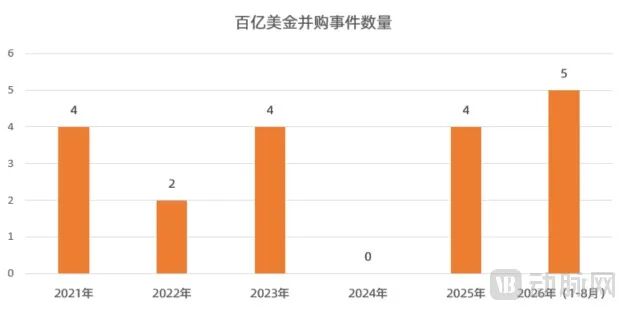
Changes in the number of US$10-billion-level M&A deals in the global pharmaceutical sector from 2021 to 2026 (collated by VCBeat)
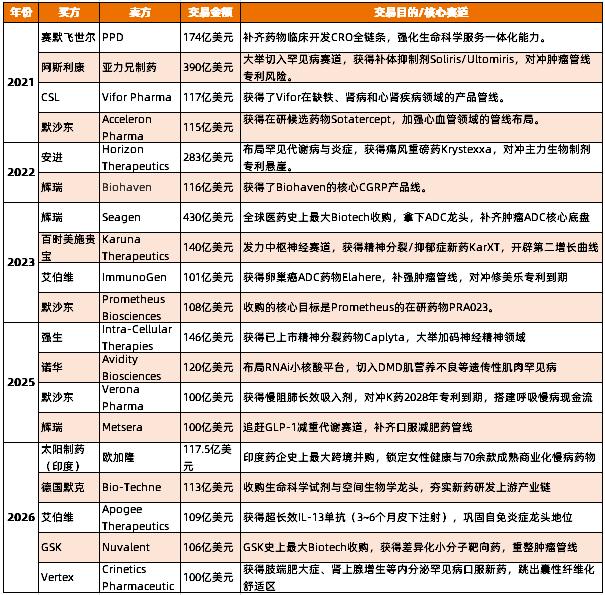
Global US$10-billion-level M&A deals in the pharmaceutical sector from 2021 to 2026 (collated by VCBeat)
Different from acquisitions of US$100 million to US$1 billion that only serve to supplement product pipelines, and mid-sized transactions of US$1 billion to US$10 billion that optimize a single business segment, M&A deals worth over US$10 billion per transaction have the power to reshape the industrial landscape. This type of chassis-reconstructing transaction is enough to rewrite the pipeline layout, revenue structure and market capitalization ceiling of MNCs in the next 5 to 10 years, and it is also the most important industrial vane to observe the global new drug R&D and M&A trends. Therefore, sorting out the ten-billion-level M&A behaviors in recent years can clearly capture the strategic changes of industry giants.
The market generally believes that this wave of large-scale acquisitions stems from the fact that MNCs hold sufficient cash flow and are eager to hedge the patent cliff that will come in a concentrated manner in the future. However, if we deeply dissect this series of transaction targets, it is not difficult to find that the industry's M&A evaluation criteria have undergone structural changes.
Six years ago, multinational pharmaceutical companies were willing to spend tens of billions of dollars on a mature commercial blockbuster drug; today, pharmaceutical companies that only rely on a single star pipeline can hardly get sky-high quotes, and "mature products as the foundation + iterable technology platform" has become the hard standard for ten-billion-level M&A. From "betting on a single hit product" to "buying a set of R&D engines that continuously produce drugs", the underlying logic of MNC M&A has been completely switched.
01 From buying single product bombs to dual anchoring of "product + platform"
From 2021 to 2023, the single-product M&A strategy was dominant. The core demand of most ten-billion-level transactions was very straightforward: to acquire 1-2 blockbuster drugs that have been launched or are close to application, quickly hedge the revenue gap caused by the expiration of core patents, and the technology platform is only an additional gift.
In July 2021, AstraZeneca acquired Alexion for US$39 billion, and the core payment target was two mature blockbuster drugs Soliris and Ultomiris in the complement field; in December 2022, Amgen acquired Horizon Therapeutics for US$28.3 billion, valuing the gout-specific drug Krystexxa; in March 2023, Pfizer acquired Seagen for US$43 billion, and the value anchors were two commercialized ADC products Padcev and Tivdak as well as their technology platform.
At this stage, the core tool for pharmaceutical companies to evaluate acquisition targets is DCF cash flow calculation, and the M&A value revolves around the peak sales of core single products. Even if the iterative capability of the enterprise's underlying R&D platform is weak, as long as the commercial potential of the single product is sufficient, it can support a valuation of tens of billions of dollars.
However, successive clinical failure cases have sounded the alarm for industry giants.
Gilead acquired Immunomedics in 2020, almost paying for the single ADC product Trodelvy. As Gilead announced the failure of the Phase III breast cancer clinical trial of Trodelvy, the US$21 billion acquisition target "shrank significantly".
Pfizer acquired Seagen for US$43 billion in 2023, with the core anchor being two already-launched ADCs (Padcev, Tivdak); at the same time, it pinned its hopes on the new generation of ADCs in the pipeline. Sigvotatug vedotin is the first new self-developed ADC to read out the key Phase III results after the acquisition, used for the treatment of non-small cell lung cancer. The Phase III clinical trial of this product did not meet the target, and the clinical trial failed.
In addition, clinical failure cases in the small nucleic acid field have also occurred intensively recently. AstraZeneca's Phase III clinical trial of ATTR cardiomyopathy ASO did not reach the primary endpoint, and patients had no clinical benefit; Roche's two Huntington's disease ASO drugs tominersen and RG6496 projects were terminated.
Candidate small nucleic acid and ADC drugs only meet the standards at the biomarker level, but fail to achieve patient benefit after entering Phase III clinical trials. These events further confirm the risk of betting on a single product.
The market has seen the fatal shortcoming of the single-product model: if an enterprise only has a single core pipeline, once the later-stage clinical trial fails, the value of the entire M&A deal worth billions or even tens of billions of dollars will shrink significantly, and the enterprise has no alternative pipeline to hedge the loss. In this context, MNCs began to change their M&A criteria.
Multiple ten-billion-level M&A deals completed since 2025 have formed a unified screening logic: mid-to-late stage pipelines are responsible for underpinning short-term performance, and reusable technology platforms undertake long-term innovation output.
In October 2025, Novartis acquired Avidity for US$12 billion: relying on the DMD small nucleic acid pipeline to realize short-term value, and at the same time locking in the long-term expansion potential of the muscle-targeted delivery technology AOC platform; in June 2026, GSK acquired Nuvalent for US$10.6 billion: taking differentiated small molecules as the short-term pipeline foundation, and targeting the precise targeted small molecule R&D platform.
Also in June 2026, Merck KGaA acquired Bio-Techne for US$11.3 billion. What was acquired was not a drug pipeline, but the upstream of scientific research reagents and CGT raw materials, which is used to smooth the cyclical fluctuation of the pharmaceutical business and strengthen the chassis of the entire R&D industry chain.
Mature commercial asset platforms have also become the target of ten-billion-level acquisitions: in April 2026, Sun Pharmaceutical acquired Organon for US$11.75 billion, not valuing the cutting-edge innovative pipelines, but a complete mature product portfolio of chronic diseases in women's health and the global commercial network, pursuing stable cash flow rather than blockbuster new drugs.
It can be seen that today's US$10-billion-level M&A market has not completely abandoned blockbuster drugs, but eliminated targets that "only have single products and no iterative capability". For MNCs, the ideal acquisition target should not only be profitable at present, but also have the underlying capability to continuously produce new drugs.
02 Premium logic reconstruction: three practical pressures that make MNCs willing to pay for platforms
An investor deeply rooted in the pharmaceutical field told VCBeat that MNCs' heavy bet on platforms is not a short-term trend-chasing hype, but a rational choice made after weighing risks and long-term benefits after the industry has experienced multiple rounds of clinical failures, intensified track involution, and iteration of capital market valuation logic. Multiple practical pressures superimpose to jointly promote giants to pay high M&A premiums for platforms.
1) The R&D risk of single molecule has risen sharply, and the platform can disperse the cost of trial and error
The clinical failures that have concentratedly broken out in the past two years have reshaped giants' perception of the risk of innovative drugs. No matter in the small nucleic acid or ADC track, the down-regulation of target proteins and high expression of tumor targets do not mean that the hard endpoints of patients can be improved.
If only a single molecule is acquired, the enterprise will have no second alternative route after the clinical failure; a mature technology platform can quickly iterate the molecular structure, delivery system, linker and payload. If one pipeline fails, the new generation of improved molecules can take over and push forward, greatly dispersing the R&D uncertainty.
At the same time, the GLP-1 and ADC tracks have severe pipeline involution, and it is difficult for homogeneous me-too drugs to produce monopolistic blockbusters, making it much more difficult to break through relying on single products.
2) The self-construction cycle of cutting-edge technologies is very long, and acquiring platforms is the optimal time solution
Cutting-edge technologies such as protein degradation, tissue-specific nucleic acid delivery, and ultra-long-acting peptides have extremely high technical barriers. If MNCs build a complete R&D platform from scratch, they need to invest years of R&D cycles and tens of billions of dollars in trial and error costs, and the success rate is difficult to guarantee.
Directly acquiring a clinically verified mature platform can make up for the long-term missing technical shortcomings in one step, quickly enter low-involution blue ocean tracks such as autoimmunity, rare diseases, and neurology, and save a lot of R&D time.
3) Pharmaceutical companies' strategic demands have escalated: from short-term emergency response to long-term pipeline reserve
From 2028 to 2031, many global blockbuster drugs with annual sales of ten billion levels will face patent expiration in a concentrated manner, and all major MNCs have huge revenue gaps.
Five years ago, the idea of giants was to acquire mature single products to quickly make up for the performance gap of 2-3 years. Today, the capital market evaluates the value of pharmaceutical companies, and pays more attention to the thickness of long-term pipelines. A single drug can only alleviate the short-term crisis, and a technology platform with continuous output capability can continuously output differentiated candidate molecules, extending the overall innovation life cycle of the enterprise.
03 Platforms are not universal antidotes: multiple practical dilemmas hidden behind ten-billion-level acquisitions
MNCs' heavy acquisition of platforms has become a new trend in the industry, but this does not mean that platform M&A is a master key to resolve performance anxiety, and multiple hidden risks continue to restrict the realization of M&A value.
The first is clinical falsification. The so-called "technology platform" may fail to adapt when it comes to human clinical trials. If the core molecule stops at Phase II/III clinical trials, what is bought for tens of billions of dollars is just a set of expensive "advanced laboratory tools", which is difficult to convert into commercial benefits.
The second is the risk of brain drain. What M&A buys are patents and pipelines, but what cannot be retained are people. The flexible trial-and-error atmosphere of Biotech collides with the bureaucratic process of MNCs. Once core scientists leave, no matter how cool the technology platform is, it will fall into "stagnation".
Moreover, MNCs have a fixed internal project priority and budget allocation system. After the acquisition is completed, a large number of early diversified pipelines of the platform will be directly shut down due to considerations such as resource concentration and cost control.
The R&D platform that originally had the capability of multi-target expansion is limited to serving a few designated tracks within the pharmaceutical company, and the advantages of diversified iteration completely disappear. Even if there is no defect in the underlying technology, the failure of organizational integration will also make the platform premium completely unfulfilled.
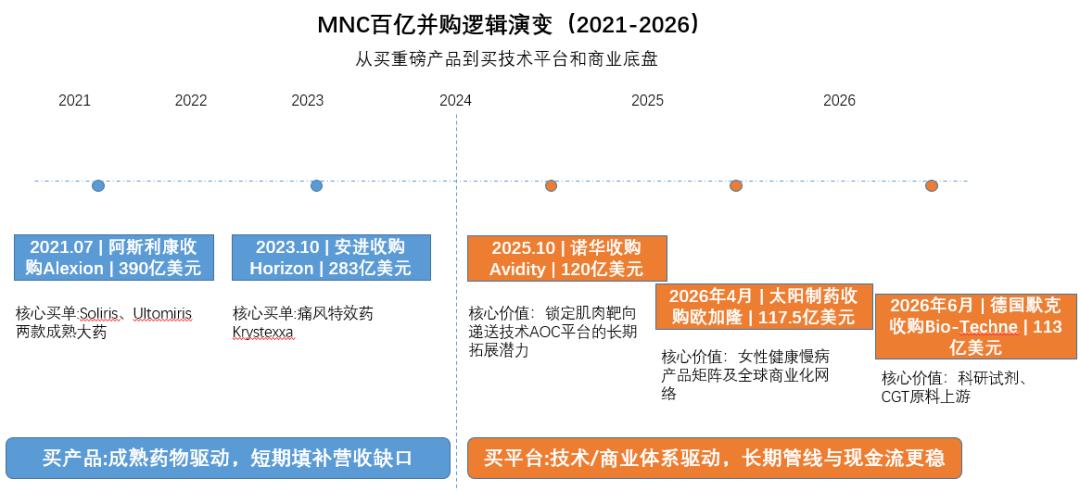
The difference between MNCs acquiring products and acquiring platforms (produced by VCBeat)
On the other hand, not all MNCs are frantically acquiring platform-based enterprises. The reality is the opposite, and the M&A strategies of giants have also shown obvious differentiation.
AbbVie and Merck & Co. continue to make ten-billion-level platform acquisitions; companies such as Biogen have publicly stated that they will abandon super-large acquisitions and choose to rely on internal R&D + small and medium-sized BD cooperation to supplement pipelines. It can be seen that acquiring platforms is only a strategic choice for some enterprises, and there is no unified standard answer.
The strategic shift of MNCs' ten-billion-level M&A boom is essentially the iterative upgrade of the pharmaceutical industry's perception of innovation risks.
The end of the single-product bomb model does not mean that mature commercial drugs lose their value; the core demand of MNCs shifting to acquiring platforms is to hedge the devastating risk of a single pipeline and build a long-term and stable innovation engine.
However, it is necessary to clearly realize that platforms can only disperse risks, not completely eliminate the uncertainty of new drug R&D. Whether a ten-billion-level M&A deal can truly realize value does not depend on the eye-catching technical concept at the time of the official announcement, but on whether after the acquisition is completed, core R&D talents can be retained, and differentiated new drugs with real clinical value can be continuously produced.
For local pharmaceutical companies, if they want to get the admission ticket for MNCs' ten-billion-level M&A, they must prove that they have "reusable technology platforms" and "blue ocean pipelines that have not been involuted" (such as small nucleic acids, CNS, etc.). At the same time, this wave of M&A also reminds us: while pursuing technological breakthroughs, how to maintain the organizational resilience of the core team and avoid being reduced to an "R&D outsourcing department" after being acquired will be a long-term proposition that founders must think about.
After all, for MNCs, buying the wrong platform is just a write-down on the financial report; but for the acquired party, selling itself at the wrong time may lose better development opportunities.
This article is from the WeChat official account "VCBeat" (ID: vcbeat), author: Wang Lutai, published with authorization from 36Kr.