Tactile perception enables world models to better comprehend physical laws, but also makes it more challenging for them to achieve generalizability.
Since the start of this year, new shifts have emerged in the tactile technology track.
At WRC, it is noticeable that many industry players no longer only highlight the superior hardware capabilities of their sensors, but have started to present their self-developed datasets, models and even evaluation benchmarks. Competition centered on tactile technology is expanding from a single sensor to the entire chain covering data collection, model training and capability assessment.
Behind this trend lies a paradox that is easily overlooked: tactile technology can make up for the shortcoming of pure vision models that can "see" objects but cannot perceive their physical properties, making the world model's "imagination" of the physical world more reliable. However, for the exact same contact, if you switch to another sensor or a different robotic hand, the feedback signals may be completely different. This is both the biggest value and the biggest pain point of tactile technology at the current stage: it enables models to understand the physical world better, but also easily locks the models to a specific set of hardware.
Tactile competition has extended from sensors to data and models
If we only look at shipment volume, tactile technology is still a hardware-driven business. But if we examine the investment and financing news as well as product updates since 2026, it is evolving into a business increasingly focused on data and models.
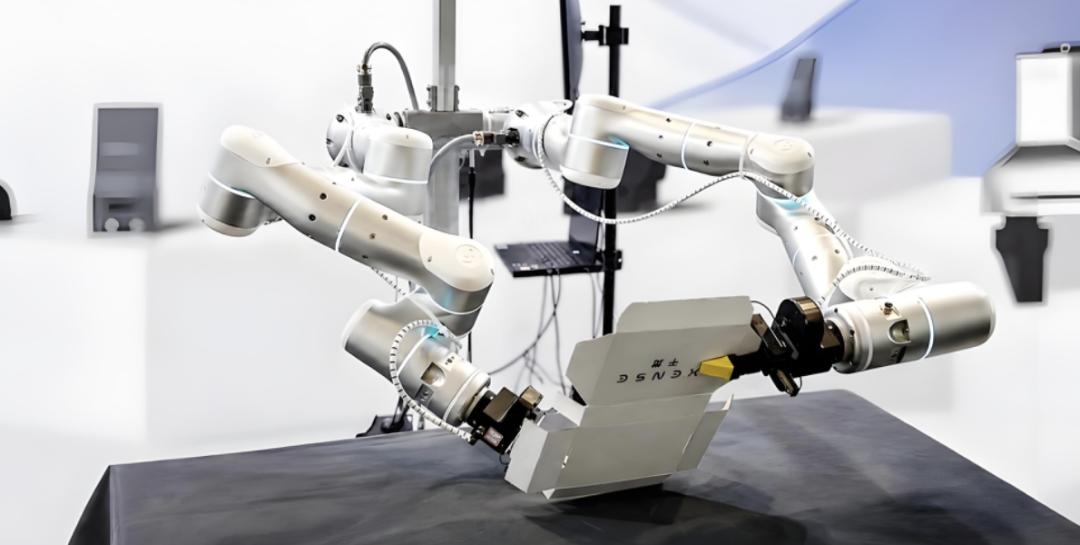
In July, Qianjue Robotics simultaneously launched a data acquisition gripper, the thousand-hour visual-tactile dataset TacVerse 1k, and the tactile model X-TouchMind V1. The three products correspond to a continuous technical chain: the acquisition device records the visuals, tactile signals and motions during operations, the dataset aggregates these records, and the model learns from them to figure out how to complete tasks.
Similar changes have taken place in other companies. In April, Daimon Robotics released Daimon-Infinity, a full-modality dataset with tactile data. According to its public information, the first batch of 10,000 hours of data has been open-sourced on Alibaba's ModelScope community. In June, it jointly launched RobOmni, a tactile operation evaluation benchmark, with Galaxy Universal Intelligence, and its 100-million-yuan Series A financing is explicitly earmarked for physical interaction data and physical world models. While Tashan Technology's monthly delivery of tactile sensors has reached tens of thousands of units, it has started to build a tactile training platform and proposed to develop "tactile-native models".
While enterprises are extending their business to the data and model end, the research community is also moving in the same direction. At the tactile workshop of the RSS 2026 conference, researchers from leading enterprises and academic institutions agreed that in the past, many robotics papers used to briefly mention tactile technology as part of "future work", but now it is being brought back to the core design links of robotics foundation models. OmniVTA, jointly proposed by institutions including the National University of Singapore and Fudan University, as well as TouchWorld launched by the team from Harbin Institute of Technology, both include tactile technology into the scope of "predicting what will happen next", which is exactly the core task of world models.
Of course, the public achievements on the model side are currently limited to preprint papers, exhibition demos and technical verification, with very limited commercial revenue and long-term production deployment. But the trend is clear enough: tactile technology enterprises are no longer only competing for the hardware positions on robots, but also vying for the right to define how tactile data is collected, represented and integrated into models. When the underlying standards have not yet converged, it has become a relatively common engineering approach for enterprises to master sensors, calibration, data acquisition and models at the same time, build a set of operable internal closed loops, and minimize the adaptation cost between all links.
From videos to interactions, the definition of "data shortage" has been redefined
Admittedly, this is not a brand-new concept. Back in 2019, the paper Manipulation by Feel published by the University of California, Berkeley and the Facebook AI team had used tactile prediction models to control robot operations. The recent change is that tactile technology has started to enter the world model system that processes vision and motion on a larger scale.
The tactile prediction capability is exactly where pure vision world models are most likely to show their shortcomings. The paper Visuo-Tactile World Models published by the University of Washington and the Meta FAIR team in February this year points out that pure vision world models often generate images that violate physical laws out of thin air when objects are occluded or the contact status is ambiguous. After adding tactile data, the model's performance in understanding object permanence improved by 33%, the proportion of outputs that conform to motion laws increased by 29%, and the zero-shot task success rate on real robots increased by up to 35%.
The N₀-TWAM model released by the New Embodied Intelligence team and Fudan University in July achieved an average success rate of 84.5% on the public UniVTAC simulation benchmark, higher than the 48.0% of FastWAM, the best-performing pure vision world action model in the same experiment. Ablation experiments show that removing the prediction of future tactile signals or the current tactile input will lead to a significant drop in the success rate.
All these results indicate that tactile technology can indeed make the world model's "imagination" closer to the real physical world. But a more tricky problem has also emerged.
In June this year, the T-Rex paper jointly published by teams from Stanford, UC Berkeley and NVIDIA (authors include Li Feifei, Jim Fan and others) gave a direct counterexample: after directly splicing tactile signals into a pre-trained VLA model, the average success rate dropped from 17% to 6%; the success rate rose to 65% only after adopting an independent high-frequency tactile expert, temporal coding and a dedicated training process. The authors identified the frequency difference, synchronization method and representation approach between tactile and vision as key challenges. At the RSS 2026 workshop, Stanford University professor Mark Cutkosky also corroborated this point, comparing the temporal structure of tactile signals to sound rather than static images, and noting that the industry has not yet developed a standard process dedicated to processing such high-frequency, multi-rate signals.
This is the unavoidable core challenge after tactile technology is integrated into world models: what the model learns is either transferable laws such as "how the friction force changes when an object slips", or hardware-bound rules such as "how the voltage of this specific sensor jumps when slipping". If it is the latter, after switching to another sensor, a different dexterous hand or a new control system, the "tactile experience" accumulated by the model may have to be learned from scratch.
From demo to deployment, models start to calculate economic costs
The reason why a virtuous cycle between models and data was formed in the vision field in the early stage largely lies in the existence of relatively standardized hardware bases such as cameras. However, general solutions have not yet taken shape for tactile hardware itself: technologies including capacitive, piezoresistive, Hall effect and visual-tactile routes do not record the same type of signals. For the same grasping action, some sensors output pressure values, some measure forces in different directions, and others record the deformation images of the contact surface.
Similar discussions took place at the RSS 2026 workshop, where experts stated frankly that the tactile industry still lacks a similar hardware specification. The coexistence of too many competing sensor solutions has long kept the entire industry fragmented. Tashan Technology summarizes this as the "difficulty of cross-device migration for tactile data"; New Embodied Intelligence gives it a more vivid name: the "dialect problem" of tactile technology.
Some people are trying to build a "translator" for different tactile hardware. FTP-1, jointly proposed by 8 institutions including Tsinghua University, UC Berkeley and Sharpa, is a tactile foundation strategy trained across sensors. It does not forcibly mix the raw signals from different sensors, but uses different encoders to process inputs such as images, arrays and force states first, then puts the encoded results into a unified tactile representation space according to the source position of these signals (whether from the fingertip, palm or wrist), for the same tactile expert and motion strategy to use.
FTP-1 was pre-trained by aggregating 26 data sources, 21 types of sensors and about 3000 hours of tactile operation data. On two sets of sensor configurations that had never been seen during the training phase, the researchers retrained the corresponding sensor encoders and used 50 or 100 demonstrations for each task respectively for fine-tuning. Finally, FTP-1 achieved an average success rate of 46.6% in three tasks, higher than the 15.0% of the baseline model in the same experiment.
But FTP-1 is not the ultimate answer for general tactile technology. When connecting a new sensor, it still needs to train the corresponding encoder from scratch; 50 or 100 demonstration data are still used respectively for the three new tasks instead of direct migration; the experiment only covers two new configurations and three tasks. It proves that part of the tactile experience can be migrated across hardware, but it is far from translating all sensors into the same type of directly interchangeable "tactile perception".
For world models, this means that tactile data cannot be directly merged into the same training pool for the time being. As a result, the scale of data cannot be measured only by the number of hours: if the data from different sensors cannot be trained together, even a very large dataset may only expand the experience of one specific set of software and hardware systems, instead of expanding the world model's understanding of physical laws synchronously.
For tactile technology enterprises, this will determine whether the system they build after upward extension is a software and hardware system running around their own products, or a data infrastructure that can connect more sensors, robots and models. The former is more conducive to the rapid implementation of specific products and the formation of commercial barriers, while the latter is more in line with the long-term vision of world models to expand across hardware and across agents.
We can expect that under the current hardware and data conditions as well as commercialization requirements, the "full-stack faction" that can form a self-owned usable system will be more likely to achieve landing results in the coming period. After all, what customers need at present is a workable solution, rather than exploring the technical vision of "general tactile technology" together with the R&D team. Companies like Qianjue and Daimon that develop sensors, data and models at the same time, essentially trade the closed-loop system integration for faster commercial implementation.
In a longer time dimension, companies that only focus on full-stack development will probably be locked by the shipment ceiling of their own hardware. The player that can achieve a high valuation will be the one that can create the "ImageNet for tactile technology" or the "Transformer architecture for tactile technology", no matter it is a systematic industry-university-research achievement like FTP-1, or a company that is willing to open its data interface.
Tactile technology will enable world models to stand the test of real physical contact, but also add some twists to the originally seemingly straightforward scaling path of world models. The sign that tactile technology is truly integrated into general world models will not stop at the model's ability to generate a realistic tactile signal, but that the model does not need to re-learn the physical world for every new sensor.
This article is from the WeChat Official Account "Prior Lab", author: Vincent, authorized for release by 36Kr.