DeepSeek Harness rolls out three updates per week, enlists Claude Code and Codex as its sub-agents, and aims to become the "scheduling layer" in the Agent era.
DeepSeek has released another update, and this time the protagonist is not a new model.
Late at night on August 19, DeepSeek Harness rolled out v0.1.0-rc.8 — only two days after RC.7. This Agent workbench, which was just open-sourced on August 13, gained over 30,000 GitHub Stars on its first day, topped Hacker News, and set a record for the fastest project ever to hit 20,000 Stars in history.
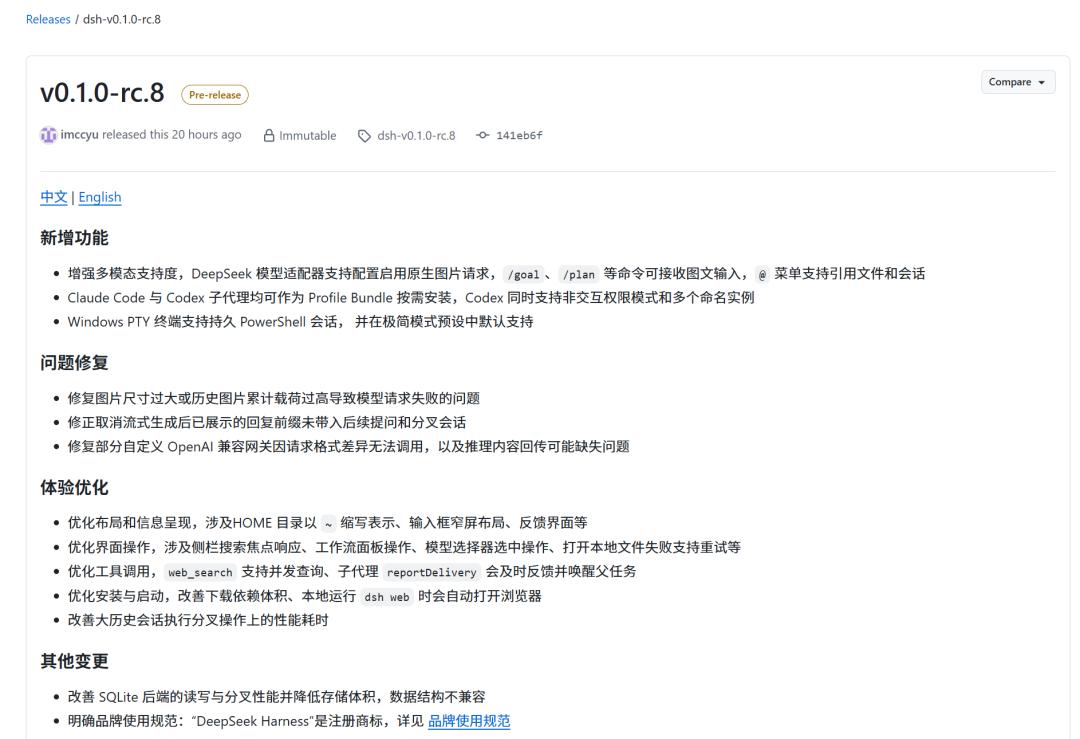
The most noteworthy part of this new version is not the multimodal capability, but this: Claude Code and Codex can now be integrated as sub-agents to be scheduled within DeepSeek Harness.
Turning competitors' products into your own components is a move worth breaking down in detail.
DeepSeek Harness releases RC.8: native image recognition support, Claude Code and Codex as sub-agents, concurrent web_search queries. Just one week after its open-source launch, this Agent runtime that follows the "everything is a plugin" design is occupying the scheduling layer of the Agent era.
What Exactly Is Harness
First, let's add some background for readers who haven't followed the latest updates.
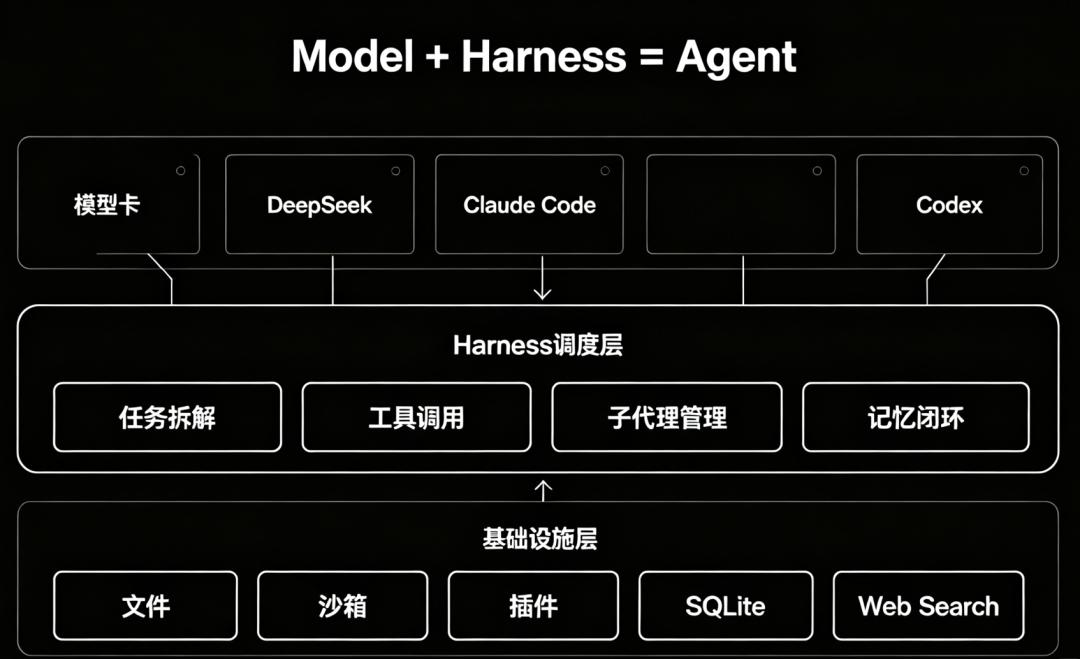
The literal meaning of Harness refers to the outer engineering shell wrapped around the model, which is responsible for reading files, invoking tools, managing context, and executing commands. DeepSeek put it very straightforwardly in its official formula: Model + Harness = Agent. The model is in charge of thinking, while Harness handles all the engineering work beyond the model: task decomposition, tool calling, memory management, error retry, and result closure.
Late at night on August 13, DeepSeek dropped three consecutive updates within two hours: the official release of V4 Pro, the announcement of API price hikes, and then the developer preview version of Harness v0.1, open-sourced under the MIT license.
The most disruptive design in its architecture is "everything is a plugin": models, tools, skills, sessions, sandboxes, storage, scheduling, UI, and even the main Agent loop itself are all plugins that can be fully replaced. At its core is the Cordis microkernel — DeepSeek copied the entire source code into its own repository and modified 18 places. The startup list is only 129 lines long, the format of the main Agent loop is exactly the same as that of the timer plugin, no component is hardcoded and non-modifiable.
There is another detail worth noting: from the first commit on June 10 to the public release on August 13, the project received 12,293 commits in 64 days, with 683 design notes attached, and even the 11 rejected solutions are all publicly available in the repository.
What's New in RC.8
This update includes a total of 14 items, which can be broken down into four main lines.
The first line is native image support. The DeepSeek model adapter can directly enable native image requests, core commands such as /goal and /plan support mixed text and image input, and the @ menu adds references to files and historical sessions. Previously, if you wanted the Agent to solve interface-related problems, you had to first transcribe the buttons, error messages, and layout relationships in the screenshot into text; now you can directly throw the screenshot into the system.
What's more interesting is the fallback solution dug up by the community: for models that do not support image input, Harness will call tools such as OCR, color statistics, and pixel scanning to decompose the image into structured information and then feed it to the text model — which is equivalent to using tool orchestration to assemble a "homemade vision system" for pure text models.
The second line is the integration of sub-agents. Claude Code and Codex can be installed on demand as Profile Bundles, acting as executors for specific tasks in the Harness workflow. Codex also supports non-interactive permission mode and multiple named instances — you can run multiple Codex instances at the same time in one task to handle different jobs. The supporting reportDelivery mechanism will return results in time and wake up the waiting parent task, so multi-Agent collaboration no longer requires idle waiting.
This feature was actually laid out in RC.7: in the version released on August 17, the sub-agent tasks of Codex and Claude Code were first connected to the Job Panel for unified management; RC.8 takes it a step further by packaging the two as ready-to-use plugin bundles.
The third line is the acceleration of the toolchain. web_search now supports concurrent queries to initiate multiple problems in parallel; the Windows PTY terminal adds persistent PowerShell sessions, and the minimalist mode is enabled by default; the performance of large historical session forking and the read and write performance of the SQLite backend have also been optimized.
The fourth line is the start of brand specification building. "DeepSeek Harness" has been registered as a trademark, and an independent brand usage guide has been released. Open-source as it is, the brand is fully controlled by the team itself — this action is essentially preparing for its ecological niche.
Note one pitfall: the new version has incompatible changes to the SQLite data structure. If you have stored a large amount of local Harness data, you need to think carefully before upgrading.
Why Is The Scheduling Layer A Must-Win For All Players
Models can be replaced, Agents that execute tasks can be replaced, but the working environment layer that organizes models, schedules Agents, manages tasks and tools is very difficult to migrate once users get used to it. This is exactly the position DeepSeek is targeting.
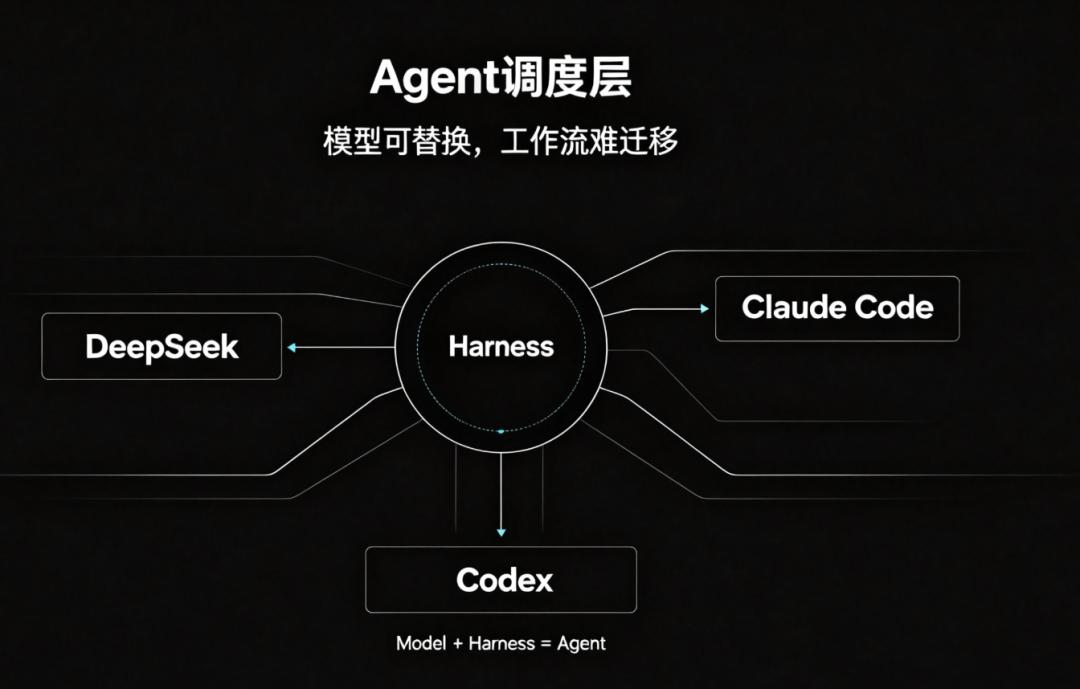
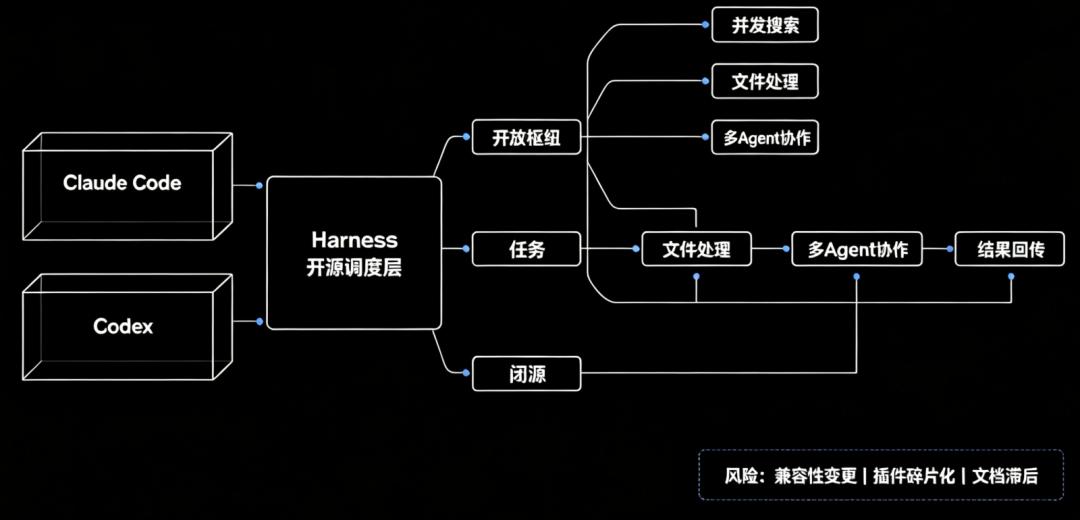
Comparing with competing products can easily show the difference: Claude Code is bound to Anthropic's models, Codex is bound to OpenAI's models, both are closed-source finished products; Harness is open-sourced under MIT license, supports arbitrary model replacement, and can be fully deployed offline. The pricing of V4-Flash at 2 yuan per million tokens has pushed the usage cost to the lowest level in the industry.
One content creator made an analogy: this is similar to Android's strategy — it does not manufacture mobile phones itself, but makes all manufacturers run on its own system. A reasonable deduction is that DeepSeek follows the "water seller" logic: if everyone uses its Harness to orchestrate workflows, it will never be out of the competition at the model layer. After all, the default routing still points to its own API, and it has adopted time-of-use pricing since August 17.
For Anthropic and OpenAI, this situation is a bit delicate: their own closed-source Agents are integrated into the open-source framework of their competitors to act as "workers", and they cannot stop this trend since the interfaces are public, but their ecological niche is indeed being eroded. By packaging the two as Profile Bundles in RC.8, DeepSeek has officially endorsed this kind of "integration".
Calm Down: It's Still v0.1
The part that pours cold water cannot be omitted.
The official document uses all caps to warn: there will be breaking changes that damage compatibility. Internal beta developers said frankly that the current experience of DSH is indeed not as perfect as Claude Code and Codex; for a repository that receives hundreds of commits every day, it is inevitable that the documentation lags behind. There is also an unflattering detail: after running, the local machine will generate a UUID that is sent with each request, and the telemetry switch does not affect this behavior.
In addition, the "everything is a plugin" design is a double-edged sword. A reasonable deduction is that if a large number of developers freely customize Agents based on Harness, compatibility issues between plugins will inevitably arise sooner or later, and ecological fragmentation is an inherent risk of this development route.
Conclusion
There is a highly upvoted comment under the main Hacker News post worth quoting here: "This time it looks pretty original." A company that has long been accused of making shell products has been recognized as original for the first time in that community — not by launching a new model, but by an open-source Harness.
From open-sourcing models to open-sourcing frameworks, DeepSeek's product portfolio is getting more and more complete. If the two-day update rhythm of RC.8 can be maintained, the balance of the answer to the question "Which Harness should I use to run Claude Code, Codex and DeepSeek together" will tilt towards DeepSeek day by day.
The competition for the entry point of the Agent era has just begun.