Are big tech firms vying for top talents, but are they only targeting AI professionals now?
At what point will a person realize that they are being abandoned by the times?
It is not the day you receive a layoff notice, nor the moment you find your position has been merged.
It is when you open Maimai and find that the jobs you have been doing for many years are being rewritten by a completely unfamiliar logic — the competency framework has changed, the tool requirements have changed, and even the definition of talent has changed.
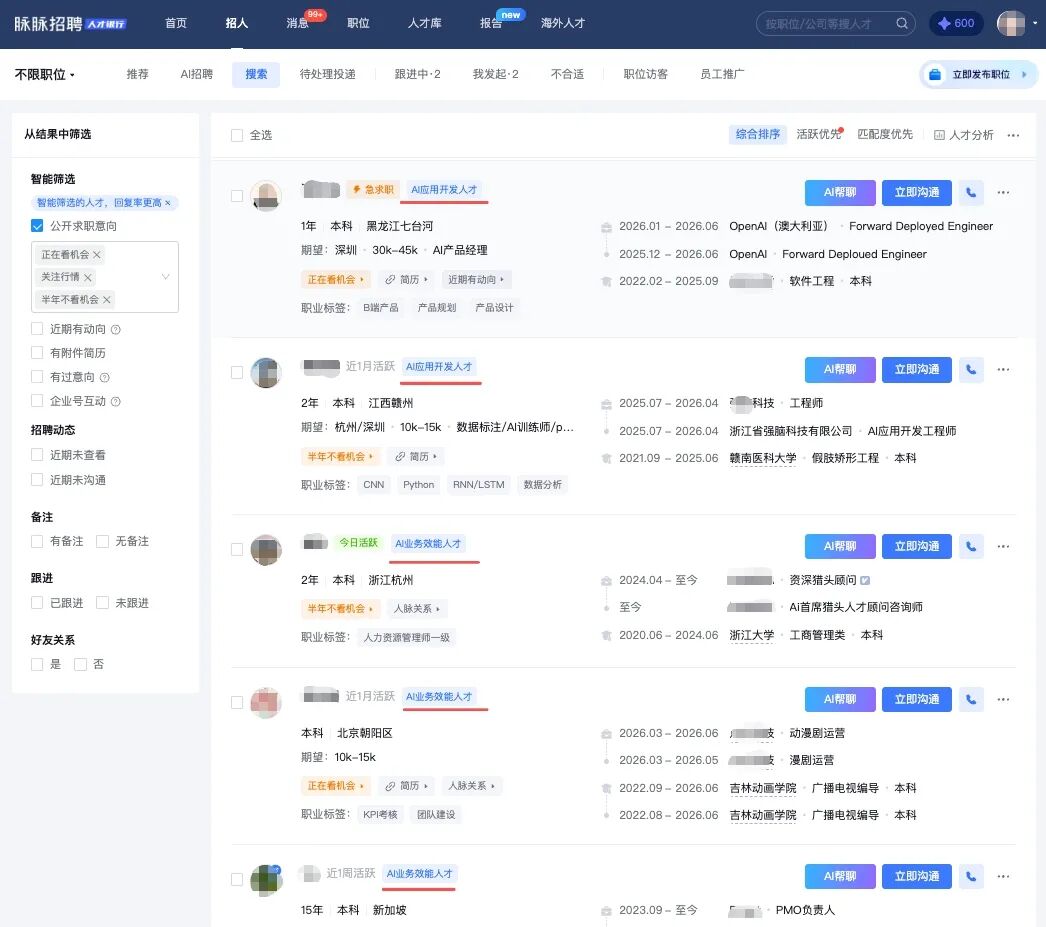
Meanwhile, a subtle but glaring change is taking place in Maimai's talent pool: a new label, "AI Talent", has begun to appear next to many people's names.
This label on Maimai is redividing the working population into two camps: AI talents and non-AI talents.
Campus Recruitment of Major Tech Firms: AI, AI, and More AI
Push the timeline back two years.
Back then, the autumn recruitment of the internet industry used to kick off at the fixed time node of "Golden September and Silver October". But since last year to this year, the autumn recruitment has been advanced to midsummer.
Baidu launched its campus recruitment in July, Alibaba and ByteDance opened their 2027 graduate recruitment channels in the first week of August, and the always low-key DeepSeek released a large-scale recruitment notice as early as June. ByteDance even set up a separate "early bird application channel" for AI product managers, through which candidates can get a direct offer in as fast as two days.
Looking at the recruitment lists of these major tech firms, you will find a suffocating trend:
Alibaba's current recruitment covers eight major job categories including algorithms, R&D, chips, and products, with AI-related positions accounting for 80%. Taotian Group is more resolute: almost all of its recruitment positions are AI-oriented, with AI technical positions accounting for more than 90%.
ByteDance's demand for technical and product positions accounts for more than 70%, and the demand for algorithm positions has increased compared with last year, with new positions such as full-stack AI engineer and AI Agent developer launched for the first time. Baidu offers more than 4,000 positions in its campus recruitment, of which AI-related positions account for over 90%.
There are also Maimai users posting that a well-known mid-sized internet company even requires candidates to provide 6 months of AI chat records for campus recruitment.
Tencent, Alibaba, Meituan, ByteDance... The recruitment page of every major tech firm is conveying the same signal:
AI, AI, and more AI.
Maimai's "Label": The Wind Vane of Era Transition
While AI positions are expanding, another equally cruel hidden line is taking place at the same time: traditional positions are being squeezed.
In the first half of 2026, almost all well-known major tech firms have carried out personnel optimization to varying degrees, and positions with reduced recruitment or layoffs are concentrated in front-end development, testing, operation, marketing, and design.
Recruitment is ongoing for some positions while layoffs are happening for others. A picture of a talent "scissors gap" is taking shape.
And the subtle actions of recruitment platforms are often the wind vane of era transition.
As a recruitment platform for high-end talents, Maimai's move to mark "AI Talent" as a separate category shows that enterprises' preference for AI talents has lasted for a long time.
So who exactly are the AI talents that enterprises want to recruit?
Maimai's recruitment background defines three types of labels:
AI Infrastructure Talent: Engaged in Pre-train / Post-train / RL / inference optimization / Agent underlying development, active in the scientific research circle, top open source and competition circles.
AI Application Development Talent: Use Agent / Workflow / RAG / tool calling to develop AI applications, active in the mixed circle of engineering and product.
AI Business Efficiency Talent: Proficient in using AI tools to deliver results in specific businesses, active in the intersection of business and AI.
These three labels are becoming the dividing line of opportunities.
Enterprises Are Also Being Rewritten by AI
If the changes in the recruitment market are the iceberg above the water, what is happening inside enterprises is the huge change under the water — more intuitive and more profound.
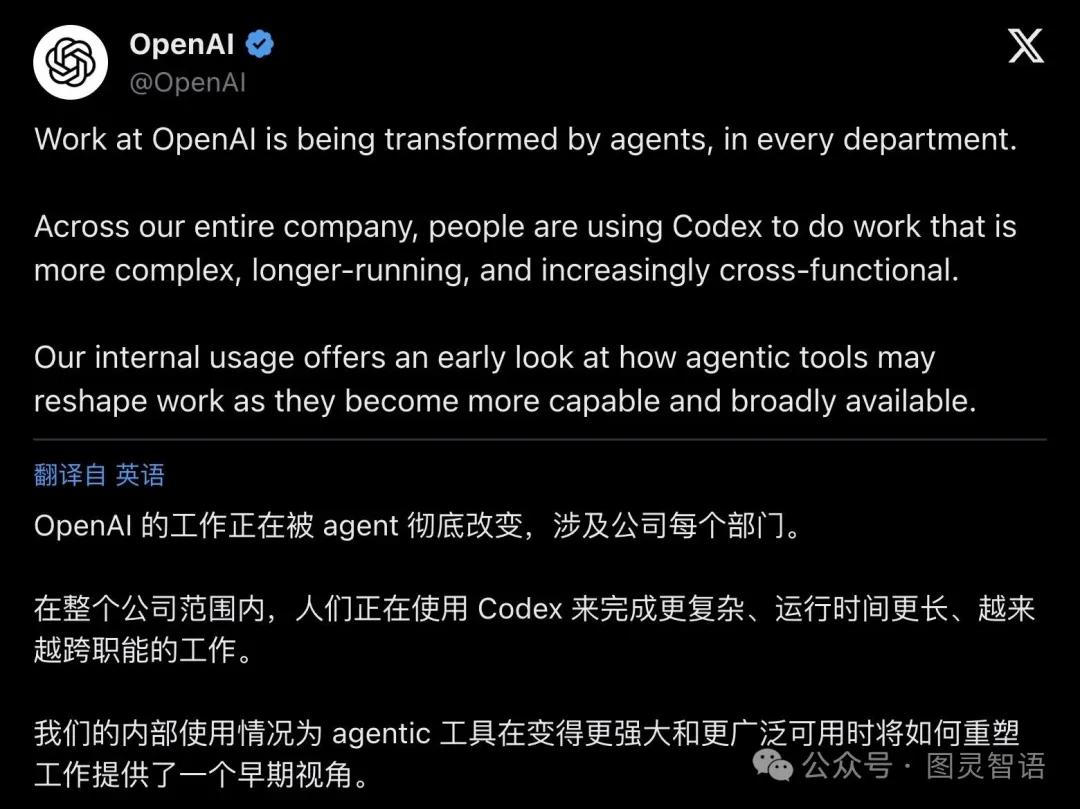
In August 2025, OpenAI engineers began to test Codex, but departments such as legal and finance hardly used it. By June 2026, 99.8% of the tokens output internally every week came from Codex, and 97.9% of employees were active users.
The legal team let AI take over the generation of first drafts for contract review and policy comparison, and lawyers only need to do the final review. The number of active non-developer users internally has increased by 12 times. More than 10% of users manage at least 3 or more concurrent agents every week.
This is no longer just "tool upgrading", but a fundamental change in the way of working.
AI Is the Best Leverage for Ordinary People to Overtake on a Curve
Everything that happened inside OpenAI is a microcosm of the entire workplace. A clear fact is emerging: the biggest difference in 2026 is the full penetration of Coding Agent into the workplace.
Facing the biggest variable in the life of our generation, what should ordinary people do?
According to the classification of AI talents, the first two types of AI talents have high technical thresholds and are out of reach for most people. But the path of AI business efficiency talent — as long as you can skillfully use AI tools to deliver results in specific businesses — is open to everyone.
Lin Fan, CEO of Maimai, put forward a "radical view": The real mastery of Coding Agent means letting it run tasks automatically for more than 1 hour. Evaluate yourself, can you do that?
"1 hour" means you hand over a complete task to the agent, letting it plan, execute, verify and iterate on its own.
This is exactly the fairest part of the AI era: it does not look at your background, age, education or resume, but only at whether you can master this tool to deliver results.
Whether you are 35 years old or a liberal arts student, those identity labels that once troubled you are losing their weight in front of AI capabilities. You can use AI to complete tasks that used to require a whole team, and cross the technical threshold to realize your own ideas.
AI is the leverage that allows you to get rid of old labels and overtake on a curve.
All you need to do is update the results you achieve with AI to your Maimai profile and personal resume, so that the algorithm can identify you and opportunities can find you.
Final Notes
When you are struggling with whether your background is good enough and whether it is too late to learn now, those who have already taken action are replacing you with AI.
When you are arguing about whether AI has consciousness, those who are using AI have already delivered results.
Labels will not disappear because of your anger, but will only change because of your choices.
Will you choose to become an AI talent, or choose to wait passively?
The answer lies with you.
And time waits for no one.
This article is from the WeChat Official Account "Internet Compass" (ID: hlwzhibei), written by Zhibei, and published with authorization from 36Kr.