A destiny-altering decision: How Zhipu AI, valued at 500 billion, "defies headwinds to rewrite its fate" | DeepKr
By | ZHOU Xinyu, ZHANG Yuxin
Edit | ZHANG Yuxin, YANG Xuan
Less than an hour after the release of GLM 5.3, a sales representative at Zhipu AI was flooded with calls and WeChat messages: dozens of inquiries about the API launch timeline, and many clients who learned lessons from Kimi K3 wanted to lock in Zhipu AI's inference computing power in advance. This situation lasted throughout the entire weekend.
On the afternoon of August 14, Zhipu AI suddenly released a new generation of models, which once again refreshed the coding performance of domestic models on evaluation leaderboards, tying for first place among open-source models with the recently released Kimi K3, and reaching the same level as closed-source flagship models such as Claude Fable 5 and GPT-5.6 Sol. This instantly ignited the enthusiasm of clients.
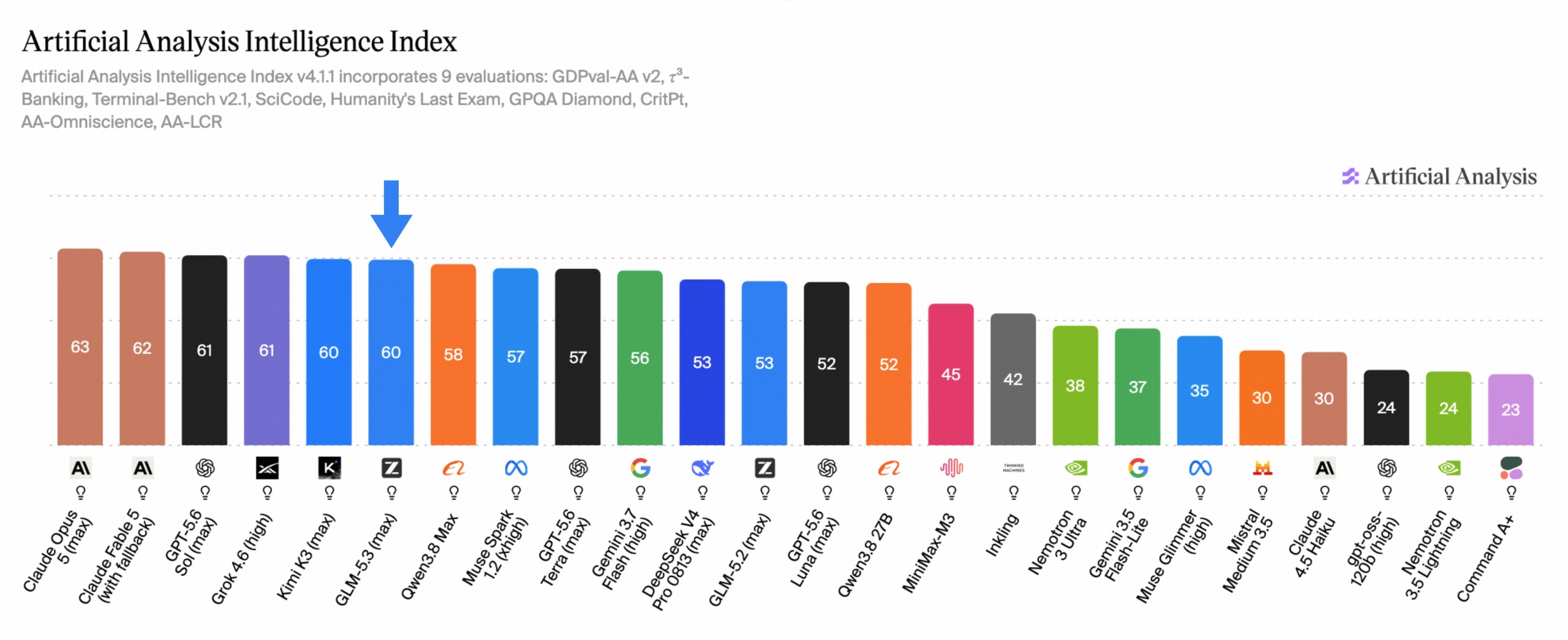
Artificial Analysis ranking chart. Source: Zhipu AI official WeChat public account
After the weekend, messages and calls did not stop — the GLM 5.3 API originally scheduled to launch on August 18 was postponed, and sales teams were once again "besieged" by clients. "Clients shouted at me over the phone: our internal budget, development and operation and maintenance teams are all in place, and every day of delay adds tens of thousands of yuan to our management costs!"
The aforementioned sales representative recalled that this kind of "API rush buying" roughly started in February 2026 — the time when Zhipu AI released the major version updated model GLM 5, which was praised by multiple foreign media at the time as "the first time to truly push Chinese open-source models to the vicinity of the world's cutting-edge models". After that, GLM 5.1 entered the world's first-tier model echelon, and GLM 5.2 obtained the SOTA (state-of-the-art) position among global open-source models. It can be said that every version has achieved significant improvement.
During this period, more and more people began to ask: what kind of company is Zhipu AI behind these models?
In fact, in the wave of large models that emerged in China starting in 2023, Zhipu AI was originally an existence that "did not fit the mainstream narrative".
It is not young enough — it was established back in 2019, which seemed not cool enough in an atmosphere that admired "young prodigies";
It is not "corporate enough" — it was almost entirely derived from Tsinghua University, with a distinct academic and laboratory temperament;
Its commercialization path did not seem attractive enough — it has long provided private model deployment for government and enterprise clients, which does not follow the internet logic of "replicable and scalable".
However, if you only started paying attention to this company in the past year, your perception of it will most likely be: the world's first large model stock, with a market capitalization that once peaked at HK$1.3 trillion, equivalent to several times that of Meituan; it owns an open-source SOTA model with a global reputation; its ARR (Annual Recurring Revenue) currently ranks first among Chinese model manufacturers...
The core of this major transformation lies in the coding capability of the model — when global large models were immersed in the coding carnival brought by Anthropic, Zhipu AI was the first large model company in China to obtain the coding admission ticket, relying on its sufficiently good coding models to achieve a surge in reputation and revenue, and to a certain extent, it has raised the competition intensity of domestic large language models in the past six months.
What did Zhipu AI do? Why was it Zhipu AI that took the lead in getting the coding admission ticket?
To answer these questions, we need to go back to May 2025, two months before "Zhipu AI bet on coding".
I. Fight to the Last Ditch and the Unexpected Coding Boom
In May 2025, Zhipu AI urgently held a strategic meeting. "Only core executives and a few shareholders participated, and one of the core topics was which direction Zhipu AI's next-generation models should move towards," an insider told 36Kr.
This topic almost determined Zhipu AI's subsequent fate at that point in time.
On the one hand, DeepSeek R1, which emerged out of nowhere during the 2025 Spring Festival, almost hung a knife over the main artery of Zhipu AI's commercialization. This model with performance comparable to OpenAI o1 but priced at only 1/30 of o1 impacted the entire B-end market at that time, and customized model deployment for the B-end was Zhipu AI's most important commercialization direction back then.
An employee of Zhipu AI in charge of commercial delivery told 36Kr that he did not have a good Spring Festival: "I received 5 or 6 client calls a day, but most of them were asking if we could deploy DeepSeek." He felt mixed emotions, "DeepSeek became known to the whole country overnight, and many clients' bosses instructed their teams to switch to DeepSeek." Another Zhipu AI employee told 36Kr, "Conservatively estimated, nearly 30% of Zhipu AI's clients flowed to DeepSeek at that time, which dealt a huge blow to the company." He mentioned that in order to retain clients, Zhipu AI offered very low discounts to some of them.
On the other hand, the domestic large model market was also quietly shifting. The popularity of chatbots faded, and at that time, other members of the "Six Little Tigers" such as Moonshot AI and MiniMax were betting on flagship models with outstanding capabilities in tool calling and complex task execution.
Facing the crisis and changes, Zhipu AI made a fate-twisting decision at this strategic meeting: to abandon the original route of building separate vertical models for capabilities such as text, multimodality and programming, and bet on large-parameter all-in-one models that integrate three types of data: Reasoning, Coding, and Agentic.
Zhipu AI realized that it must step out of its comfort zone to find new opportunities for the next stage, and new opportunities will only grow out of large models with sufficiently good performance that can solve more complex productivity demands.
This decision was not easy for Zhipu AI. "Many shareholders opposed continuing to scale up the model (i.e. increase model parameters) because the investment was too high," an insider told 36Kr. Zhipu AI has long been under considerable financial pressure — its 2025 financial report shows that Zhipu AI's net loss reached 4.718 billion yuan, of which R&D alone cost 3.182 billion yuan, 4 times its total revenue of the year.
Another reason is that the multi-data integrated model is inherently incompatible with Zhipu AI's B-end customized business model. A Zhipu AI B-end business insider told us that in order to match clients' specific business scenarios, Zhipu AI previously divided model capabilities into very clear vertical scenario categories — corresponding models and products for conversation, image generation, video generation, coding, etc. If one integrated model is used to match all scenarios, the deployment cost will become extremely high.
This "all-in-one" model was GLM 4.5, which launched in July 2025. "It was originally supposed to launch in April, but due to the temporary adjustment of the model direction, it was delayed until July," an insider told 36Kr.
This was Zhipu AI's fight to the last ditch. To train the "all-in-one" model, Zhipu AI prepared 15 trillion tokens of general data, as well as 8 trillion tokens of Coding, Reasoning and Agentic data, and the total training data volume was almost 1.5 times that of models in the same period.
Anxiety spread among almost everyone. Multiple Zhipu AI employees told 36Kr that in the months before the release of GLM 4.5, almost all algorithm engineers in the AI Institute (Zhipu AI's technology and R&D department) practically lived in the company. "On the day 4.5 was released, I got off work in the early morning, and when I came to work in the morning, the algorithm team was sitting neatly in their seats, almost exactly the same as when I left last night." Some marketing employees also stayed up all night until 8 a.m. on the release day, "We were so anxious that we had no idea what the market response to GLM 4.5 would be."
The subsequent story is well known to all: GLM 4.5 became Zhipu AI's first large model to gain a reputation in coding, and also made Zhipu AI one of the first large model companies in China to bet on the coding track. It truly helped Zhipu AI find new opportunities for the next competitive stage — coding.
In fact, many domestic large model companies noticed the signs of coding as early as June 2024 when Claude 3.5 Sonnet was released, but did not dare to enter the market.
Yan Junjie, the founder of MiniMax, asked DeepSeek founder Liang Wenfeng two years ago: "Do you want to do AI coding." Liang gave a negative answer. "At that time, everyone agreed that there might only be 1 to 2 million people in China who can write code, which did not seem to be a large enough market," Yan Junjie recalled at an event. But they did not expect that when AI coding becomes a variable that changes production methods, the market of 2 million people can also expand to 20 million people.
However, Zhipu AI's early successful bet was not "all fully planned in advance".
A Zhipu AI employee told us that when the "all-in-one" model was first trained, there was no obvious difference in priority among Reasoning, Coding and Agentic, and the model finally focused on coding, with user selection being a direct incentive.
According to 36Kr's understanding, the team repeatedly discussed during the R&D process that the model should be close to users' real needs, not just chase leaderboards, and the model's real capabilities need to be verified in real tasks. Therefore, the algorithm team frequently refers to user/client feedback to understand their demands. Among them, "improving R&D efficiency" is a highly frequently mentioned demand. And this happens to be consistent with the direction of "pursuing a higher upper limit of intelligence" emphasized by the management.
After GLM 4.5 was released, a sales representative remembered that many KA clients kept putting forward demands to integrate GLM 4.5 into programmers' workflows. On social media, voices of "Claude's affordable alternative" also began to appear — after all, GLM 4.5's coding capability is close to Claude Sonnet 4, but its price is only 1/7 of the latter.
Coding became the best-performing capability of GLM 4.5 in the market. In September 2025, Zhipu AI launched the "GLM Coding Plan", becoming the first large model company in China to launch a coding plan. In October, the "GLM Coding Plan Enterprise Edition" was launched, and the new model GLM 4.6 released in the same month, according to the official statement, specially enhanced coding capabilities.
Up to this point, Zhipu AI's new storyline gradually became clear — in addition to the heavy and hard-to-replicate B-end model deployment business, it has seized the coding business that can be scaled up and has high commercial value.
"The chatbot story ended after DeepSeek came out. What we should think about is what the next bet is," Tang Jie, the founder of Zhipu AI, mentioned at an event in early 2025. Looking back now, this bet is coding.
II. GLM 5.2 and Trillion Market Capitalization
On the day Zhipu AI was listed in Hong Kong in January this year and became "the world's first large model stock", CEO Zhang Peng gave every employee a red envelope of 200 yuan. But this joy only lasted for one day — one day later, MiniMax went public, its stock price skyrocketed by 109% on the first day of trading, and its market capitalization exceeded 100 billion yuan, almost twice that of Zhipu AI.
When two large model companies with completely different genes were examined by the public market at the same time, Zhipu AI temporarily fell behind in market capitalization. "At that time in China, the C-end market that MiniMax focused on was considered to have greater imagination space, and Zhipu AI, labeled as toB and toG, did not seem that attractive," a large model investor told 36Kr.
However, after only 5 months, Zhipu AI reversed the situation again with an open-source SOTA model, and this time it was more thorough than GLM 4.5: revenue, reputation and stock price all achieved a full-scale boom.
On June 13, 2026, Zhipu AI released its new generation flagship model GLM 5.2. This model, which still takes coding as its main capability, ranks SOTA among open-source models on the Artificial Analysis comprehensive leaderboard, second only to the closed-source Claude Fable 5, Claude Opus 4.8 (max), and GPT 5.5 (xhigh).
Users' wallets are the most honest. GLM 5.2 made Zhipu AI's API revenue climb rapidly.
A shareholder of Zhipu AI told 36Kr that in May 2026, Zhipu AI's ARR was still around 500-600 million US dollars, and the expectation for year-end ARR was 1-1.5 billion US dollars. One month after the release of GLM 5.2, 36Kr exclusively learned again that Zhipu AI's ARR in July had soared to 1 billion US dollars, almost doubling compared with two months ago, and the year-end ARR expectation was also raised to 2.5 billion US dollars. Zhipu AI has no response to this data for the time being.
Cloud vendors that can get revenue sharing from selling third-party models also quickly captured the opportunities brought by GLM 5.2. A Zhipu AI insider told 36Kr that Alibaba Cloud, Volcano Engine, even Xiaomi and Kingsoft Cloud "promote GLM 5.2 more aggressively than Zhipu AI itself", because "clients are all coming to ask about GLM 5.2". A sales representative from Alibaba Cloud also confirmed this: due to the extremely strong downstream demand, by July, Alibaba Cloud "directly recommended GLM 5.2 to clients".
Zhipu AI ushered in its own "DeepSeek moment".
Not only in China, its overseas influence was also rapidly expanded by GLM 5.2. Monitoring from Vercel, a cloud deployment and hosting platform, shows that the growth rate of GLM 5.2's invocation volume is the fastest among all models since 2026, exceeding DeepSeek V4 released in April.
"Zhipu AI does not have much marketing budget. Our approach is to give potential KA clients and KOLs free early access (trial quotas) to let them intuitively feel the model's capabilities," a sales representative told 36Kr. Another marketing practitioner told us that before the release of GLM 5.2, Zhipu AI's middle and senior management flew overseas to meet KA clients and tech KOLs whenever they had the chance, inviting them to participate in internal tests. "At that time, many overseas clients found that GLM 5.2's comprehensive capability exceeded DeepSeek V4 after using it, and that was how Zhipu AI's overseas reputation reversed."

After the release of GLM 5.2, the LOGO on the outer wall of Zhipu AI's headquarters, Sohu Network Building, was changed from the Chinese characters "Zhipu" to the letter "Z". Source: photo taken by the author
The stock price also soared.
On the first trading day after the release of GLM 5.2, Zhipu AI's