WRC On-site Observation: In the first year of embodied intelligence implementation, Reconova has delivered a productivity-oriented answer sheet.
On August 19, the 2026 World Robot Conference (referred to as WRC 2026) officially opened at Etrong International Exhibition & Convention Center in Yizhuang, Beijing.
The atmosphere inside the venue was as fiery as the weather outside, with crowds coming from all over the country shuttling between four different pavilions and robots of varying sizes and shapes. More than 300 enterprises participated in the exhibition this year, a 36% increase over 2025, with over 2,000 exhibits. For embodied intelligence enterprises, this is both a showcase and an examination.
After several years of stunning debuts and industry hype, 2026 is known as the first year when robots enter production scenarios and achieve large-scale implementation. This points to an underlying trend: both enterprises and the public are no longer satisfied with the entertainment attributes of robots, but expect to see them truly integrated into production and daily life.
This means that robots need to understand specific tasks, cope with complex changes, and stably create value. When it comes to getting work done, they should increasingly behave like humans.
Leading enterprises are accelerating the exploration of implementation paths in different scenarios. For example, Agibot focuses on manufacturing scenarios to explore the application of humanoid robots in factory tasks such as handling, loading and unloading materials, while Galbot cuts into high-frequency scenarios such as retail to verify the commercial value of robots in links such as recognition, grasping and operation.
How to find high-value scenarios, improve robot stability, and form a sustainable commercial closed loop has become the key to competition in the next stage. It is also under this background that more and more enterprises are beginning to rethink the definition of robots starting from real production tasks.
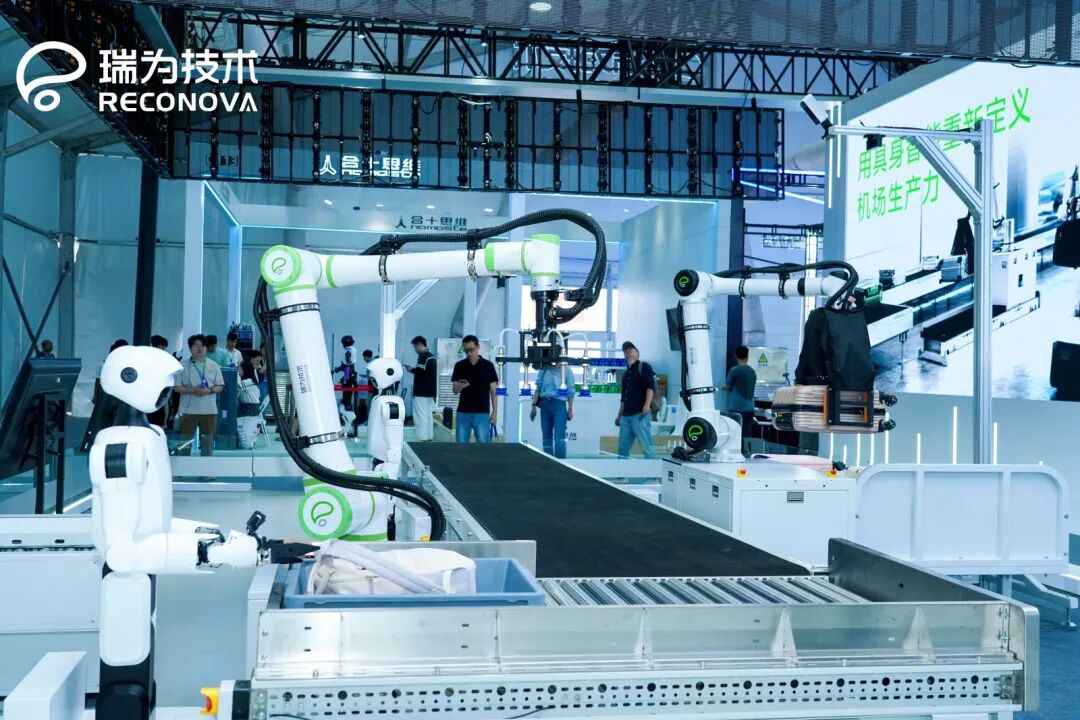
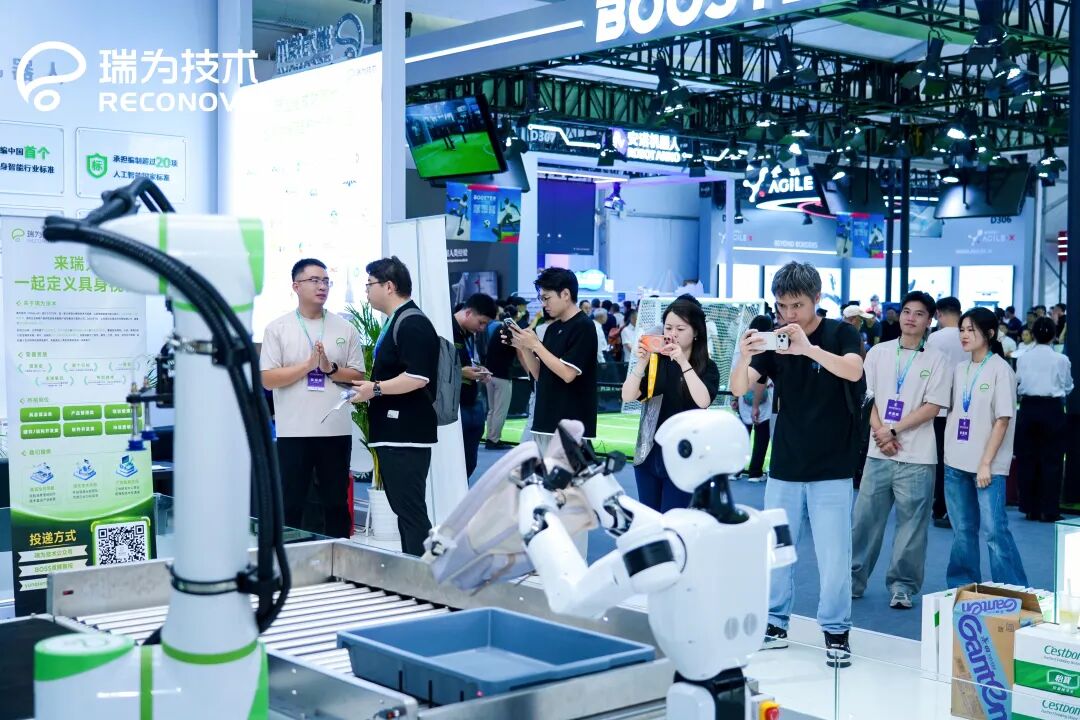
Reconova is a representative enterprise among them. At this year's WRC, Reconova directly reproduced the baggage handling operation process at the exhibition booth, showcasing a set of embodied intelligent solutions for the airport baggage transfer scenario. The Xiaoyi baggage transfer robot stably grabs and lifts the suitcase from the conveyor belt, then gently places it on the trolley, with smooth overall movements, unhurried like a skilled worker, while the wheeled dual-arm humanoid robot stands by to prepare for handling flexible baggage. The four large screens configured can display real-time detected data such as baggage size, force, and surrounding environment. In addition to audiences interested in airport scenarios, many people from warehousing, logistics and manufacturing production lines stopped to watch, as handling is undoubtedly a common large scenario in industrial scenarios.
At present, its core product, the Xiaoyi baggage transfer robot, has been connected to the real flight guarantee environment at airports in East China to carry out POC verification. About 80% of standard baggage can be processed by the robot, and the remaining non-standard and abnormal baggage is processed manually in collaboration. Compared with a large number of robots that are still in the booth Demo stage, Reconova is trying to make robots truly enter the airport production process.
Among a large number of enterprises founded during the embodied intelligence boom, Reconova, a mature listed enterprise established 14 years ago, looks rather special. It has focused on vertical scenarios such as civil aviation airports for many years. According to data from Frost & Sullivan, in terms of 2025 revenue, Reconova ranks first in China's civil aviation enterprise visual intelligent product market, with a market share of 8.7%. And now, it is becoming a productivity-oriented commercial robot company.
Different from the common industry model of building robots first and then finding scenarios, Reconova has chosen a reverse path, defining robots starting from the real production needs of airports. It is not placed into the airport, but naturally "grows" out of the airport scenario.
Based on such particularity, the process of mutual achievement between Reconova and the airport is also trying to answer a question for the industry: how can embodied intelligence enter complex B-end scenarios and form a commercial closed loop?
01
From single-point intelligence to system breakthrough: Let robots solve real production tasks
Carrying human imagination about the future form of robots, among more than 2,000 exhibits at WRC, general-purpose humanoid robots still account for a considerable proportion.
Reconova did not choose to make general-purpose robots from the very beginning. Zhan Donghui, founder and chairman of Reconova, once explained that general-purpose robots do not conform to Reconova's strategy of realizing commercial realization within two to three years. "We focus on familiar B-end scenarios to make industrial commercial robots, converge the generalized embodied intelligence problems into specific problems under specific scenarios, so the technical cycle is shorter and the commercial value is implemented faster."
How to quickly enter production and implement scenarios is the problem that Reconova considered at the very beginning when it entered the embodied intelligence industry. Therefore, Reconova chose to start with the more familiar baggage handling scenario.
Everyone is very familiar with airports, but baggage handling is a tough job hidden behind the scenes. Shi Miaohong, Vice President of Reconova and General Manager of the Commercial Robot Division, still remembers the scene when he went to an airport in a central city for investigation: in summer, in a huge warehouse, baggage handlers kept repeating the action of bending over to carry and put down baggage, most of them were over 40 or 50 years old, and there were few young people. Shi Miaohong was deeply impressed that the mobile phone step count of one of the workers showed that he had walked more than 20,000 steps in that handling space. "Baggage handling is a highly labor-dependent, heavy-load and boring job," said Shi Miaohong.
At the technical level, handling seems simple, but it has great sophistication. Compared with relatively fixed production environments such as factories, the airport itself is a more complex dynamic scenario. First, it needs to face a large number of baggage of different sizes, materials and weights every day, and the operation objects are not completely standardized. Second, multiple subjects such as people and vehicles usually move simultaneously in the baggage transfer area, and robots need to understand the changes of the surrounding environment in real time and make adjustments.
As a high-reliability operation scenario, airports also have extremely high requirements for stability and safety, and robots must ensure long-term, continuous and stable operation. Therefore, the airport scenario not only tests the perception and operation capabilities of robots, but also tests their ability to understand complex environments, as well as the engineering ability to collaboratively integrate with existing business processes.
Aiming at the airport baggage handling scenario, Reconova has started to explore along two different technical paths since 2025. One is the dedicated robot route for current large-scale production demand, namely the Xiaoyi baggage transfer robot, which mainly solves high-frequency tasks such as mass transfer of standard suitcases, sorting to trailer loading, can adapt to standard hard boxes of different sizes and placement postures, automatically identify trailer space, plan baggage placement, and can adapt to the operation demand of 7×24 hours continuous production at airports. The other is to develop a wheeled dual-arm humanoid robot for more complex flexible operation tasks, explore the operation ability of soft and irregular baggage such as backpacks and handbags, and carry out technical reserve for further processing of non-standard tasks in the future.
In April this year, Reconova also launched its self-developed VTFLA embodied intelligent technology architecture, which introduces physical feedback capabilities such as force sense and tactile sense into the traditional VLA framework to solve the stable operation problem of flexible and irregular objects such as soft bags and backpacks. Different from standard hard boxes, the shape, material and stress state of such objects are more complex, and it is difficult to make a complete judgment only relying on visual information. Force and tactile feedback can further perceive the stress change, contact state and slip risk during the grasping process, and dynamically adjust the operation strategy according to the feedback.
In the real airport production environment, Reconova's current strategy is not to pursue 100% unmanned realization in one step, but to let robots enter the production process through human-machine collaboration first. In the POC of real flight guarantee environment at airports in East China, about 80% of standard baggage can already be processed by the Xiaoyi baggage transfer robot, and the remaining about 20% of soft bags, special-shaped, damaged and other abnormal baggage are intervened manually.
The wheeled dual-arm humanoid robot exhibited at this WRC represents Reconova's exploration of flexible operation capabilities in the next stage. In the future, Reconova hopes that more general-purpose robots will gradually take over some complex tasks that still need to be completed manually, and continuously expand the operation boundary of robots in the production process.
Shi Miaohong said that derived from years of experience, Reconova has long identified the pain point of baggage handling. The promotion from a single robot to a full-chain solution also reflects Reconova's overall strategic path: starting from real production tasks, first break through single-point automation and human-machine collaboration through mature dedicated robots, then gradually evolve to more complex flexible operation, multi-robot collaboration and autonomous operation, and finally promote robots to participate in a more complete production process.
This coincides with the airport intelligence direction advocated by policies. The Civil Aviation Administration of China has issued guiding opinions to promote the digital transformation, intelligent application and intelligent integration of civil aviation. In 2025, it further issued implementation opinions to clearly promote the application of artificial intelligence technology in key scenarios such as civil aviation operation and logistics support. Under this background, it is indeed an opportunity for robots to enter the real business process of airports.
Developing first and then finding scenarios can promote the development of robot hardware and model capabilities, but it also faces challenges in the actual implementation process. After all, the production processes, operation requirements and environmental complexity of different industries vary greatly, and very practical problems remain, such as whether the demand really exists and whether a single form of robot can directly adapt to all scenarios.
02
Do not pursue optimal indicators, but pursue optimal system: How to truly implement the production process
Just as not pursuing 100% unmanned from the very beginning, "We do not think that robots must wait until they solve 100% of the problems before they can enter the real production process", Shi Miaohong emphasized. This is also the core concept of Reconova's full-chain baggage handling solution: it does not reduce the requirements for technology, but prioritizes solving the most valuable and certain tasks in real production, allows mature capabilities to enter production first, and then continues to iterate through real operation.
Taking human-machine collaboration as an example, the core is not to pursue a fixed robot replacement ratio, but to select a more appropriate execution method at the current stage according to the technical maturity and production value of different tasks: high-frequency and standardized tasks are preferentially handed over to robots, while complex and abnormal tasks are covered by manual work. For Reconova, the key to measuring the commercialization of robots is whether they can truly participate in production and create productivity from the first day.
When technology and products are ready, how to integrate into existing equipment, processes and scenarios is a key step. After years of operation, airports have formed a mature production process and infrastructure system, and any large-scale transformation will involve costs, safety risks and operational impacts. One of the practical challenges of airport robot implementation is not simply completing a certain action, but how to integrate into the existing business system.
Reconova emphasizes "let the robot adapt to the scenario, not let the scenario adapt to the robot", and the underlying logic is to reduce the threshold for robots to enter the real production environment. For example, Shi Miaohong cited that if the space is narrow, the robot structure will be optimized; if large-scale construction is not allowed, modular and segmented design will be adopted; at the current stage, robots cannot efficiently and stably handle all non-standard baggage, so human-machine collaboration is used to solve long-tail problems; the staff already have mature processes, so the system will actively adapt to the existing production rhythm.
"So we always believe that not all problems should be handed over to large models. The ultimate goal of real production is system optimization. Some problems are solved by models and algorithms, some are solved by mechanics and system engineering, and some are solved by business process design," Shi Miaohong emphasized.
From a commercial perspective, the important significance of this idea is that robots are no longer "new equipment" that requires customers to reconstruct the supporting environment, but become an enhanced module in the existing production system. For high-reliability operation scenarios such as airports, being able to enter the production process at low transformation cost and run stably for a long time is often more important than simply demonstrating more advanced technical capabilities.
On the basis of verified human-machine collaboration, the next issue Reconova focuses on is how different types of robots collaborate with each other. At present, the East China Airport POC mainly undertakes standard baggage processing tasks by the Xiaoyi baggage transfer robot, and the wheeled dual-arm humanoid robot is still in the flexible operation technology verification stage. However, from the very beginning of the system architecture design, Reconova did not limit its goal to "one robot", but designed for the scenario where multiple robots participate in production together in the future.
"In the future enterprise production environment, there may be handling robots, operation robots, humanoid robots, inspection robots, and a large number of fixed intelligent devices at the same time." Shi Miaohong believes that the real problem is not just how to make a single robot smarter, but how to decide "what task, at what time, by which kind of robot to complete" around the complete production task according to different situations, and realize the collaboration between different devices through planning and layered architecture.
All this points once again to Reconova, a mature listed enterprise, in its consideration of commercial implementation - not pursuing local optimization of technical indicators, but pursuing global optimization of the entire production system, and entering the market at the right time. This path difference also determines that Reconova's focus in the field of embodied intelligence is not a single robot body, but how robots enter the real production process and operate collaboratively with the existing business system.
Shi Miaohong revealed that in the current POC actual measurement in the real flight guarantee environment of airports with tens of millions of passenger flow, the single baggage processing rhythm of the Xiaoyi baggage transfer robot is less than 18 seconds, which can meet the rhythm requirements of actual airport production operations. On the current 3.0m × 1.5m three-side enclosure trailer used in the test, the maximum loading capacity of a single vehicle can reach 39 pieces, which is close to the loading level of 40 pieces by skilled manual workers under the same conditions. At the same time, the loading accuracy rate reaches 99.9%, and the baggage detection rate reaches 99%.
Compared with individual technical indicators in the laboratory, these data from the real flight guarantee environment are closer to the way airports measure a robot system - not only can it "work", but also see whether it works fast enough, accurately enough, and whether it can stably integrate into the existing production rhythm.
The airport is a typical highly dynamic, highly changing and highly diverse environment. Robots not only need to know "what this is", but also need to further understand "where it is", "what the state of the surrounding space is", "how people and equipment are moving" and "what I should do next".
Therefore, Reconova will continue to make technical progress. Starting from the past computer vision (CV), Reconova is further extending to multi-modal perception, spatial intelligence, task understanding and physical interaction. VTFLA improves the ability of robots to interact with the physical world by introducing physical feedback such as force sense and tactile sense; spatial intelligence further solves the robot's understanding of the environment, position, objects and dynamic spatial relationships. The two types of capabilities ultimately serve a single goal, allowing robots to gradually move from performing predefined actions to understanding environmental changes, planning autonomously and completing production tasks.
In this direction, Reconova has carried out in-depth cooperation with the Intelligent Cyber-Physical Industrial Systems Laboratory (RoboCPS Laboratory) of the University of Hong Kong. Reconova gives full play to the advantages of complex production scenarios, real data and engineering capabilities, while the University of Hong Kong laboratory gives full play to the advantages of cutting-edge technology research and scientific research talents. The two sides focus on research on spatial perception, spatial modeling and autonomous operation capabilities of robots in complex dynamic environments, and continuously optimize the entire system combined with real production scenarios.
"We hope that in the end, instead of letting the robot complete a pre-programmed action, it can understand environmental changes and independently complete production tasks."
Behind this, what Reconova is really trying to build is not the capability of a certain robot form, but a robot intelligent system oriented to production tasks: understand objects through multi-modal perception, understand the environment through spatial intelligence, realize interaction with the physical world through technologies such as VTFLA, and then complete more complete production tasks through task planning and multi-robot collaboration, and continuously generate data in real operation to feed back the model and the entire system.
03
From steady progress to long-term development: Continuous evolution driven by real data
At present, the