The Big Short clashes head-on with Jensen Huang: The $500 billion financing in the AI industry is comparable to Enron.
Jensen Huang is on a "crazy expansion spree" in the financial sector.
Recently, NVIDIA publicly announced that its stake in SpaceX is worth approximately 21 billion U.S. dollars, making it the sixth largest shareholder of SpaceX. In return, Elon Musk stated during the Q2 earnings call that the company will exclusively use NVIDIA chips in its AI data centers.
Pouring capital into investments and then pushing investees to purchase its own chips, the money flows right back to NVIDIA after a full cycle, making Jensen Huang's financial business kill two birds with one stone.
Just a few days ago, a $500 billion financing plan sparked a fierce long-short battle between famous short sellers and Jensen Huang.
Famous short sellers stated bluntly that NVIDIA's $500 billion fund is an "off-balance-sheet vehicle", which is a mutual back-scratching arrangement between NVIDIA and Wall Street, and there is a self-circulation loop between Jensen Huang and downstream AI companies, whose risk level is several orders of magnitude higher than that of Enron. Jensen Huang then published a long article to explain that chips will not depreciate that fast, and GPUs will be as valuable as land, still worth a lot even ten years later.
If the short sellers' prediction comes true, Jensen Huang has built such a huge financial system that relies on the self-circulation of the AI industry, how huge a hidden risk it will be once it collapses?
$500 Billion Financing Ignites the "Big Short"
Last week, NVIDIA teamed up with six institutions including Apollo, BlackRock, Blackstone, Brookfield, Goldman Sachs and KKR to launch a financing platform with a target size of $500 billion:
Taking NVIDIA's AI chips as the underlying assets, the platform issues bonds to pension funds, insurance companies and sovereign wealth funds, and the raised capital will be lent to AI companies to purchase chips and rent computing power.
If the transaction is finally completed, it will become one of the largest financing operations in Wall Street history.
Jensen Huang has spared no expense for this plan. According to Morgan Stanley's research report, NVIDIA only provides no more than 25% of the "residual value support mechanism" under this structure. Jensen Huang also personally stated that the company may provide financing support for relevant cooperation "up to 25% of the project size".
According to Jensen Huang's vision, AI computing power will be redefined as an investable asset just like houses, airplanes and power stations:
"They are revenue-generating assets now, with productivity, long lifespan, substitutability and flexibility."
To explain his plan, it is to turn computing power into financial products, add leverage for companies in the AI industry, securitize computing power, and allow people to buy GPUs in the form of mortgage. In the past, AI companies had to pay 1 billion U.S. dollars out of their own pockets to buy chips, but now they don't have to. They can borrow money from this financing platform to make the purchase. NVIDIA acts like a real estate developer, getting the full payment for chips, AI companies pay back the loans, the financing platform earns handling fees and interest, and people speculate on computing power in the same way as speculating on real estate, without even needing a large down payment.
Larry Fink, CEO of BlackRock, said proudly that this financing plan is equivalent to the birth of Mortgage-Backed Securities (MBS) in the 1970s.
However, the core cause of the 2008 subprime mortgage crisis was MBS, which packaged American people's mortgages into financial products and sold them to the whole world. This financing platform is clearly planting huge hidden risks.
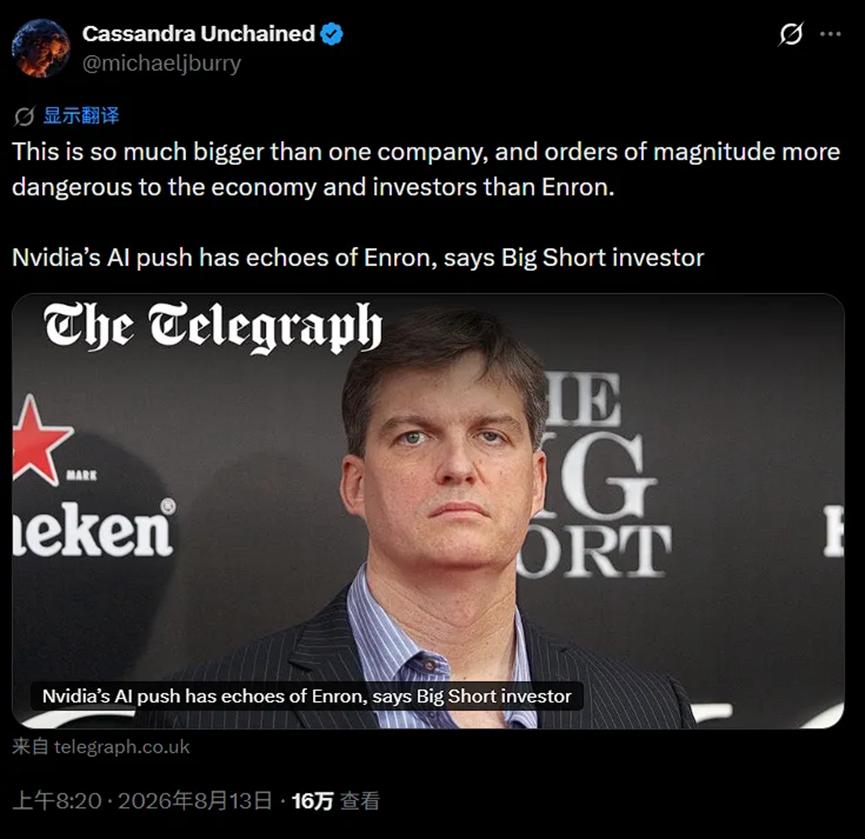
After this incident was exposed, Wall Street was in an uproar. On August 13, Michael Burry, the prototype of the movie The Big Short, posted on X that this $500 billion plan is "several orders of magnitude more dangerous to the economy and investors than Enron", and the US stock market was in a complete mess when Enron collapsed back then.
"Dr. Doom" of Wall Street, Jim Chanos, also posted a status:
"The next time these people sit together at the same table to explain AI financing, it is not impossible that it will be at the congressional hearing in 2031..."
Michael Burry, the "Big Short", started increasing his short positions on Micron, NVIDIA and the Philadelphia Semiconductor Index back in July. His reason at that time was that "a large part of NVIDIA's huge demand comes from the self-circulation of off-balance-sheet financing, and there are not that many real end customers". Now that Jensen Huang launched this leverage plan, Burry is more convinced that NVIDIA and Jensen Huang are mutually propping up each other's valuations.
Wall Street is no stranger to the consequences of excessive leverage. Earlier this month, a 24-year-old "AI stock god" saw his $45 billion fund blow up and suffer huge losses due to excessive leverage, and he sold the remaining assets for only 10 billion U.S. dollars after the discount. The entire global capital circle still has lingering fears about this incident, so more and more people have agreed with the big short in recent days.
Jensen Huang's Dangerous Cycle: Lend Money to Customers, Who Then Buy His Own Chips
Essentially, Apollo, BlackRock, Blackstone, Brookfield, Goldman Sachs and KKR are all private equity institutions rather than banks. Even banks with strict risk control standards dare not participate in this kind of capital pool game, because NVIDIA's model is far too "self-circular":
The financing platform provides loans to AI companies or AI startup teams, who then use the money to buy NVIDIA GPUs. As a result, NVIDIA's revenue keeps rising rapidly, and its financial reports and stock price keep hitting new highs. But the core essence of this model is lending money to customers to buy its own products. The revenue and profit of customers are not mentioned. Jensen Huang only said that he wants to build GPU computing power into infrastructure assets just like real estate and power. It is none of Jensen Huang's business how the customers can recoup their costs after purchase.
This model is exactly what the saying "climb up the steps by stepping on the air" describes.
Jensen Huang naturally does not believe in this risk. He took the A100 chip launched in 2020 as an example, saying that this product has been on the market for six years, still performs very well in inference, training and high-performance computing, and keeps getting new orders, with its "economic lifespan extending towards 10 years". In addition, the one-year lease price of H100 rose from $1.70 per hour last October to $2.35 per hour in March this year; the latest B200 has a cloud quotation of $5.30 to $7.05 per hour.
The price only goes up, plus he provided a 25% residual value guarantee, so the risk is not that big at all.
All of this is based on the fact that computing power prices have kept rising in recent years. He believes that this industry has broken the price cycle law of conventional chips such as memory chips. What Michael Burry bets on is that this law will reappear in the future, and once the price starts to fall, the whole system will collapse.
According to the calculation of SemiAnalysis, a well-known semiconductor research institution, the capital expenditure credit in the AI industry is snowballing at present, and it is estimated that it will exceed 7 trillion U.S. dollars by 2029, approaching the size of the US mortgage market.
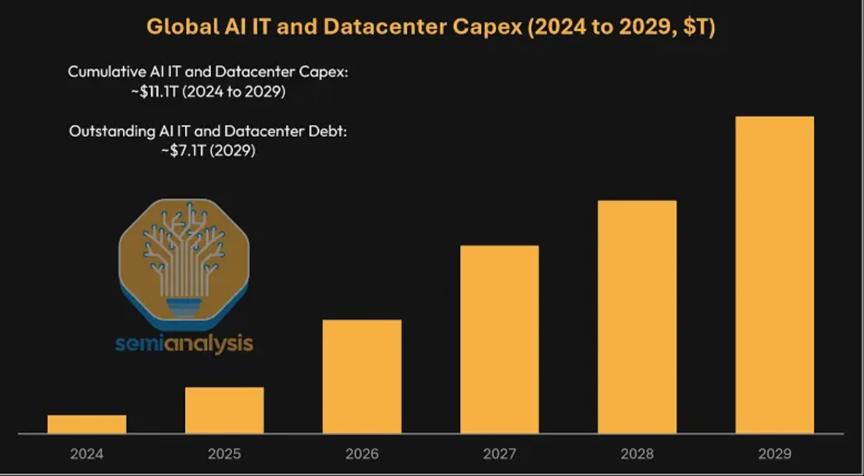
This report was released at the beginning of last month, and the actual growth may be faster than his prediction.
Just at the end of last month, Jensen Huang proposed a $250 billion financing guarantee for OpenAI. Reports say that NVIDIA plans to provide approximately $250 billion in financing guarantees for OpenAI, and this fund will be mainly used for an under-construction data center project of OpenAI to purchase computing power.
This project is located in Ohio, USA, developed by SB Energy, the energy subsidiary of Japan's SoftBank Group. The total investment scale of the project may reach as high as 500 billion U.S. dollars. The plan is that NVIDIA provides the guarantee, OpenAI signs a huge number of computing power orders, and SoftBank can also obtain more favorable financing terms. In turn, SoftBank's data center construction requires the procurement of a large number of NVIDIA chips.
NVIDIA has far more than OpenAI as its customers under this "circular model". Many AI giants including Oracle and Anthropic are all in its circulation loop:
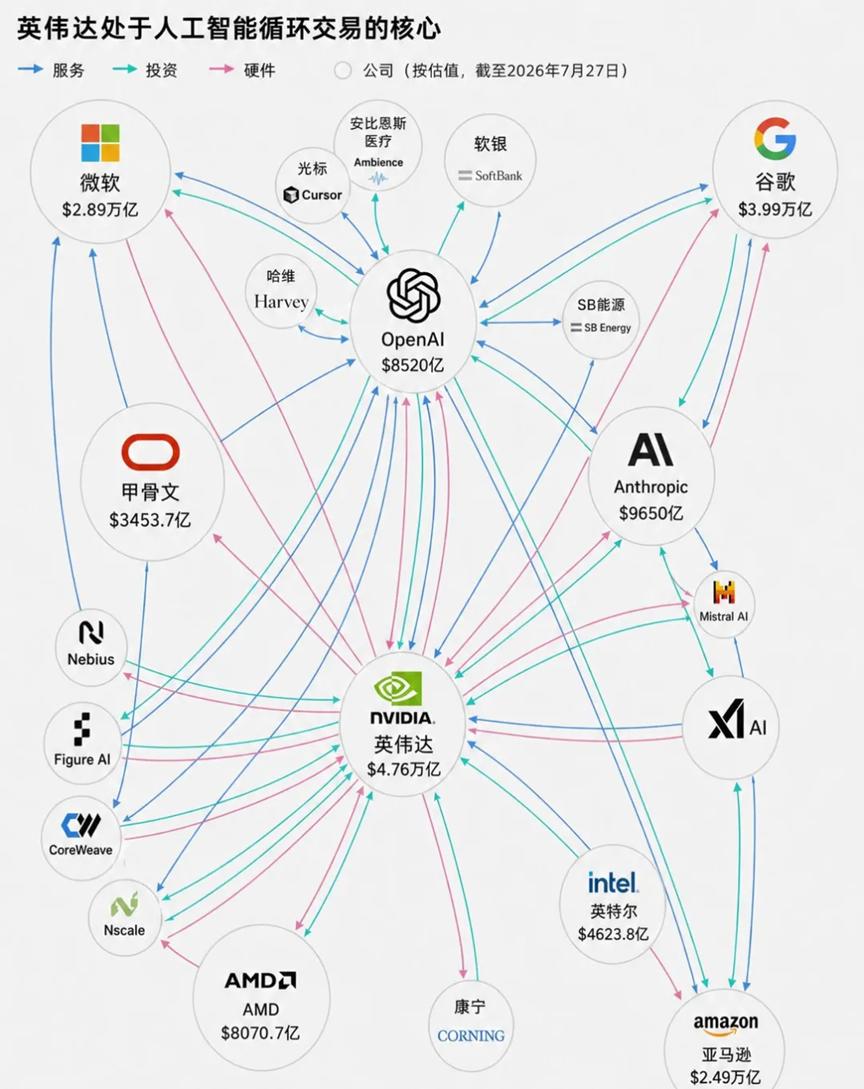
▲
In the past, NVIDIA has invested in almost all of its major customers: it invested 30 billion U.S. dollars in OpenAI, 10 billion U.S. dollars in Anthropic, and holds a 2 billion U.S. dollar stake in cloud service provider CoreWeave. Customers have become its affiliated companies, and customers purchase computing power and then buy its own chips, so the "self-circulation" is formed naturally.
Against the backdrop of huge investments from Alphabet, Microsoft, Amazon and Meta, Apple's artificial intelligence capital expenditure is very restrained, its stock price has been rising all the way, and it overtook NVIDIA at the end of July, returning to the position of the world's most valuable listed company.
Cathie Wood and Big Short Bearish in Turn, But NVIDIA Keeps Rising Despite Criticism?
In fact, Wall Street's doubts about the bubble of NVIDIA have never stopped in the past two years.
In February 2024, famous female fund manager Cathie Wood, who had always been bullish on NVIDIA, announced that she had reduced her holdings of NVIDIA to cash out. She said at that time: "Large tech companies including Meta, Tesla, Google's parent company Alphabet and Amazon are developing their own AI chips, which may put pressure on NVIDIA's future demand." She even believed that NVIDIA would be the next Cisco, saying "It is very dangerous now. In 1994, Cisco accounted for 2.5% of the S&P IT industry index and 0.2% of the S&P 500 index; while in 2023, NVIDIA's proportion in these two indices reached 4.7% and 2.8% respectively, which is far too high."
At that time, someone also made a comparison chart of the trend of NVIDIA and Cisco:
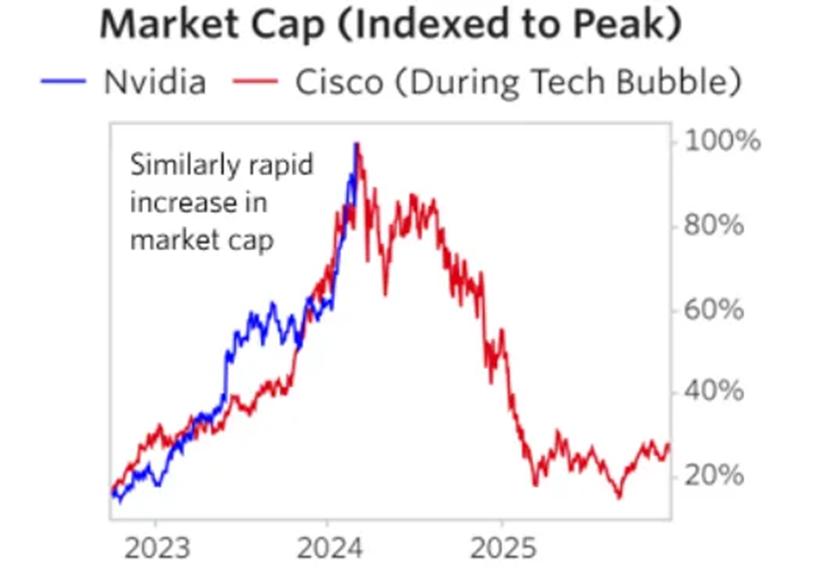
However, after she reduced her holdings, NVIDIA did experience a short-term adjustment, but soon it continued to rally, and its stock price kept hitting new highs.
Half a year after Cathie Wood announced the reduction of her holdings, in early August 2024, top Wall Street hedge fund Elliott Management issued a warning to its investor clients that large tech giants, especially NVIDIA, are in a bubble, and the artificial intelligence technology that drives its stock price to rise sharply is overhyped.
The report states:
Many applications are not ready for prime time. Many so-called use cases of artificial intelligence will never effectively save costs, never work properly, consume too much energy, or prove to be untrustworthy. So far, artificial intelligence has failed to deliver the promised significant productivity improvement. Apart from summarizing meeting minutes, generating reports and assisting computer coding, there are few practical use cases. Artificial intelligence is essentially a kind of software, which has not brought value commensurate with the hype so far.
However, this barely affected the upward trend of NVIDIA's stock price.
Last year, more and more bearish voices began to appear. In August, the Massachusetts Institute of Technology released a report titled The Generative AI Gap: The State of Business AI in 2025, which said "Although enterprises have spent 30 to 40 billion U.S. dollars on generative AI, 95% of companies have not obtained commercial returns so far."
So many companies have invested heavily in AI, and now people say all that money has been burned for nothing? After the report was released, it caused a drop in the stock prices of chip and AI stocks including NVIDIA, Oracle, AMD, Palantir and Arm, but these stocks are very resilient, and they continued to rise after the pullback.
In late October, the market was still immersed in the fanaticism towards NVIDIA. Jay Goldberg, an analyst at well-known investment bank Seaport Global Securities, gave NVIDIA a "sell" rating with a target price of $100, while the average target price of Wall Street analysts was $220 at that time.
"I am skeptical of all the hype around AI," Goldberg said in an interview with Bloomberg. "This is not the first time I have seen a bubble."
Shortly after this report was released, Michael Burry, the big short, set his sights on NVIDIA. He did not invest a huge amount of capital to short it at first, but published a column article titled The Cardinal Sign of a Bubble: Supply-Side Gluttony, which explicitly pointed out that NVIDIA is the Cisco of this era.
Jensen Huang immediately refuted him. NVIDIA sent a memo to the Wall Street group, saying that it "does not use special purpose entities (SPVs) nor rely on supplier financing", so as to reject the market's analogy between it and past accounting scandals. In addition, it also denied the so-called "$610 billion circular financing" rumor, saying that "strategic investment was only 3.7 billion U.S. dollars in the third quarter, and about 4.7 billion U.S. dollars year to date, which only accounts for a small part of its revenue, and the so-called huge circular financing is completely unfounded."
Since then, the two rivals have started a nine-month debate, responding to each other every few days. Until now, NVIDIA has launched a $600 billion financing platform plan, Michael Burry can no longer hold back. This time he no longer calls NVIDIA "Cisco 2.0", but "Enron 2.0", which is a far harsher accusation.
In the end, will NVIDIA's leverage model really bring down the entire AI industry?
This article is from the WeChat official account "Finance Gossip Girl Channel" (ID: baguanvpindao), written by Xinghua, and authorized for release