After four months of practical training at the automobile factory, Xiaomi has unveiled its new generation of humanoid robots.
On August 19, 2026, at the 2026 World Robot Conference, Xiaomi's new-generation humanoid robot that had completed 4 months of practical training in an automobile factory was officially unveiled to the public.
This robot continues the product code "CyberOne", with a total height of about 1.70 meters and a weight of 66 kg. It has 66 degrees of freedom across the whole body, 33 of which are concentrated in both hands, and its hardware specifications fit the physical conditions of frontline workers in the manufacturing industry. The whole machine adopts an integrated light gray body design, with a matte silver helmet-shaped head and no redundant decorations, which is more oriented to industrial practicality.
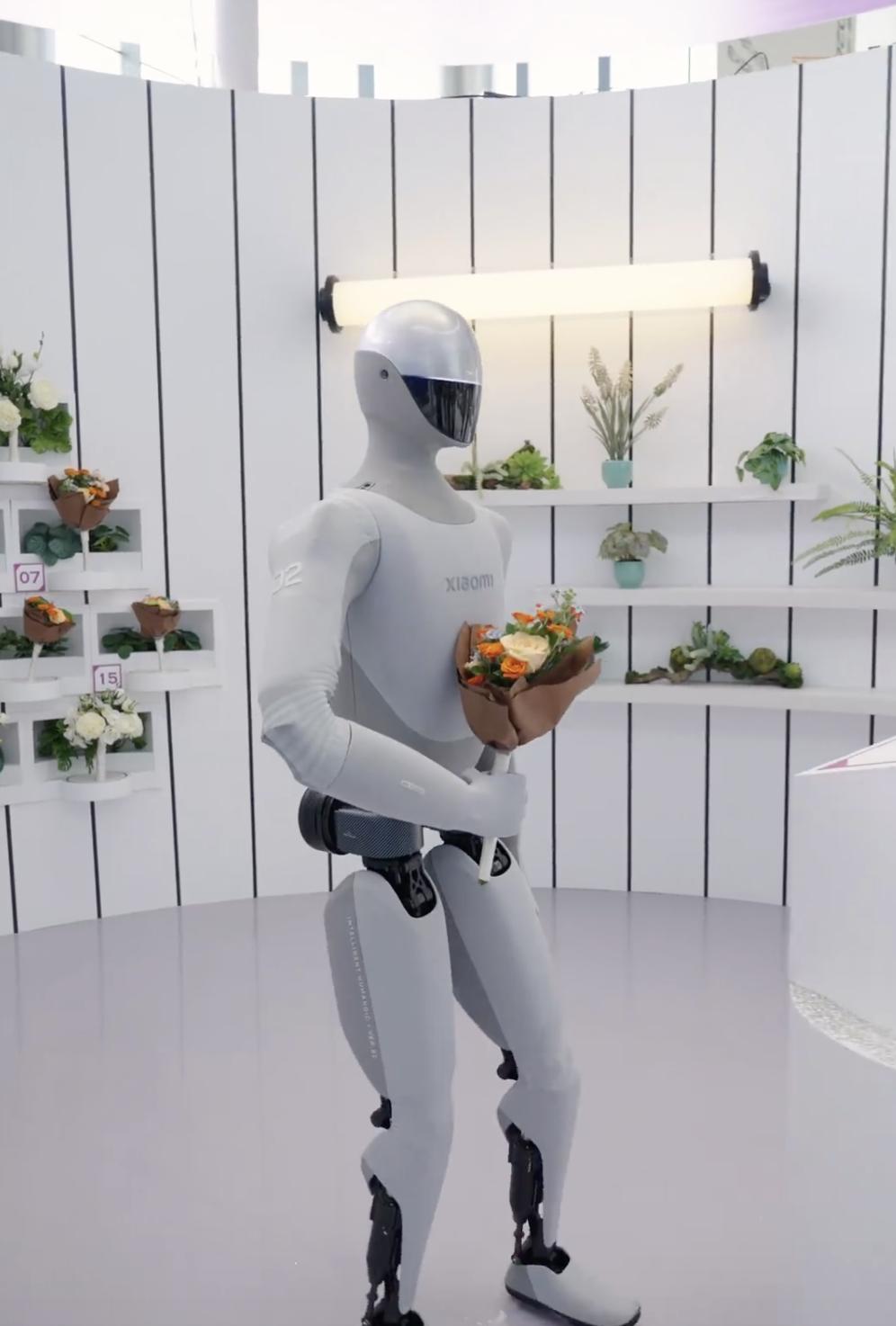
Image source: Xiaomi Technology
At the exhibition site, the robot completed multiple sets of interactive actions in the role of a "florist". It can independently grab the bouquet on the exhibition stand, sprinkle the scented sheets into the bouquet, then hand the bouquet to the audience on site, and complete physical feedback such as shaking hands, fist bumping, and making a heart gesture. The opening and closing of fingers, rotation of wrists, and fine adjustment of the torso are relatively natural, with no obvious stuttering in movements.
According to Xiaomi, the whole set of actions is not driven by pre-set scripts, but by the embodied large model for autonomous decision-making and execution. The robot is still in the prototype R&D stage at present, and will go on exhibition in Europe after completing its first domestic exhibition.
Different from the path of many products that are publicly released first and then find application scenarios, this prototype of Xiaomi has completed production line practical training in the Xiaomi Automobile Factory before its official public exhibition.
In March this year, Lei Jun, the founder of Xiaomi, posted that Xiaomi's robot had entered the automobile factory for internship, and a large number of humanoid robots would enter Xiaomi's factories to work in the next 5 years.
According to Lei Jun, on the basis of the general VLA base model Xiaomi-Robotics-0, Xiaomi combines multi-modal perception capabilities and reinforcement learning technologies to enable its humanoid robot to initially realize independent work in scenarios such as the self-tapping nut loading station and material box handling. Key indicators such as the mean time between failures and the success rate of a single task of the robot are steadily improving, and the actual deployment and verification work around more classic workstations is also continuously advancing.
Lei Jun mentioned that there is a huge and hard-to-cross gap between robot operation in the laboratory and in real factories — the production rhythm. For technical exploration in the laboratory, 10,000 failures can be exchanged for one success; in real factories, 10,000 tasks must be successful every time to meet the production requirements.
According to other data released by Xiaomi, the robot ran continuously and independently for 3 hours at the self-tapping nut loading station in the die-casting workshop, with an installation success rate of 90.2%, and simultaneously met the production line rhythm of 76 seconds. Xiaomi said that this is the first step for its humanoid robot to be stably applied in the field of intelligent manufacturing.
In July this year, Xiaomi released a working video of the robot. The video was shot in the logistics area of the assembly workshop of the Xiaomi Automobile Factory. In the scene of the sorting operation of the center console side cover, the robot, relying on the cooperation of multiple degrees of freedom of the whole body, leans forward moderately, and its dexterous hand stretches into the material box to grab the cover; after getting the workpiece, it will change hands and adjust the holding posture of the workpiece in real time. After the adjustment is completed, the robot holds up the flexible cover with both hands and places it in the corresponding grid of the material rack truck to complete the flexible part sorting process.
In the material box folding and recycling operation, facing the empty plastic logistics material boxes in the factory, the robot uses its dexterous hands to accurately pry open the pull ring of the material box lock, and its two arms cooperate to exert force to complete the folding, pressing and buckling step by step, so as to fold and compress the unfolded empty material box. After the folding is completed, the robot will also push and stack the folded material boxes to the designated storage position to complete the whole process of material recycling.
According to Lei Jun, at this time, the success rate of Xiaomi's robot in bilateral operations at the self-tapping nut loading station has increased from 90.2% to 98%, the success rate of center console side cover loading and material box folding has reached 90%, and the long-term operation of flexible workpieces has been realized for the first time.
Xiaomi initially laid out humanoid robots around 2021, and officially released the first-generation CyberOne humanoid robot the next year. At that time, the product mainly undertook the function of technical verification. The first-generation robot had 21 degrees of freedom across its whole body, focusing on the display of interactive capabilities, and there was still a big gap from industrial-level operation capabilities.
In terms of product positioning, Xiaomi's humanoid robot does not pursue an independent hardware product, but mainly cooperates with Xiaomi's "full ecosystem of people, cars and homes" collaborative strategy. Its technical route chooses a full-size bipedal solution, adopting a hybrid architecture of "brain + cerebellum". The company has also self-developed the Mi-Sense depth vision perception system, simultaneously promoted the R&D of embodied large models, and open sourced the Xiaomi-Robotics-0 robot model to reduce the industry deployment threshold.
Lei Jun mentioned in July that Xiaomi's embodied base model Xiaomi-Robotics-1 ranks first in the world in comprehensive ranking in the two major embodied lists of Robocasa365 and RoboDojo. Xiaomi's robot team has initially completed the layout of "body, data and model", and will then promote the robot to move towards a more open and complex real world.
Just on August 18, Xiaomi released its financial report for the second quarter of 2026, with a total revenue of 108.9 billion yuan, a year-on-year decrease of 6.1% and a month-on-month increase of 9.9%; the adjusted net profit was 6.2 billion yuan, a year-on-year decrease of 42.6% and a month-on-month increase of 2.4%.
Although both revenue and net profit have declined, Xiaomi's R&D expenditure in the second quarter reached 9.23 billion yuan, a year-on-year increase of 18.9%, which was mainly invested in core fields such as intelligent electric vehicles and AI.
Lei Jun previously revealed that Xiaomi's cumulative R&D investment in the past 5 years has exceeded 1000 billion yuan, and the planned investment will exceed 2000 billion yuan in the next 5 years. In the next three years, Xiaomi plans to invest more than 600 billion yuan in the AI field. This year, Xiaomi's R&D and capital expenditure on AI will exceed 160 billion yuan. Humanoid embodied intelligence is also one of its key investment directions.
However, Xiaomi's robot business is still in the stage of prototype iteration and internal verification, and there is no independent external revenue for the time being. At this stage, its value is more reflected in internal factory cost reduction and technical precipitation, and there are still many engineering problems to be solved before large-scale external commercialization.
This article is from Jiemian News, the reporter is Song Jiannan, and it is published by 36Kr with authorization.