Hard Kr Exclusive | The embodied brain enterprise backed by Tsinghua University and the Chinese Academy of Sciences has raised 1 billion yuan in financing, and has already secured hundreds of millions of yuan worth of overseas orders.
According to Hard Krypton, Zhongke Fifth Era, an embodied intelligence enterprise, has recently completed consecutive Series A1 and A2 financing rounds, with a total financing amount exceeding RMB 1 billion. The Series A1 round was jointly invested by Xigao Investment, BOC AIC Fund under Bank of China, and Sanfeng Investment; the Series A2 round was jointly invested by Sinopower Venture Capital, BOC AIC Fund, Zhongshan Venture Capital, Hongruida Investment, Beyondsoft, and Jintou Venture Capital (Zhejiang New Energy Vehicle Sub-fund).
Founded in 2024, Zhongke Fifth Era has completed billions of yuan in financing in less than two years of establishment. Fifth Era is a leading "embodied brain" company that builds products and solutions centered on large embodied operation models. It has served more than ten core domestic customers including Sinopec Group, Leapmotor, and State Grid.
Compared with the domestic market, the more obvious incremental growth of Zhongke Fifth Era in the next stage will come from overseas. After the completion of this round of financing, globalization will become one of the core directions of the company's future development. At present, Fifth Era has obtained overseas orders worth hundreds of millions of yuan, its overseas business has entered the stage of actual delivery, and a localized service system has been established. In the next six months, Fifth Era will focus on expanding overseas markets including Europe, Australia, New Zealand, Japan and South Korea.
In March this year, Zhongke Fifth Era completed the real-scene verification of universal bin handling at the headquarters of a global manufacturing enterprise in Germany. Faced with bins of different specifications placed randomly, the robot can continuously complete identification, grasping and handling without manual intervention. For embodied intelligence companies, being able to complete verification at European manufacturing sites means more than just a project landing, it also means that its technology has begun to undergo the test of a high-standard industrial system.
Liu Nianfeng, Founder and CEO of the company, holds a doctorate from the Institute of Automation, Chinese Academy of Sciences, studied under Tan Tieniu, Academician of the Chinese Academy of Sciences, and has long been engaged in R&D of artificial intelligence and robot products as well as the commercialization of core technologies. He told Hard Krypton: "The European manufacturing industry is facing changes in labor structure and a new round of automation upgrading, which provides new market opportunities for Chinese embodied intelligence enterprises. Overseas, 'delivering what you promise' is extremely important. To win orders from leading manufacturing enterprises, our products can quickly adapt to the local production system and truly deliver the projects."
Over the past year or more, the global embodied intelligence track has been undergoing a shift in technical routes. In Silicon Valley, the echelon represented by Figure and 1X Technologies generally introduces the Scaling Law of large internet models into the physical world, trying to spawn the GPT moment of embodied intelligence by infinitely stacking video diffusion models and millions of hours of real robot grasping data. However, the unstructured features of the real physical world lead to problems such as high data collection costs and long scene generalization deployment cycles.
Against this industry background, Fifth Era has launched the world's first ultra-few-shot FAM series large embodied operation model. The traditional VLA architecture easily loses the prior spatial structure of the physical world in the dimension reduction process, resulting in misoperation of the robot when the background or light changes slightly. Therefore, Fifth Era has created the original "heatmap alignment" technology, which accurately "lifts" the features back to the 3D heatmap, retains the geometric relationship of 3D space, reduces the loss of spatial data through the industry's original model architecture innovation technology, improves data utilization efficiency, and thus realizes the technical closed loop of "few-shot, high reliability and strong generalization".
In actual operation and deployment, this model reduces the task learning threshold to only 3 to 5 real demonstrations, achieving a basic task success rate of up to 97%, and the data demand is reduced to 1% of the traditional method.
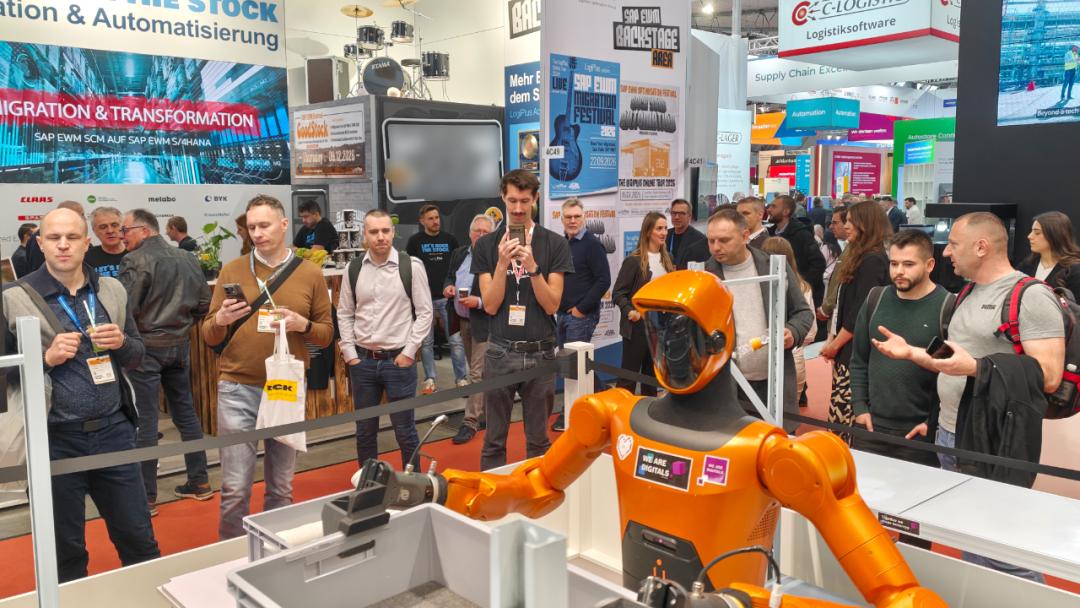
(Image source: the enterprise)
While improving the operation generalization ability, Fifth Era also enables the robot to deduce first and then execute by imitating the ability of human beings to predict results and judge risks before action through the world model, further improving the safety in real operations. In its recently upgraded FAM-1.3 version, the team deeply integrated the 3D spatial structure prior with video generation for the first time, realizing the leap from discrete heatmap prediction to serialized heatmap generation. Another world model, BridgeV2W, can directly "translate" complex action instructions into pictures that may be seen in the future, so as to achieve high-precision and visual simulation of action results. Its new-generation world model FlowWAM, which has not been officially released yet, topped the total score list of the WorldArena global ranking in April this year.
The first self-developed wheeled embodied robot of Fifth Era has achieved large-scale implementation in three core scenarios: logistics, industrial flexible production lines, and energy inspection and operation. Equipped with the FAM series large models, the robot is 189cm in height, 65cm in arm span, adopts a lightweight design, and has 28 degrees of freedom in the whole body, of which the humanoid arm has 7 degrees of freedom, taking into account high load and high flexibility in terms of parameters.
The technological breakthrough is also one of the reasons why Fifth Era focuses on expanding overseas markets. Overseas factories have obvious differences in material specifications, production beats, station layouts and other aspects. Relying on the FAM series large embodied operation models, Fifth Era uses ultra-few-shot learning to improve the robot's rapid adaptation ability when facing unfamiliar scenarios, thus reducing the deployment cost in different countries and different factories.
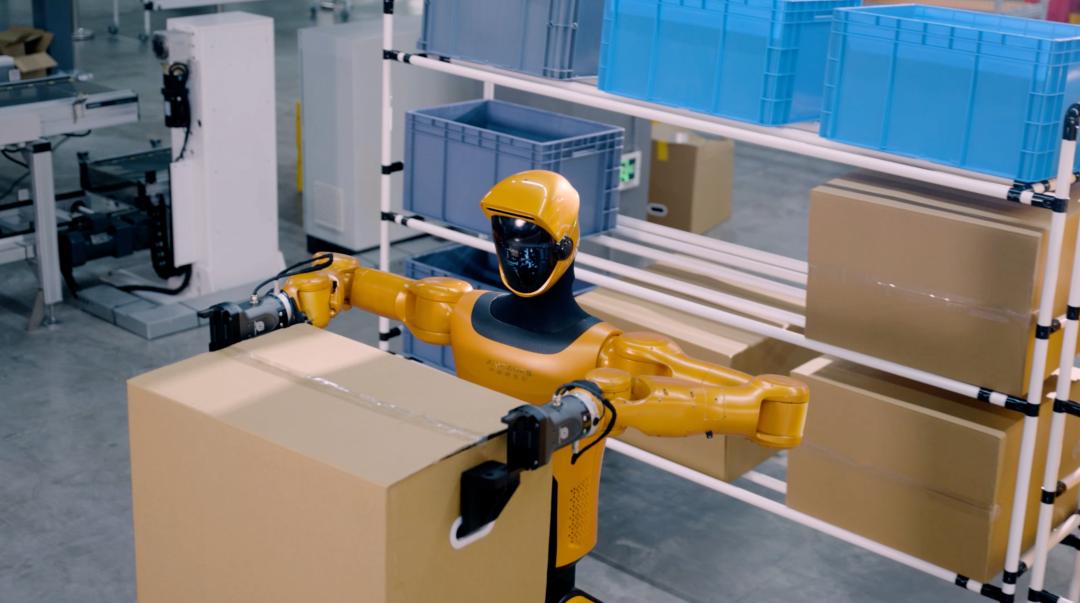
(Image source: the enterprise)
At present, the company's overseas business focuses on industrial scenarios with high standardization and clear market demand, such as industrial logistics and flexible manufacturing. Compared with robot enterprises that mainly focus on hardware export, Liu Nianfeng said that we will adhere to the integration of software and hardware, because only by doing both software and hardware can we truly connect scenarios, data, models, control and delivery.
The following is the interview with Liu Nianfeng, Founder and CEO of Fifth Era:
Hard Krypton: The mainstream of the industry is currently following the VLA route. Why did Fifth Era choose to "subvert" it from the very beginning of its establishment? What is the biggest challenge in engineering implementation when "lifting" the 1D features back to the 3D heatmap?
Dr. Liu Nianfeng: We hope the way embodied robots understand the world is closer to that of human beings.
When facing the real world, humans do not calculate all information with the same intensity. The brain is always filtering: what is related to the current task, what can be ignored for the time being, and where is worth investing more attention. Real effective intelligence is never about processing the most information, but being able to quickly grasp the part that determines the result.
This is also the starting point for us to redesign the technical architecture. Embodied robots live in the 3D physical world, where position, distance, occlusion and contact relationship directly determine whether the action is feasible. If this information is prematurely compressed into 1D features, the calculation may be simpler, but the 3D structure and spatial constraints may also be lost accordingly.
Fifth Era pulls the features back to the 3D heatmap, on the one hand, retaining the original spatial relationship of the physical world, on the other hand, allowing the model to form a selection mechanism similar to human attention, quickly locking the area most relevant to the task.
The biggest engineering challenge is to accurately express the relationship between targets, positions and actions in 3D space, while allowing the model to quickly find the key areas that truly determine the success or failure of the task from the complex environment. We need to solve the loss of spatial information in feature compression, and also prevent the model from processing all information indiscriminately. The core of Fifth Era is to enable embodied robots to not only understand the 3D world, but also have the ability to focus on key points.
Hard Krypton: The industry is still using massive data to train large models. What makes you dare to bet on "ultra-few-shot"? If ultra-few-shot is adopted, will higher requirements be put forward on the quality, dimension of demonstration data and operators?
Dr. Liu Nianfeng: The capability of the model depends on two variables, one is the quantity of data, and the other is the quality of data.
I believe that the more data, the stronger the model capability will be, but the problem is that what is truly scarce in embodied intelligence today is high-quality real machine data. When it is difficult to significantly increase the amount of data in the short term, the industry can not only focus on "how much data we have", but also pay attention to data utilization efficiency.
If the data utilization efficiency of the model is only 1%, even if we keep increasing the data, a large amount of effective information will still be wasted; if the utilization efficiency can be increased from 1% to a higher level, the same amount of data can support stronger learning capability. As the data scale expands in the future, this efficiency advantage will be further amplified. Therefore, we carried out model architecture innovation, reducing the demonstration data required to learn a new task to 3-5 pieces. Ultra-few-shot is just the result. What we have truly broken through is the long-standing data utilization efficiency bottleneck in embodied intelligence.
As for the second question, on the contrary — ultra-few-shot does not transfer the burden to on-site personnel, but digests the complexity inside the system. On-site workers only need to complete several simple demonstration operations in the normal operation way. The complex reasoning such as action understanding, spatial modeling and safety verification should be completed by the model and the system in the first place. Our principle is very simple: let customers get the most stable implementation effect with the least intervention. If "ultra-few-shot" makes customers more tired instead, it will have no commercial value at all.
Hard Krypton: World models are very hot this year, and Fifth Era has also released BridgeV2W. What role does the world model play in Fifth Era's technical blueprint?
Dr. Liu Nianfeng: The world model, in essence, simulates the human capability of "deducing before acting".
Humans do not act immediately after receiving information. Before taking real action, the brain will quickly deduce the possible results according to past experience: whether this action is feasible, how the environment will change, what risks may arise, and whether it is necessary to change to another way. Most of the time, this kind of deduction is not clearly perceived by us, but it is an important reason why humans can complete actions in complex environments.
What BridgeV2W wants to endow robots with is exactly this capability. Before the robot actually performs the action, it first predicts the possible environmental changes brought by the action, and judges the result. If the expected result is reasonable, it will enter the execution stage; if there are risks such as collision, falling or other risks, it will adjust the action in time, and introduce manual intervention when necessary.
In short, ultra-few-shot solves the problem of how embodied robots can learn efficiently from limited experience like human beings; the world model solves the problem of how embodied robots can predict results before acting like human beings. It enables the decision-making of embodied robots to no longer stay at the level of "what you see and what you should do", but further understand "what will happen after doing this".
Hard Krypton: You have self-developed the first 189cm wheeled dual-arm embodied robot. What is the logic for Fifth Era to self-develop the ontology? Will you firmly follow the software and hardware integrated route in the future, or tend to be a brain supplier in the embodied intelligence era?
Dr. Liu Nianfeng: First of all, we are essentially a "brain company". Self-developing the ontology is a necessary choice for us to bring the brain into the industrial site at this stage.
At present, most robot ontologies are more suitable for demonstration, and there is a clear gap from industrial-grade operation. Real factories require robots to run continuously for a long time at high beats, while meeting the requirements of high stability, high reliability, large load and wide temperature range operation. If the body can not meet these standards, no matter how powerful the brain is, it can not give full play to its capabilities.
Therefore, according to the requirements of specific tasks for load, working range, operation beat and environmental adaptability, we have matched a body that can carry the brain's capabilities. 189cm height, wheeled and dual-arm are all choices made based on the existing industrial stations and actual operation requirements.
Fifth Era will continue to maintain the capability of integrating software and hardware, because the brain must complete verification and iteration in the real body and real scenarios. But the core of the company is always the embodied brain. Self-developed ontology serves the implementation of brain capabilities, and our embodied brain will also adapt to more forms of robots in the future.