The AI office productivity track is already highly saturated, what enables the two major products to pull ahead of the pack and achieve accelerated growth?
AI office is undoubtedly the most certain track in 2026.
From the lobster craze at the beginning of the year to the current desktop office battle, besides AI Coding, this is the field where large models can best reflect productivity efficiency on the application side. Therefore, it has become a must-win territory for major internet giants.
In the first half of 2026 alone, more than 20 AI office agents have been intensively launched in China, the industry market size has exceeded 230 billion yuan, with a year-on-year increase of 47%.
Giants not only attach great importance to this track, but also keep making heavy investments. In the just past July, Tencent's WorkBuddy temporarily ranked first with a monthly active user scale of 11.1523 million, while Baidu DuMate took the first place in high growth rate with a 1063.79% month-on-month increase. The public exclaimed that these two products are performing extremely aggressively in the market.
However, AI office is still in the early stage of development. From rapid product iteration to internal enterprise restructuring and user-side promotion, what major companies are competing the most fiercely for is actually the growth rate.
Whoever can start quickly and achieve high growth will have the opportunity to occupy a place in this market.
The Divergence of AI Office Players
In the July ranking of the AI Product List · Desktop (PC) List released a few days ago, WorkBuddy won the first place in the overall AI office agent list with a monthly active user scale of 11.1523 million, while Baidu DuMate took the first place in the AI office agent growth rate list with a 1063.79% month-on-month growth rate.
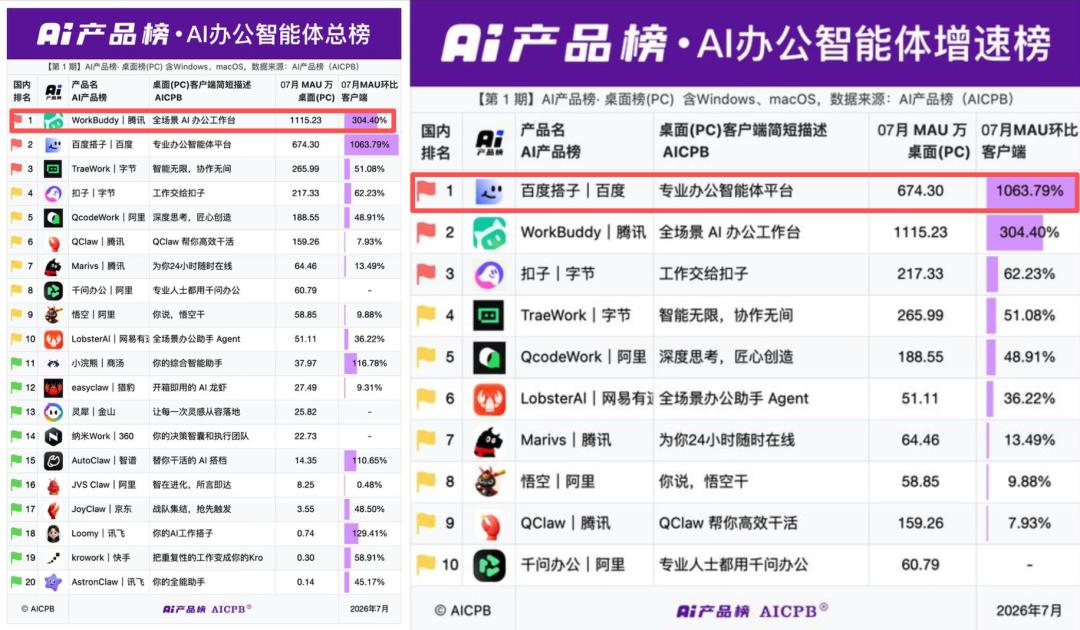
This ranking list is very long, almost all major internet giants have joined the competition, behind which the AI office market is expanding rapidly.
According to the *2026 Q2 China Office Agent Platform Market Insight Report* by Analysys, in June 2026, the total monthly visits of 17 mainstream domestic desktop AI-native office agents exceeded 60 million times. Compared with the data of 20 million times in March this year, the scale has tripled in just three months.
Moreover, users have a strong overall willingness to pay, and the industry has broad growth space. Data from iiMedia Research points out that 59.1% of users are willing to pay for AI office agents.
When we look at the global market, the same trend can be observed. Gartner predicts that by the end of 2026, 40% of global enterprise applications will be embedded with AI agents with task execution capabilities, while this proportion was less than 5% in 2025.
The industry has huge growth potential and a large number of track players, so the competition is naturally fierce. However, the two products WorkBuddy and Baidu DuMate have been advancing rapidly all the way, and the industry has gradually shown a trend of divergence.
A very important point is that these two products started earlier and obtained a very good initial position.
As early as 2024, Li Yanhong mentioned on multiple public occasions that agents are the future trend of generative AI, the most mainstream form of AI applications, and are about to reach the explosive point. He also emphasized that Baidu regards agents as its most important strategic direction.
When lobster-like products became popular before the Spring Festival this year, Baidu took a number of actions to integrate lobster functions into its own products, and at the same time actively explored more AI-native products that fit the production end. Shortly after the Spring Festival, Baidu DuMate (DuMate) was fully launched. Baidu's official expectation for this general agent is to enable AI to evolve from "capable of understanding and generating" to "capable of planning, executing and delivering".
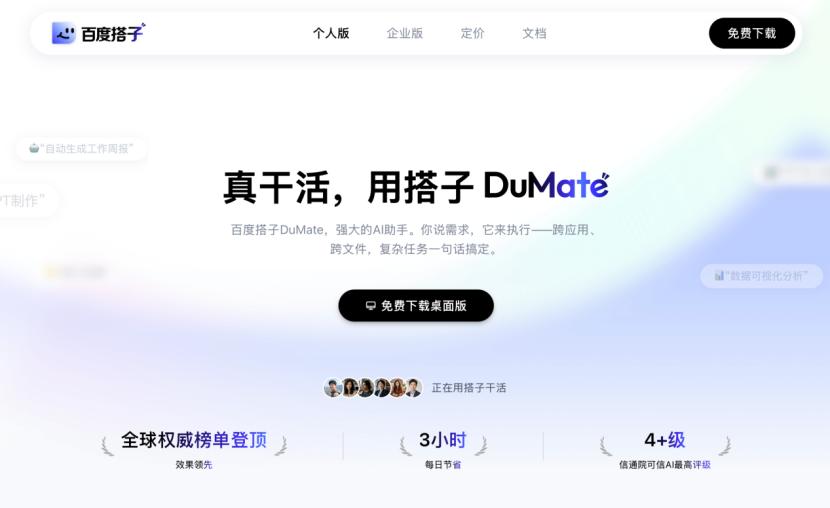
After that, Baidu DuMate iterated at a speed of three versions per week, and successively launched special capabilities such as design suite, self-media suite and finance suite, which can handle complex work in multiple scenarios. At the same time, it integrates many of Baidu's previous core AI capabilities such as Baidu Search, Netdisk and Map in the form of Skill. Users only need to put forward the target, and the back-end retrieval, analysis, generation, file processing, web page operation and result delivery can form a complete closed loop.
According to the July ranking released by the AI Product List · Website List, Baidu DuMate reached 8.97 million monthly visits, with a month-on-month increase of 845%, ranking second in the global overall growth rate list, and becoming the AI Agent product with the fastest growth rate in this list. In terms of the average daily number of queries, it has increased by 60 times since its launch in March, and was previously selected into the "Top 10 Most Practical Agents" released by Frost & Sullivan jointly with LeadLeo Research Institute.
As a key standalone product launched by Baidu Intelligent Cloud, its product launch rhythm has been very dense and high-standard in the past two quarters.
At the Create 2026 conference in May this year, Li Yanhong personally released the Baidu DuMate mobile APP, and put forward the "measurement standard" in the AI era for the first time, that is, the number of daily active agents (DAA). In his view, Token measures input rather than output. "To measure the prosperity of a platform and ecosystem, we should pay more attention to the DAA indicator, and focus on how many Agents are working for humans and delivering results." He also predicted that the number of global daily active agents may exceed 10 billion in the future.
Two months later, at the WAIC 2026 conference, Baidu DuMate appeared as the "treasure of the museum", becoming the only product of the same type selected among the top ten "treasures of the museum". According to the report released by iiMedia Research, agents are the most consistent main line throughout this conference. The number of exhibitors of AI Agent intelligent applications reached 83, accounting for 64%, while the number of exhibitors of basic large models was only 18, accounting for 13.8%. In such a high-density exhibition of agent applications, the selection of Baidu DuMate fully demonstrates its high recognition.
Earlier, Baidu DuMate also held the AIDAY event in Chengdu, releasing new capability upgrades such as the enterprise version, and the product's popularity and attention are gradually increasing.
All signs show that in the AI agent battlefield, Baidu DuMate is not only Baidu's most important move, but also a heavyweight player that cannot be ignored in the AI office field.
Behind the High Growth Rate
At a time when the AI office track is so crowded, why is Baidu DuMate the fastest growing?
A non-negligible background is that Baidu seized the opportunity to exert efforts quickly and won the time window for the transformation of the AI industry.
At the beginning of 2026, OpenClaw triggered the lobster craze around the world, and AI achieved a major leap from passive question-and-answer to active execution, which verified the feasibility of agents completing tasks independently in real scenarios on a large scale for the first time. While most companies were still waiting and seeing, Baidu had taken the lead in completing the access and implementation of OpenClaw.
In addition, from Li Yanhong's strategic prediction on the importance of agents in 2024, we can also see that Baidu had already made technical reserves before the lobster craze broke out. When everyone was still discussing whether to do it, Baidu was already figuring out how to do it better. At the beginning of this year, Baidu Intelligent Cloud launched multiple lobster-like products within a week, and Baidu DuMate was one of them.
If you start quickly but go in the wrong direction, there is no such thing as first-mover advantage. Baidu DuMate has a clear and accurate positioning to solve real problems, which is also an important factor for its subsequent rapid growth.
When most AI products on the market were still pursuing chat and dialogue experience, Baidu DuMate had already established the product positioning of "really getting work done". The fundamental difference between the two is that the former stops at answering, while the latter focuses on delivery.
Taking the office scenario as the key landing scenario, Baidu DuMate is not satisfied with simply generating or polishing a copy, but hopes to enable users to complete their work without taking steps and calling multiple tools separately. That is to say, users only need to give a goal, and Baidu DuMate can continuously complete data analysis, content organization and result delivery like a human.
Moreover, Baidu DuMate can provide corresponding one-stop solutions for office scenarios in different subdivided fields. After the launch of the self-media suite on July 10, Baidu DuMate launched the design suite and finance suite one month later, covering professional tasks such as content production, page making and financial analysis.
Obviously, this positioning fully hits the core pain points of knowledge workers, requiring the next generation of productivity tools to upgrade from "answering a question" to "reliably completing a task".
This means that the premise for AI to truly enter the enterprise workflow is that Baidu has proven back-end capabilities including large models, agents and AI Infra, which can be transformed into front-end products that users can use directly. It can be predicted that if the main way for enterprises to use AI in the future changes from "occasionally asking questions to models" to "letting agents complete work continuously", office agents are likely to become an important entry point for enterprise AI.
Moreover, in this process, Baidu has gradually found its own product advantage, which is also a strong demand on the user production side: the ability to complete long-term tasks.
The built-in Ernie large model and harness engine of Baidu DuMate can enable AI to maintain a correct path and normal actions when executing tasks that last for several hours or even several days. With the built-in long-term memory and data flywheel, Baidu DuMate also has the ability to evolve continuously, realizing the goal of "the more you use it, the more it understands you, and the smarter it gets".
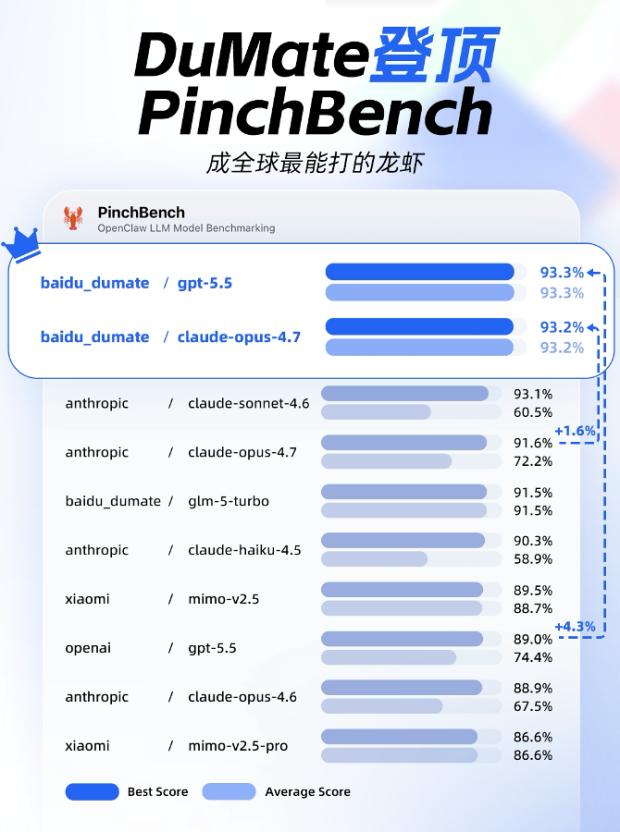
On May 8, 2026, Baidu DuMate topped the PinchBench agent evaluation benchmark list, taking the top two positions with total scores of 93.3% and 93.2%, surpassing the same models of Anthropic and OpenAI. This means that the same model shows stronger execution capability in the Baidu DuMate framework. In another DeepResearch in-depth research list, Baidu DuMate also ranked first.
At the same time, product iteration speed is also very critical.
Since its launch in March, Baidu DuMate has maintained an iteration efficiency of three versions per week on average. In mid-June, it completed the core engine upgrade, which reduced the Token consumption during task execution by 75% on the premise of ensuring the final effect remains unchanged, and the corresponding user point consumption was also reduced by 75%. It should be noted that normally, the most direct way for agents to reduce Token consumption is to use a smaller model or compress the task process, but this often comes at the cost of reduced performance.
The high growth rate of Baidu DuMate is not the result of a single point explosion, but the product of the combined force of strategic prediction, product positioning, technical capability and organizational efficiency in the same period of time.
Key Variables of the AI Agent Track
The past barbaric growth has proved that although parallel multi-product lines have produced many single-point functions, they also cause problems such as scattered computing power, overlapping positioning and torn user cognition. At present, internet practitioners have reached a consensus one after another: the AI industry has transformed from capability display to result delivery, and major manufacturers must gather the previously scattered model, tool, data and agent capabilities into a new productivity entry point.
At present, in the AI office track, WorkBuddy and Baidu DuMate have shown a trend of two strong players rising together, but the outcome of this battle is far from settled. Data from the AI Product List shows that the current total monthly active users of domestic AI office desktop terminals is about 30 million. If estimated according to the user scale of traditional office software, AI office still has about 20 times of growth space. Shen Dou, Executive Vice President of Baidu Group and President of Baidu Intelligent Cloud Business Group, also publicly stated that 90% of the work in the future may be deeply involved and assisted by agents.
As more and more office agents appear on the market, a non-negligible change has emerged: in the daily office scenarios, the capabilities between models are rapidly converging.
*LatePost* once explained that a truly functional agent consists of three layers of capabilities: the model is responsible for understanding and reasoning, Harness is responsible for calling tools, managing context and executing tasks, and the context comes from files, data, historical records as well as internal enterprise knowledge and rules. The first two layers determine whether the agent can get things done, and the last layer determines how well it can get things done.
However, in a large number of standardized office tasks, it is increasingly difficult for models to form a sufficiently large gap by relying on individual capabilities. In this case, what are the key variables that really determine the performance of AI agents?
It is certain that data will play a more important role. In the end, enterprises do not rely solely on an agent, but a set of work context accumulated around the agent. This is where the core competitiveness of AI office agents is most reflected.
Most of these contexts come from the massive data precipitated in the real work process. Whether it is documents, tables, pictures, videos, or meeting materials and project plans, they will eventually be precipitated as work files.
The massive file data accumulated over a long period of time from Baidu Netdisk, Search, Map and other products constitutes Baidu's biggest underlying advantage in entering the AI office field. For example, Baidu Netdisk has accumulated more than 1 billion users and more than 1000 billion GB of total storage space, which provides Baidu DuMate with core "raw materials". It can directly access and understand the assets in the disk when making PPT or analyzing tables, forming a data barrier that is difficult to surpass in the short term.
Moreover, Baidu DuMate is also continuously expanding more ecological capabilities. For example, it seamlessly integrates tools such as Miaoda and Famou; at the same time, based on Baidu Search AI API and Search Agent, it has higher accuracy and less hallucination in the information retrieval scenario; it connects third-party skills in office and life services.
After evaluating many general agents, a user found a unique feature of Baidu DuMate: it will not stay in place when blocked. For example, when using Apple products to query the price of a certain product, the macOS system security policy will block the operations of browsers and Apps. In this case, most Agents will automatically suspend the task and wait for the user to give new instructions.
The processing method of Baidu DuMate is that if the browser path is blocked, it will automatically switch to Baidu Search to complete the price query, and finally deliver a complete price summary.
Therefore, the "first place in growth rate" is only the opening report card. The real competition in the future lies in who can run through the real workflow more stably, who has deep precipitation of context data, and who can mobilize more ecological resources.
Baidu has a full-stack layout at the chip, model, intelligent cloud and agent levels: from Kunlun chip, Paddle framework, Ernie large model to agent and cloud services. This in-depth layout enables it to continuously improve computing power efficiency and reasoning efficiency. It always has available cards to play, so it can maintain continuous forward-looking strategic possibilities and a sense of stability during business advancement.
After all, running fast is one thing, and running stably is the normal state.
Although the AI office track is booming, some analysis believes that the product window is closing quickly on a monthly basis. Tian Feng, Dean of Fast and Slow Thinking Research Institute and the founding dean of the former SenseTime Intelligent Industry Research Institute, once said, "Entry-level products naturally tend to oligopoly."
That is to say, users are most likely to