Cao Xi and Zhiyuan invested in a post-95s entrepreneur.
Investment Digest has learned that humanoid intelligence company Current Robotics has disclosed its financing situation for the first time — it has completed seed round, angel round, and Pre-A round of financing, with a total cumulative amount of several hundred million yuan.
The investors include well-known market-oriented institutions such as BV Baidu Venture Capital, GL Ventures, Oasis Capital, Monolith Capital, Qianhai Ark, Fosun Chuangfu, Junshan Capital, as well as industrial parties including Zhi Yuan, StarSeas Map, Jike Technology.
The founder behind the company, Zhu Yichen, is a post-95s generation who led a team to carry out VLA research very early. He has published more than 40 top conference papers during this period, and his years of accumulated technical routes have condensed into a complete set of infrastructure covering full-body dexterous manipulation base model, data acquisition equipment and world model evaluation strategy, which continuously transforms real human behaviors into humanoid capabilities.
"Humanoid intelligence originates from human beings." Following the concept of Current Robotics, we are witnessing robots starting to move from demonstration platforms to thousands of households.
Post-95s Technical Expert Quickly Completes Three Rounds of Financing
The history of Current Robotics began with Zhu Yichen.
Born after 1995, he was the former minister of the Embodied Intelligence Department of Midea Group, and one of the first researchers in China to release VLA and world models. He once led the team to first propose the end-to-end VLA paradigm of diffusion model and VLM (TinyVLA), and expanded the CoT strategy (DiffusionVLA & DexVLA, published in ICML and CoRL). He was also the first to propose the application of world model in embodied strategy evaluation (dWorldEval, published in ICML Spotlight).
The π0 paper of Physical Intelligence has cited research results from only one Chinese team, which is exactly the TinyVLA and ScaleDP work completed by Zhu Yichen's team. Since then, these researches have gradually extended from VLA models and human demonstration data to full-body robot learning, and have become the technical foundation of Current Robotics.
Starting a business came naturally. Zhu Yichen observed that in the past, humanoid robots either focused on full-body motion control to make robots better at "walking", or focused on hand manipulation to make robots better at "grasping", which finally presented the scene of "walking over first and then stopping to operate". But tasks in the real world are often not so simple. Even a simple action faces the challenge of stable coordination between hands and body.
This requires "Loco-Dexterous Manipulation". The solution given by Current Robotics is system integration, which puts full-body movement, posture coordination and fine hand interaction into the same strategy for training. The resulting full-body dexterous manipulation model Curr-0 enables the robot to continuously adjust its movements during movement. The five types of publicly available tasks are completed by a set of strategies with shared weights, and are distinguished through language instructions.
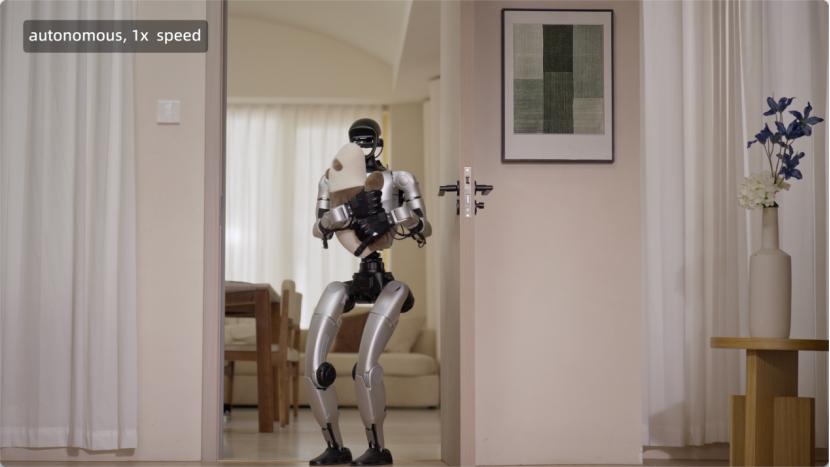
The robot holds an object through the door frame and places it at a specific position
With the model in place, more landing details come one after another — first is data. Current Robotics has independently developed a full-body exoskeleton data acquisition system, which expands the acquisition scenarios from laboratories to more real environments such as factories, offices and homes. The second is faster evaluation and iteration, exploring the use of world models to evaluate real robot strategies.
Up to now, the company has focused on Loco-Dexterous Manipulation, and has formed full-link technical capabilities covering data acquisition, model training, world model-based evaluation and post-training, aiming to improve the robot's motion manipulation and capability generalization in different tasks and environments.
This is very rare at the moment when embodied intelligence is generally short of practicality, data and generalization. Therefore, Current Robotics received collective bets from well-known market-oriented institutions as soon as it was established, and the degree of favor is self-evident. What is even rarer is the joint participation of industrial parties. In addition to funds, the more important significance lies in industrial coordination.
Investment Digest has learned that Current Robotics has joined the Yishu Intelligent Data Ecosystem Alliance initiated by StarSeas Map, and will jointly build a complete link from data acquisition, annotation to application. In addition, the company is also a strategic partner of Mifeng Technology, an embodied intelligence data platform under Zhi Yuan.
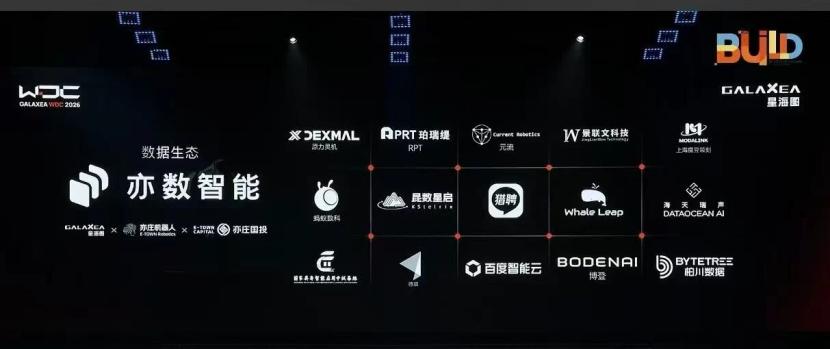
Providing capital, orders and ecological support, this kind of investment method is particularly distinctive in the era of embodied intelligence. After all, only with scenarios can a data flywheel be formed, so that robots can have the ability to work stably in the real world at lower cost and in shorter time.
Build Embodied Intelligence Infrastructure
From the very beginning, Current Robotics has focused on the gaps in the existing embodied intelligence technical routes.
For example, to light up a coil of mosquito-repellent incense, a natural idea is that the robot first walks to the corresponding position, and then stops to operate. The corresponding technical solution is to train the motion strategy and manipulation strategy separately, and finally combine them with system engineering. This idea works in factory assembly lines, but once it enters real scenarios such as homes, there will be obvious cracks between movement and manipulation.
This is not difficult to understand: even if the robot stands still to complete desktop tasks, the waist and lower limbs still need to be adjusted according to the movements of the upper body. If only the "splicing" method is adopted, once the body tilts and the force application mode of the hand is damaged, the robot will appear clumsy.
The full-body dexterous manipulation base model Curr-0 released by Current Robotics is born for coordination — it realizes hand-foot coordination through full coupling of navigation movement, whole-body balance and dexterous hands. For fine tasks that are difficult to be simply divided into two stages of "walking" and "operating", such as tearing tea bags, cleaning desktop garbage, and holding objects through door frames, Current Robotics' solution has shown excellent performance.
After the model is completed, the data source also needs to be updated synchronously. The mainstream first-person collection can cover rich environments and behaviors, but cannot accurately restore physical interaction information such as human motion state and contact force; the ontology teleoperation collection has higher precision, but is limited by equipment and cost and more difficult to scale up.
Can we efficiently collect data that reflects the environment, body movement and physical interaction at the same time? Based on this, Current Robotics has independently developed a full-body data acquisition device, which records the first-person vision, movements of both hands and whole body, and the force on the whole body of people in real scenarios through head-mounted devices, data gloves, full-body exoskeletons and electromyographic devices. The whole process does not need to deploy a robot in advance. In this way, the data collection scenario is directly extended to real human tasks, which not only has better cost and applicability, but also can support the real data required by the humanoid robot brain.
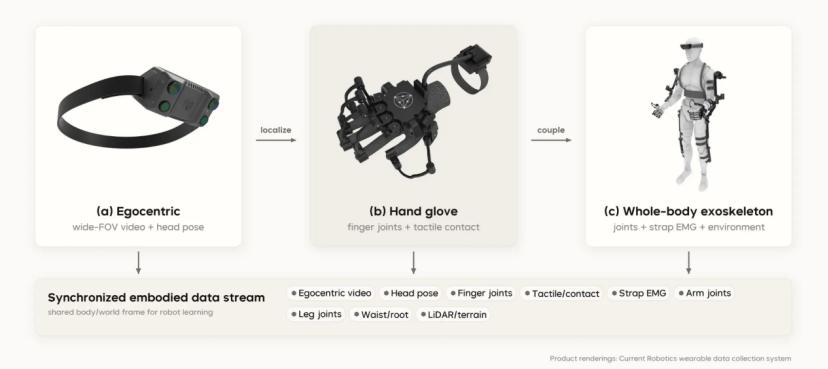
HumanEx Wearable System
The last part is the evaluation and post-training link. The traditional real machine evaluation relies on robots, sites and manual reset, and the cost of test hardware, time and scenario reproduction is relatively high. Especially in tasks where the contact state changes continuously, it is difficult to accurately return the environment state to the previous moment after failure, which will directly affect the efficiency of model iteration.
Based on this, Current Robotics began to explore the use of world models to undertake robot strategy evaluation very early. The team successively proposed WorldEval and dWorldEval, which execute robot strategies in the generated future world, and evaluate the strategy performance by predicting the task process. Then in Hi-WM (Human-in-the-World-Model, published in RSS 2026 Robot World Models Workshop), manual intervention is further added. When the strategy has errors or uncertain situations, humans can directly intervene to correct, and the new interaction trajectory can be continuously used for post-training.
The CurrentWorld-0 released this week further pushes Current Robotics' previous strategy evaluation and post-training work around the world model to a more complete interactive environment. The team defines it as an Interactive World Simulator, and integrates cross-ontology, multi-view and force-tactile prediction into a unified framework for the first time.
Once the robot replaces its ontology, the action space and control method will also change accordingly. It is difficult for different robots to share the same set of low-level control representations, but CurrentWorld-0 well preserves these differences, allowing different robot platforms to act in their own way, and then learn the shared environmental dynamics from cross-platform interactions.
After the ontology difference is solved, the new problem falls on "how to perceive". Real robots often rely on head, wrist and third perspectives at the same time. The pictures of the same task from different camera positions are very different, but the object state, robot posture and task process behind them cannot be separated from each other. When an object has been pushed away in one view, other views must change synchronously; even if it is blocked halfway, the subsequent state must continue the previous interaction.
When the robot actually comes into contact with the object, RGB will soon expose its limitations. Whether the grasp is stable, how the force at the end changes, and whether the object has a sliding trend cannot always be directly judged from the picture. Therefore, CurrentWorld-0 further incorporates force sense and tactile sense into the prediction, so that the physical feedback that is difficult to be covered by vision during the contact process can also change continuously with the action.
From stacking socks and sorting pillows to peeling cucumbers, opening bottles and pouring wine, CurrentWorld-0 is not limited to rigid body manipulation. Flexible objects, fluids and complex contacts are all integrated into the generation environment. In the strategy evaluation stage, the model must also continuously respond to the actual actions performed by the robot: if the policy has already grasped with deviation, the subsequent state cannot be brought back to the common success trajectory by the video prior, and the failure records that should have been exposed need to be retained instead of being "corrected".
This is also the basis for CurrentWorld-0 to be used for strategy comparison. Robot strategies can be run, compared and exposed to failure modes in the generated environment first, and then the results can be compared with the performance of the real machine. The results announced by the team show that the relative performance of different policies can well correspond to the real robot test, and the main failure modes in the real machine execution can also be reproduced in the generated environment.
After the evaluation, these failure experiences can continue to be utilized. When the strategy runs to a position where errors are prone to occur, humans can take over midway; even the same intermediate state can be saved, rolled back, and then different recovery methods can be tried from there. The resulting corrective trajectories can also be continuously used for policy post-training, so that the problems exposed in one evaluation can be further transformed into the next round of training data.
At this point, CurrentWorld-0 has formed a relatively complete model evaluation and post-training collection link: the strategy is first verified in the generated environment, after the problems are exposed, new interactive experience is supplemented through human correction, and then the process continues to enter post-training.
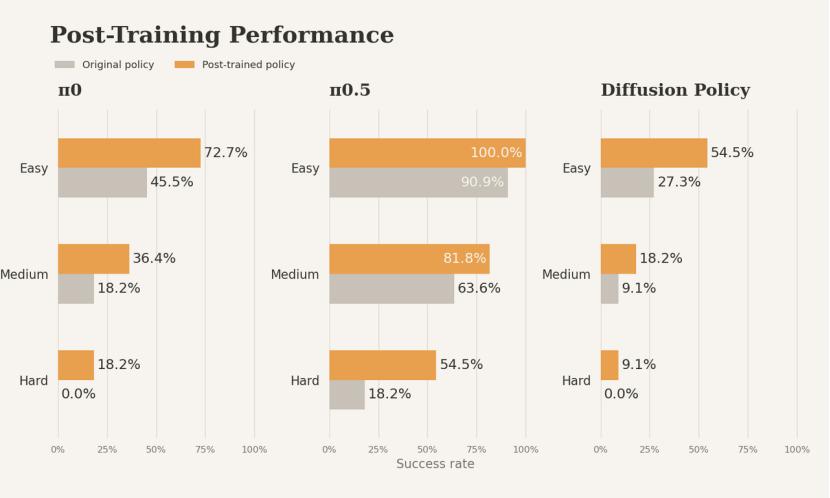
[Results after CurrentWorld-0 multi-modal correction trajectories are used for post-training]
As a result, Current Robotics has gradually formed a data, model and evaluation system around full-body dexterous manipulation: real data provides physical experience, the model is responsible for transforming these experiences into movement and manipulation capabilities, and the world model continues to undertake strategy verification, failure correction and post-training, so as to promote the continuous iteration of robot capabilities.
The Critical Leap, Robots March Towards the Real World
"When will robots be able to work practically?"
As we can see, embodied intelligence is shedding the coat of story-telling and entering the "handing in answer sheet" stage of competing for implementation. No matter how beautiful the Demo is or how gorgeous the performance is, it must finally land in real task scenarios, which is far more complex and rough than the conceptual model —
On the one hand, the traditional fixed station-type manipulation only touches a very narrow part of physical labor, and most real tasks require movement between spaces. On the other hand, the robot is facing a continuous, complex and inexhaustible real world, and the training and iteration workload behind it is immeasurable. A set of efficient and simple data acquisition and processing methods is urgently needed.
From HumanEx, Curr-0 to CurrentWorld-0, Current Robotics is connecting real human experience, robot capability learning and subsequent evaluation iteration to achieve full-stack closed loop: the front end collects real behaviors, the middle part forms full-body dexterous manipulation capabilities, the strategy then enters the world model for verification, and new data generated near failures flows back for training continuously.
The more core highlight lies in starting from the end and keeping the final goal in mind.
The market is voting with real money, and the industry dividend of embodied intelligence only belongs to those who can truly implement and create real industrial value. During this period, industry competition extends from manufacturing ontologies to competing for data and infrastructure. The one who can take the lead in building the evolution barrier of data and next-generation models can gain an advantage in the new round of iteration.
In this regard, Current Robotics has given a very end-game oriented answer — first assume that the data is infinitely large, and then design the solution based on the real operation mode of human intelligence. As a result, navigation, body balance and hand movements can be fully coupled, localization is integrated into the end-to-end process, and data collection can also get richer details in the real workflow.
The ending part of the book "The Great Gatsby" is well known: "So we beat on, boats against the current, borne back ceaselessly into the past." This is exactly the origin of the name Current Robotics — to overcome the limitations of existing technologies, go upstream, and build a bridge between human experience and humanoid robots. Just as the company's logo is inspired by Leonardo da Vinci's "Vitruvian Man", a symbol that regards the human body as the symbol of movement, proportion and design scale.
Current Robotics Company Logo
After all, the source of humanoid intelligence is still human beings. Through wearable devices to collect data, simulate human movement to build the base model, combined with manual intervention for evaluation and post-training, what Current Robotics is doing is to continuously transform real human behaviors into stronger humanoid capabilities through hardware, data pipeline and model closed loop.
Current Robotics' wearable collection system captures a signal called "incidental human behavior" —