Skyrocketing Moderna: A four-year-long battle to vindicate mRNA technology
In August 2021, Moderna's share price hit an all-time high of $484, with its market capitalization approaching $200 billion, once surpassing Merck, a century-old pharmaceutical company. At that time, the capital market believed that mRNA was the new continent in the history of human medicine, and Moderna was the one holding the map.
The map later proved to be real, but the first gold mine dug on this new continent, the COVID-19 vaccine, was exhausted after only five years.
After the epidemic dividend faded, Moderna's revenue plummeted from $19.2 billion in 2022 to less than $2 billion in 2025, with four consecutive years of revenue decline and accumulated losses of billions of dollars. By the beginning of 2026, although the former "Vaccine King" still had $6.9 billion in cash on its books, the capital market only valued it at the "option value" of a cancer vaccine that had not yet proven its efficacy.
On August 19, 2026, this option was exercised.
Ahead of US stock trading that day, Moderna and Merck jointly announced the results of the Phase III INTerpath-001 clinical trial: the personalized mRNA cancer vaccine intismeran autogene combined with Keytruda simultaneously met the primary endpoint (Recurrence-Free Survival, RFS) and key secondary endpoint (Distant Metastasis-Free Survival, DMFS) in 1137 patients with high-risk melanoma, both with statistical significance.
This is the world's first mRNA cancer therapy to achieve Phase III success, and also the first personalized neoantigen therapy to succeed in Phase III. As soon as the news came out, Moderna's pre-market share price soared by more than 100% at one point, Merck rose by about 7%, BioNTech followed up by 10%, and the entire mRNA sector rallied collectively.
For Stéphane Bancel, CEO of Moderna, the significance of this day goes far beyond the share price. Over the past four years, he has repeatedly told investors the same story: mRNA is not equal to COVID-19, it is a platform technology, and the second act of this platform is oncology. Now, the story finally has its first set of hard data.
But beyond the carnival, a more stern question is also on the table: passing the Phase III endpoint is only getting the admission ticket. For mRNA cancer vaccines to truly become a viable business, there are still four major mountains to cross: production, cost, pricing and regulation.
01 A "counterintuitive" technology: Why can vaccines cure cancer?
The public's understanding of vaccines remains at "preventing problems before they happen": inoculating inactivated viruses to let the immune system practice in advance. But intismeran takes a completely different path. It does not prevent diseases, but treats conditions that have already occurred.
The logic starts with the "individuality" of tumors. The academic community discovered very early that everyone's tumor carries a unique set of gene mutations, just like fingerprints. Some of these mutations are exposed on the surface of cancer cells, forming so-called "neoantigens", which do not exist on normal cells, so in theory they can be accurately recognized by the immune system.
The problem is that tumors are very good at "playing dead". Neoantigens are exposed, but immune cells often turn a blind eye, because the tumor microenvironment suppresses the immune response. This is why the human body produces mutated cells every day, but most people do not get cancer — and those who do get cancer are often the result of this surveillance system being breached.
The design of intismeran splits this process into two steps:
Step 1: Identify the target. After surgically removing the tumor, perform gene sequencing on the patient's tumor tissue, screen out up to 34 unique mutations that can activate the immune system, and encode them into a synthetic mRNA. This step is customized for each patient, and it takes about six weeks from sampling to finished drug.
Step 2: Release the brake. After the mRNA is injected, it translates neoantigen proteins in the body to train T cells to recognize residual cancer cells; at the same time, Keytruda (a PD-1 inhibitor) removes the tumor's suppression of the immune system, allowing the activated T cells to act freely.
One is responsible for "portraiture" and the other for "unbinding". This combination is almost perfect in concept. But between concept and therapy, there is a history of more than ten years of failures.
Therapeutic cancer vaccines are the "Holy Grail" that has plagued the oncology field for more than a hundred years. Over the past two decades, Pfizer, Sanofi, and Novartis have all failed in the development of personalized tumor vaccines, for various reasons: inaccurate antigen screening algorithms, insufficient intensity of immune response, and lack of synergistic drugs when used alone. The prostate cancer vaccine Provenge, approved in 2010, is also the only therapeutic cancer vaccine ever approved by the FDA so far, but it ended in a dismal commercial performance. Its high personalized production cost made it a famous "lesson learned" in the industry.
The reason why Moderna and Merck's solution has come to this day is not a single-point breakthrough, but the fact that three things have matured at the same time: the plummeting cost of sequencing, the advancement of neoantigen prediction algorithms, and the ready-made "unbinding" partner Keytruda.
As for why melanoma was chosen as the first indication? The answer is almost blunt: Melanoma is one of the tumors with the highest mutation burden. The more mutations there are, the more neoantigens available for screening, and the greater the design space for vaccines. Choosing the easiest battle to fight first to prove the technology is feasible — this is a very classic strategy in clinical development.
02 The 10-year pact: A marriage with each party's own agenda
In 2016, Merck and Moderna signed a cooperation agreement for personalized cancer vaccines. At that time, there were still three years before the COVID-19 outbreak, Moderna had not yet gone public, and mRNA was still a controversial term in the academic community; while Merck had just reached the top in the tumor immunology track with Keytruda, and was at the height of its success.
Looking back ten years later, both parties in this marriage had their own agendas, but both bet correctly.
For Moderna, it is a story about "survival".
COVID-19 allowed Moderna to cash in the value of its mRNA platform ahead of schedule, but it also left a fatal structural problem: more than 90% of the company's revenue came from a single product, and the market for this product was visibly disappearing.
From 2022 to 2025, Moderna's COVID-19 vaccine revenue dropped from $18.4 billion to less than $100 million per quarter. Transforming to oncology has gone beyond a strategic choice and become a survival choice. Bancel did not hide his attitude after the results were announced — "We are now an oncology pharmaceutical company", and predicted that the company would achieve its first sales rebound in four years around Christmas 2026.
For Merck, it is a story about the "relay baton".
Keytruda is one of the best-selling drugs in the history of human medicine, with sales of $8.03 billion in the first quarter of 2026 alone, heading for $30 billion for the full year. But it faces the fate of all blockbuster drugs: patent expiration. Keytruda's key patents will begin to expire in 2028, and the generic drug "machine guns" are already set up.
The value of intismeran to Merck is therefore very subtle: it is not just a new product, but a "life extension device" for Keytruda. Because the usage of intismeran is combined with Keytruda, every time a dose of the vaccine is prescribed, a dose of Keytruda is consumed at the same time.
In other words, even if Keytruda's patent expires, the "intismeran + Keytruda" combination can still maintain pricing power as a new therapy. This is a classic tactic for oncology pharmaceutical companies to deal with the patent cliff: use incremental innovation to extend the commercial life of old drugs.
"By intervening at an earlier stage of the disease, when many cancers are considered most treatable, the goal of adjuvant therapy is to give more patients the chance of a cure." — Dean Y. Li, President of Merck Research Laboratories.
One wants a new story, the other wants a relay baton, and the two demands fit perfectly on one molecule. This kind of "mutually beneficial" cooperation is often the most stable cooperation in the industry.
03 From 157 to 1137: Ten years of a data chain
The carnival of the capital market last night was not unexpected in the strict sense. It was more like a rally waiting for the shoe to drop.
The verification chain has long been laid out. As early as 2023, the three-year follow-up of the Phase II KEYNOTE-942 (157 patients) gave the first signal: the combination therapy reduced the risk of recurrence or death by 49%. At the ASCO Annual Meeting in early 2026, the five-year follow-up data further consolidated the results — the risk of recurrence or death was reduced by 49% (HR=0.51), the risk of distant metastasis or death was reduced by 59% (HR=0.411), and the five-year overall survival rate was 92.2% vs 71.3%.
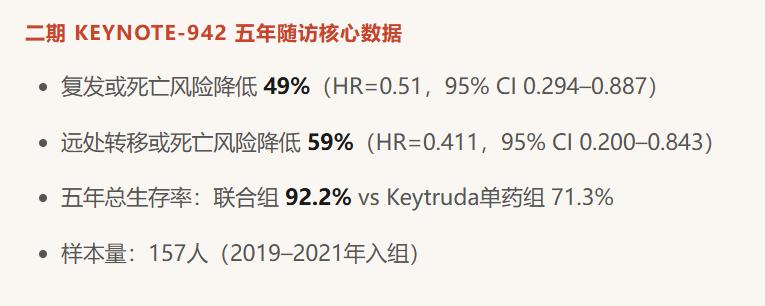
Figure: Core data of 5-year follow-up for Phase II KEYNOTE-942
Therefore, the Phase III results announced on Wednesday essentially put the signal from 157 people into a sample of 1137 people for recheck: INTerpath-001 was randomly grouped at a ratio of 2:1, the treatment group received intismeran (1mg every three weeks, up to 9 doses) combined with Keytruda (400mg every six weeks), and the control group received Keytruda alone, with a total treatment course of about one year. The results confirmed that both RFS and DMFS achieved statistical significance and clinical meaning, and for the first time proved that the efficacy is better than Keytruda monotherapy, the current standard of care.
But there is a detail that is easily overshadowed by the surge in share prices: The Phase III announcement only released the topline (whether the endpoint is met), not the specific data. How much the combination therapy reduces the risk of recurrence, how many months the recurrence-free survival is extended, and what the HR value is — these numbers that determine clinical value and pricing space will not be announced until subsequent international medical conferences.
In other words, what the market bought on Wednesday was "the direction is correct", not "the magnitude is clear". The difference between the two is often a matter of life and death in pharmaceutical investment. Whether the 49% risk reduction in Phase II can be replicated in a sample of 1137 people directly determines whether this drug is a "me-better" or a "breakthrough therapy".
In addition, the overall survival (OS) data is not yet mature, and the trial is still under follow-up. Whether the improvement of RFS can be translated into OS benefit is the most important question mark in FDA approval.
This is why Bancel's goal of "launch in 2027" was widely reported, but the two companies only stated cautiously in their announcements that they "will communicate with regulators about the submission", meaning that the specific submission time is not yet determined. After all, the road from passing the Phase III endpoint to approval is never guaranteed to be smooth.
04 After the carnival: Four major mountains
Assuming everything goes well and intismeran is approved as scheduled, will it be a good business? Not necessarily. The real test comes after approval, and those tests have been previewed for everyone by Provenge.
The first mountain: Production. Traditional drugs are produced in millions of doses with one formula, while intismeran requires one production line for one patient. From tumor biopsy to vaccine release, it takes about six weeks, and every link — sequencing, algorithm screening, mRNA synthesis, quality control — has to be repeated for a single patient.
This means that the way to expand production capacity is not to "increase batch size", but to "replicate production lines", and its marginal cost curve is completely different from that of the traditional pharmaceutical industry. Moderna has built a dedicated production facility in Marlborough, Massachusetts, but it is prepared for clinical supply at the scale of thousands of people; if the real demand for adjuvant therapy for melanoma is tens of thousands of people per year, the production capacity gap is a problem of order of magnitude.
The second mountain: Cost and pricing. Personalized production is inherently expensive. Provenge was priced at $93,000 per course of treatment in its time, which was still not enough to cover the cost structure, and eventually its developer Dendreon went bankrupt. The full course of intismeran combined with Keytruda (Keytruda itself has an annual treatment cost at the $100,000 level) plus six weeks of customized production is destined to be not cheap.
Barclays predicts that by 2035, the melanoma indication alone can contribute about $3 billion in annual revenue. This is a considerable number, but compared with Moderna's peak revenue of $19 billion, it is a "life-sustaining drug", not a "savior".
The third mountain: Accessibility and payment. Markets outside the United States are more tricky. There is structural friction between personalized therapies and the medical insurance systems of various countries that pay for treatments by indication. Medical insurance pays for "one course of treatment", while intismeran pays for "one customized project for one patient". The FDA itself is still exploring how to define the "batch" and "quality standard" of such products in regulation.
The fourth mountain: Uncertainty of indication expansion. Success in melanoma does not mean success in all areas. There are 8 more Phase II/III trials under the INTerpath program, covering non-small cell lung cancer, bladder cancer, renal cell carcinoma, as well as Phase I explorations for pancreatic cancer and gastric cancer.
In theory, tumor types with higher mutation burden are more suitable for this strategy, but the adjuvant treatment pattern of lung cancer and bladder cancer is far more competitive than that of melanoma. There are not only Keytruda, but also heavy deployments from AstraZeneca, Bristol-Myers Squibb, and Roche.
Another detail worth remembering is that before the surge on Wednesday, Moderna's short positions accounted for about 13.5% of the outstanding shares, nearly 50 million shares. This means that a considerable part of the more than 60% increase that day was not longs buying into the belief, but shorts being forced to buy to stop losses. The share price pushed up by short squeezing will eventually have to be supported by fundamentals.
05 Epilogue: The second act of the platform
Zooming out a bit, what was really proven last night was not a vaccine, but the "transferability" of a technical route.
Over the past five years, mRNA has been labeled with two kinds of tags: first as "the terminator of the century-old plague", then as "the remnant of the epidemic concept stock". Moderna itself is a specimen of this narrative tear. It has the production capacity, delivery technology and billions of dollars in cash accumulated in the COVID-19 era, but no new product that can support its valuation. Bancel's oncology narrative has been told for four years, and the market was skeptical, with the share price falling from $484 to the double digits at the lowest point.
The significance of INTerpath-001 is that for the first time, it uses Phase III evidence to prove the logic that "the mRNA platform can be systematically transferred to oncology".
This does not mean that mRNA will be invincible from now on — the failure of norovirus vaccine is still fresh in people's memory. Instead, it means that the commercial model of this platform has changed from "one-time government orders" to "long-term payment for chronic diseases", and from "responding to public health emergencies" to "entering the $240 billion oncology drug market". The latter is the story structure that the capital market is willing to give a high valuation to.
For Chinese mRNA players, this signal is equally important. In the past few years, the narrative of domestic mRNA companies has almost completely been tied to COVID-19 and influenza. The Phase III success of intismeran provides the world's first systematic verification for the "personalized oncology vaccine" track: the business closed loop of neoantigen screening, personalized production, and combined administration is feasible. Now that the road is open, the next