Is it possible to build a high-quality car within 18 months?
Is it really possible to develop a well-qualified vehicle in less than two years?
Recently, around this question, several senior executives of automobile enterprises hold completely opposing views.
Li Fenggang, General Manager of Beijing Hyundai, stated bluntly at the China Automotive Forum: "Some enterprises skip many due tests to launch products quickly, and eventually make consumers become test drivers."
"Some joint-venture automakers cannot achieve it themselves, so they criticize us for doing wrong and label us." A few days later, Lu Fang, Chairman of Voyah Automotive, gave an unceremonious remote response in an interview.
He believes that development speed is not the only criterion for judging vehicle quality. If all necessary development and verification are completed, the product is not a "hastily-made vehicle", but an "efficiently-developed vehicle". Moreover, with scientific technical and management methods, efficient development can be achieved.
Although the industry has been arguing endlessly about "hastily-made vehicles", an indisputable fact is that all multinational automakers are now following the pace of Chinese automakers to compress the vehicle development and iteration cycle.
Some joint-venture automakers even publicize "keeping product iteration up to China's speed" as an advantage of a new joint-venture model.
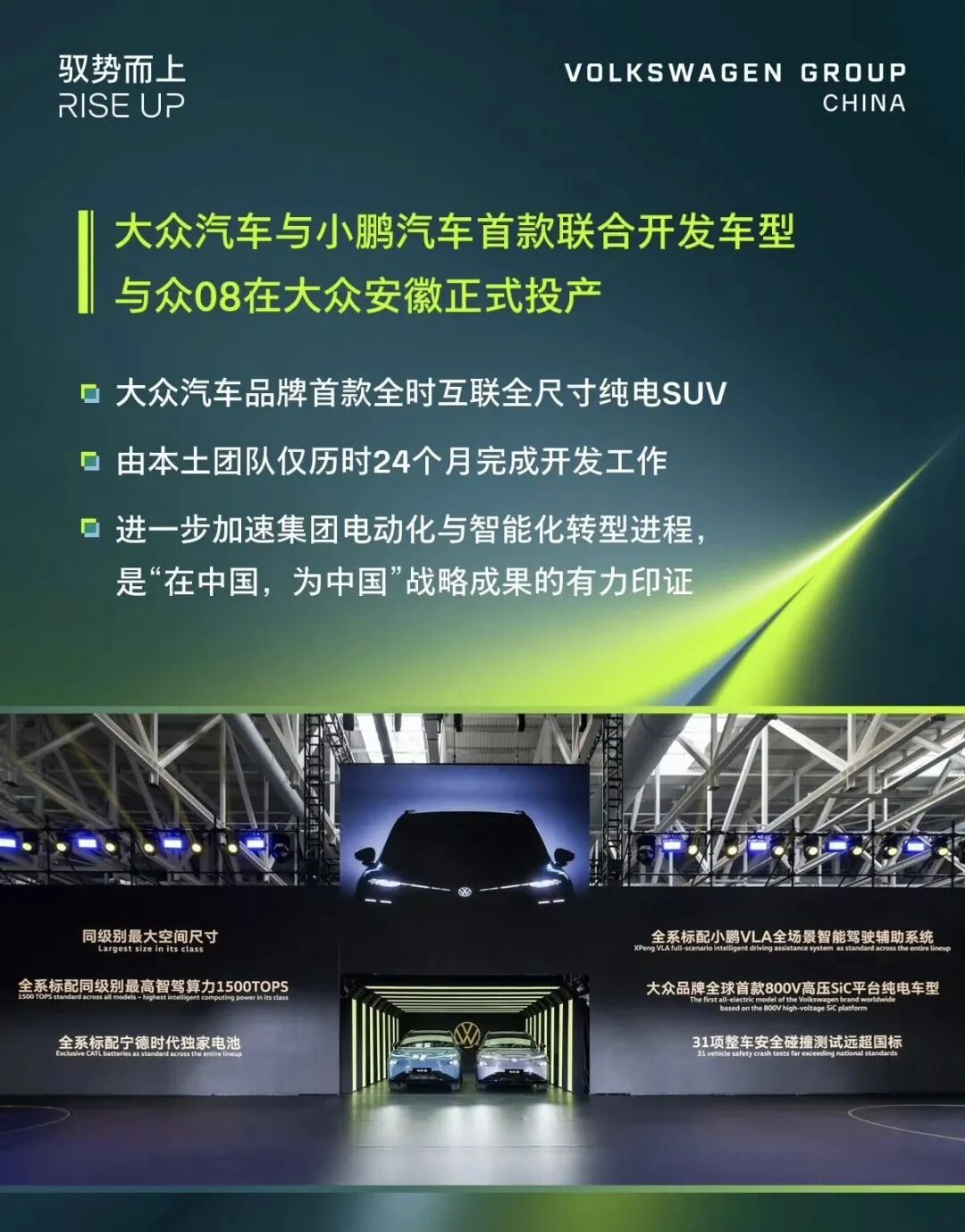
The 24-month development cycle of the Zunyi 08 is regarded as a publicity highlight
For example, Volkswagen Anhui claims that the development cycle of Zunyi 08 only took two years. The Shenxingzhe 8, which has entered the pre-sale stage, also claims that it completed the development of the whole vehicle in about two years.
Audi and SAIC jointly developed a China-exclusive intelligent electric vehicle platform, and the first AUDI E5 Sportback only took 18 months from development to mass production.
In addition, the three declining Japanese auto giants (Honda, Toyota, Nissan) also announced that they will learn from China's model to accelerate product development and iteration.
In April, Nissan announced that it will compress the development time of new models from 50-55 months to 37 months, shorten the cycle of derivative models to less than 30 months, and reduce the R&D cycle of models led by joint ventures to less than 24 months.
Honda did not give a specific timetable, but also put forward the goal of halving development costs, development cycles and development man-hours at its global strategy conference in May.
Toyota is more conservative and has not announced a similar unified target plan, but the BZ7 developed by GAC Toyota also took only about 18 months from planning to its global debut.
Of course, while speeding up, these automakers also claim publicly that they will complete all necessary verification links to ensure the delivery quality of vehicles.
Is this a one-sided statement, or can it really be achieved? First of all, we need to figure out how the R&D cycle of a vehicle has been cut from more than three years to two years or even shorter.
NO.1 [From 36 months to 18 months, how is the time saved?]
From official project approval to SOP mass production, a vehicle generally goes through four stages: scheme definition, engineering development, test verification, and mass production introduction.
For the purpose of risk control, traditional automakers emphasize the maturity of each stage. Usually, they will not move on to the next stage until the current stage is sufficiently mature, and the process becomes more rigorous as it moves forward.
The reason is not hard to understand: if a problem is found in the design stage, it may only be necessary to modify the drawings. But in the real vehicle verification stage, it may be necessary to adjust the molds, parts, production lines and subsequent verification links together.
Therefore, the entire development process of traditional automakers takes 3-5 years, and a considerable part of the time is used to ensure the maturity of each link and reduce the risk of expensive rework in the later stage.
This also means that shortening the development cycle cannot be simply equated with cutting corners and reducing necessary processes, because the development process of traditional automakers itself has many links that can be compressed.
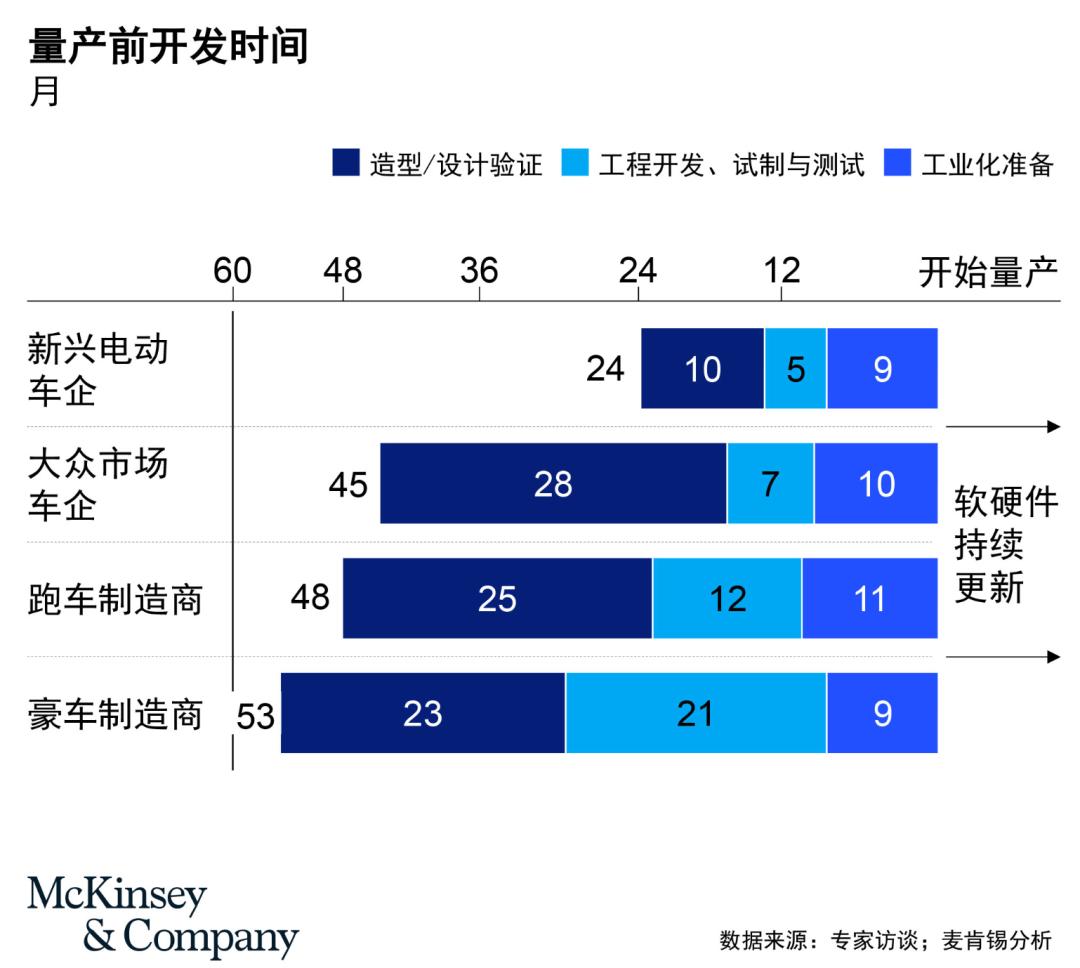
McKinsey data shows that the development cycle of emerging electric vehicle enterprises has been greatly shortened
The first stage: scheme definition.
At this stage, automakers need to convert the general direction determined at the time of project approval into specific product and technical indicators, such as body size, performance targets, power form, adopted platform and main system architecture.
The most direct way to save time here is to reduce the content that needs to be redefined.
If the platform, three-electric system, electrical and electronic architecture, and a large number of core components of a vehicle are all redeveloped, it is obviously unrealistic to compress the cycle to 18 months. But if it is built on a mature system, it is not impossible.
In fact, Toyota's TNGA architecture and Volkswagen's MQB modular platform essentially reduce the work of developing each new car from scratch by improving the reuse rate of platforms and components between different models.
On new energy vehicles with simpler vehicle structure, the scope of reusable components between models on the same platform is further expanded, and many mature modules can be more easily shared between different models.
This can not only reduce a large number of definition work, but also save repeated design and tests caused by partial changes.
According to McKinsey's statistics, Chinese new energy automakers can shorten the development cycle by 1-3 months by streamlining product portfolios, standardizing components, adopting modular design and improving cross-model reuse rate.
The second stage: engineering development.
This stage requires a large number of design, calculation, prototype trial production and modification, until each system gradually matures and reaches the state of physical verification.
Due to the large number of participating departments and frequent modifications, this stage itself has great potential for efficiency improvement.
For example, let procurement, manufacturing and suppliers get involved in the project earlier, and judge the feasibility of cost, process and supply in advance before the scheme is fully finalized;
Some automakers also follow Huawei's practice, with a small number of core principals quickly handling issues such as product positioning and design changes, shortening the decision-making chain and reducing the time occupied by layer-by-layer reporting and repeated reviews.
Apart from processes, another important change comes from simulation.
This is not a technology that emerged in recent years. But with the progress of computing power, model accuracy and development tools, more design schemes can be simulated and compared in the same time, which also makes subsequent physical tests more likely to pass at one attempt.
Of course, simulation is ultimately the calculation of real products, which can reduce trial and error in development, but cannot replace verification. Whether the final manufactured product meets the requirements of durability, safety and other aspects still needs to be confirmed by corresponding real vehicle tests.
However, this method of combining a large number of simulations with a small number of real vehicle verifications does reduce the cycle of "trial production - problem discovery - modification - re-trial production".
The third stage: test verification.
Although problems will be found and solved in advance through simulation and other means in the engineering development stage, the completion of design does not mean the end of development.
Components, systems and the whole vehicle still need to go through performance, safety, durability and environmental tests such as high and low temperature tests, to confirm that they can meet the design requirements under specified service conditions and within the service life.
In the development process of traditional automakers, this single item alone may take nearly two years, and the compression of this stage is also the most prone to problems.
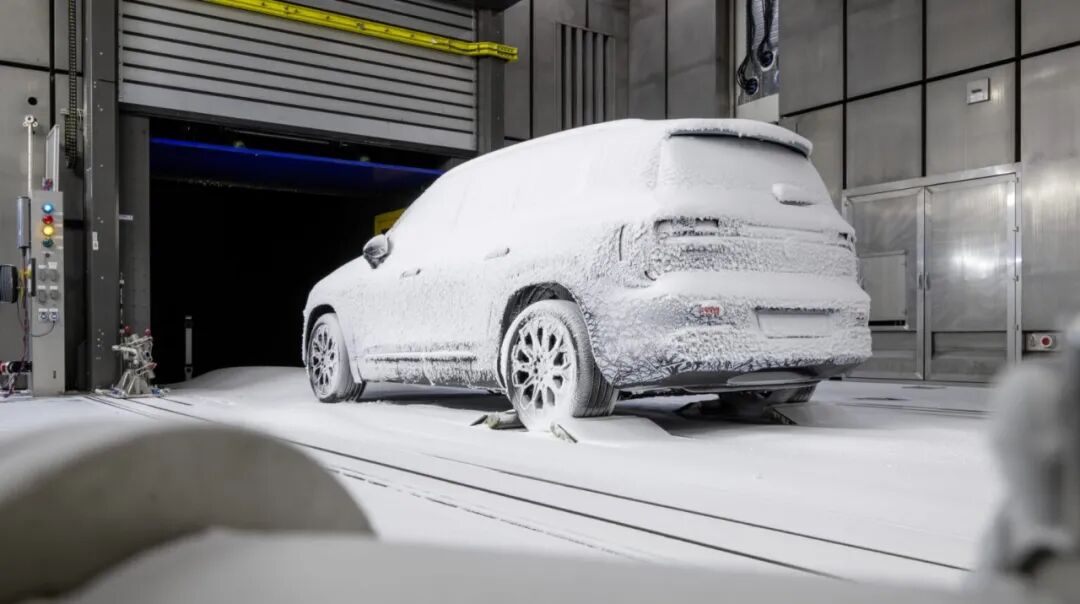
The cold climate wind tunnel at the Mercedes-Benz Technology Center in Sindelfingen, Germany, can simulate extreme environments from -40°C to +40°C
Conducting a large number of accelerated tests to "exchange time" with enhanced intensity is the most common method.
For example, drive the vehicle to specially paved washboard roads, Belgian roads, pebble roads and bumpy roads for tests. One kilometer of the accelerated road is roughly equivalent to 10-20 kilometers of real roads.
In addition, automakers can also put vehicles on the test bench for 7×24 hours accelerated tests, and apply additional conditions such as vibration, high temperature and high pressure according to test requirements.
At present, automakers have a relatively mature test acceleration system, which can theoretically concentrate the originally long real vehicle tests into a shorter period of time.
Moreover, these methods mainly compress the time of a single test, but the verification process of "problem discovery - modification - retest" cannot be reduced accordingly.
Take high temperature and extremely cold tests as an example. Traditional projects usually span two winters and two summers, not just for longer test duration, but also to leave an error correction window for the development team. The problems exposed in the first round of tests can be re-verified in the second winter and summer after modification and optimization.
When the development cycle is compressed to 18 months, this margin will also decrease accordingly.
If the problem can be modified quickly, the adjustment and retest can still be completed before the end of the same winter or summer. Or if the corresponding working condition is relatively single, and the environment can be stably reproduced in the environmental laboratory or test bench, the verification can also be directly carried out in the simulated environment after modification.
The trouble lies in those problems that have a long modification cycle and are easy to be exposed only under the superposition of high and low temperature and real roads.
Although temperature, vibration and other conditions can also be simulated in the laboratory, they are usually pre-collected typical working conditions. Even if a large number of generalization parameters are added, it is difficult to cover various random combinations and extreme long-tail scenarios on real roads.
Therefore, within 18 months, if efficient development and verification cannot be achieved to complete modification and retest in the same season, we can only choose between delaying mass production and reducing re-verification on real roads.
This is actually the most controversial point.
The fourth stage: mass production introduction.
This stage mainly completes the preparation of molds, tooling, production lines and mass-produced parts from suppliers, and confirms that products can be stably mass-manufactured through trial production. It can also be accelerated by starting relevant work earlier.
Shenxingzhe provides an example in this regard. In traditional vehicle body development, people usually wait until the soft mold verification is basically completed before starting the more expensive hard mold. But in order to compress time, they will start the hard mold in advance according to the evaluation result before the soft mold verification is fully completed.
In this way, the two originally sequential work segments are overlapped. If the judgment is correct, the time waiting for the end of soft mold verification can be directly saved. If there is a mistake, the hard mold needs to be modified accordingly, which increases cost and workload. But as long as the change is not too large, the overall development cycle still has the opportunity to be shortened.
NO.2 [Vehicles are delivered before the development is finished]
From scheme definition to mass production introduction, a lot of time can be compressed by improving efficiency, but the final product delivered to consumers still needs to complete necessary verification.
Only in the era of software-defined vehicles, automakers have obtained a new development flexibility that did not exist in the past: the launch of a vehicle does not mean that all development work must be completed at the same time.
This also makes automobiles more and more close to the development mode of Internet products: first deliver a product that can be used normally, and then add functions and optimize experience through subsequent updates.
Today, with the increasing intelligence of automobiles, this method does have practical demands.
A typical example is intelligent driving, especially after entering urban scenarios, the function development and verification cycles are significantly extended. When the hardware and other functions of a vehicle are already ready for delivery, the intelligent driving software may still be under development.
If we wait until it is completed for delivery, the launch rhythm of the whole vehicle will be easily delayed. Therefore, some automakers regard intelligent driving as a function to be updated via subsequent OTA, which is also understood and accepted by consumers.
The problem is that there is no clear boundary for this kind of flexibility.
If only some functions are not opened temporarily, and the automaker reaches a consensus with consumers in advance to complete them through subsequent OTA, there is no big problem in itself.
However, if the core functions that are frequently used in daily life or affect safety are left to OTA, or some insufficiently verified software is directly installed on vehicles to catch up with the schedule and then overwritten through OTA later, the situation will be completely different.
At this time, OTA no longer provides a convenient way for users, but becomes a channel to transfer development work to consumers.
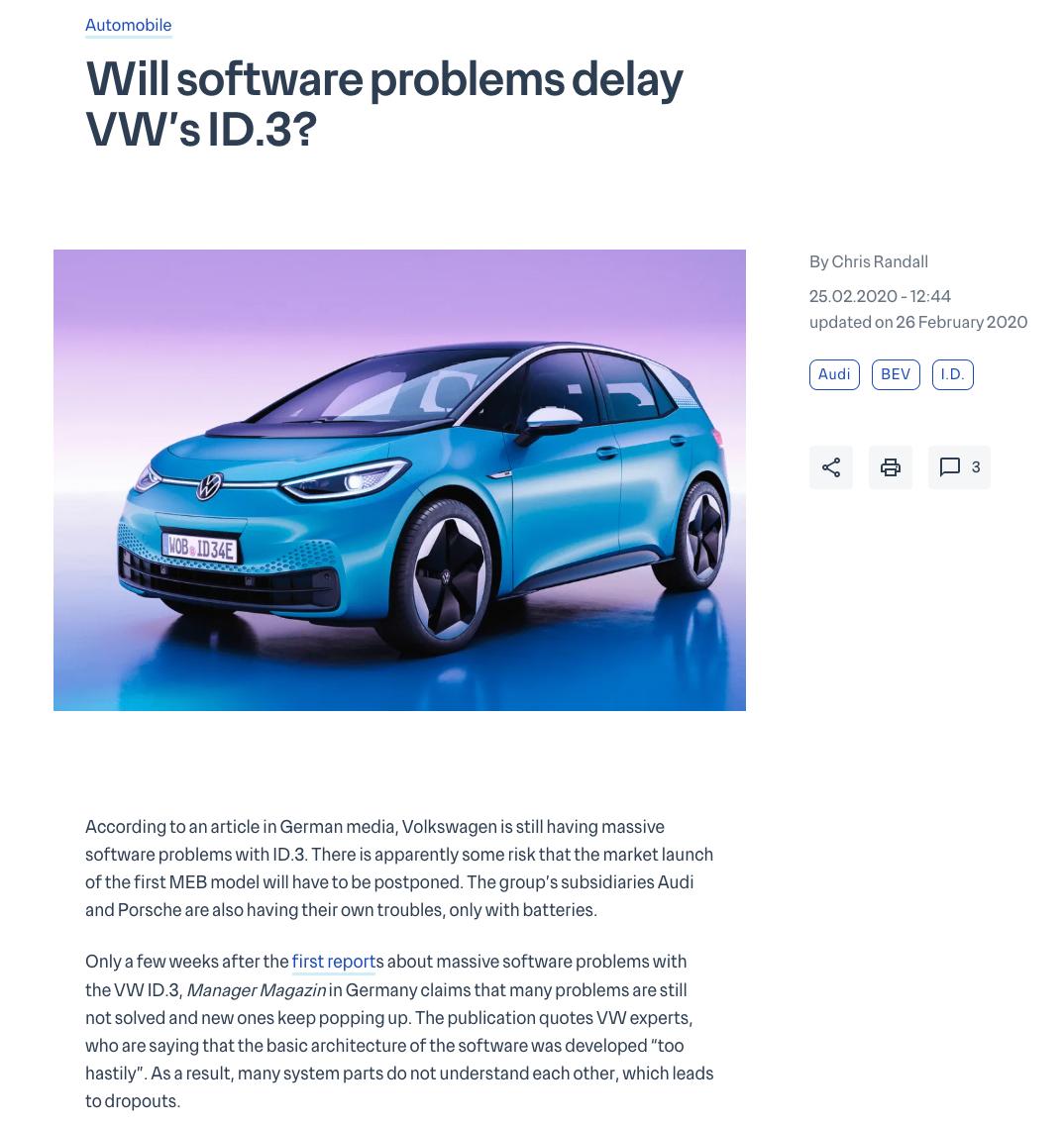
The software problem of ID.3 once aroused widespread public concern
For example, in 2020, the Volkswagen ID.3 1st Edition in Europe was forced to start delivery before the whole vehicle software of the MEB platform was completed under the pressure of EU carbon emission assessment.
As a result, basic functions such as AR-HUD, CarPlay and mobile App remote control were unavailable, and even the remote OTA was not debugged, so updates could only be done through offline flashing.
In addition, in the early stage, some new Chinese brands left daily functions such as scheduled charging and remote air conditioning to be completed through version upgrades after delivery; some other models have been installed with hardware, but basic functions such as ACC, AEB and lane keeping are not opened synchronously, and also need to wait for subsequent OTA.
It is the progress of the times that automobiles embrace intelligence and new experiences. But OTA must have a clear boundary and cannot become an excuse for shirking responsibilities.
This is another controversy over hastily-made vehicles.
NO.3 [Closing remarks]
"Hastily-made vehicles" are the result of changes in the rhythm of market competition today, but the most noteworthy point is not the 18-month figure itself, but how these 18 months are achieved.
In fact, automobile development is never aimed at creating perfect products.
A more realistic goal is to meet the requirements of safety, performance and reliability under specified service conditions and within the service life, and control possible risks within an acceptable range.
This leaves room for development acceleration. As long as the corresponding regulatory, quality and reliability requirements are finally met, 18 months cannot directly explain the problem.
If the development cycle is compressed by improving efficiency through technology and management, it should be regarded as the progress of the automotive industry, and also a manifestation of China's automotive industry leading new trends and new standards.
But unfortunately, judging from the current situation, the phenomenon of cutting corners to compress the cycle is widespread.
In the first half of this year, the