It has quietly secured a 6% market share in the quadruped robot market dominated by Unitree.
After selling nearly 100 million yuan worth of quadruped robots, Vbot has entered the humanoid robot track.
The humanoid robot exhibition area at this year's WRC is still packed with products.

With heights of 1.7 meters or 1.8 meters, exposed metal frames, dexterous hands, and capabilities of running, jumping, carrying and grasping... standing in the exhibition hall, it is easy to have an illusion: humanoid robots seem to have had an increasingly set of standard solutions.
Yet Vbot brought a seemingly "unconventional" robot to the public today.
ATOM is only 160cm tall, with its body wrapped in fabric, a special silent design on the sole of its feet, and a screen on its face that can display operation status. Even the length of its arms and the freedom degree of its waist are redesigned around the most common living spaces such as cabinets, desktops and door handles.
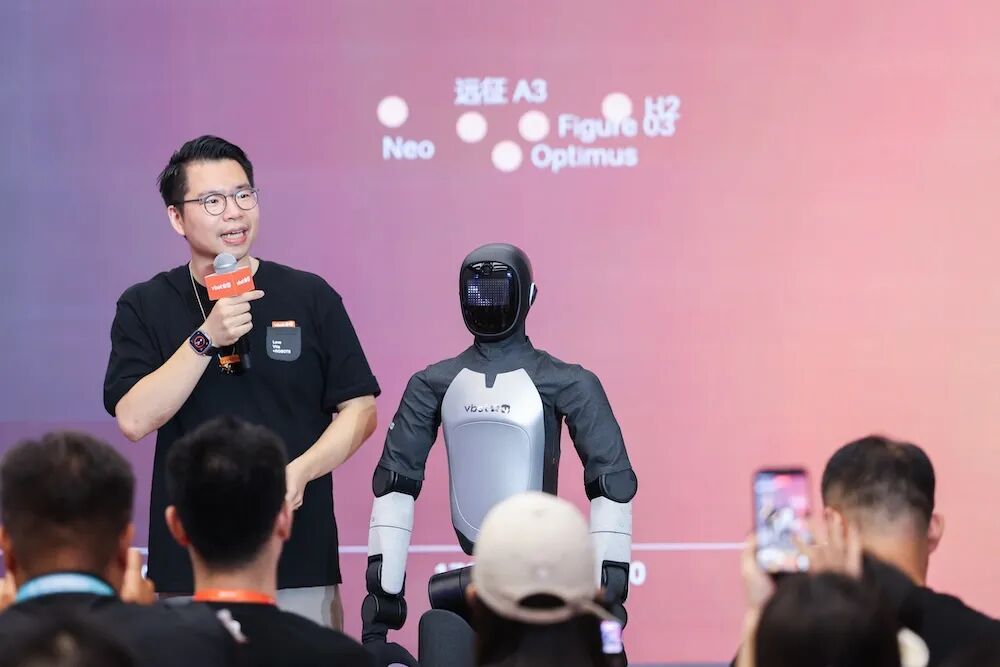
Unlike many humanoid robots that initially target industrial scenarios such as factories and warehouses, ATOM is designed from the very beginning to prepare for the space where humans and robots coexist for a long time. It has launched the personal version, enterprise version and developer version at the same time, and opened reservations on site at WRC.
For this company that has not been established for a very long time, why does it dare to bet on the humanoid track that is already crowded with startups and large technology companies at this moment?
The answer may lie in another type of robot it has sold before.
In the first half of 2026, SAG estimates that the global shipment of quadruped robots reached about 26,000 units. Unitree still firmly ranks first with about 13,600 units, accounting for 52% of the market share, but this figure has dropped from 75% in the same period of the previous year. At the same time, the proportion of consumer applications rose from 33% to 45%, becoming the largest application market for quadruped robots for the first time.
Vbot emerged precisely in this incremental market.
SAG data shows that Vbot's shipment of quadruped robots in the same period was about 1,600 units, accounting for about 6% of the global market. Its consumer-grade robot dog "Datou" previously achieved 6,540 units of pre-orders in its first sale, with the order amount nearly reaching 100 million yuan, and entered mass production and delivery in May this year.
In a market where Unitree has already occupied a clear advantage, Vbot has found a new demand group: ordinary consumers.
What is more noteworthy is how this market was tapped.
From Vbot's perspective, when robots truly enter the product stage, competition will extend to product definition, mass production, user experience, after-sales service, data feedback and OTA. Delivering a robot to the user only completes the first step. Now, Vbot is ready to apply this set of paths that has been fully verified on quadruped robots to its humanoid robot ATOM.
01. Behind Unitree, Vbot "opened a gap" from the consumer-grade quadruped robot track
Before entering the most crowded humanoid robot track, Vbot has proved one thing in a market also full of strong competitors: robots can be sold and actually used just like consumer electronics products, and get iterated version by version.
SAG data shows that in the first half of 2026, the global shipment of quadruped robots reached about 26,000 units, a year-on-year increase of 75%; Unitree's shipment increased by 23% year-on-year to about 13,600 units, still accounting for 52% of the market share, but it dropped significantly compared with 75% in the same period of the previous year.
This does not mean that Unitree sold fewer products. On the contrary, its sales still maintain growth, but the entire market is expanding faster. The most obvious variable is the consumer market.
SAG statistics show that the proportion of consumer applications in the shipment of quadruped robots has increased from 33% to 45%, which has exceeded other scenarios and become the largest application direction.
Vbot shipped about 1,600 units in the same period, accounting for about 6% of the global market, and entered the sequence of major global manufacturers counted by SAG. It has captured a type of users that was not mainstream for quadruped robots before - ordinary consumers.
GGII data also shows the same change. In 2025, the sales volume of consumer-grade quadruped robots in China reached about 37,700 units, a year-on-year increase of 289.67%, the market scale reached about 561 million yuan, a year-on-year increase of 93.28%.
GGII also listed Vbot as a representative enterprise of consumer-grade quadruped robots, and recorded that the cumulative pre-order of "Datou" in its first sale reached 6,540 units, with pre-sale sales nearly 100 million yuan, and called this achievement "the highest sales record for listed consumer-oriented embodied intelligent products".
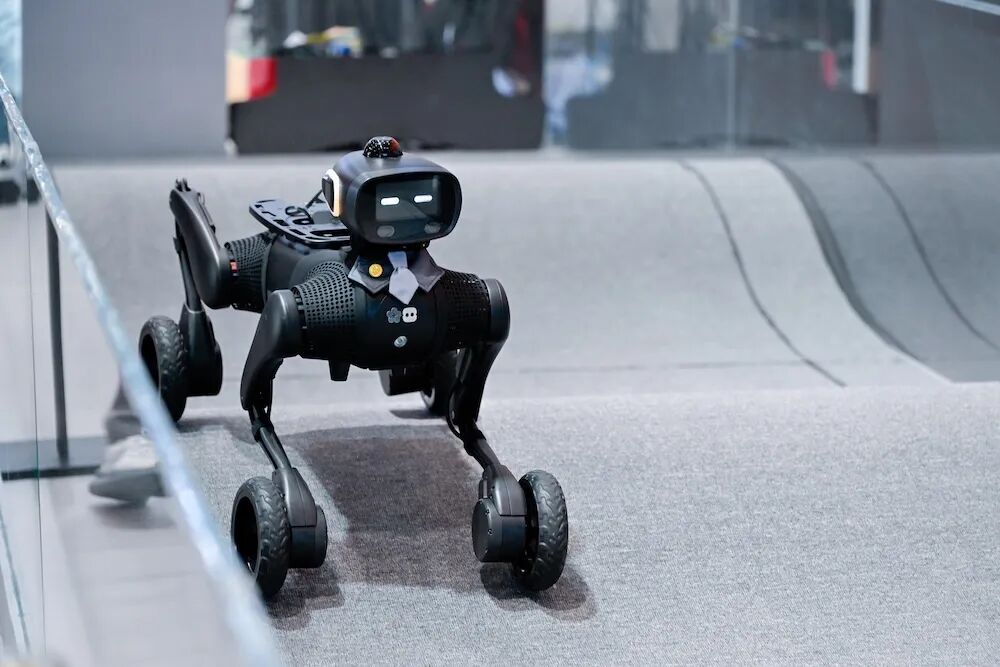
For a long time in the past, quadruped robots mainly competed around scenarios such as scientific research, industry and inspection. When it comes to the consumer market, the product logic has changed.
A very typical detail is the remote controller.
For scientific research or industrial robots, the remote controller mostly undertakes the functions of debugging and control; but for ordinary consumers, if a robot requires complex learning to use, it will increase the product threshold by itself. Therefore, Datou has been reducing the use complexity from the very beginning, so that more operations can be completed through more direct interaction.
Behind this is actually a completely different product idea: robots should not only complete tasks, but also consider whether ordinary people are willing to use them, whether they can get started quickly, and whether they are willing to continue to use them after taking them home.
After delivery, this set of product logic continues to operate.
Up to now, Datou has accumulated 1.26 million large model interactions, 23,700 kilometers of accompanying mileage and 131,500 hours of companionship, and the two-week user retention rate has reached 86%. In the past three months, Datou has completed 4 OTA updates, added 31 new functions, optimized 66 functions, and the model capability of each version has been improved by more than 30%.
After the robots are delivered to real users, the products will expose more problems that are difficult to be found in the laboratory in advance. These feedbacks will in turn become the direction of the next OTA update.
For Vbot, the truly valuable part of Datou is therefore more than the 6,540 orders. It allows the company to fully experience the whole link of robot product definition, mass production, delivery, after-sales service, user feedback and continuous iteration.
At the same time, Datou is also expanding from a single product to a product family. In July this year, Datou EDU was launched; during this WRC, Vbot also brought the EDU-W wheel-footed version.
EDU-W is oriented to the real environment with a large number of flat grounds, as well as thresholds and undulations, and its maximum speed reaches 2.5m/s. Under the unified test conditions, its energy efficiency is 50% higher than the standard EDU version, and it is also equipped with a self-developed ground hovering stability enhancement algorithm.
Splitting one type of robot into different products for different users and different tasks is also a very familiar play in the consumer electronics industry.
Quadruped robots have given Vbot a "product test" that truly faces consumers, and ATOM is built on the experience of this test.
02. Why develop humanoid robots? The answer lies in ATOM's 160cm body
Family robots do not naturally need bipedal structures. Wheeled chassis are more mature, have higher movement efficiency, and their mechanical structure is relatively simple. If you only need to solve the problems of flat ground movement and dual-arm operation, the wheeled solution even seems more "cost-effective".
Vbot still chose the humanoid structure.
One important reason is that the space ATOM is going to enter is not a space specially transformed for robots, but the living environment that has existed around the human body for decades or even hundreds of years.
The height of the table, the size of the cabinet, the position of the door handle, the scale of the stairs, and the range of items placed are almost all designed around the human body.
If a robot wants to enter these spaces for a long time, instead of retransforming the entire environment to adapt to the robot, one of the more direct paths is to make the robot adapt to the existing space as much as possible.
This also explains a series of parameters of ATOM.
160cm height, 180cm arm span, 95cm leg length and 31 body degrees of freedom are not simply pursuing higher, larger or more degrees of freedom, but derived reversely from the movement and operation requirements in living spaces.
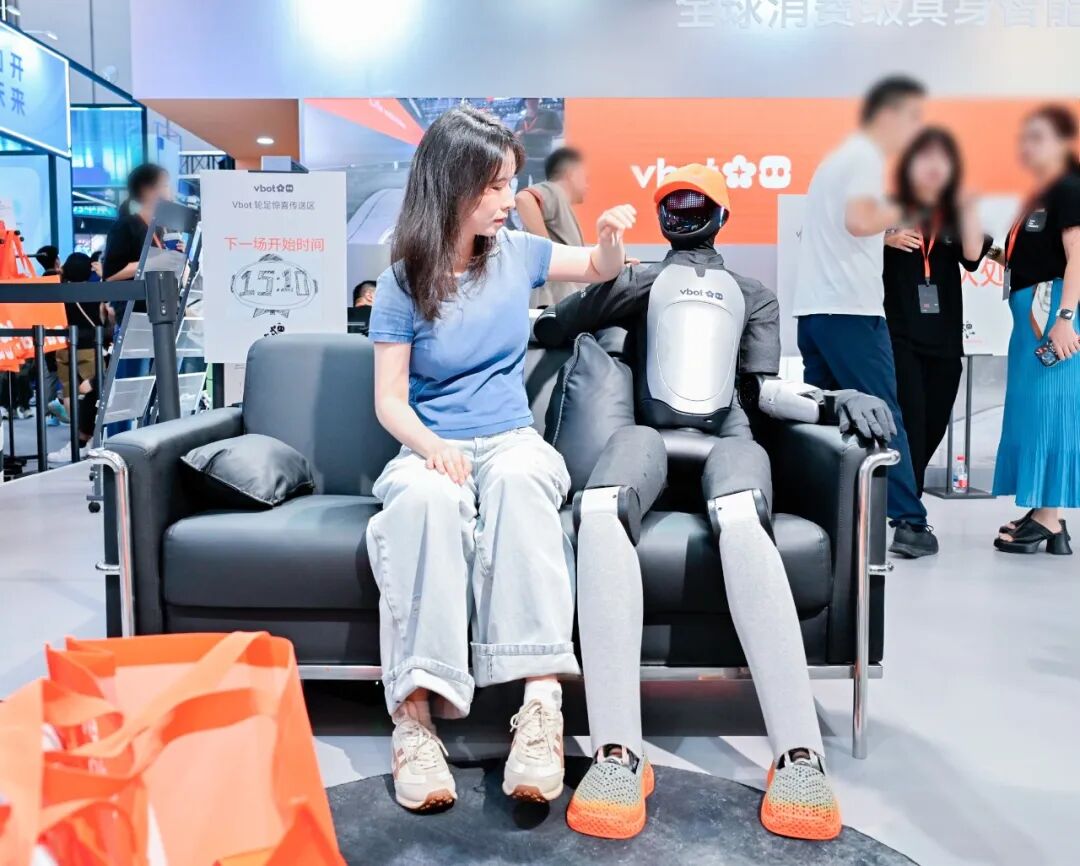
For example, when working near cabinets, desktops, shelves and door handles, what range the arms can cover; when turning in a narrow space, what size the body needs to be; when facing objects of different heights, how much movement space the waist needs to provide. These details determine whether the robot is easy to use after it is actually put into application.
The difference between ATOM and a large number of industrial-style humanoid robots in the exhibition hall is therefore very intuitive.
Its body is covered with fabric, the face is equipped with a screen for displaying status, it is equipped with ear lights, and the soles of the feet are designed for silent operation.
If the robot only moves boxes in the factory, these designs will hardly become the top priority. But if it passes by people every day, moves in the living room, and communicates with customers in the mall, the sound, material, sense of distance and the sense of oppression brought by the appearance may directly affect the user experience.
This is also the reason why ATOM first targets four types of living spaces: family, retail, public services and offices. Corresponding to the capabilities, Vbot summarizes the core requirements into three things: able to move, able to operate, and able to interact.
This set of product definition does not pursue to cover all scenarios from the very beginning.
For today's humanoid robots, absolute versatility is still an extremely difficult task to complete. But if in order to achieve landing as soon as possible, the robot is compressed into a highly dedicated device that can only complete a single task, the value of the humanoid structure itself will also be weakened.
Therefore, the path ATOM chooses is another one: first build capabilities around limited but widely applicable living spaces, and then gradually expand the task boundary of the robot.
If robots really live with humans every day in the future, how should they be designed? ATOM tries to answer this question first.
03. After the robot is sold, the real difficult competition begins
In the robot industry, what is most easily noticed is often the few minutes of demonstration. A new grasping action, a more fluent running movement, a task that has never been completed before, may quickly become a hot spot in the industry. But a few months later, the same capability may be "copied" by another company.
After truly entering the end market, the competition logic will become much more complex. This also explains why Vbot defines itself as "an embodied intelligent terminal company focusing on living spaces".
"Terminal" means that robots ultimately need to be truly manufactured, sold, and used by users for a long time, and it also means that after the product is delivered, the R&D process does not end.
During this WRC, Vbot further released the Vbot Embodied Genome embodied model system, as well as three core models: Vbot-OmniDuplex, Vbot-WorldModel, and Vbot-EvoMorph.
This system corresponds to a series of problems that need to be solved after the robot enters the real world: understanding human intentions and environmental changes, forming task capabilities in real scenarios, and enabling capabilities to continuously evolve with terminal feedback.
For Vbot, this model system also has an important keyword - cross-body.
Datou is a quadruped robot, while ATOM is a humanoid robot. Their mechanical structures, movement modes and control constraints are obviously different, so the control model of the quadruped robot cannot be simply copied to the humanoid robot. But there are many things that can be migrated.
For example, task understanding, human-robot interaction modes, scenario assets, strategy generation, real user feedback, and a complete set of methods for discovering, verifying and continuously updating problems can all be precipitated between different robot bodies. The movement structure and control constraints brought by different bodies need to be re-adapted on the specific body.
This is also the more valuable part of "Datou's experience" for ATOM.
1.26 million large model interactions, 23,700 kilometers of accompanying mileage and more than 130,000 hours of companionship do not mean that these data can be directly converted into ATOM's movement capabilities, but they prove that Vbot already has a batch of real terminals, and has run through a set of methods for terminals to enter the real world, continuously collect feedback and complete iterations.
For robot companies, this kind of capability can hardly be built only through one demo. Real users and terminal feedback have thus become another set of key variables.
Vbot also plans to add 100 new retail outlets, recruit 1,000 cooperative developers, and launch the first batch of industry pilots in the next stage.
04. Conclusion: The real "productization moment" of robots is coming
In the past few years, the humanoid robot industry has been expanding its capability boundary fast enough.
Able to walk, run, grasp, carry, fold clothes - as soon as a new capability becomes news, it will soon become the standard demo of another company. Technological progress is still important, but when more and more robots have similar bodies and similar capabilities, another problem is increasingly unavoidable: who will buy these robots in the end,