Sora exits the stage, domestic industry players rise: the "inflection point" moment of AI video generation
In March 2026, OpenAI officially announced its farewell to Sora. The "rainy Tokyo night" that once kept Hollywood awake turned into a shutdown announcement a year and a half later. At the same time, Keling's global users exceeded 100 million, Wan 3.0 entered public beta, Seedance 2.5 was launched, and MiniMax H3 was open-sourced — Chinese domestic AI video models did not oust Sora, but followed the path it left unfinished, shifting the focus from "building guns" to "hitting targets". The second half of the AI video competition is not about who can make a more stunning demo, but who can integrate into work workflows, issue valid invoices, and reduce costs.
On March 25, 2026, OpenAI posted a line of "Say goodbye to Sora" on X.
No press conference, no long open letter, only a section of thanks to user works and a preview of the offline schedule.
It has only been 178 days since the independent Sora 2 App went viral and exceeded 1 million downloads in five days.
A year ago, the whole world was exclaiming that "directors are going to lose their jobs"; a year later, Silicon Valley moved video generation away from the consumer stage, and reallocated its budget to the research and development of "world models" and robots.
This is not the failure of AI video, but the closing statement of the era of showing off technical stunts.
Sora's Exit: It Was Defeated Not by Competitors, But by the "Cost-Retention-Compliance" Triangle

Attributing Sora's demise to "domestic players winning the competition" is the most effortless misinterpretation.
The real reason behind Sora's collapse is three fatal blows hitting at the same time:
The first blow is cost. Multiple estimates put its daily operation and maintenance cost at the level of tens of millions of US dollars, and its monthly computing power expenditure exceeds 10 million US dollars. Even after the free user quota was cut from 30 to 6, it was still a money pit.
The second blow is user retention. In December 2025, downloads dropped by 32% month-on-month, followed by a 45% drop in January 2026. The 30-day retention rate was only 1%, and the 60-day retention rate approached zero — users came to say "wow" and left immediately, unwilling to pay for subscriptions for random generation like blind boxes.
The third blow is compliance and copyright. Issues such as celebrity face swapping, abuse of Disney IP, and tightening regulations around the world emerged; Disney's $1 billion investment plan disappeared along with the termination of the cooperation.
What's more fatal is the controllability gap: when you want "the camera to pan left", it gives you "random shaking of the picture"; when you want "the protagonist's face remains unchanged", it gives you "face change every three frames". In professional workflows, this kind of unreproducible performance means no commercial value.

Figure/OpenAI Official Social Platform
So Sora's epitaph is not "defeated by Chinese manufacturers", but:
It has a very high technical ceiling, but it is too far from being deliverable; its demos are amazing, but it is too far from being reimbursable.
OpenAI moved its team to robotics and world model R&D, which is equivalent to admitting that the single-model route for consumer-grade AI video has stalled first.
Three Tracks of Domestic AI Video Models: Keling Pursues Revenue, Alibaba Builds Ecosystem, ByteDance Cuts Costs

In the same quarter when Sora exited, three non-overlapping development routes emerged in China. The only common point is: they no longer pursue 60-second demos, but focus on daily active users, ARR, and the time of being integrated into Photoshop and CapCut.
Keling AI: Turn the model into revenue. In 2026 Q1, Keling's revenue of Kuaishou reached 650 million yuan (up more than 300% year-on-year), and its Q2 revenue hit 850 million yuan (up more than 200% year-on-year); in June, its global users exceeded 100 million, covering 224 countries, with nearly 50,000 enterprise clients and an ARR of nearly 500 million US dollars.
Its 3.0 Omni adopts the All-in-One strategy, unifying the workflows of text, image, audio and video, with native audio-video synchronization, multi-shot narration and subject consistency — targeting scenarios such as advertising, e-commerce and brand films where "image quality directly drives transactions". It proves one thing: domestic models do not necessarily outperform Veo in every parameter, but they have first secured the invoice title for creators.
Alibaba: Dual-model layout. Wan 3.0 (Tongyi Wanxiang) entered public beta in August 2026, which can directly generate 30-second clips at one time, supports input of doc/xls/ppt/pdf documents for the first time, and is priced at 0.3/0.6/1.2 yuan per second for 480P/720P/1080P, stitching video generation into office and courseware production; HappyHorse takes the flagship competition route, ranking in the first echelon in the visual quality item of Artificial Analysis, leaving a high ceiling for brand short dramas.
One is for mass adoption, the other is for top ranking. What Alibaba wants is the full-link closure from Qwen Creation to Alibaba Cloud Bailian.
ByteDance's Seedance 2.5: The hidden champion of market share. Released on July 31, it supports native 30-second direct generation, 50 full-modal references, local precise editing, and second-level timestamp control. Volcano Engine's API was launched accordingly, and the price of 2.0 mini/fast was cut at the same time; XCMG, XPeng Motors, Lingchu Intelligence and other enterprises have integrated it into embodied intelligence and intelligent driving preview.
ByteDance's strategy is not to "amaze people", but to use Douyin's corpus and Volcano Engine's computing power to lower the unit price, so that small and medium teams can afford it, and enterprises can integrate it into their internal workflows.
The three tracks can be summed up in one sentence:
Keling proves it can make profits, Alibaba proves it can be embedded into the ecosystem, and ByteDance proves it can realize cost reduction and industrialization. Sora achieved none of these.
From "Comparing Benchmarks" to "Comparing Monetization": H3 Open Source, Both Equalization and Reshuffling

On July 31, MiniMax released H3, and on August 3, the open-source H3-Base was uploaded to Hugging Face.
It supports 2K resolution, 15-second duration, native dual audio channels, and unified context for text/image/audio/video; it ranks first in the world in the video editing item of Artificial Analysis, with the price as low as 1/3 of similar flagship models (0.8 yuan/second @2K).
Ascend, MetaX, Moore Threads, vLLM and ComfyUI adapted to it on the same day — Is this the "DeepSeek moment" for domestic video models? Not exactly. DeepSeek realized the equalization of language reasoning, while H3 realized the equalization of the right to local deployment of industrial-grade video foundation models.
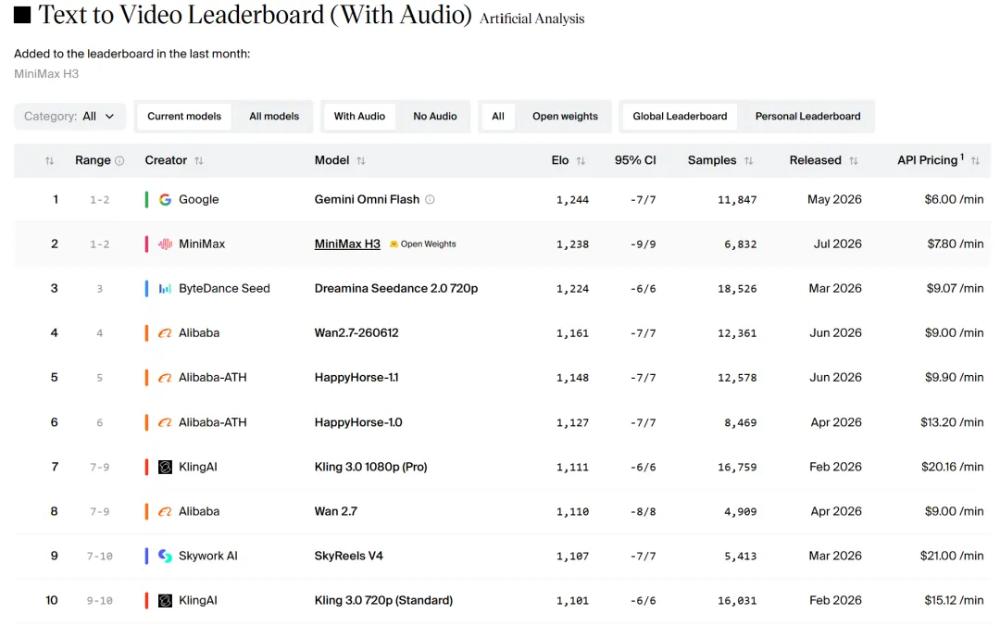
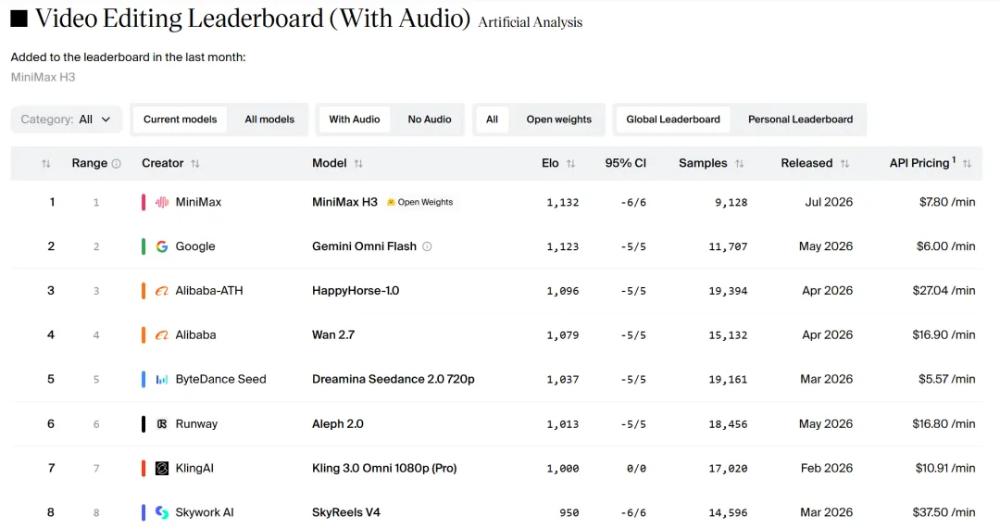
Figure/Iterative AGI
But the judgment of Xiner (New Entropy) is more rational:
Open source is not charity, but MiniMax's move to exchange community ecosystem for the entry of enterprise private deployment when the price war of closed-source APIs cannot continue. Small and medium-sized enterprises save reasoning costs, while MiniMax wins the ecological niche of the "domestic video PyTorch moment".
If we broaden our perspective, what the 2026 inflection point really changes is the evaluation formula:
The first half of the competition: compare the number of parameters, compare Benchmark results, compare whose demo gets more reposts on Twitter;
The second half of the competition: compare whether it can be integrated into the CapCut timeline, compare whether it can compete with Qwen's document-to-video function, compare whether the ARR is real revenue, compare whether the customer service can issue valid invoices.
A monetizable finished video has to go through more than a dozen processes including script, storyboard, asset reuse, version management, compliance watermark, etc. A single-point model only solves the first process.
The collective advantage of domestic manufacturers does not lie in "a certain frame being more realistic", but in "integrating the model into the assembly line of 224 million users, 50,000 enterprise clients, and tens of millions of daily materials of Douyin E-commerce, and ensuring that it can run stably, be properly managed, and generate returns".
On the day Sora exited, OpenAI did not mention the name of its Chinese competitors.
What it mentioned was "leaving computing power for world models".
In the same week, Keling wrote "revenue of 850 million yuan" in Kuaishou's financial report, Alibaba Cloud posted the Wan 3.0 price list online, the number of API calls of Seedance 2.5 on the back end of ByteDance's Volcano Engine kept rising, and MiniMax H3 rushed to the top of the hot list on Hugging Face.
The world is still arguing over "gun barrel calibration", while Chinese manufacturers have already set their guns beside the assembly line, aiming at the targets of "short videos, e-commerce product pages, corporate promotional videos, and industrial previews" and firing.
The "China Moment" of AI video is not a slogan.
It is the month-on-month growth in financial reports, the unit price in APIs, and the icon that stays on creators' desktops all the time.
References:
Volcano Engine, Seedance 2.5 Release on July 31, 2026; Economic Reference Daily, August 7, 2026
Guangming Online/The Paper, March 25, 2026, "OpenAI Announces Shutdown of Sora" (cost/retention data)
Alibaba Cloud, Wan 3.0 Public Beta Announcement on August 6, 2026; Artificial Analysis HappyHorse Ranking
Xinhua News Agency, March 27, 2026, "OpenAI Will Increase Research on 'World Models'" (Sora's Exit and Termination of Cooperation with Disney)
Kuaishou 2026 Q1/Q2 Financial Reports; China Securities Journal, June 5, 2026, Keling's 2nd Anniversary Data (100 million users / $500 million ARR / 650 million yuan Q1 revenue / 850 million yuan Q2 revenue)
MiniMax Official H3 Release on July 31, 2026 / Open Source on August 3, 2026; CNR, August 6, 2026, Open Source Ecosystem Adaptation
This article is from the WeChat Official Account "Xin Entropy" (ID: baoliaohui), written by Xin Entropy - AI New Technology Group, published with authorization from 36Kr.