Lancun Technology: Standing between large models and agents, building a standardized business
Is the real entry point for AI to step into the physical world a module that costs only dozens of yuan?
Most of the edge-side AI businesses in the industry may have taken a wrong approach in their thinking.
Essentially, edge-side AI should be a manufacturing business, but the industry has always been treating it as a software problem to solve.
This leads to most players focusing on model capabilities and interactive experiences, while the other set of variables that truly determine whether a smart hardware product can be scaled up are: mass production consistency, acoustic engineering, and delivery cycle.
These links that seem the least "AI-related" have blocked the development of the entire industry.
The leap in the model side has not reserved time for this set of variables. In 1997, Deep Blue won the chess game. Nineteen years later, AlphaGo claimed victory in Go. After that, ChatGPT took only a few years to bring language capabilities to consumer-grade products. However, the set of engineering processes to embed models into hardware has not formed industry standards to this day.
A straightforward case is that when an AI robotic dog receives an instruction, its execution rate is only 60%. For the remaining 40% of the time, it stays completely still, but it will report "Look, I'm dancing beautifully".
Execution hallucination is a common status of current AI hardware products. Moreover, the larger the terminal scale and the closer it is to people, the greater the risk exposure. Therefore, the engineering standardization and safety mechanism of physical terminals are changing from optional items to preconditions.
Some players in the industry have already turned this part into products. For example, Lanchun Technology, a company founded in 2025, provides a complete set of engineering solutions to embed models into hardware, with product forms of standardized AI modules and an intelligent control platform.
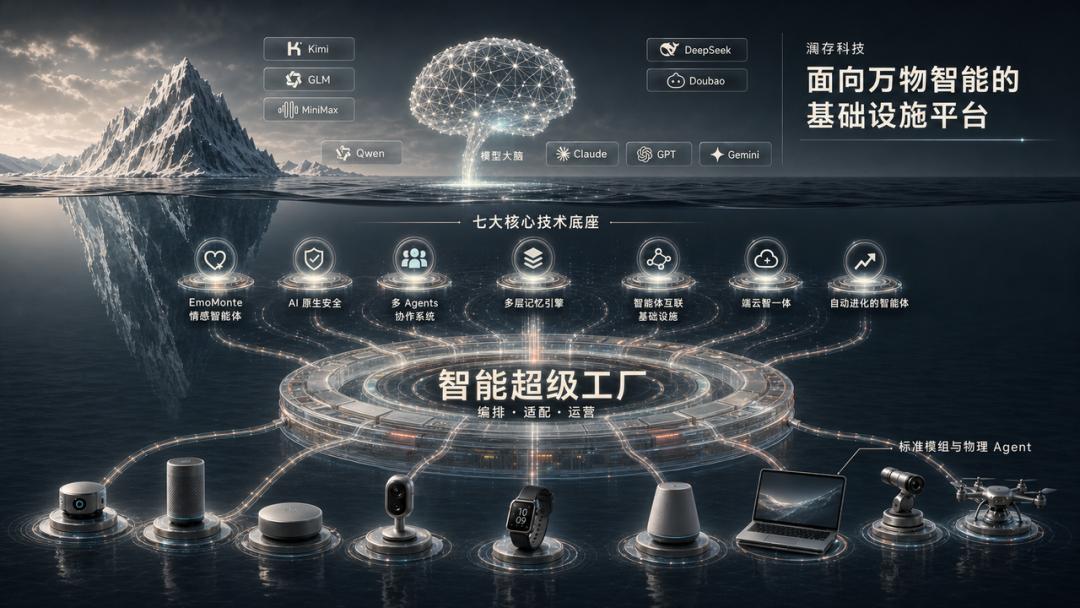
Why not develop humanoid robots, but cut into the middle layer instead?
Why is standardization the answer?
The goal of standardization is to enable more terminals in the physical world to stably access cloud intelligence, and capital has begun to price this long-absent infrastructure.
In August 2026, the company completed its Pre-A round of financing, with Wuxi Municipal Industrial Investment Platform Xi Venture Capital investing tens of millions of yuan, and its valuation doubled to 150 million yuan within half a year.
When Lanchun was founded, it was at the peak of the AI hardware investment boom. Embodied intelligence, AI toys, and AI terminals became the focus of capital, and humanoid robots were the most popular track among them, with many companies obtaining large-scale financing.
This company also has the confidence to develop in this direction, as its core members have been engaged in the implementation of industrial AI for nearly a decade. However, the company did not end up making robots.
Why not making robots has become a clear strategic choice based on technical logic.
The core reason is that the current mainstream reinforcement learning methods essentially allow robots to acquire capabilities through massive repeated training. After letting a robot "dance for ten thousand years", it can dance very well when the training is finished. But if the position of the table changes or the friction coefficient of the floor alters, its performance will degrade significantly.
Excellent demonstration effect and lack of generalization have become the common status of the embodied industry at present.
The alternative end-to-end route of large models also leads to a pessimistic conclusion: even if the technical route is feasible, humanoid robots will not enter thousands of households in the next three years. The annual sales volume of only several thousand units among early users cannot support data, the most critical element among the three core elements of AI.
It has been a consensus in the industry that algorithms and computing power are becoming increasingly inclusive as the large model ecosystem matures, and data has become the biggest barrier. The positive feedback closed loop of edge-side AI depends on the number of terminals: the more terminals there are, the more data generated from real interactions, the faster the model iterates, the better the experience will be, and then more terminals will be attracted to access the system.
The embodied industry is the largest market where human beings and AI move towards the future together. But before commercialization is realized, someone needs to bet on this data flywheel, exchange scale for data, and choose a path that can penetrate massive terminals at the fastest speed.
The standardized modules that Lanchun Technology is developing are the new access path to the physical entry point of this "largest market".
The reason why edge-side AI is essentially a manufacturing business is that, just like industrial AI, it requires technology vendors to embed algorithms into production lines. When developing industrial AI, the deliverables are machines, automated equipment, and the entire production line, and customers will pay for turnkey solutions. The standardized modules behind the embodied intelligent data flywheel follow the same logic, providing customers with complete solutions from hardware access to platform operation.
Therefore, the industrial chain will also be clearly layered like the manufacturing industry, with each party performing its own duties. Basic module manufacturers produce basic capabilities, and the middle layer is responsible for engineering these capabilities and distributing them to various terminals. For hardware to make good use of large models, a complete intermediate system is required for the implementation of instruction compliance, motion control, and multimodal sensing transmission.
By 2026, the reason why physical terminals are still "dumb" does not lie in the model, but in the lack of middle-layer infrastructure. The market has a more urgent demand for a set of easy-to-use standardized modules than for one more outstanding humanoid robot company.
One set of standard modules covers three layers of businesses
The most widespread misconception in the market about edge-side AI is that its capabilities are limited by chip bottlenecks or insufficient computing power.
The actual situation is that IoT chips such as ESP32 are domestically produced, low-priced and in sufficient supply. Large model reasoning is completed on the cloud side, and the edge side is only responsible for collection and execution. It is not realistic to embed large models into edge-side chips at present, and what can be embedded is only a product with intelligence level of several years ago.
The real implementation barrier is to debug and smooth the complete voice interaction link on real hardware to meet mass production requirements.
This is because audio engineering is the link most prone to accidents: acoustic interference between speakers and microphones, real-time competition of data queues. It is very difficult to achieve good stability processing in high-concurrency scenarios, and any detail may lead to hallucinations and accidents during mass production.
Heat dissipation and charging safety also need to be included in the control system. Products cannot generate abnormal heat, and there are strict requirements for current stability during charging.
The core underlying technology is no longer a difficulty. Many talents and teams are good at fine-tuning large models, and the watershed lies in the details of engineering and standardized mass production.
For edge-side AI, what exactly is a standardized module?
Simply put, it is a circuit board integrated with AI voice interaction, sensor collection, motion control, network connection and interface expansion capabilities. Its volume may be smaller than an AirPod, but after customers buy it, they can directly install it into the shell of their own products without building the technical link from scratch.
The product logic does not sound complicated, but standardized modules were once a blind spot in the market.
For most hardware manufacturers, from "having an idea for a smart product" to "making a usable AI hardware", there are a large number of difficulties in between: how to implement hardware access, how to debug voice interaction, how to manage content safety, who will do equipment joint debugging, and how to operate after launch. But the mainstream solution is still that hardware manufacturers fight on their own, and each of them is repeating the work of making wheels.
Toy factories find solution providers to assemble machines, and home appliance factories and robot companies form their own teams. As a result, they all get stuck in the same place: the voice link cannot be debugged, the mass production consistency cannot meet the standards, continuous iteration is impossible after launch, and users buying smart products becomes a "one-off deal".
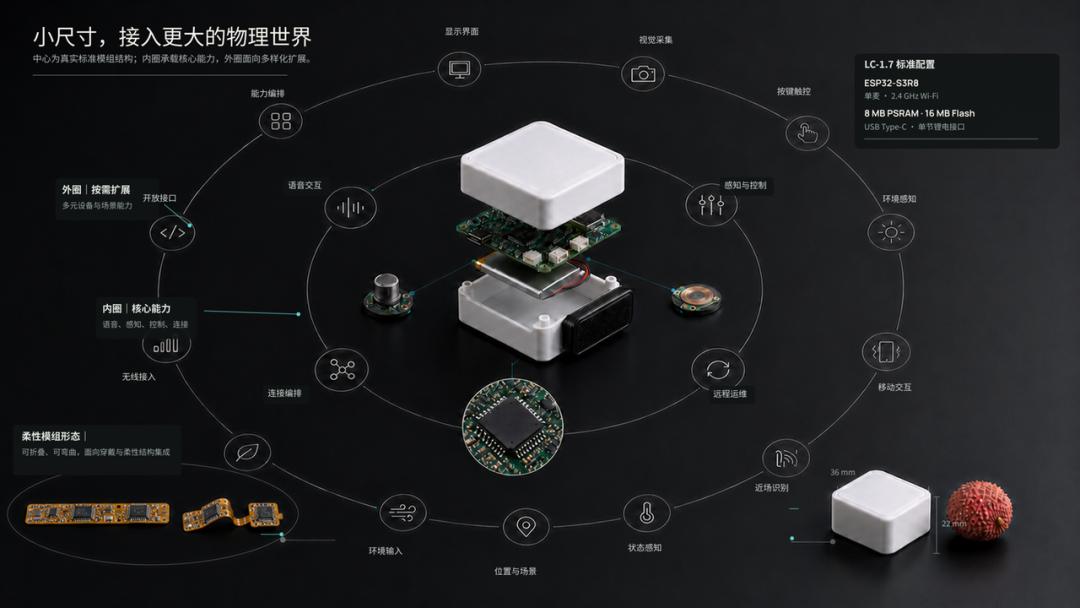
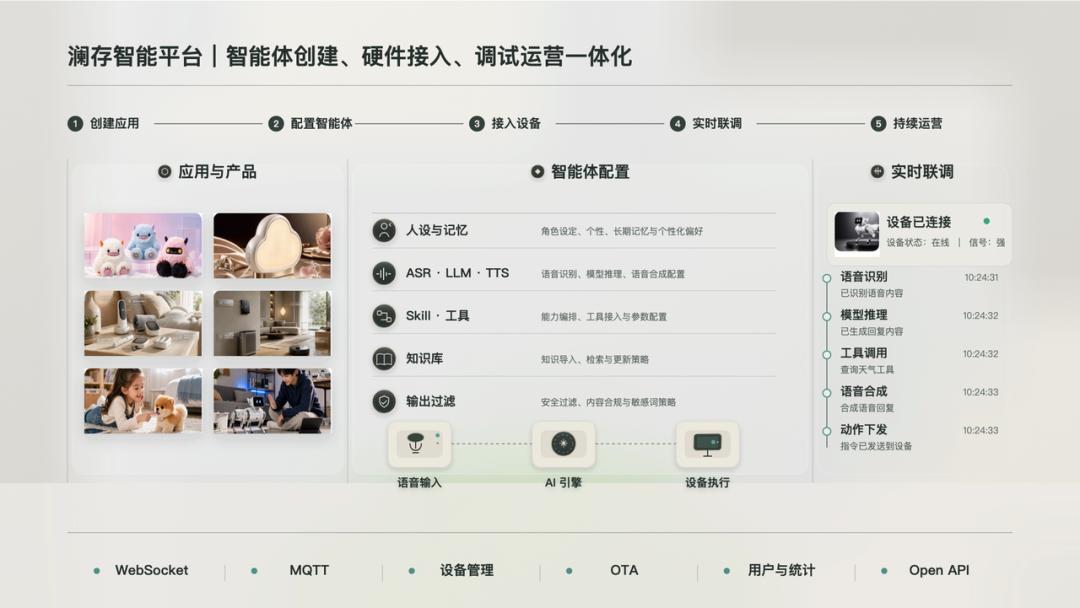
Standardized AI modules are designed to bridge this gap.
Judging from the business composition of Lanchun:
- Standardized Module Product Lanca LC-1.7 is the hardware entry, which integrates the basic capabilities for a terminal to listen, speak, perceive and execute;
- Lanchun Intelligent Platform is a development and operation tool, where customers configure agents, conduct joint debugging of equipment, manage firmware and users;
- Token Transfer Operation is the long-term business model. Every AI interaction after the terminal goes online consumes tokens, and Lanchun is responsible for reducing costs, ensuring safety and optimizing experience in the process.
The three layers are connected to form a complete commercialization link for this new track of standardized modules: product definition, hardware access, agent configuration, test and joint debugging, and then continuous operation after launch.
In the early stage of the architecture of the edge-side AI implementation middle layer, a complete industrial chain does not yet exist, so all three layers of capabilities are required. Customers who buy the modules do not know how to connect to the platform; after the platform is built, they do not know how to configure the agents; after the agents are running, there is no continuous token support, and the products stop operating as soon as they are launched.
The commercialization speed has verified this path. Up to now, Lanchun has accumulated signed orders of over 100,000 sets, with a contract value of over 10 million yuan. Its partners include leading companies in various industries such as Yingtai Group, Dreame, Changba, Yuanlong Yatu, and China Mobile IoT.
However, although technology vendors represented by Lanchun Technology have won the favor of many leading hardware manufacturers, it cannot be denied that this track needs to grow along with AI hardware, and the entire AI hardware industry is still in its early stage.
For example, Yingtai, one of the top three toy manufacturers in the world, ships 20 million sets of toys every year. The annual shipment of the best-selling AI toys on the market is only 200,000 to 300,000 sets. There is a difference of nearly two orders of magnitude between the two figures, and the penetration of AI terminals has just started.
But the future imagination is far more than that. AI smart toys are just the tip of the iceberg. More key consumer scenarios of hardware will follow, including health care, smart home, interactive education, and municipal renewal, which will form a broader market.
Everything is the tentacle of AI
According to the report released by SNS Insider in 2025, the global On-Device AI market was valued at 17.61 billion US dollars in 2025, and will increase to 115.74 billion US dollars in 2033, with a compound annual growth rate of 26.57%.
What is more critical than the scale is the structure: what is valuable in this market is no longer a certain type of terminal, and the middle-layer system that every terminal cannot bypass has a more clear right to define the technical architecture. Whoever makes it the standard first will grasp the next stage of trend.
As an independent track and category, standardized AI modules really started in 2024 following the implementation of large models on the edge side, and there is no recognized leading manufacturer in the market at present.
In the early pattern, Lanchun's product finalization, platform launch, and 100,000 sets of signed orders at least mean that domestic manufacturers have run through the key links from technical verification to commercial implementation.
Then, what stage have the pioneers of standardized modules reached?
From the perspective of industry benchmarks, Lanca LC-1.7 has reduced the voice delay from the initial 2 seconds to 300 milliseconds, and the instruction compliance rate has reached more than 99%. It is worth mentioning that in order to prevent the model from generating "execution hallucinations" in the physical world, Lanchun has embedded a set of verification mechanisms based on logical paradoxes in the underlying instruction set, which is equivalent to adding a physical safety lock to the large model. The robotic dog equipped with Lanchun's solution can continuously execute complex instructions such as "move forward, lie down, do 15 push-ups, turn around, and dance". When it gets stuck, it will lower its body, shake left and right, and try to break free.
The flexible circuit board module, as Lanchun's industry-first product, can be embedded in clothing and wearable products. A real scenario is that when you go camping and see a mushroom, you can take a picture and ask if it is edible, and it can be used even in places without signals.
In addition, the actual universality of standardized AI modules is deeper than the public imagines. For example, robotic dogs and HVAC panels can use the same module, and larger-scale mass production can dilute costs, accelerate iteration, and increase stability accordingly.
Duan Yilin, the founder of Lanchun Technology, also reviewed the mass production ramp-up process for 36Kr: from 2000 pieces to 20,000 pieces, and then approaching 100,000 pieces, the mass production milestones are the epitome of the industry's development from 0 to 1.
From the industry's point of view, this is also the logic why Xi Venture Capital chose to increase its investment in this new track in the Pre-A round: at the moment when a trillion-level market has just opened, bet on the fastest "middle-layer player".
The imagination of the trillion-level market is certainly not limited to the existing AI hardware market. For example, under the proposition of smart city, if it can be fully promoted, the annual demand for modules may reach 5 billion pieces. HVAC panels, smart seats, utility poles, and city tour terminals can all theoretically become intelligent nodes.
Imagine a scene: a person walking on the street suddenly feels unwell in the heart, and can ask for help from the utility pole beside him. The module worth dozens of yuan in the utility pole can endow it with the ability to connect to AI, call an ambulance urgently, and also prompt first-aid methods by voice.
However, compared with the rapidly changing capability demonstration of humanoid robots, the middle layer based on data will have a more robust implementation path, which follows the maturity of the entire industry.
When the early track transitions to the mid-term, the rapid entry of large manufacturers is the most powerful proof of the correctness of this track. ByteDance, Alibaba, Stepfun and other former "cloud players" have all started to deploy on the edge side.
Edge-side AI solutions are more suitable for privacy-sensitive and lightweight scenarios, but to achieve good human care and experience consistency, cloud large models are of course indispensable. Therefore, cloud-edge-end collaboration will become the mainstream technical route in the future, which is also the current technical path of Lanchun.
If you always focus on the position of the middle layer, you will find that in the flourishing but uncertain robot narrative, the middle layer of edge-side AI may be the easiest path for startups to "survive".
Because the demand for infrastructure exists for a long time, just like road and bridge infrastructure. No matter how the general environment of the AI industry fluctuates and where the trend is, the underlying demand for terminal intelligent infrastructure exists, and everything will eventually become the tentacle of AI.
As for terminal manufacturers, they do not care about the complex technology behind the doors and locks, they only care about whether the key is easy to use. The answer given by Lanchun is that the cost of a single module is as low as dozens of yuan, the underlying hardware is universal, and the scenario can be switched within one day by changing the skill pack.
The cost of a single module can be as low as dozens of yuan, and the delivery cycle is much shorter than that of traditional power facilities. Table lamps, air conditioners, desks and chairs, and utility poles can all be connected; the underlying hardware of the module is universal, the scenario can be switched