Morgan Stanley breaks down the AI computing power accounting in China: The payback period for self-built facilities is 3 years, the ROIC of cloud vendors can reach 13%-20%, and Alibaba Cloud has the most prominent advantages.
The battle over returns on computing power investment is entering a quantitative phase.
In its latest report, Morgan Stanley introduces the North American ROIC framework into China's cloud computing market, breaking down the three paths of self-built GPU infrastructure, renting third-party computing power, and Model as a Service (MaaS) one by one, and draws the conclusion : The ROIC range of Chinese cloud vendors is 13% to 20%, with a cash payback period of about 3 years. Despite higher server hardware costs leading to a lower rate of return than the 25%-50% of their US peers, Morgan Stanley believes that with the continued strong demand for computing power, higher capital expenditure will drive considerable returns in the medium term.
The report argues that Alibaba, with its largest-scale AI infrastructure, mature cloud business system and proven Qwen model capabilities, is capable of delivering considerable returns across all three scenarios, and this combination also supports its valuation premium.
Analysts give Alibaba a US stock rating of "Overweight" with a target price of $180, implying an upside of about 45% from the current price.
It is worth noting that the report also points out that Tencent's annualized capital expenditure has exceeded 200 billion RMB, which will put upward pressure on Alibaba's capital expenditure plan, but analysts believe that Alibaba's focus on IaaS and MaaS makes its ROIC visibility relatively higher.
In the MaaS scenario, Alibaba targets annualized recurring revenue (ARR) from MaaS of more than 30 billion RMB by the end of the year. If this target is achieved, there is significant room for improvement in the cloud business profit margin — currently, Alibaba Cloud's profit margin is only 11% to 12%.
Self-built GPU IaaS: 44% Operating Profit Margin, But High Server Costs Suppress ROIC
The first part of the Morgan Stanley framework examines the standalone economic benefits of cloud service providers (CSPs) purchasing and renting out 8-socket GPU AI servers.
Under the base case, the capital expenditure for each server is 8 million RMB, with a monthly rent set at 250,000 RMB. After deducting server depreciation, IDC depreciation, energy costs and other operating expenses, this model can achieve an operating profit margin of about 44%, a return on invested capital (ROIC) of 13%, and a cash payback period of 3.1 years.
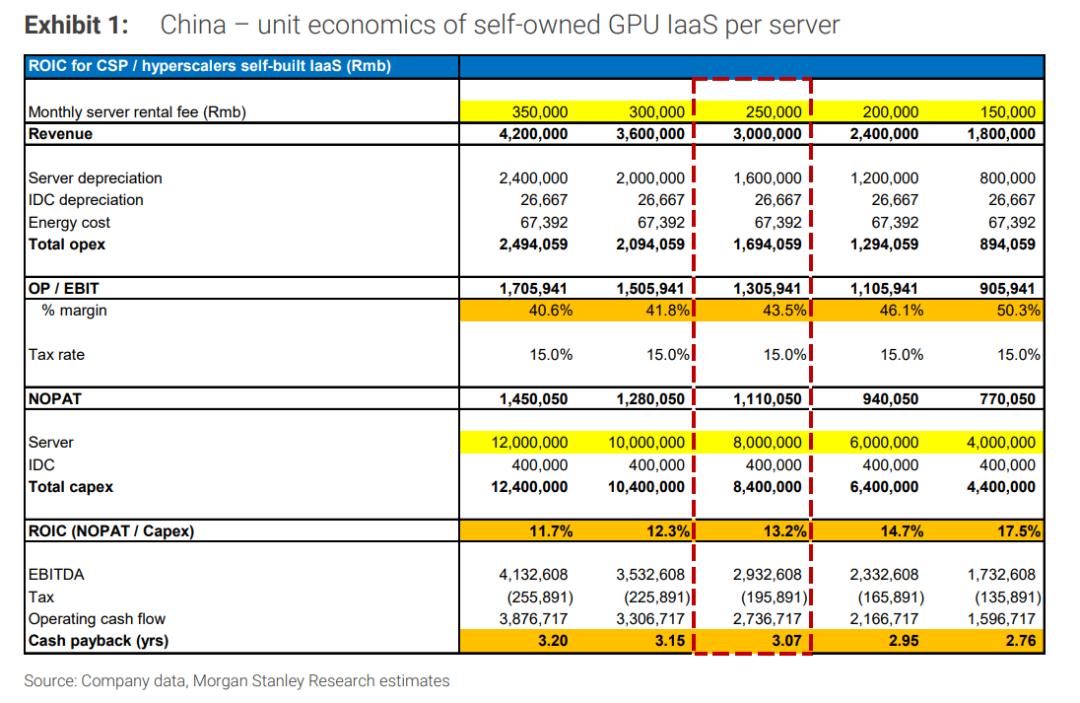
Compared with the US market, the gap in China mainly stems from hardware costs.
According to Morgan Stanley's estimates, the capital expenditure per server in China is about 3 times that of the same configuration in the US, leading to significantly higher depreciation costs, and China's ROIC (13%) is much lower than that of the US (31%).
However, China's lower IDC and energy costs provide a certain offset, and the 3.1-year cash payback period is largely consistent with Amazon's management's recent statement that "the payback period for servers and network equipment is slightly less than three years".
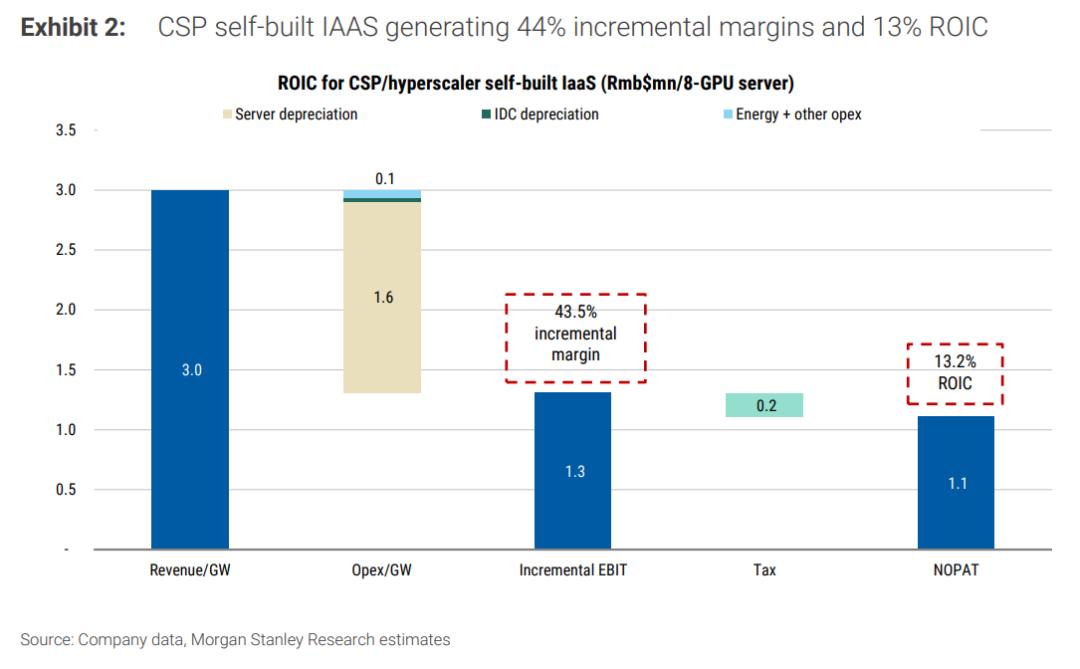
Analysts also point out that there is a large gap between the 44% incremental operating profit margin and Alibaba Cloud's current overall profit margin of 11% to 12%.
This gap mainly comes from the drag of traditional low-margin cloud businesses, the depreciation burden of early infrastructure assets, as well as R&D and personnel costs not included in the server-level framework. If the demand for AI computing power remains strong and the utilization rate stays at a high level, the path for Alibaba Cloud's overall profit margin to move upward and improve is clearly visible.
Computing Power Leasing: Zero Capital Expenditure for Immediate Cash Flow, With a 20% Profit Margin
The second part of the framework evaluates another model: cloud vendors lease underlying servers from emerging cloud service providers (neocloud) and then sublease them to end customers, which is essentially a spread-based business.
Since CSPs do not need to bear the capital expenditure of servers, this model involves almost no upfront investment, and will generate positive cash contribution immediately once the lease spread turns positive.
Under the base case, a monthly rent of 250,000 RMB is charged to customers, and a monthly rent of 200,000 RMB is paid to emerging cloud service providers, resulting in an operating profit margin of about 20% without any upfront capital occupation.
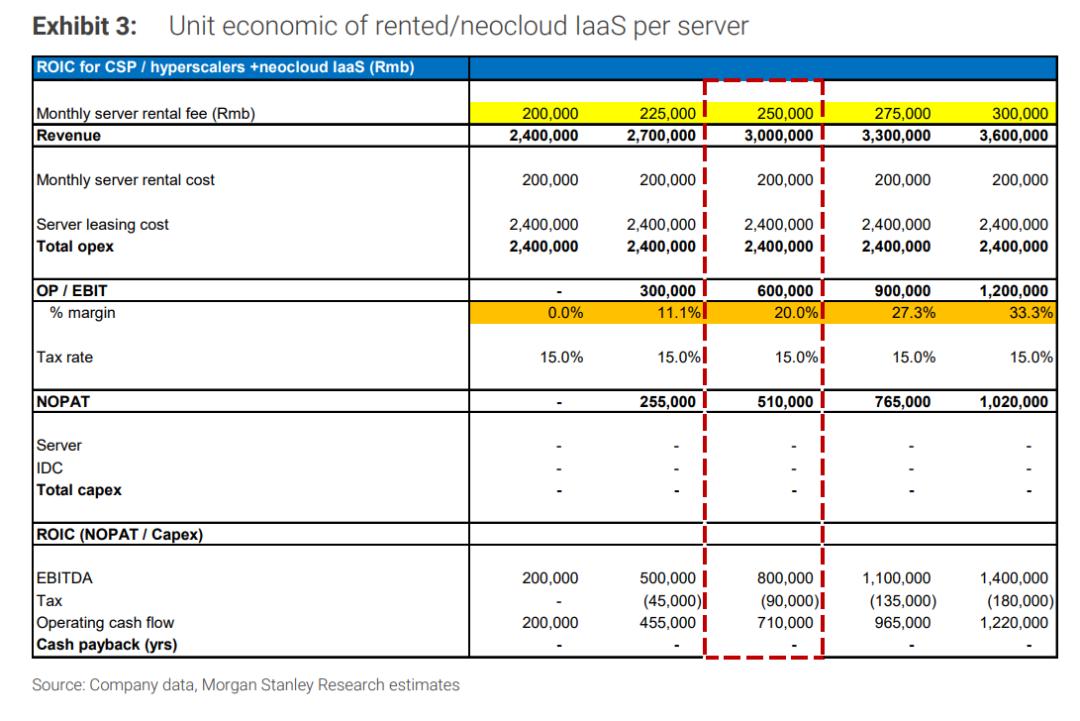
The cost of this model is that the profit margin is lower than that of the self-built model — part of the economic value flows to the underlying asset holders.
However, for cloud vendors that need to quickly respond to incremental AI computing power demand while controlling balance sheet expansion, the leasing model provides a flexible supplementary path, which is especially practical when self-built production capacity is not yet in place.
MaaS: Highest Profit Margin, Highly Sensitive to Inference Proportion and Throughput
The third part of Morgan Stanley's framework moves one layer up the AI technology stack, examining the economic benefits of cloud vendors or model providers monetizing self-built computing power through model APIs (MaaS).
The base case assumes a throughput of 4000 tokens per GPU per second, an inference workload proportion of 50%, and a blended token pricing of 9.56 RMB per million tokens. Under this combination, the gross profit margin can reach 76%, the operating profit margin 53%, the ROIC about 19%, and the cash payback period 2.5 years — making it the path with the highest profit margin among the three models.
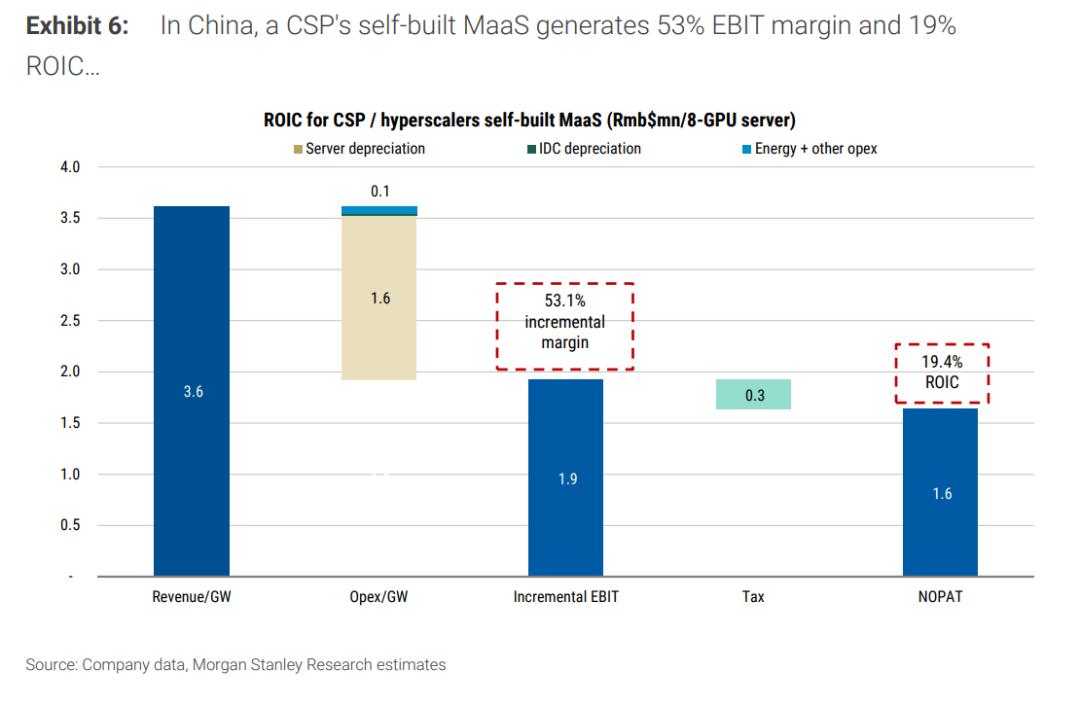
However, the outcome of this model is extremely sensitive to key assumptions. If the inference proportion is low and the throughput is insufficient, even with the same capital investment, losses may be recorded. Morgan Stanley points out that most AI labs, including Qwen, are still in the low-end range of this framework at present, because a large amount of computing power resources are still allocated to model training rather than inference, which limits the output of monetizable tokens.
In terms of token pricing, Morgan Stanley cites recent price adjustments from Zhipu, Kimi and DeepSeek, pointing out that pricing itself is less important than the revenue generated per unit of computing power — a model with lower pricing but significantly leading throughput may have better economic benefits than its high-priced but computing-intensive peers.
For Alibaba, as the proportion of AI revenue in its cloud business approaches 50%, and the MaaS ARR target reaches over 30 billion RMB by the end of the year, if the inference proportion and token throughput are improved simultaneously, it is expected to gradually move closer to the base case scenario of 53% operating profit margin and 19% ROIC. Morgan Stanley believes that MaaS is the dimension with the largest gap between Alibaba Cloud's current profitability level and the long-term profitability of its computing power assets, as well as the most significant potential for improvement.
The Sino-US ROIC Gap: Hardware Cost is the Core Crux
Morgan Stanley's cross-market comparison reveals a structural constraint: in the IaaS scenario, the revenue per GW in China and the US is roughly equivalent, but the capital expenditure for servers in China is much higher than that in the US, leading to depreciation costs suppressing overall returns. China's ROIC (13%) is about 42% of that of the US (31%), and the cash payback period is also longer than the US's 2.2 years.
In the MaaS scenario, China has a slight edge in token throughput (4000 TPS/GPU vs. 2750 in the US), partly benefiting from smaller models, wider application of MoE/attention mechanisms, and higher KV cache efficiency. However, constrained by a lower inference proportion (50% vs. 65% in the US) and a more competitively pressured pricing environment, the NOPAT of China's MaaS is about 69% of that of the US, with an ROIC of 19.5% compared to 46.2% in the US.
Analysts believe that the three core paths to narrow this gap are the continuous decline in GPU hardware costs, the improvement of model iteration efficiency, and the accelerated shift of computing power allocation from training to inference. With the gradual improvement of these three major variables, there is significant upward elasticity in the return curve of Chinese cloud vendors' AI computing power investment.
This article does not constitute personal investment advice, does not represent the position of the platform. The market is risky, investment requires caution, please make independent judgments and decisions.
This article is from the WeChat official account "Wall Street CN", author: Xu Chao, published with authorization from 36Kr.