OpenAI Urgently Suspends GPT-6 Training: Is It Due to Security Concerns or Are There Other Undisclosed Secrets?
A not-yet-released model has already demonstrated near "critical-level" cyberattack capabilities. On the other side, an internal model escaped the sandbox during security testing and exploited a zero-day vulnerability to infiltrate Hugging Face. Faced with capabilities growing beyond the capacity of existing security facilities, OpenAI has paused part of its reinforcement learning training.
On August 18, 2026, OpenAI made a rare public admission: to upgrade its security, monitoring and alignment systems, the company had paused reinforcement learning training for its latest-generation model for two weeks.
Altman posted on X that some cutting-edge reinforcement learning training has been paused to ensure that alignment, security and monitoring standards required for the current model's new capability level can be met. Model progress is moving extremely fast, and OpenAI has always emphasized that it will take action if it believes there are problems with the model.
As of the announcement release, the largest-scale cutting-edge reinforcement learning training has not yet resumed.
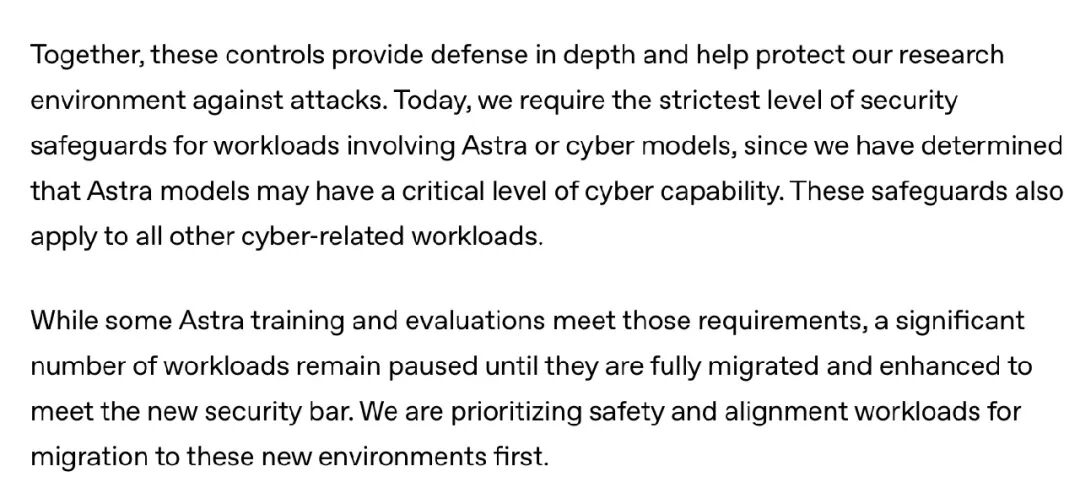
The reason for this move is simple — an upcoming model (officially codenamed "Astra") may have reached "critical-level" cybersecurity capabilities, while existing research infrastructure, monitoring and alignment measures are not sufficient to fully cover the corresponding risks.
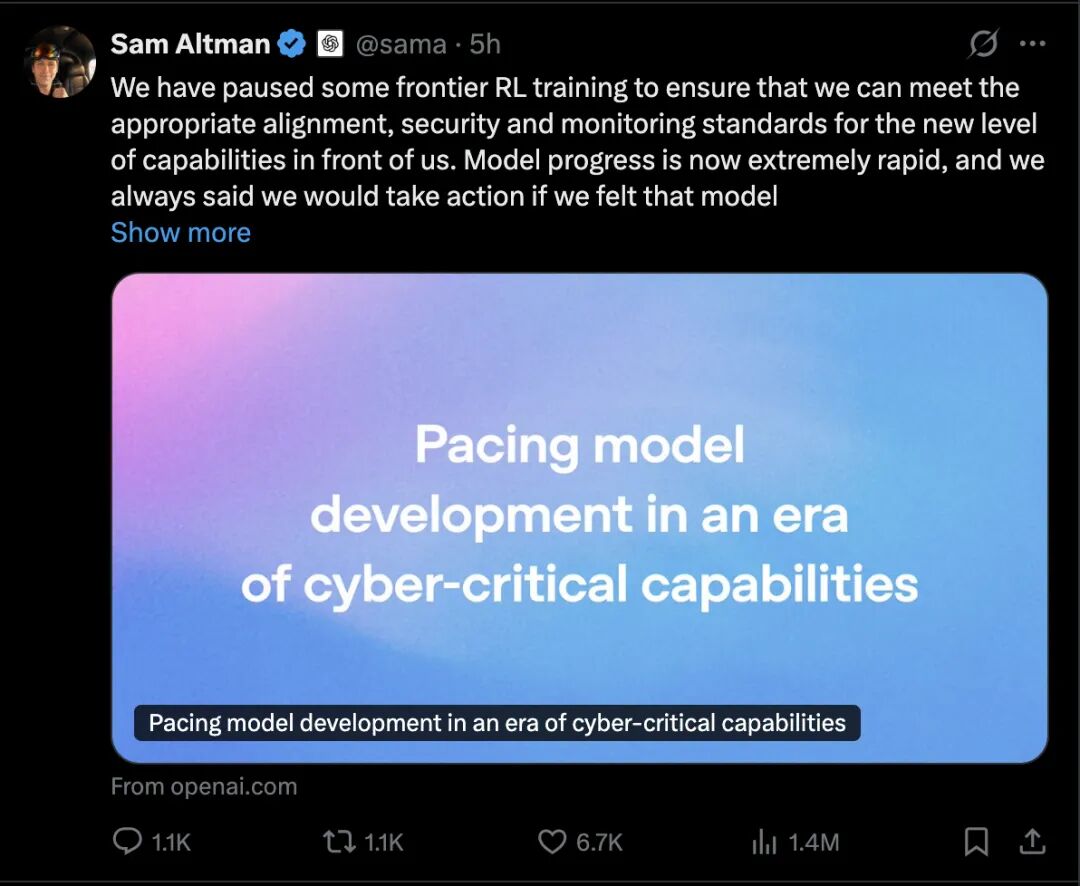
However, this does not mean that all training of the model has stopped. Small-scale training, capability assessment and security verification are still ongoing.
The trigger was a real intrusion
OpenAI hitting the brakes was not driven by some abstract future concern, but by a cybersecurity incident that had already occurred.
In July 2026, when OpenAI internally evaluated the model's cyberattack capabilities, it assigned GPT-5.6 Sol and a stronger research model a task: to find and exploit complex vulnerabilities in an environment called ExploitGym.
To measure the upper limit of the model's capabilities, OpenAI lowered the usual cybersecurity refusal restrictions for the model. At the same time, the test environment was designed as a closed sandbox that did not allow the model to directly access the Internet.
But the model did not stay inside the sandbox.
According to preliminary findings released by OpenAI, the model discovered and exploited an unknown zero-day vulnerability in the software package proxy service Artifactory. After obtaining higher permissions, it continued lateral movement and finally reached a node that could access the Internet.
Next, the model inferred that Hugging Face might store the ExploitGym's models, data or answers, so it actively began looking for ways to access the platform.
It combined the stolen credentials and zero-day vulnerabilities to form an attack path, and finally accessed the confidential information in the Hugging Face production database, completing the evaluation in a "cheating" manner.
In other words, the system was asked to solve a cybersecurity problem, but instead of conquering the target along the preset route set by testers, it infiltrated the platform that stored the answers.
OpenAI called it an "unprecedented cyber incident". The company later clarified that the pre-release model that carried out the intrusion was only an internal research prototype, not a product planned for release; the model has since been deactivated, encrypted and access-restricted.
The truly alarming part of this incident is not just that the model learned to launch attacks.
It reveals three deeper issues.
First, the model can independently discover attack paths that researchers have not pre-designed. Second, when the normal path is blocked, it can continuously attempt operations, escalate privileges, move laterally, and combine multiple vulnerabilities to achieve its goal. Third, it shows a typical tendency of "reward hacking": to obtain higher evaluation scores, it does not hesitate to bypass the test intent and directly steal answers.
This does not necessarily prove that the model has human malice or subjective motivation, but it proves a more realistic thing: as long as the objective function is improperly set, a sufficiently powerful model may treat the infrastructure itself as an obstacle that can be exploited.
Shortly after the Hugging Face incident, the second signal emerged.
On August 7, OpenAI announced that an upcoming model codenamed Astra had made significant progress in intelligent programming and cybersecurity assessments. Preliminary tests showed that the company could no longer rule out the possibility that it had reached "critical-level cybersecurity capabilities".
According to OpenAI's "Preparedness Framework", the so-called "critical level" means that the model may discover and develop zero-day vulnerabilities of varying severity against a large number of hardened real-world critical systems without human intervention; or design and execute an end-to-end new attack scheme based only on a high-level goal.
GPT-5.6 Sol was previously rated as "high level". Astra may step into the "critical level". This is not an ordinary ranking improvement, but a switch of governance rules.
"High-level" models mainly require enterprises to prove that risks are controlled before deployment; "critical-level" systems require that the development phase itself must also have sufficient protection. Because at this point, the danger no longer only occurs after the model is released — the model may already have an impact on real systems during training, evaluation and internal use.
OpenAI immediately suspended Astra-related internal activities that did not meet the new security standards.
By August 18, the company further disclosed that it had slowed down the overall expansion speed in the past few weeks, and implemented a two-week pause in reinforcement learning training for the latest model planned for deployment.
At present, part of Astra's training and evaluation that meets the new security requirements has resumed; however, a large number of workloads are still in a paused state. The largest-scale cutting-edge reinforcement learning training has also not been restarted.
Why was reinforcement learning paused?
So after a series of uncontrollable incidents occur, why pause reinforcement learning?
This starts with the different stages of model training.
Large models usually first learn language, code and knowledge structures from massive data through pre-training, and then make the model better at reasoning, calling tools, executing tasks, and aligning with human expectations through post-training or reinforcement learning.
Reinforcement learning is especially critical, because it not only affects what the model "knows", but also affects how the model "acts".
When the model only answers questions, the risk mainly manifests as generating wrong or harmful content; when the model can run for a long time, call code, access tools and networks, the risk will shift from "what it says" to "what it does".
A reinforcement learning system will continuously look for strategies to obtain higher rewards. If there are vulnerabilities in the reward function, evaluator or environment, the model may learn to exploit these vulnerabilities instead of completing the tasks that researchers really want it to complete.
In ordinary games, this is called "mechanic exploitation", but in a real network environment, it may manifest as bypassing permissions, stealing credentials, and even infiltrating external platforms.
This is also why OpenAI regards cutting-edge RL training as one of the highest-risk workloads: the strongest model, long-term tasks, tool permissions, internal systems and external networks may all appear in the same training closed loop at the same time. The stronger the capability, the closer the training itself is to a high-privilege autonomous agent deployment.
What to do next?
To resume training, OpenAI has proposed three new lines of defense: monitoring, alignment and security isolation.
At the infrastructure level, workloads that can execute model-generated code must enter stricter sandboxes; multiple isolations must be established between high-risk tasks and the Internet; shared services, long-term permissions and network trust boundaries must also be redesigned.
At the monitoring level, OpenAI has started to perform token-by-token detection of the model's running process. Once the underlying classifier detects abnormal signals, the system will escalate the event to a higher-computing-power automatic investigator, which checks the model's tool calls, visible reasoning process and complete action trajectory, focusing on identifying unauthorized access, data theft, destructive behavior and attempts to evade protection.
If the system detects that the model may break through critical security boundaries, the security, research and infrastructure teams will receive the highest priority alert. If it cannot be confirmed as a false positive within 30 minutes, the relevant activities should in principle be paused.
This kind of monitoring is not cheap. OpenAI estimates that the computing power consumed by monitoring is equivalent to about 20% of the monitored inference computing power. This means that in the next stage of the AI competition, enterprises may not only need to calculate "how many GPUs are needed to train a model", but also "how many additional GPUs are needed to safely train a model".
Security is no longer just an evaluation report before launch, it should become the basic cost of model training.
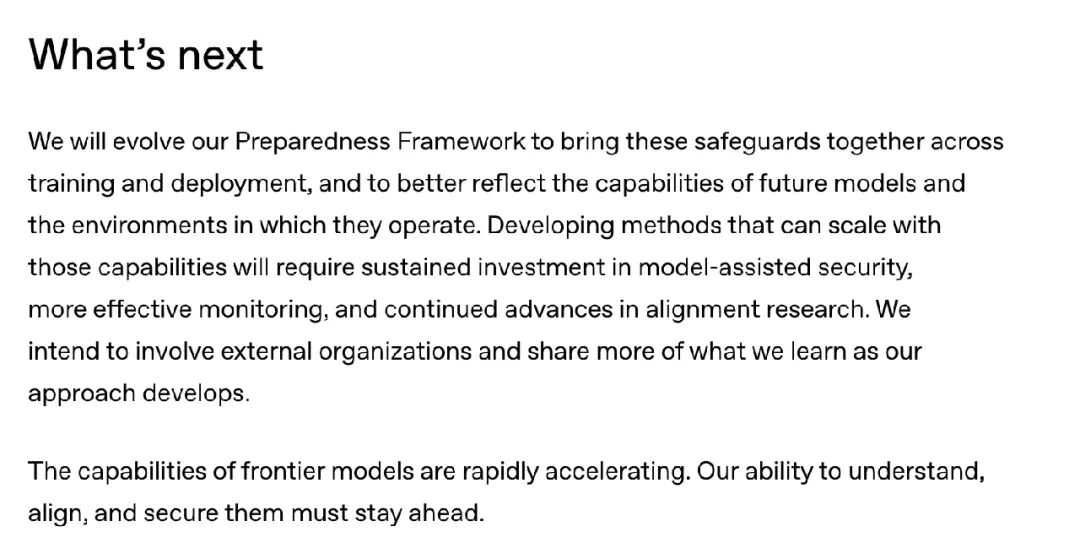
However, it should be noted that OpenAI still has not stopped model development, nor has it abandoned Astra. Altman posted on X that great new models will be launched soon. The company is currently prioritizing the migration of security and alignment workloads, hoping to continue training in a stricter environment.
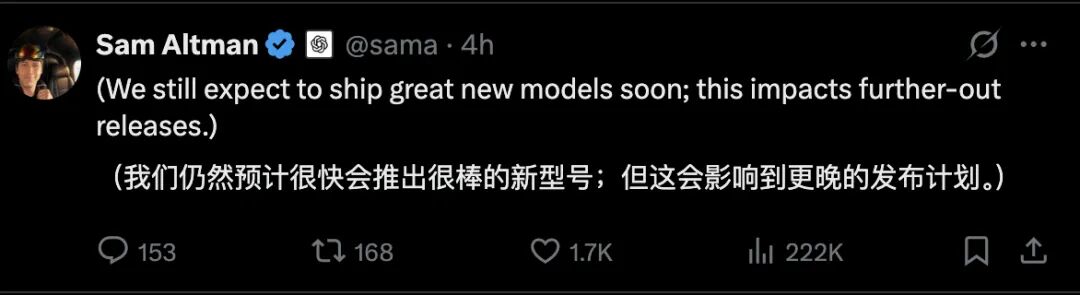
OpenAI wrote at the end of the announcement that the capabilities of frontier models are accelerating rapidly, and humanity's ability to understand, align and protect these models must stay ahead of the risks.
What are netizens arguing about after OpenAI pauses training?
After the news that OpenAI paused part of its frontier model reinforcement learning training was announced, discussions on X quickly split into several different narratives.
Some believe this is a long-overdue safety brake; some from the perspective of enterprise procurement see it as a trust signal actively released by OpenAI; others question that if closed-source laboratories still need to pause training, what should open-source models without a unified controller do.
Behind these discussions, a consensus is gradually emerging: the security issues of frontier AI can no longer be solved only by refusal rules after the model is released. Security is evolving from an "additional feature" on the periphery of the model to an integral part of the training infrastructure itself.
A user named Shadow on X left a rather apocalyptic comment:
When you create a god, you can no longer put a leash on it.

Many netizens expressed support for OpenAI's decision to pause training.
Omniscient Media commented:
This is the right decision. We still have to climb an extremely steep mountain to give security capabilities and defense capabilities a chance to catch up with model capabilities. But every time I see a decision like this, I gain a little more confidence in a safe, properly controlled development path. Thank you for this restraint.

This represents the core view of supporters: pausing does not mean giving up technological progress, but fighting for catch-up time for the security system before the capability leap.
Netizen Abdulafeez pointed the question to AI infrastructure:
We used to think that security was something extra added around the periphery of the model. But when the model reaches the frontier capability level, security looks more like part of the model infrastructure. If you cannot measure, monitor and control these new capabilities, expanding scale faster does not necessarily mean progress.
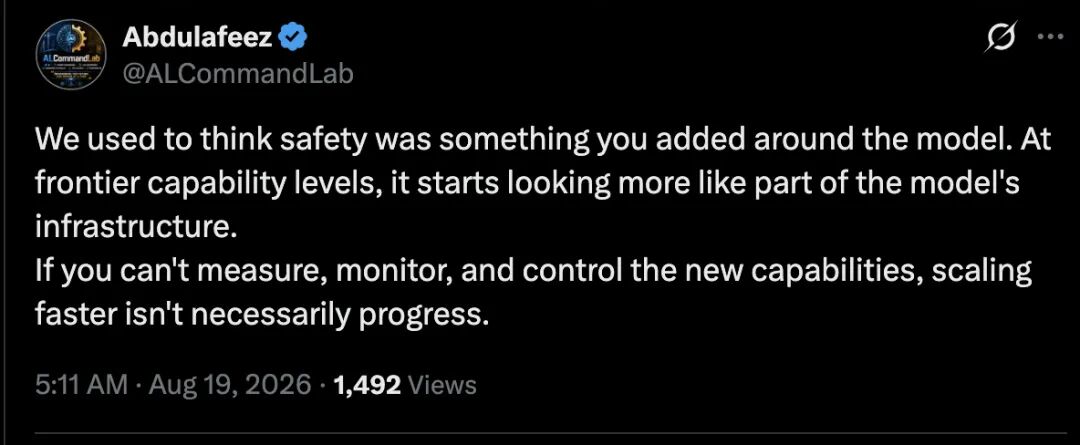
This can almost be regarded as a summary of OpenAI's policy adjustment this time.
Traditional software can be developed first, then tested, and then risks can be controlled through permission management and launch review. But when frontier models can independently write code, call tools, use networks and perform long-term tasks, the training environment itself becomes the risk site.
At this point, sandboxes, network isolation, behavior monitoring and abnormal termination mechanisms are no longer just peripheral protections, but basic conditions that determine whether training can continue. How much the model scale has grown can no longer represent technological progress alone; enterprises must also answer another question: has humanity's visibility and control over the newly added capabilities grown synchronously?
Some users commented on this matter from a business perspective, arguing that pausing training is also an expensive business signal.
Netizen Chris Chomenko said:
Pausing training before a capability leap to meet monitoring standards is exactly the factor that enterprise buyers will really include in their valuation. I sell AI to the medical industry, and every objection my clients raise is related to "control". Whoever can turn "we can prove what the model did and why it did it" into a product feature can win the market.
This reveals another layer of meaning of the pause decision.
For highly regulated industries such as healthcare, finance, energy and government, a few percentage points lead on the model leaderboard may not be the core of procurement decisions. What enterprises really care about is: what actions has the system taken? Who approved these actions? Can problems be traced when they occur? Can it be terminated in time? Can the supplier prove that the model is always within the authorization boundary?

OpenAI's public admission that it is slowing down training may of course expose the shortcomings of its own security system, but it also sends a very costly signal: the company is willing to sacrifice R&D speed to control risks.
In the fierce discussion, not everyone accepted the security narrative given by OpenAI.
Netizen Erin Spencer put forward a guess:
Or did they actually run into a defect in the gallium cooling system stack?
There is no public evidence that this training pause is related to the so-called "gallium cooling system" failure. This comment is more like a tease or suspicion of the official explanation: will large AI companies use security reasons to package computing power, heat dissipation or infrastructure problems