At 10 p.m. on the eve of WRC, neither the robots nor the staff have clocked out yet.
At 7 p.m. on August 18, one day before the official opening of the World Robot Conference (WRC), we arrived at the Intelligent Robot Innovation Park in Yizhuang, Beijing.
This is the permanent venue of WRC. Over the past decade, the World Robot Conference has been held here continuously. This year marks its 11th session, and it is also the fifth consecutive year that "UnKnown" has come to the WRC site.
Perhaps after a full decade of development, the 11th WRC has seen very significant changes even in terms of venue layout. The road in front of the main venue has been renovated, and Hall C, which used to be built with prefabricated temporary panels in previous years, has disappeared, replaced by a brand-new main venue full of technological elements.
In the next few days, more than 500 leading figures from the global robotics industry will give speeches here to share their ideas and speak for their enterprises.
When we entered the venue, the night had completely fallen over Beijing, but inside the exhibition hall, workers were still working at a fast pace to set up, and the air was filled with the unique glue smell left after new decoration.
The booths of many enterprises were still very busy, employees wearing custom-made corporate uniforms gathered around robots, dexterous hands and various equipment to carry out the final debugging before the exhibition opens to the public.
On the first floor of the Conference Center, Galaxy Universal will hold a sub-forum themed on embodied intelligence large models the next day (August 19). Dozens of people on site are constantly busy adjusting the lighting and stage settings.
In front of the booth, several staff members are eating packed meals while staring at the large screen, revising the PPT word by word, reconfirming the process, lines and personnel movement routes.
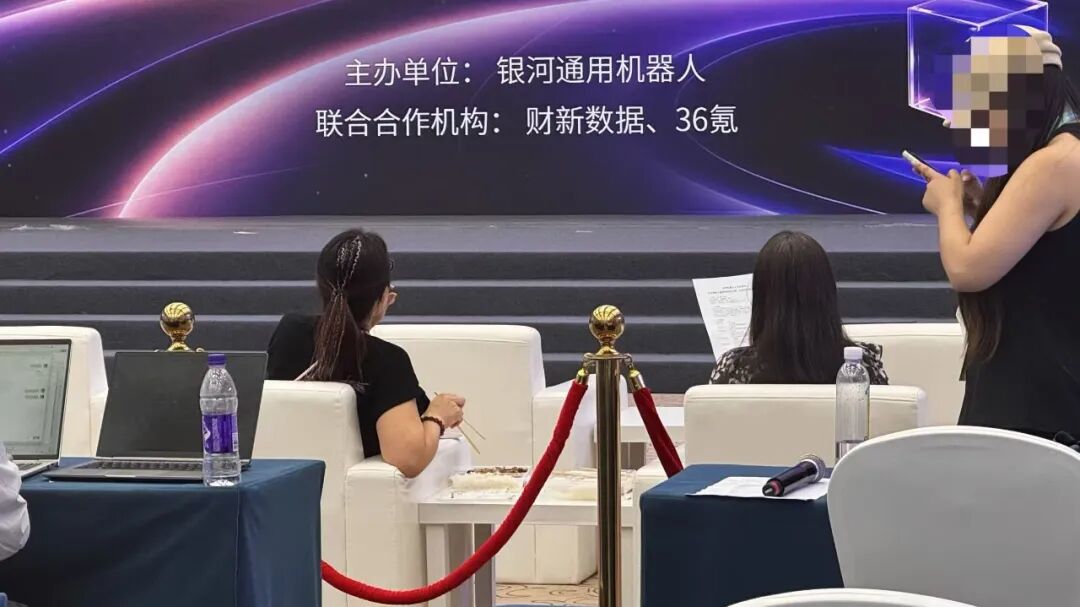
Galaxy Universal staff modifying the PPT while eating on site
In Hall C, at the booth of Luming Robotics, eight or nine staff members wearing branded uniforms are resting on the booth, obviously exhausted after a whole day of busy work. Next to them, employees from another robotics company sit on the floor, eating hamburgers just brought back from outside the venue.
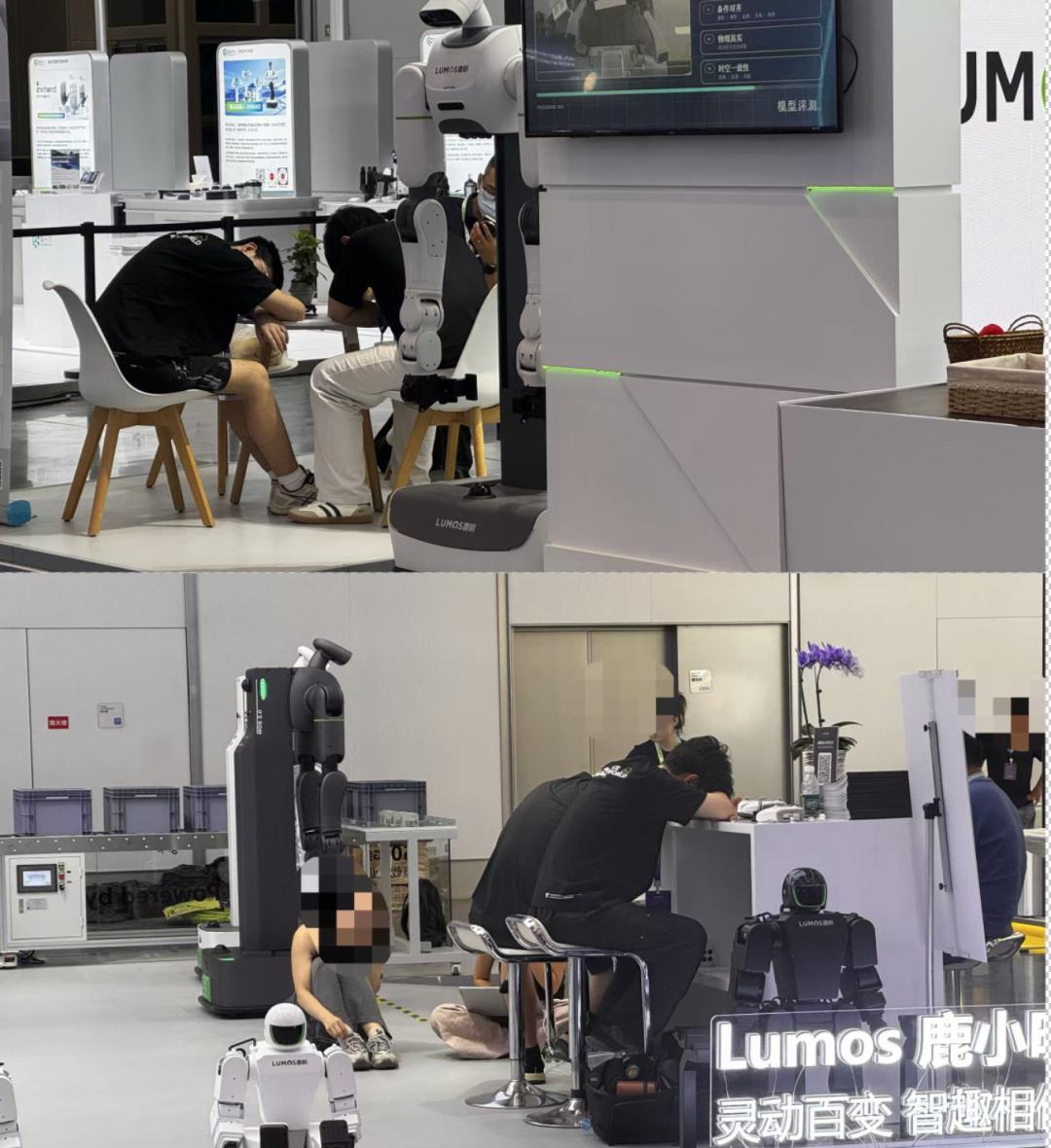
Luming Robotics staff resting after getting tired
In Hall B, Zhongqing Robotics is still seizing the time to rehearse the boxing performance scheduled for the next day (August 19).
On site, the T800 robot keeps adjusting its posture and posing in different positions under the instruction of a lady through the microphone, just like a warrior returning from the battlefield. Two photographers keep taking snapshots from different angles, including long shots, medium shots and close-ups, showing a determination not to stop until they get satisfying photos.
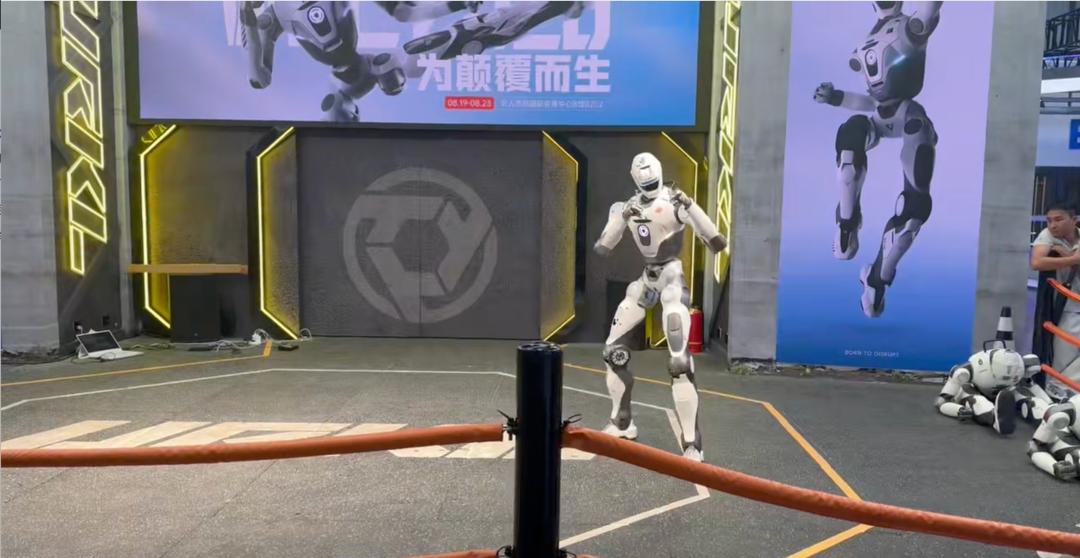
Zhongqing Robotics conducting tests
Moreover, even though the exhibition hall is not officially open to the public yet and everyone is busy with their own work, a circle of onlookers has already gathered around the booth of Zhongqing Robotics.
It is almost predictable from here how many people will stop to watch around this booth in the next five days.
For enterprises whose booths are located next to Zhongqing Robotics, this may be a kind of happiness mixed with distress.
After all, it is obvious that Zhongqing Robotics will attract huge traffic, but this also means that if an enterprise cannot present attractive highlights, it will inevitably be completely overshadowed by the limelight of Zhongqing Robotics.
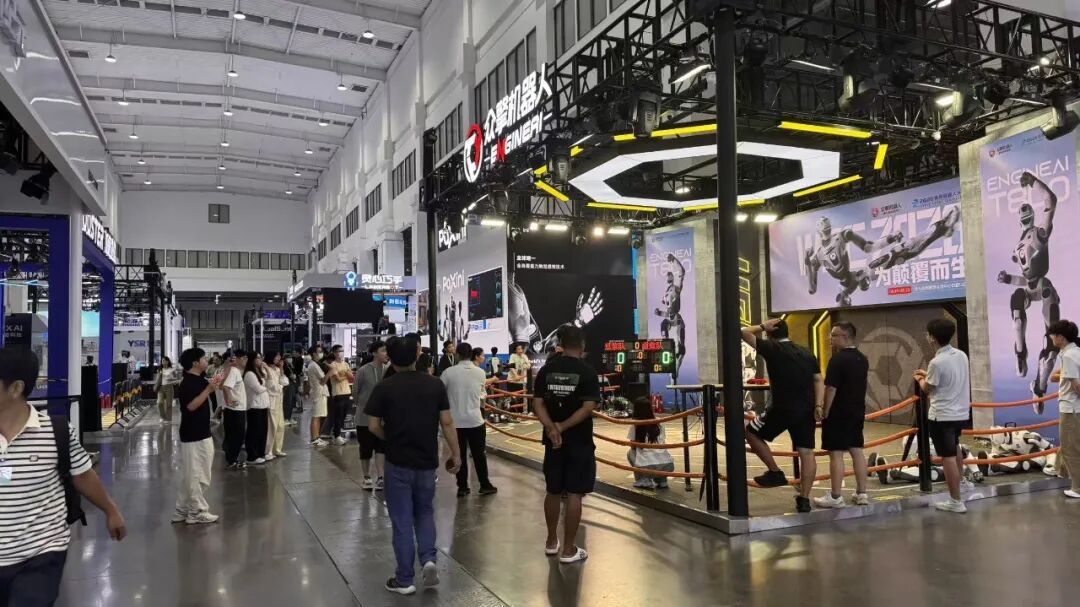
Crowds of people watching Zhongqing Robotics' test
For example, Star Era, whose booth is directly opposite to Zhongqing Robotics, has set up a robot solution demonstration for logistics sorting scenarios on site. There are a large number of people coming and going, but very few of them stop to pay attention to their exhibition.
While walking around the exhibition, we even overheard two employees of other exhibitors located near Zhongqing Robotics chatting as they walked: "This performance effect is really good, we can learn from it next time."
This is probably a very interesting side of today's robotics industry.
But if we shift our vision from a single booth to the entire venue, several more obvious changes have emerged at this year's WRC than the competition for better performance effects.
Behind the increasingly large booths
Stepping into the exhibition hall, my first feeling is that the booths of robotics companies this year are extremely large.
This kind of "largeness" first of all means sufficient capital support.
Of course, robotics companies have indeed had no shortage of funds in the past two years.
According to the statistical standard of IT Juzi, from January to June 2025, a total of 286 financing events took place in the primary market of China's robotics sector, with a year-on-year increase of 138%; the total financing amount of robotics startups reached about 27 billion yuan. In the first half of the year alone, more than 26 robotics startups obtained financing of "hundreds of millions of yuan and above".
Interestingly, we can hardly see these robotics companies spend money so generously in normal times. Most robotics companies are very cautious no matter in media investment or market budget arrangement.
A recent report by TMTpost mentioned that some robotics company executives said their companies have enough cash on the books to support operations for 100 months. Citing sources familiar with the matter, the report said that Starsea Atlas spent less than 100 million yuan in total over two years, with extremely low capital utilization rate and very abundant book reserves. Public data shows that the total publicly announced financing amount of Starsea Atlas in the past two years has approached 5 billion yuan.
For robotics enterprises, the only two occasions worth spending huge sums of money in the past two years are probably the Spring Festival Gala, as latecomers are constantly trying to replicate Unitree's success, and the WAIC and the World Robot Conference.
This WRC also reflects this point, as robotics companies almost spare no cost here. For example, Unitree and Starsea Atlas even built second floors in the most core areas of the venue, which has never been seen in previous conferences over the past years.
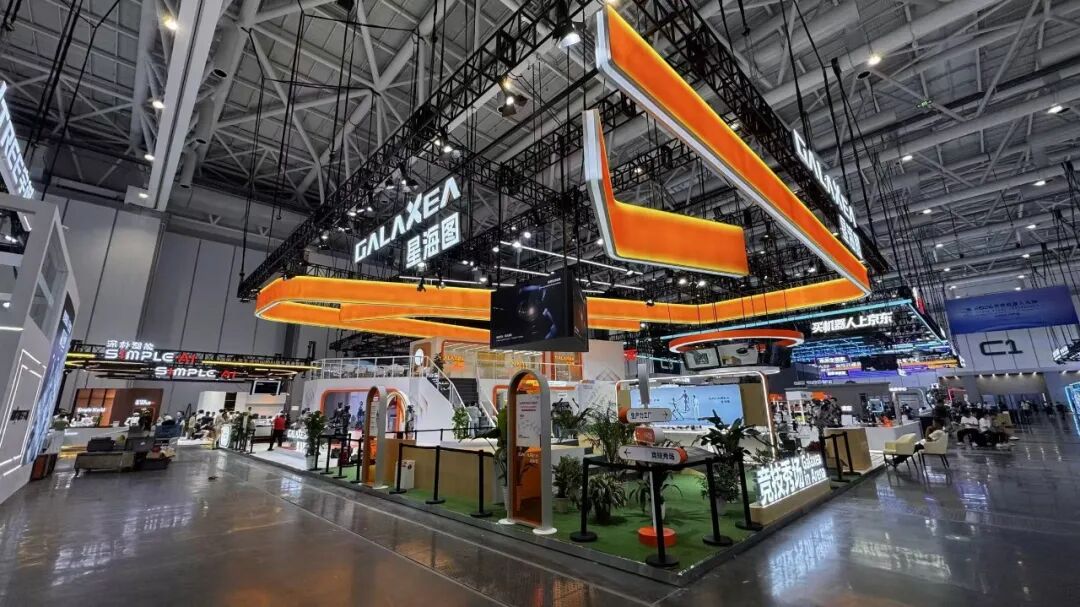
The oversized custom-built booth of Starsea Atlas
The custom-built booth areas of other companies are also expanding. In previous years, these locations could even accommodate four or even five enterprises.
Even such large booths, which only existed in the core areas of Hall A and Hall B in previous years, are crowded in Hall A, B and C this year, so that small booth enterprises that could still set up in the main venue in previous years have all been moved to Hall D built with temporary tents this year.
The money that was reluctant to spend in normal times is concentrated on booth construction at this moment.
Because for today's robotics companies, the booth is no longer just a place to display robots.
It is becoming an important window to compete for attention, demonstrate business capabilities and show the corporate imagination.
This also leads to the second more important change of this year's WRC.
From being able to perform to being able to take up jobs
The large venue does not mean that these robotics companies are spending money recklessly.
An important reason why everyone is pursuing super large booth areas is that almost all robotics companies are trying to move a real scenario into the exhibition hall.
And this is the second keyword of this year's World Robot Conference: scenarios.
This year, almost every robot on site comes with an identity and a profession, such as shopping guide, salesperson, express sorting worker, boxer, chef, barista and so on.
In order to more intuitively demonstrate how these robots are competent for their jobs, almost every robotics exhibitor in the main venue has built a 1:1 real scenario.
For example, Star Era mentioned earlier moved a full logistics sorting line here; Cross-dimensional Intelligence moved the mobile phone quality inspection assembly line and an entire convenience store, including the back kitchen and the front cash register, to the exhibition site.
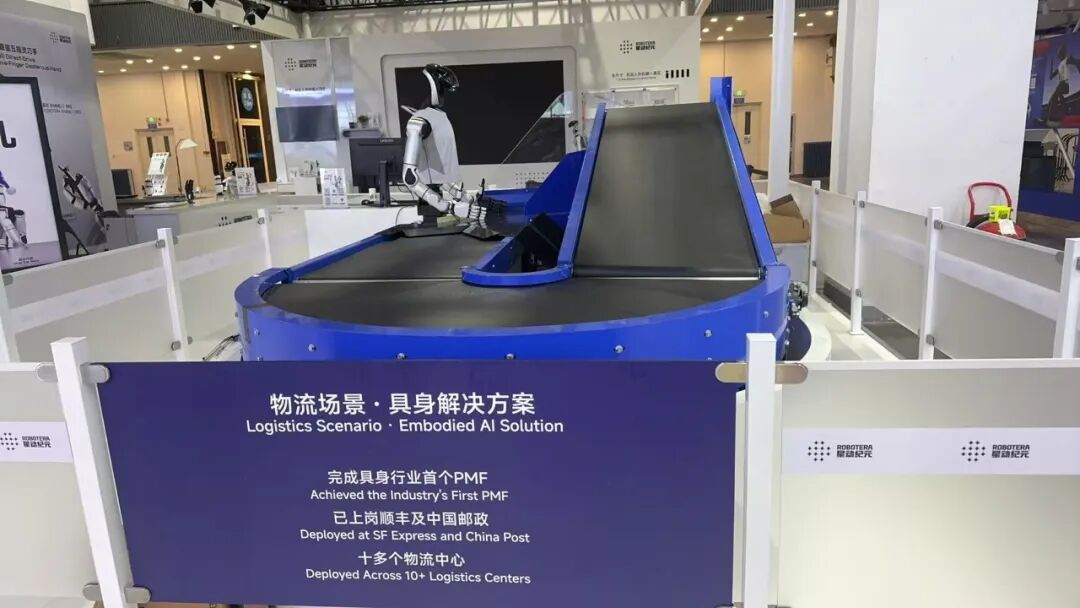
The logistics scenario solution of Star Era
Wujie Power built a coffee shop in the venue; Deeppu Intelligence built a large living room to demonstrate the home service capabilities of robots; Starsea Atlas even built a robot "park" divided into three exhibition areas, namely the productivity factory, future life and competition show, which almost covers the three most mainstream application scenarios of current humanoid robots.
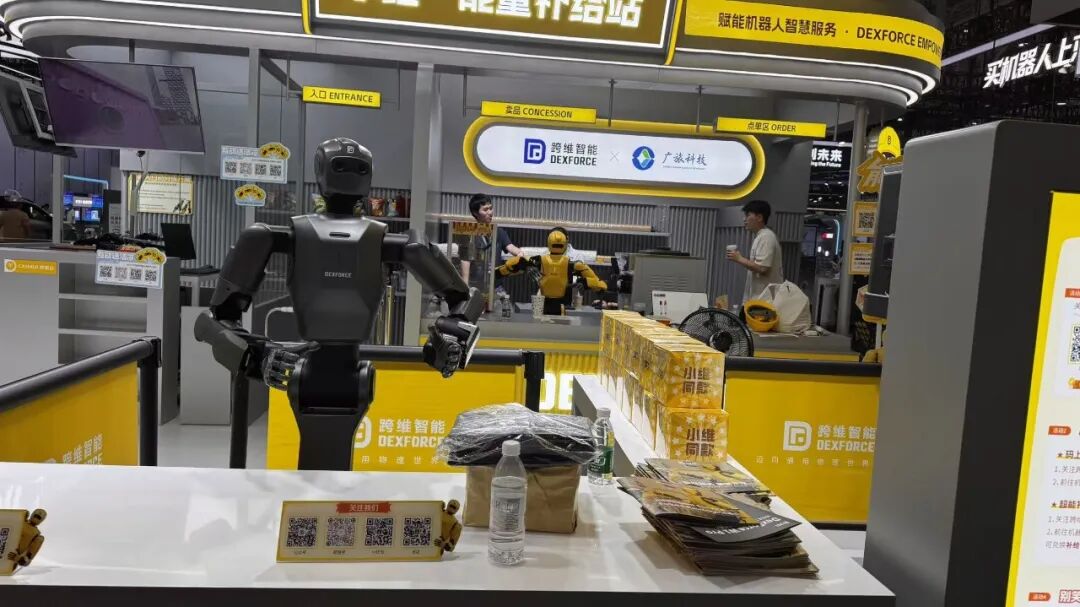
The solution demonstration of Cross-dimensional Intelligence
We still remember that last year, a robot that could make coffee was enough to attract crowds of onlookers, with endless queues and extremely limited robot-made coffee supply. But this year, robots that can only make basic coffee are not qualified to be displayed at all, and some robots even perform specialty coffee making on site.
Walking into the exhibition area, we can intuitively see that various keywords such as real industrial park, intelligent on-duty and intelligent service are made into posters, custom decorations or displayed on large screens.
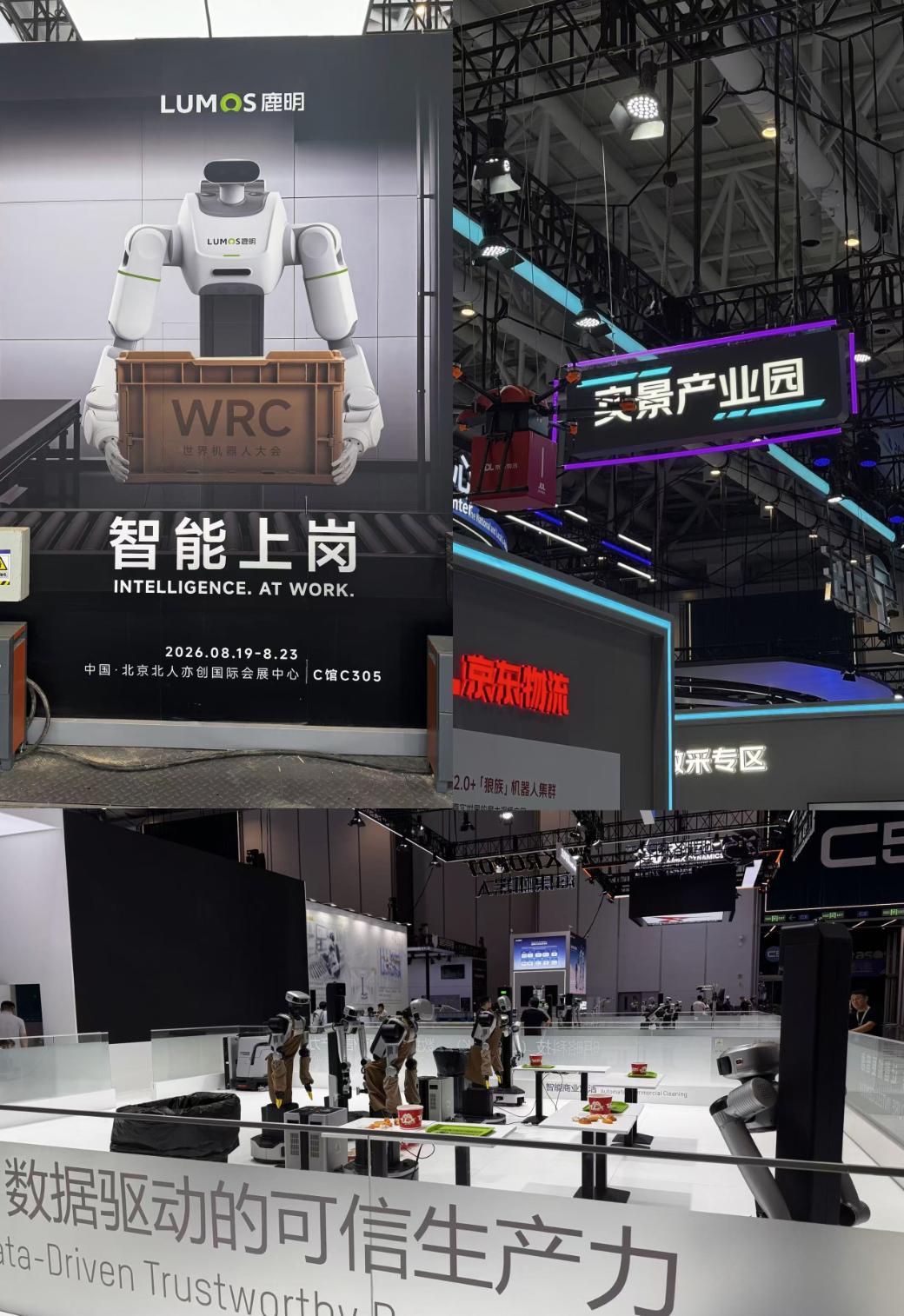
Some productivity-related keywords in the venue
Almost all enterprises are sparing no effort to label themselves with such keywords.
This also reflects the transformation of the whole industry from last year to this year: the focus has shifted from whether the robot can run, jump, fight, dance and look more like a human, to whether it can take up jobs, complete tasks and create value.
The key to this transformation is closely related to the sufficient capital of robotics companies mentioned earlier.
After all, mass production of robots has become a common practice in the past year.
By the end of June this year, Agibot has announced that its 15,000th embodied robot has rolled off the production line; by July this year, Unitree Robotics has produced a total of 18,000 robots.
This makes it difficult to further push up valuations only relying on the previous stories of robots running, jumping, fighting, dancing and shaking hands.
So the question that capital will naturally ask next becomes: you have raised billions or tens of billions of yuan in financing, can your robots really make profits? This forces the whole industry to gradually shift its narrative from technological breakthrough to value verification.
This point also reflects the particularity of Zhongqing Robotics.
After all, when all enterprises are committed to delivering tangible productivity, only Zhongqing Robotics is still using last year's narrative to demonstrate its performance capabilities, so it has to be said that Zhongqing Robotics is a special case.
Hands, perception and data become new focuses
Another obvious change this year occurs in a very small part of the robot - the hand.
At WRCs in previous years, some enterprises producing dexterous hands, sensors and core components were mostly located in the marginal areas of the venue. This year, these enterprises have moved to more prominent positions.
Lingxin Qiaoshou is one of them.
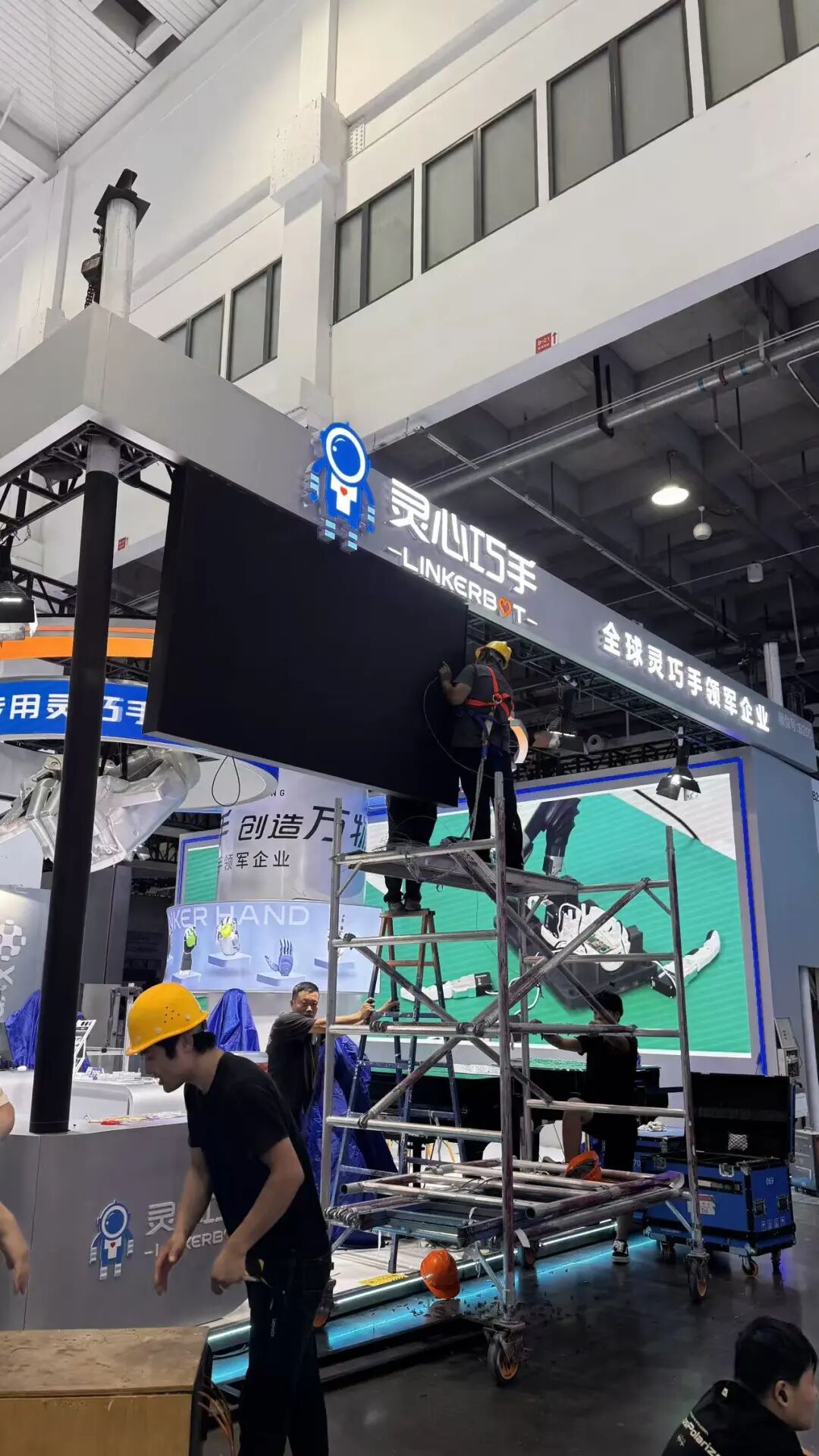
The under-construction exhibition area of Lingxin Qiaoshou
This enterprise specializing in making dexterous hands for humanoid robots has secured a considerable custom-built booth in Hall B this year. Similar enterprises include Xinuo Future, Chaowei Power, InTime Robotics, Aoyi Information, Zhongke Silicon Era and so on.
Judging from the exhibit structure of this year's WRC, dexterous hands have become a very prominent category.
This more or less confirms the shift of the robotics industry's focus in the past two years.
A humanoid robot first needs to solve the problems of "standing up" and "walking". When the ontology, joints and motion control technologies gradually mature, the problem naturally shifts from "whether it can move" to "whether it can complete practical tasks".
And most jobs with real economic value are ultimately completed by hands.
Actions that seem simple, such as tightening screws, assembling parts, sorting goods, sorting express parcels, folding clothes, grasping objects and plugging in cables, require continuous recognition, judgment, contact and fine control for robots.
