Before the dialogue, Cao Yuan from DeepMind: The boom of AI for Science has arrived, and a brand new era is coming.
In the first week of August, Jeff Dean, the iconic figure at Google, announced his departure, leaving the company with several other executives to found Discovery Loop, a startup dedicated to accelerating research processes in life sciences and other industries.
In Silicon Valley, this marks that the AI for Science track has officially entered an explosive growth phase.
While numerous mathematicians, physicists, and biologists are joining top AI labs such as OpenAI and Anthropic, AI is reshaping the paradigm of human scientific research and development. OpenAI announced that its Astra model has derived solutions to 10 long-standing unsolved mathematical problems that have puzzled humanity for years. Anthropic's unreleased research-focused Claude has pushed the lower bound of zeros related to the Riemann Hypothesis from 41.6% to 67.2%. Meanwhile, AI is rapidly advancing the frontiers of science in fields including biopharmaceuticals, materials science, and physics.

The self-evolution of AI that forms a closed R&D loop is the core of scientific research acceleration. However, in this process, the role of human beings appears somewhat awkward.
In this article, we talk about AI for Science with Cao Yuan, former senior research scientist at Google DeepMind. We cover the methodology of AI's autonomous evolution in scientific research, the applications of AI in mathematics and physics, and finally even touch on some philosophical questions and the meaning of human existence. Below is our conversation with Cao Yuan.
Leaving Google
Chen Xi: Cao Yuan, welcome to Silicon Valley 101. Could you please introduce yourself to our audience?
Cao Yuan: Hello everyone, I'm Cao Yuan, formerly a scientist at Google DeepMind. I am also the co-founder of Unreasonable Labs, an AI startup. Our company mainly focuses on AI for Knowledge Creation, AI for Science, and R&D (Research and Experimental Development).
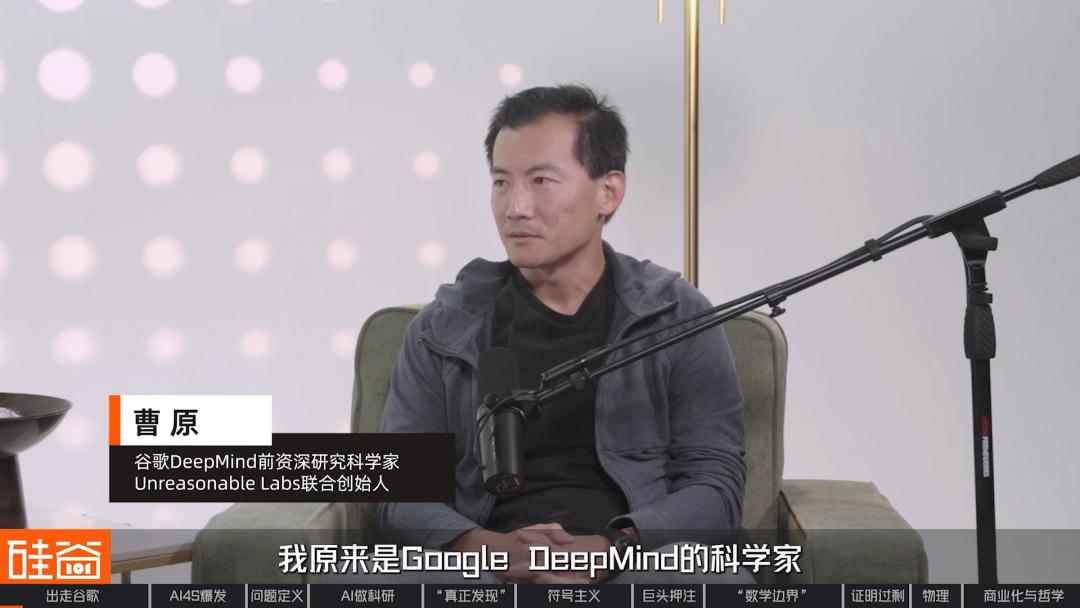
Chen Xi: The timing of our recording today is very coincidental. Just yesterday (August 6, 2026), Google's Jeff Dean announced that he would lead a group of tech executives to found a new company called Discovery Loop, which also aims to work on AI for Science (AI4S) related businesses. I have seen many comments expressing mixed feelings, saying that this is the end of one era and the beginning of another. In my understanding, the era that ends is an era of Google, and the new era that begins may be a new era of AI4S scientific research. Is that a fair interpretation?
Cao Yuan: I think this incident can be interpreted from several perspectives.
First, Google and DeepMind have always had many outstanding talents and teams. In the past, each team focused on its own topics and rarely interfered with others. However, since the Gemini project was launched three or four years ago, as it is one of the company's most critical projects, the company needs to concentrate resources to achieve major goals. Since then, this has brought great challenges to organization, personnel, and project management, and it is difficult to avoid some internal conflicts.
Second, over the past six months or so, the performance of Gemini has been relatively unsatisfactory. For example, at the beginning of this year, Gemini 3.1 Pro was still a relatively good language model on the leaderboard, but over the past three or four months, whether it is Anthropic, OpenAI, or some open-source companies in China, their model capabilities have improved rapidly. In contrast, the performance of Gemini 3.5 Flash and the latest 3.6 Flash is relatively mediocre, and the 3.x Pro that everyone expected has not been officially released yet. Overall, the progress of Gemini is relatively lagging behind. In this case, if Google wants to catch up with Anthropic's new capabilities centered on coding agents in terms of business models and shift its business direction to this track, it will also face great difficulties.
Third, the essence of Jeff Dean, Oriol, Sanjay and Quoc founding Discovery Loop is to enable AI to independently carry out knowledge development, knowledge discovery and autonomous scientific research, which is highly consistent with the direction our startup is pursuing. Logically, this is also a natural extension of the development of AI capabilities. In the past two or three years, the most concerned capabilities in the industry have been mainly focused on mathematics and programming, such as automatically writing code and solving Olympiad mathematics problems. When these capabilities gradually mature, the next direction that may trigger a new burst of AI intelligence, generate huge benefits, and help humanity solve greater problems will naturally extend the capabilities of mathematics and code to a wider range of scientific knowledge discovery. Therefore, starting from this year, the number of startups focusing on Knowledge Discovery, AI4S and Recursive Self-Improvement has increased significantly. Star teams like Jeff, Oriol, Sanjay and Quoc who come out to start a new company will definitely want to set a new benchmark in this field and become a new type of NeoLab.
But if we say that "a new era has begun and Google may have shifted its focus" just because of this incident, I think it is somewhat exaggerated. Because even with changes in the leadership, Google still has the complete full-stack capabilities needed to develop excellent language models and AI, from underlying chips, infrastructure, data centers, toolchains, to models, talents, data, and then to upper-layer products and distribution channels covering a very wide range of consumer products. Google has all of these and is completely independent of the external ecosystem. The problem is not that Google cannot do a good job, but that its priority and resource investment need to be adjusted. I believe Google will still make up for these capabilities in the future.
Chen Xi: I am still very curious. As you mentioned earlier, Google already had an internal AI4S research team, which is a direction that former CEO Demis Hassabis has always attached great importance to, and he even independently led Isomorphic Labs. Why can't Google retain this group of scientists including you and Jeff to continue doing AI4S within Google?
Cao Yuan: First, the flow of personnel between several cutting-edge technology companies in Silicon Valley has always been very frequent, not just in Google. For me personally, the reason why I decided to leave to do this is that I was previously working on Gemini's model iteration and post-training, but I have been thinking about some deeper questions, such as how to make the model truly more intelligent. To achieve AGI, although current models can already do mathematics and write code well, they still lack some key capabilities. For example, to truly solve scientific problems, the model needs to propose new hypotheses, verify new hypotheses, and continuously update itself. But now these capabilities are still far from "helping humanity achieve exponential growth in scientific knowledge". Why are these capabilities missing? How to further improve the model so that it can help humanity do better things? This is a question I am very interested in, and it is also one of the motivations for me to choose to start my own business.
Chen Xi: Then why did Jeff Dean lead people to leave? Can you make a guess?
Cao Yuan: Jeff Dean is a legendary figure at Google and even in the entire industry. From the early days of Google to the present, a large number of internet-scale infrastructures originated from his work, from MapReduce, Spanner, BigTable, to the later founding of Google Brain, then to TensorFlow (one of the earliest deep learning frameworks), Google TPU, and finally Gemini. Oriol and Quoc who left with him are both early members of the Google Brain team, and they have worked together for a long time.
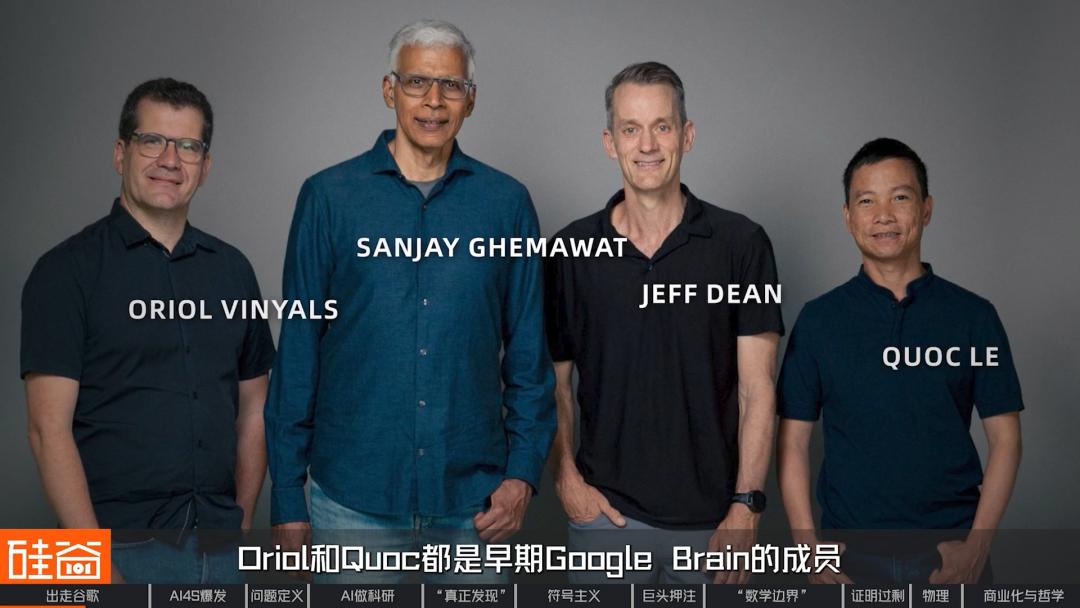
Sanjay is also a veteran of Google, who joined almost at the same time as Jeff Dean, and is also a long-term partner. So they know each other very well. I used to see Jeff Dean and Sanjay do pair coding in the office very often, writing code together. They have to spend one day a week writing code, and Jeff has always been very hands-on. So if they decide to go out and do their own things together, this is a very natural combination. They know each other well and both have strong technical backgrounds.
Chen Xi: Not only Jeff Dean left now, but earlier, John Jumper, co-founder of AlphaFold and Nobel laureate, also joined Anthropic. In the past, I always thought that Google was one of the companies that attached the most importance to the AI4S route, and Demis Hassabis has long led this direction. So the successive departures of core figures recently still surprised me. Why can't Google retain these scientists?
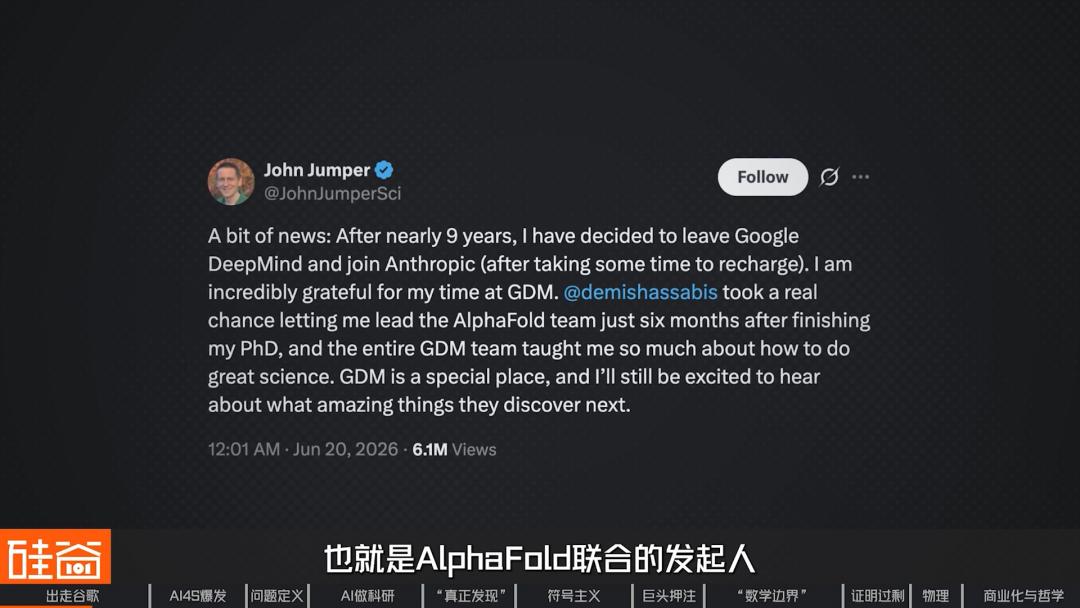
Cao Yuan: Because Google's current top internal priority is definitely to make Gemini reach SOTA, at least equal to or better than Anthropic and OpenAI. Therefore, the priority of many tasks in the short term must be shifted to Gemini, including Jumper and some people who originally worked on AI4S, their work focus will also change accordingly. When a team is so large and has a project with extremely high priority, it is impossible to make everyone completely satisfied. So how to fully reflect and reasonably arrange the abilities and demands of so many talents is a very challenging problem in itself. I think Google has done a lot of optimization and adjustment in this regard to allow each of them to maximize their potential, and the management team, scientists and engineers are also continuously iterating this process. There are still many management challenges, but I think the situation is getting better.
Chen Xi: How do you judge that it is getting better?
Cao Yuan: Now when building large models, you can no longer follow the management methods of large companies in the past, because it requires very fast iteration and continuous updates. What Google has to do is to "revolutionize itself", make the Gemini team as much like a startup as possible, and make up for its capabilities as soon as possible. This means that the management team must make adjustments in personnel arrangements, the work each person undertakes, and the arrangement of the entire project, which requires the courage to self-innovate. I believe Google has realized this and will continue to do it.
Chen Xi: So if new talents join in the future, it may also bring new changes. For example, after Alex Wang joined Meta, there have been some signs of improvement recently, including Muse Spark and the latest programming model, which have received good feedback from the outside world.

Cao Yuan: Yes, there will definitely be changes. There are several key elements in building a model, including talents, data, computing power, and project management that people tend to overlook. Every soft setting in the entire system needs some improvement and continuous iteration. For Meta, it is already very difficult for MSL (Meta Superintelligence Labs) to reach the current level in less than a year. But next, it will become more and more difficult to further move from this level to SOTA. It is possible to catch up quickly from 0 points to 80 points within a certain period of time, but the challenge is much greater from 80 points to 100 points, or even more than 100 points. Google was already at a relatively high level, but how to further move up to the best position next? This will require a lot of effort, coordinate many resources, and require everyone to arrange all work very efficiently to iterate the model quickly.
Chen Xi: So will AI for Discovery and AI4S still be the key direction that Google bets heavily on?
Cao Yuan: Yes. Sundar mentioned in the email he sent the other day that although Demis stepped down as CEO of DeepMind, he still leads the departments related to AGI and science. Among all AI technology companies, Google can be said to be one of the companies that has laid out the scientific field the earliest, most extensively and deeply, and its entire ecosystem is also the best. How to use AI to automatically drive the development of science and technology is a very important topic, which is not only important for a company, but also very important for society and even the country. The development of human society is ultimately driven by science and technology. Now that we have such powerful AI tools, we must continue to push this capability forward. So Google will not give up AI4S, there will only be a priority adjustment in the short term. And I believe that although Demis has now become Chairman, he will definitely continue to make a lot of efforts in AI4S.
Chen Xi: Can we understand that Demis took a step back now because he doesn't want to manage commercialization and products, and wants to focus more energy on AI4S?
Cao Yuan: I think this is one of the reasons. Demis has always valued long-term development more, especially in technology. His personal temperament is more like a scientist, not a CEO in charge of products and business. The merger of DeepMind and Google Brain was largely to accelerate Gemini and catch up with GPT faster. But before the merger, DeepMind was in London, and at that time it invested a lot of energy in scientific research such as the Alpha series for a long time. Later, the implementation and benefits of many commercial products were actually built on these pioneering research results.
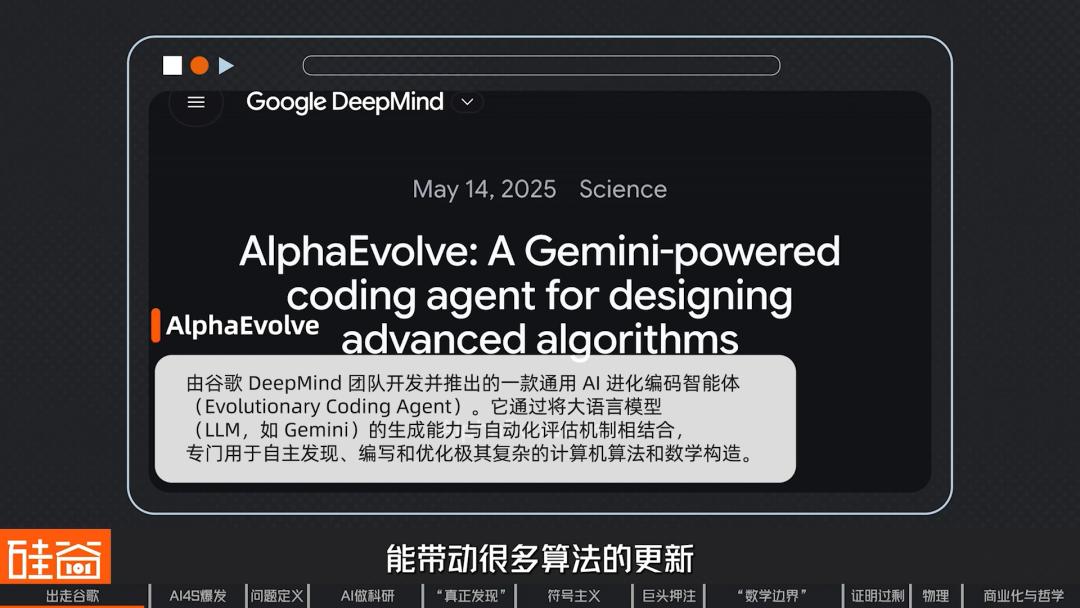
For example, current AI for RSI, and AlphaEvolve can promote automatic algorithm updates. Not to mention AlphaFold, which has won the Nobel Prize and has been further commercialized into Isomorphic Labs. Now Demis is more like a consultant. In the long run, I think Google has both the ability and the responsibility to continue promoting long-term technology and research development, and Demis is very suitable for this role.
AI4AI, AI4S and RSI
Chen Xi: At the same time, we see that both OpenAI and Anthropic are also including AI for Discovery and RSI in their key layouts. Before we talk about these three companies in detail, let's sort out several concepts first: what do AI4S, AI for AI (AI4AI), and RSI (Recursive Self-Improvement) mean respectively?
Cao Yuan: It's actually very simple. Both AI4S and AI4AI treat the AI model as a researcher itself, letting it study scientific problems or study the problems of AI itself. Taking AI4AI as an example, if the model is already very smart, how to use its intelligence to further improve the model itself? For example, give it a task: under a limited budget, with the least resources and GPU, how to train the model to the best state. Humans can certainly do it, but if we let AI do it by itself, it can try a large number of new ideas and experiments faster. For example, after looking at the code base of the current model, it finds that a certain parameter may need to be increased, so it proposes a plan, generates a suggestion, and can try to increase this parameter first.
The