70 Years of Artificial Intelligence: 14 Insights from the Boom and Bust Cycles
Deutsche Bank's latest research report sorts out the development context of artificial intelligence since its birth in 1956, extracts 14 key insights from historical patterns, and provides a reference for investors to judge the trend of the current AI boom.
This August marks exactly 70 years since the 1956 Dartmouth Summer Research Project on Artificial Intelligence, the birthplace of AI. Adrian Cox, Thematic Strategist at Deutsche Bank Research, points out in the latest report that the 70-year history of AI has been filled with alternating booms and busts, and the current round of investment and valuation frenzy is repeating the paradigm of technological revolutions that have appeared many times in history.
The report argues that "context" is critical to understanding the future direction of AI. From non-linear growth and infrastructure bottlenecks to the expansion and bursting of valuation bubbles, historical signals are clearly identifiable. The report states directly that some people may claim that "this time is different", but the data from the past 70 years provides another frame of reference — for investors betting on the AI track, these insights are directly related to asset allocation logic and risk judgment.
01 Growth is not linear, and is often severely underestimated
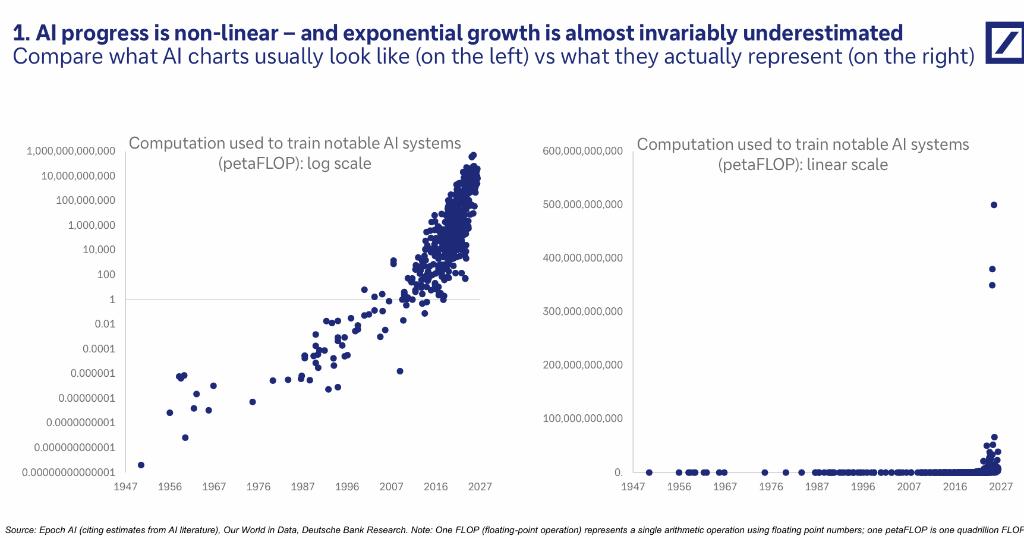
The report highlights the core feature of AI progress at the beginning: non-linearity. Presenting the historical data of training computing power on a logarithmic scale, it can be clearly seen that since 1956, the growth of computing power used to train major AI systems has spanned dozens of orders of magnitude, while the visual presentation of linear charts almost completely obscures this trend. Exponential growth is intuitively very easy to underestimate, which is the first cognitive threshold for understanding the AI wave.
Closely related to this, the progress speed of AI has surpassed Moore's Law. Traditional computing power doubles every 18 to 24 months, but after entering the era of deep learning, the average annual growth rate of computing power has reached about 4 times, far higher than the annual growth rate of about 1.4 times before the deep learning era. The reason lies in the simultaneous improvement of multiple factors such as system scale expansion, memory enhancement, and algorithm optimization, forming a superposition effect.
02 Technical routes continue to iterate, today's leader is not necessarily tomorrow's winner
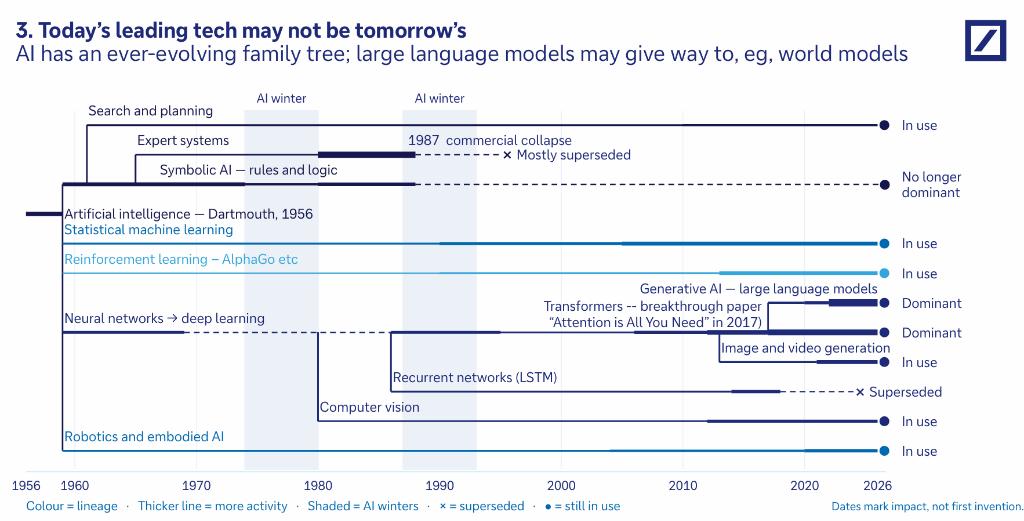
The report presents the 70-year evolution of routes through the AI technology spectrum: from symbolic logic and expert systems to statistical machine learning, deep learning, and then to the currently dominant large language models. Each generation of mainstream technology has gone through a cycle from rise to replacement. Some routes (such as recurrent neural networks) have been surpassed, while others are still evolving in parallel. The report points out that large language models may give way to new paradigms such as "world models" in the future, and the intergenerational replacement of technologies does not depend on the will of current leaders.
Historical changes in market share also confirm this point. Internet Explorer once outperformed Netscape, but was later replaced by Chrome. In the current competitive landscape of generative AI platforms, ChatGPT leads in monthly visits, but Google Gemini, DeepSeek and Claude are all catching up rapidly. Early advantages do not equal long-term moats.
03 R&D accumulation determines the competitive landscape, and the rise of DeepSeek is no accident
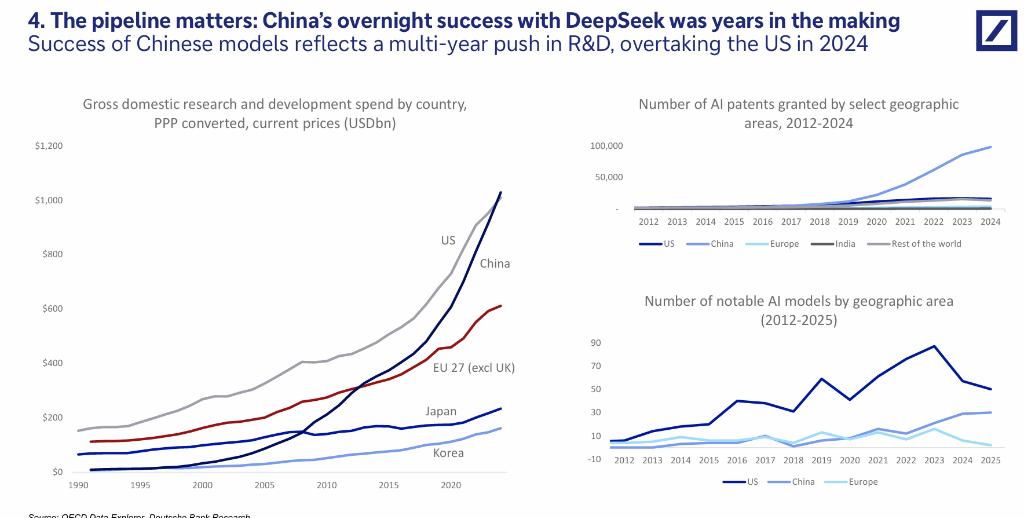
The sudden rise of Chinese AI models, represented by DeepSeek, seems to be "overnight success" on the surface, but it is actually the result of years of R&D investment accumulation. Data shows that China has surpassed the United States in total R&D expenditure in 2024, and its catching-up speed in the number of major AI models is also remarkable. In terms of the number of AI patent grants, China's growth curve is also far ahead of other economies. For investors, this means that changes in the competitive landscape often accumulate at the underlying level for many years before they are visible on the surface.
04 Cost reduction will not compress demand, but will instead expand demand
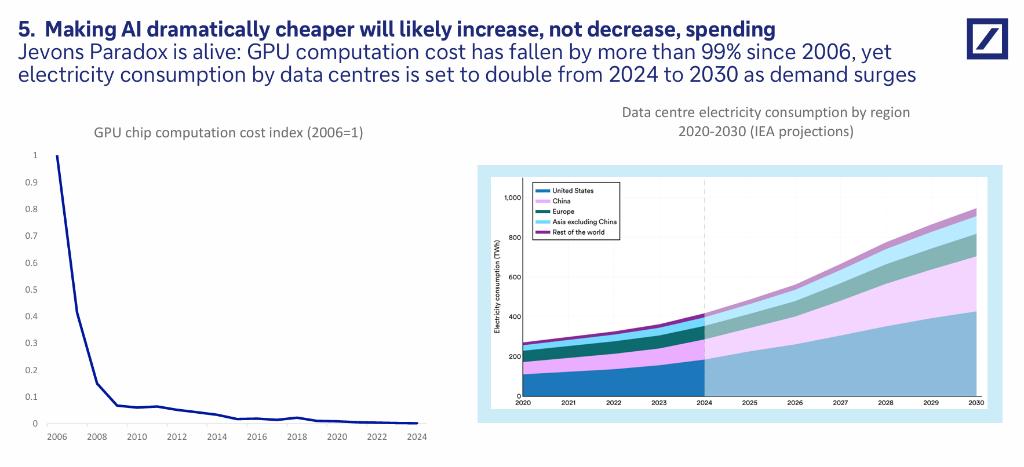
The report cites the "Jevons Paradox" to illustrate that the sharp drop in the cost of AI use will not lead to a reduction in total expenditure, but will instead stimulate a surge in demand. Since 2006, the cost of GPU computing power has dropped by more than 99%, but according to the forecast of the International Energy Agency (IEA), global data center power consumption will double from 2024 to 2030. Lower marginal cost means more application scenarios and higher total demand.
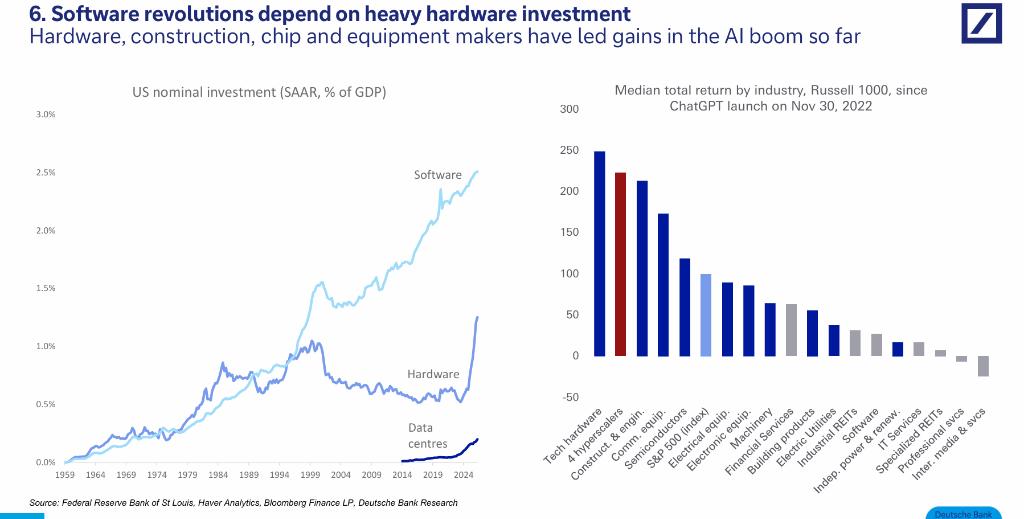
05 Software revolution requires hardware to go first, and the current bottleneck is on the supply side
All previous scientific and technological revolutions rely on large-scale hardware investment, and AI is no exception. Since ChatGPT was launched in November 2022, the total return of data center, hardware and chip-related industries in the Russell 1000 Index has been much higher than that of the software industry. Different from the past where the popularization of consumer-side equipment constituted a constraint, the current bottleneck lies more in the supply side of AI chips: the hourly rental price of NVIDIA H100 GPU chips has continued to fluctuate in the past several quarters, reflecting the structural tension between supply and demand.
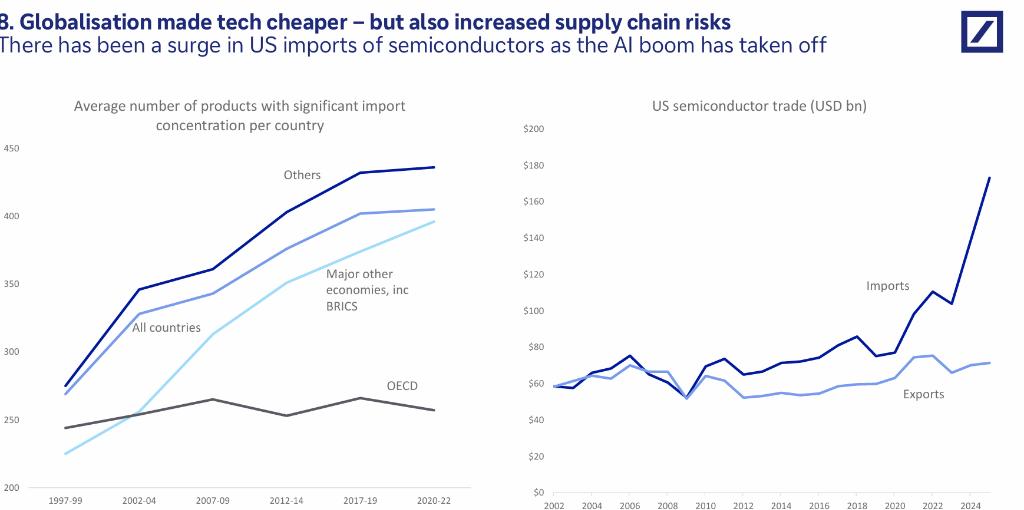
06 Globalization has reduced technology costs, but also laid hidden dangers for supply chain risks
As the AI boom heats up, U.S. semiconductor imports have risen sharply. At the same time, the concentration of the global supply chain continues to increase, and the dependence of products on a single source has increased significantly. The report points out that while globalization makes technology cheaper, it also exposes the supply chain to higher geopolitical and concentration risks.
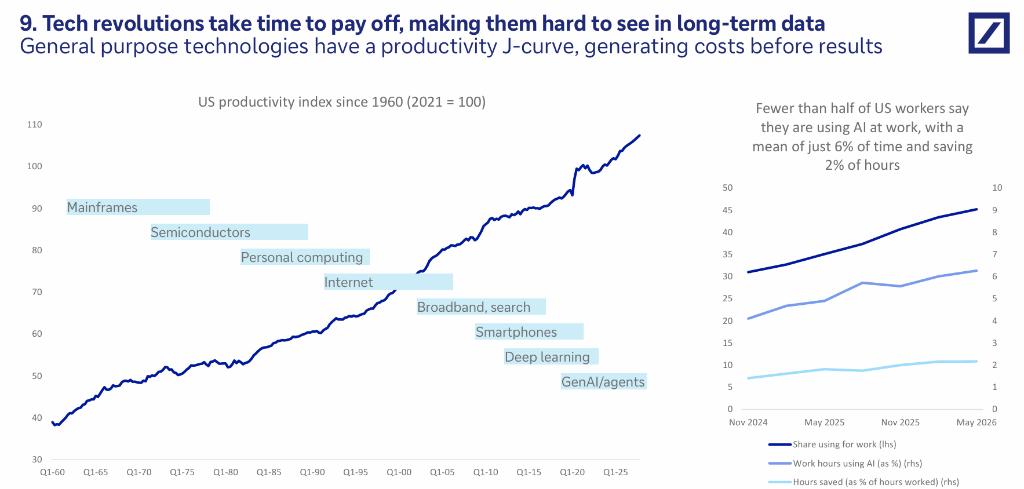
07 Technology dividends take time to materialize, and commercial implementation is still in the early stage
Technological revolutions usually have a "J-curve" effect on productivity: costs appear before benefits. The report cites data showing that currently less than half of U.S. employees use AI to complete their work, spending an average of 6% of their working hours on AI-related tasks, which only saves about 2% of their working hours.
The adoption speed on the consumer side has hit a historical record, and the popularization speed of generative AI is faster than that of the Internet and personal computers. However, the advancement of monetizable enterprise-side applications is significantly slower — downloading an app only takes a few minutes, while reconstructing enterprise operation processes around new technologies takes several years. The information, professional services, finance and insurance industries lead in AI application rate, while the manufacturing industry lags behind relatively.
08 Valuation is at a historically high level, and revenue expectations need to be "more different" to be fulfilled
Judging from the Shiller Cyclically Adjusted Price-to-Earnings Ratio (CAPE), the current S&P 500 valuation level is close to the peak of the 2000 Internet bubble, located in the highest range in the past 150 years. Almost every valuation peak in history corresponds to a transformative technology wave: electrification in 1899, radio and automobiles in 1929, the electronics wave in 1966, the Internet in 2000 — and AI in 2026.
In terms of revenue, the current revenue growth rate of OpenAI and Anthropic has exceeded the historical peak level of comparable companies in the same period. But the report also points out that to fulfill the long-term revenue expectations implied by current valuations, the growth curves of the two companies need to be "more different" compared with the historical trajectories of tech giants such as Google, Meta, and NVIDIA.
09 Long-term trends are resilient, but extreme scenarios have entered the field of discussion
The report concludes with the long-term trend of S&P 500 earnings per share. The data shows that this indicator has grown at an average annual rate of about 6.5% since 1935, maintaining a stable trend through many wars and recessions. In terms of GDP, the report sorts out three AI scenarios: the baseline trend, a moderate AI-driven acceleration (with an average annual growth rate of about 2.1% in the next 10 years), and two extremes under the "singularity" scenario — from technological utopia to human extinction. The report takes a neutral stance on this, but reminds investors that which end the current market pricing is closer to between historical trends and extreme scenarios is the core issue worthy of continuous tracking.
This article is from the WeChat Official Account "Hard AI", author: a researcher focusing on technology production and research, published with authorization from 36Kr.