Morgan Stanley: AI services are moving toward commoditization, making it impossible for cloud giants and computing power tenants to have the best of both worlds.
Cost-effective open-source models are driving AI services toward commoditization, with token prices continuing to decline. Morgan Stanley recently conducted a sand table simulation targeting the AI industry, revealing the dilemma that computing power rents need to meet both the cloud vendors' capital recovery requirements and the survival needs of computing power tenants at the same time.
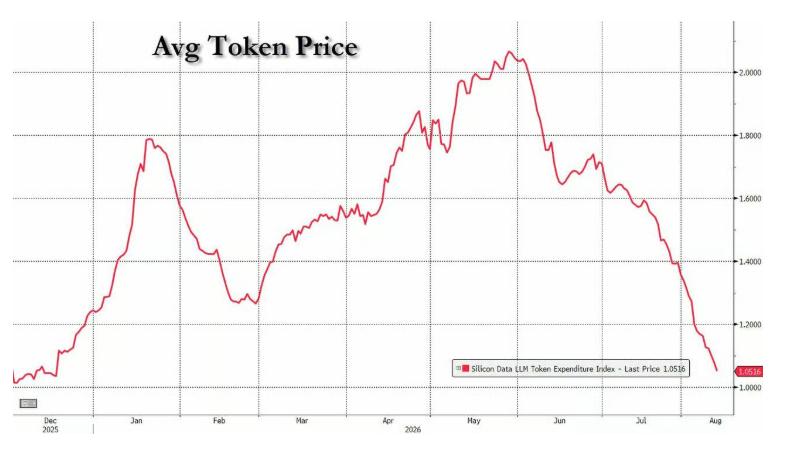
Note: The chart shows the trend of the average price of AI tokens from last December to the present.
AI Commoditization
AI commoditization means that with the maturity and popularization of AI technology, computing power, models and basic invocation services are gradually becoming homogenized and low-cost; the technical barriers that originally had high premiums are continuously dissolving, gradually evolving into standardized basic supplies similar to water, electricity and bulk commodities.
At present, there are already indexes in the market tracking the invocation price of AI text APIs; and the computing power relied on to produce these AI texts will soon have a corresponding futures market — CME (currently listed varieties include crude oil, corn futures, etc.). After the regulatory approval is completed, it will launch GPU Lease Index futures contracts on October 5.
Industry insiders pointed out that AI text API invocation services have now moved toward commoditization. Since Chinese models with open source weights and ultra-high efficiency entered the market, the price of this product has continued to decline.
The pricing unit of AI text services is per million tokens. At present, one million tokens can generate more English text than the entire book *War and Peace*.
The Morgan Stanley report points out that the stronger the chip performance, the lower the unit price of tokens. Only by maintaining performance advantages can closed-source models maintain service premiums; many closed-source model institutions' undisclosed high valuations are highly dependent on the token quotation remaining firm, but Morgan Stanley judges that this price support condition is unsustainable.
The industry trend of commoditized AI services and continuously falling token prices has broken the original profit balance of the AI industry chain.
Since the trend of token selling prices and GPU computing power rents are decoupled and cannot be linked synchronously, the downward pressure on token prices will be transmitted layer by layer along the industry chain, eventually leading to completely different profit performances and survival situations for different market entities.
The Situations of Three Types of Players
The unit price set in Morgan Stanley's calculation is $1.75 per million tokens. At present, in markets such as Meta's own cost-effective models, the pricing of multiple models that are already open for use has fallen below the level of $1.75 per million tokens.
Under Morgan Stanley's calculation, the impact of falling token prices on the three types of market participants varies. All the following are static deduction results given by Morgan Stanley, which are based on multiple preset parameters and do not represent actual market performance:
Computing Power Tenants (Most Enterprises): For customers purchasing AI-APIs, token price cuts are beneficial; but for AI enterprises that need to lease computing power, GPU rent is a rigid cost that will not decrease synchronously with the token selling price.
Morgan Stanley calculates based on the selling price of $1.75 per million tokens. After deducting computing power costs, the annual residual income of enterprises that lease computing power is about 9 billion US dollars, and this income has not paid other expenses such as salaries; when the price drops to close to $1 per million tokens, enterprises will fall into a loss-making situation.
Computing Power Owners (Giant Cloud Vendors): Computing power owners such as Amazon, Google, and Microsoft hold data center assets, with a single-chip hourly rent of $7-10; at this rent level, a data center with a construction cost of about 39 billion US dollars can achieve a rate of return of 23%-39%.
Self-purchasing Giants (A Very Small Number of Enterprises): Enterprises with strong financial strength that directly purchase chips and skip the leasing link can achieve the 20%-60% rate of return given by Morgan Stanley, but such enterprises are very few.
Morgan Stanley predicts that if token prices continue to fall, computing power tenants will be unable to afford the hourly rent of $7.
The final outcome is either the closure of tenants leading to vacant data centers, or the rent reduction erodes the profits of giant cloud vendors.
However, there is no safety buffer for rents. According to Morgan Stanley's cost calculation, if the hourly rent drops to $2, the revenue of giant cloud vendors will not be able to cover electricity bills and equipment wear and tear, let alone repay the $39 billion construction cost in the calculation.
The decline in computing power rents has historical precedents. The hourly rent of NVIDIA's previous-generation AI chips at the peak stage in 2023 was about $8, but it fell to below $2 within two years.
However, the rent set by Morgan Stanley in the pessimistic scenario is still as high as $7 per hour, which is more than three times the actual landing price of the previous generation of chips — the entire deduction logic of Morgan Stanley is built on the premise that "computing power rents are resilient".
Another key risk point is that data center construction is highly dependent on borrowed funds, and the owners of computing power production capacity do not fully invest their own cash.
Morgan Stanley pointed out that in the last quarter, the capital expenditure of leading cloud vendors has exceeded their operating income, and the gap is fully filled by the bond market, which has rarely undertaken such large-scale financing before. The market bets that AI demand will always outpace efficiency improvement, but this bet is built on the basis of credit expansion.
In summary, rents need to be high enough to support data center investment and low enough to ensure the survival of tenants — the same rent indicator is assigned these two conflicting goals.
Offsetting Price Drops with Higher Volume?
The alternative solution proposed by Morgan Stanley applies the traditional logic of the retail industry: offset the price drop with higher sales volume.
If the AI price reduction leads to a substantial expansion of invocation scale, even if the unit gross profit becomes thinner, computing power tenants are still expected to obtain considerable total profits. At the same time, strong computing power demand can also support the rent income of cloud vendors, easing the dilemma of the industry chain.
The bulk commodity industry has indeed relied on sales volume to resolve crises in history, but Morgan Stanley also pointed out that AI products may evolve into such a situation: selling access rights to open-source models has been reduced to a loss-making drainage product, similar to supermarkets selling milk at a loss — the milk itself does not make money, the purpose is to attract customers to the store to buy other goods.
All in all, it can be seen from Morgan Stanley's sand table simulation this time that the commoditization of AI services brings down token prices, and the rigidity of computing power rents further amplifies the contradictions in the industry chain. It is difficult to simultaneously meet the interest demands of computing power tenants and cloud vendors, coupled with the fact that AI infrastructure is highly dependent on debt financing, the commercial closed loop of the AI industry still faces huge tests.
This article is from the WeChat official account "Sci-Tech Innovation Board Daily", written by Li Ying, and published with authorization from 36Kr.