Shocking plot twist: GitHub suffered a large-scale 7-hour outage last night, and Cursor quickly launched its Agent-version code hosting platform.
On August 17, the day was undoubtedly a nightmare for GitHub.
Around 9:40 AM Eastern Time (9:40 PM Beijing Time), GitHub began to experience widespread outages. API Requests triggered alerts first, and less than 20 minutes later, Actions, Webhooks, Issues, and Pull Requests sequentially encountered anomalies, with services including Copilot and Pages gradually being affected.
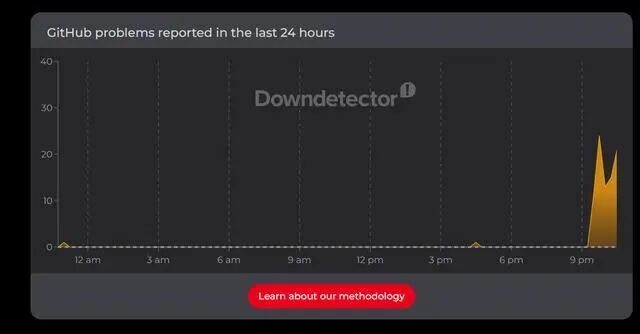
Developers soon found that they could not pull code, open PRs, or run CI/CD pipelines, and some pages even directly displayed "No servers available".
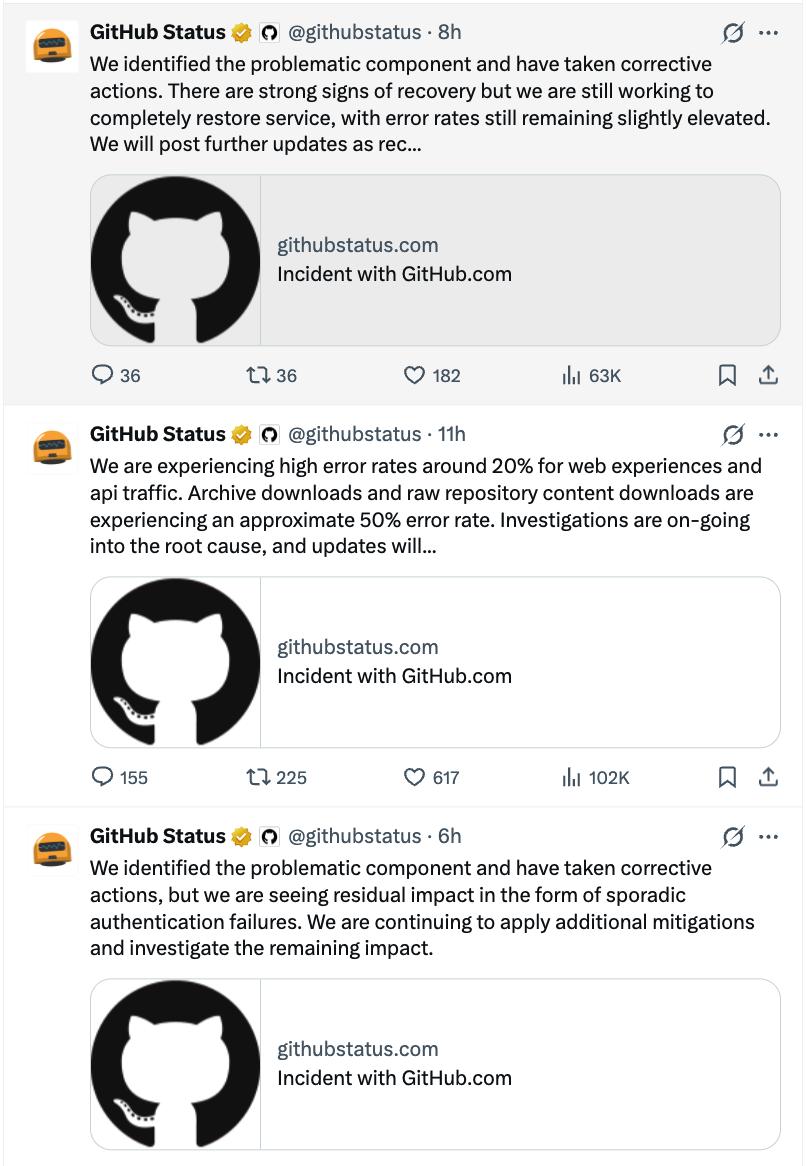
Starting at 14:04 (22:04 Beijing Time), GitHub officially disclosed that the error rate of Web and API requests once reached approximately 20%, and the download error rate of archive and raw repository content rose to about 50%. This is not an ordinary webpage glitch, but a large-scale and severe failure covering multiple development links from code browsing, collaboration to automated pipelines.
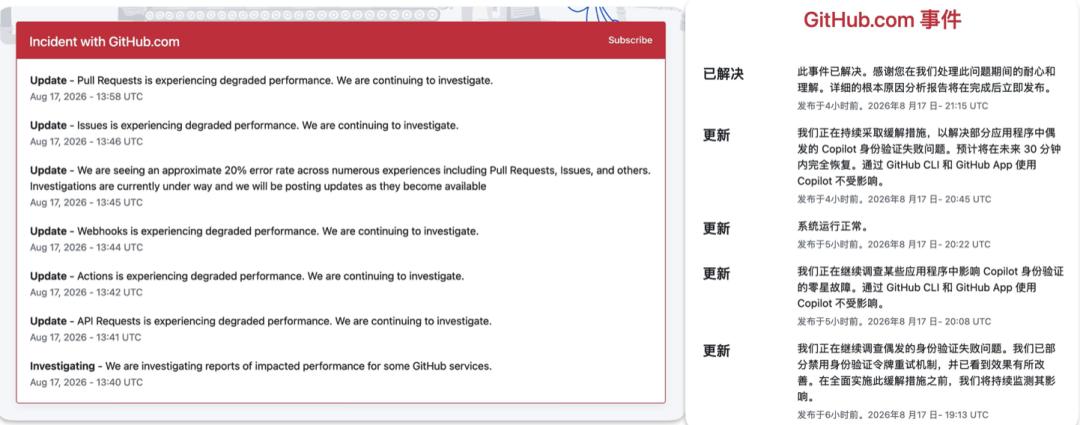
It was not until about 7 and a half hours later that GitHub announced the incident was resolved. The official currently only stated that a "problematic component" had been identified. In the second half of the failure, sporadic authentication failures continued to occur, and the authentication token retries mechanism was adjusted. The complete Root Cause Analysis has not yet been announced.
Coincidentally, while GitHub was busy putting out the fire, the official website of Cursor quickly launched Origin, an AI Coding version code hosting platform, and stated in a playful tone: "Cursor can now host your code."
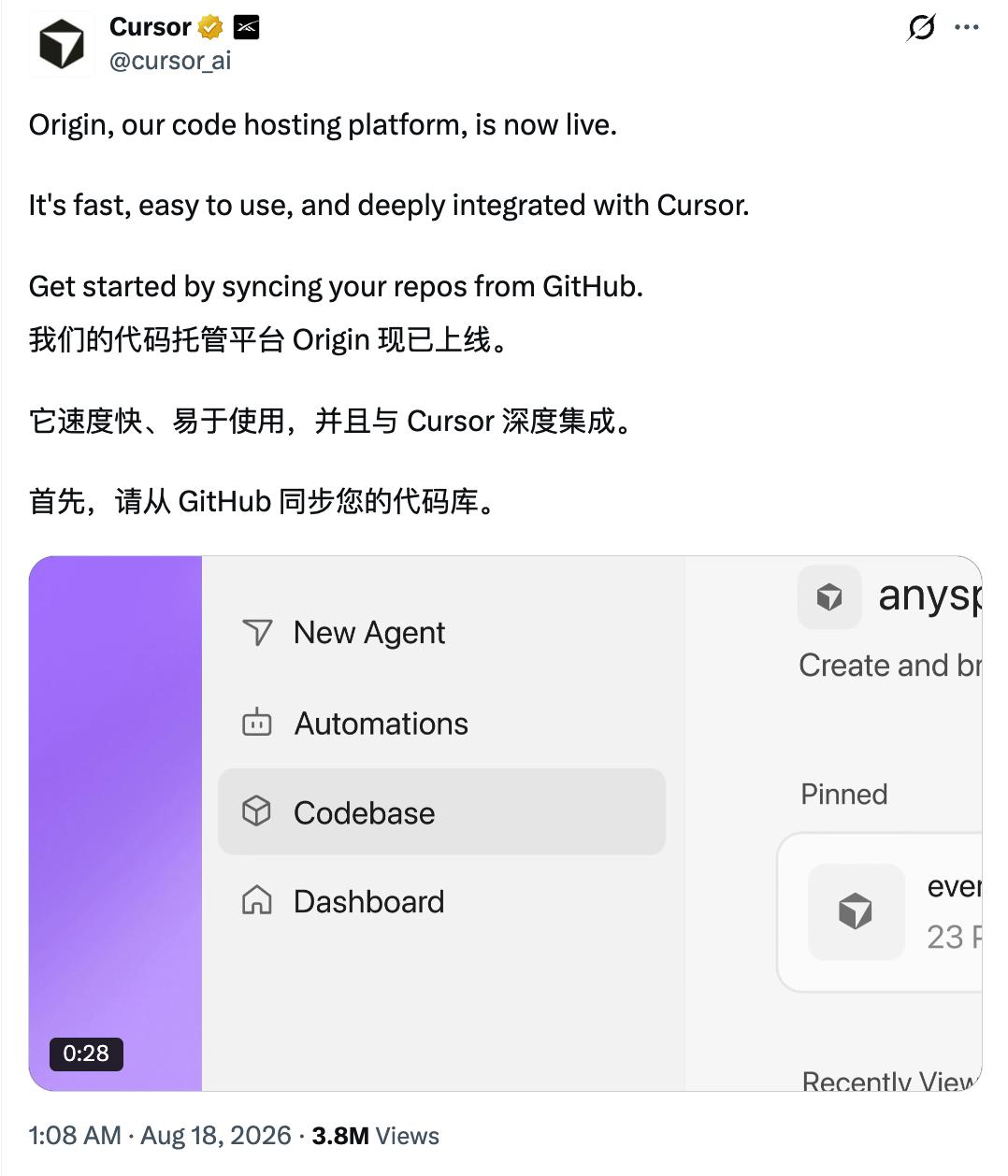
Cursor stated that it will officially start the gradual rollout of early access to the Origin code hosting platform for all paid users starting from today. Users can now create their own Repos, process Pull Requests, browse code, and support synchronization with GitHub at the same time.
In other words, Cursor, which used to be mainly responsible for helping you "write code", is now preparing to take charge of where your code is stored as well.
This timing is so coincidental that it is almost a free world-class marketing campaign for Cursor, which was even gifted by its peer competitor. Three days ago, SpaceX just completed the $600 billion acquisition settlement of Anysphere, the parent company of Cursor, making Cursor a wholly-owned subsidiary of SpaceX.

On the same trading day, the stock price of Microsoft, GitHub's parent company, also fell by more than 3%, closing at around $480.35, corresponding to a market value evaporation of more than 100 billion US dollars in a single day.
Cursor's Version of GitHub
Judging from the Early Beta released this time, Origin is not just a code copy stored in the cloud, but a complete Git Forge deeply embedded in the Cursor ecosystem.
Combined with the official update log, the core functions of Origin can be broken down into four major sections:
Seamless Onboarding
Full-featured Git Workflow: Developers can directly create Repos in Cursor, and complete regular operations such as clone, push, and pull through standard Git commands.
Native PR and Code Review: It supports the complete Pull Request process, including viewing commits, checking status (checks), code comparison (diff), as well as conducting reviews, adding comments and merging.
Web-side Code Exploration: It supports directly browsing and full-text searching the code repository on the browser side.
Two-way Real-time Synchronization with GitHub
GitHub Two-way Real-time Synchronization: The official clearly stated that it will never force developers to "migrate" in the initial stage. Existing GitHub Repos can be directly synchronized to Origin. After import, GitHub remains the authoritative Source of Truth, and code pushes are still sent to GitHub.
Millisecond-level Comment Synchronization: Reviews left in Cursor are pushed to GitHub in real time; new replies on the GitHub web page will also be updated in Cursor immediately.
One-click "Take Over Control": This is the most clever fallback feature of Origin. After the team gets used to working in Origin, they only need to click "Detach from GitHub" in the repository settings to unbind. Origin instantly transforms from a "mirror client" into a truly independent main code repository for the team.
Intelligent Agent for Each Code Repository (Differentiated Features)
The existing GitHub workflow is designed for humans, while Origin is built to support the massive AI computing power in the future.
Stacked PRs: Agents are accustomed to performing large-scale refactoring across dozens of files at one time. Origin allows breaking huge changes into multiple small PRs with dependencies, presented through a visual graph, which greatly reduces the cognitive burden of human reviewers.
Intelligent Merge Queue: When dozens of Agents submit PRs at the same time, Origin can automatically sort them and pre-process conflicts in isolation in the background, ensuring that the main branch CI is always "green".
Automatic AI Conflict Resolution: Facing complex cross-file code conflicts, Origin has a built-in AI engine at the underlying layer, which can automatically understand business logic and resolve conflicts, eliminating the need for manual intervention.
Machine-readable Review Status: Abandoning the human-readable green checkmarks and text comments, Origin makes the review status a structured API, allowing Agents to directly understand "where modifications are needed" and automatically execute the closed loop.
Connect the Peripheral Ecosystem of Development and Deployment (First Batch of Apps Integrated)
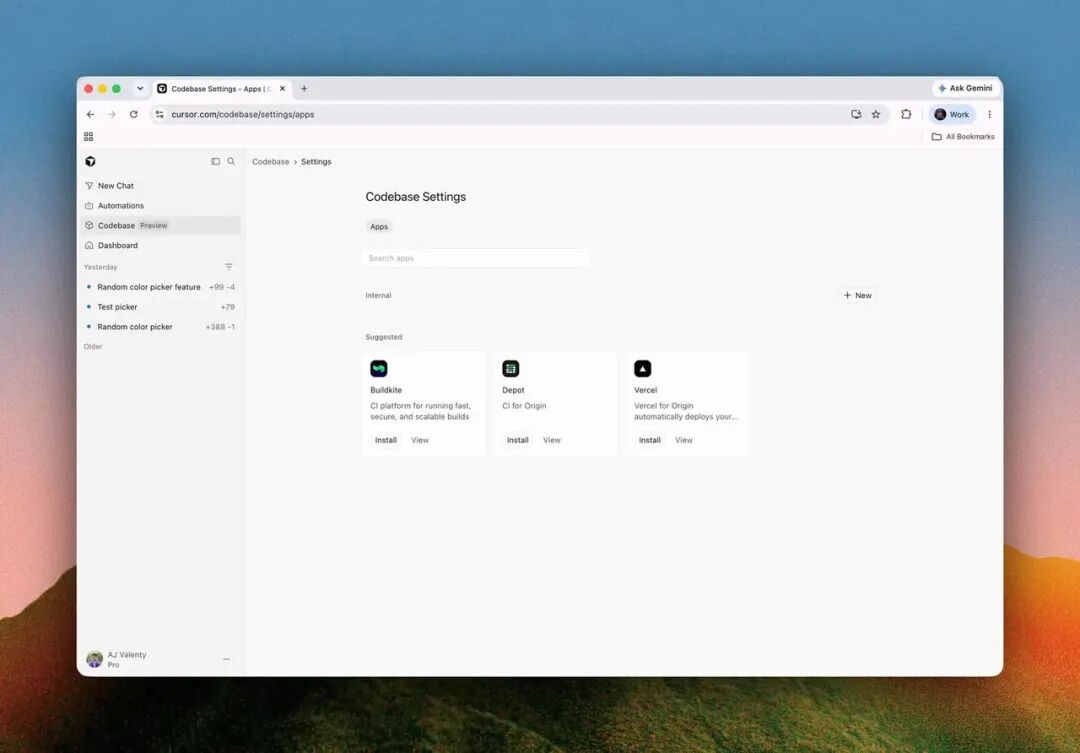
Deployment and CI/CD Integration: The first batch of integrations covers Vercel, Depot and Buildkite. Vercel is responsible for automatically generating Preview Deployment for each PR; Depot and Buildkite are responsible for running CI, and are fully compatible with developers' existing GitHub Actions workflows.
Extreme Concurrency Performance: The underlying layer has a high-throughput architecture that supports 296,000 clones per hour and 22.6 commits per second, with a global synchronization latency of less than 400 milliseconds, built specifically for carrying large-scale concurrent operations.
At this stage, it is obviously far from "replacing GitHub". Cursor's strategy is extremely pragmatic: first be compatible with everything that can be compatible, and painlessly migrate users who are willing to move in, never letting migration costs block users out.
But the problem also arises: why does a code editor company start to use "how many commits can be supported per second" and "machine-readable review status" as its selling points?
When One Programmer is Backed by 10 Agents
The answer lies in Cursor's own positioning shift.
Since the beginning of this year, Cursor has described itself less and less as an "AI-powered editor", and has talked more and more about how Agents can independently complete software engineering tasks. When developers start to schedule 5, 10 or even more Agents to work in parallel, a basic assumption of software production is completely broken: one account is no longer backed by one person, but an army of machines.
Human development rhythm has natural limits, but Agents do not, and the arrival of Agents instantly breaks through the development rhythm of human programmers. They can tirelessly read repositories, create branches, modify code, and submit PRs, instantly amplifying the amount of Git operations generated by a single user by dozens of times.
This directly exposes the shortcomings of traditional hosting platforms: when dozens of Agents concurrently modify the same repository at the same time, who will handle the conflicts? Who merges first? How to recalculate CI? GitHub recently rushed to launch Stacked Pull Requests to the public, precisely to cope with the larger PR and Review bottlenecks brought by AI.
The battlefield of AI Coding is shifting from "who writes the code" to "who manages the code".
In the past two years, Cursor seized the IDE market, and model vendors competed for generation capabilities, all fighting for the "most upstream" part of code production. But as Agents truly enter production on a large scale, the battlefield will inevitably expand downstream: where is the code ultimately stored? Who schedules CI? Who handles Merge Conflicts?
These "backyard" problems that used to belong to GitHub and GitLab are becoming a new continent that AI Coding companies can reshape and even seize.
References:
https://cursor.com/cn/changelog/origin-code-hosting?utm\_source=chatgpt.com
This article is from the WeChat Official Account "AI Front" (ID: ai-front), written by Siyue, and published with authorization from 36Kr.