The Embodied Best Paper team has mobilized all members to tackle the integrated perception-control brain model.
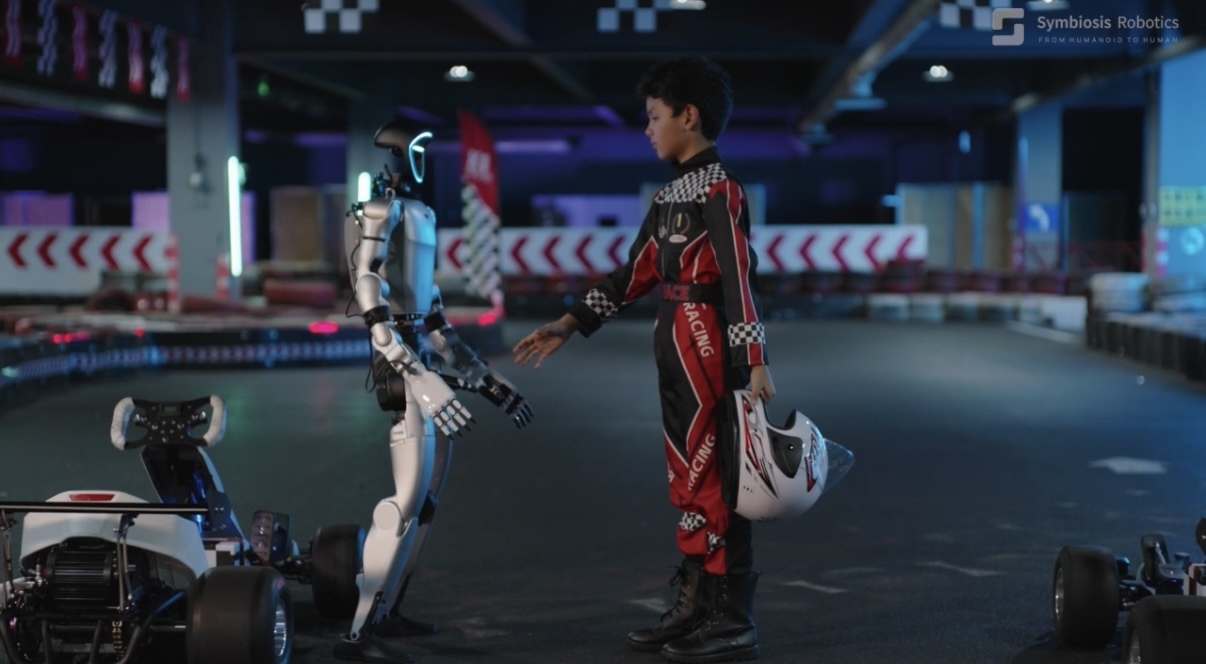
Go-karting, a skill that not even all humans can master properly, has surprisingly been conquered by a bipedal humanoid robot??
Starting from "walking to the vehicle" and "sitting in the driver's seat", the robot observes the road on its own, steers the wheel, and presses the accelerator by itself.
It controls the force with its right foot, continuously adjusts the direction with both hands, judges track changes through vision, and constantly adjusts its center of gravity to maintain full-body balance at the same time.
It is quite impressive that the robot achieves multi-contact balance, with full coordination of hands, eyes, feet, brain and the entire body, and possesses extremely precise force control capabilities.
The company that developed this solution, Symbiotic Robotics, was founded just over a month ago.
What is most surprising is that this bipedal humanoid robot in the video adopts an industry-leading original end-to-end perception-control integrated solution, which breaks the long-standing separation contradiction of "brain + cerebellum" in mainstream embodied intelligence. It no longer splits perception, decision-making and motion control into several relatively independent modules, but enables a single model to output all the way to the robot's final actions from the moment it perceives the world.
It should be noted that end-to-end and Whole-Body Intelligence are the two most high-profile technical paths in the embodied intelligence academic circle in 2026. Few top global laboratories or leading enterprises have delivered relevant results, yet a young Chinese company founded less than two months ago has successfully achieved this in such a practical demonstration?
Who on earth is Symbiotic Robotics?
01. The "Dream Team" of Best Paper Winners in Embodied Intelligence
Symbiotic Robotics was founded at the end of June this year, less than 60 days ago.
If the first "unbelievable" point of this company is that it delivered an industry-leading perception-control integrated brain model just one month after its establishment, the second "unbelievable" point is its founding team.
The founding team of Symbiotic Robotics is almost a youth dream team composed of top authors of Best Papers in embodied intelligence.
DING Pengxiang, the CEO, is a post-95s PhD graduate from Zhejiang University and Westlake University, supervised by Professor WANG Donglin. He has long been engaged in embodied intelligence research, with a string of dazzling achievements that are regarded as "legendary in the academic circle":
First author of the world's first quadruped VLA (QUAR-VLA, ECCV 2024) and the world's first humanoid VLA (Humanoid-VLA, Feb 2025), core author of ReconVLA (AAAI 2026 Best Paper), first author of the 50 million parameter lightweight benchmark VLA-Adapter (which gained over 1,000 GitHub Stars within a week, now with more than 2,000 Stars, is the open-source VLA project with the highest number of Stars in China, and also the 5th VLA project with over 1,000 Stars globally), founder of the embodied intelligence open-source community OpenHelix Robotics (accumulatively over 5,000 Stars), and one of the top 5 most cited PhD researchers in embodied intelligence in China.
Other "geniuses" in the core team are equally outstanding.
All team members hold PhD degrees, most of them are post-2000s, and all have published papers at top academic conferences. It is a rare team (both in China and across the world) that has developed foundational models for quadruped robots, robotic arms and humanoid robots, with its achievements covering:
• First author of the CoRL paper that defeated Pi0.5 and won the first Best Paper at top robotics conferences by a global Chinese team;
• Author of IJCNN Best Paper Candidate;
• First author of the HEX paper that proposed the first cross-embodiment Whole-Body Manipulation Model for full-size bipedal humanoid robots;
• First author of OpenWBC, one of the world's first open-source humanoid teleoperation systems;
• First author of Trajbooster, the first Loco-manipulation VLA that has drawn wide industry attention, which effectively improves the data utilization efficiency across different embodiments...
Loco-manipulation, quadruped robots, robotic arms, humanoid robots, WBC data collection, pre-training, post-training, motion control, cross-embodiment adaptation...
With such solid capabilities and leading research, the team has gathered almost all the authors of the most cutting-edge doctoral papers in China's embodied intelligence field over the past two years in one single company.
More importantly, their achievements are far more than just "several published papers". Three of the 5 most cutting-edge works in the international Loco-manipulation field are completed by this startup team with less than 20 people, whose Best Paper density is surprisingly high.
The youngest group of "first authors of academic papers" in China's embodied intelligence industry have started their entrepreneurial journey together.
Interestingly, people who follow the embodied intelligence track closely will find that Symbiotic Robotics is not an isolated case.
Over the past six months, a major talent paradigm "migration" has been quietly taking place in the embodied intelligence track. Two years ago, the typical entrepreneurial paradigm for China's embodied intelligence sector was that professors started their own businesses. University laboratories accumulated technology for several years, professors became the technical flag of the company, and then they entered the industry with their PhD and master students and laboratory achievements. Many star embodied intelligence startups were developed following this path.
But starting from 2026, more and more young PhD researchers who are close to the front line of scientific research have started their own businesses.
Why? The only reason is that technology is advancing extremely fast. In 2023, the industry was still discussing whether robots need large models; in 2024, VLA began to become the core concept; in 2025, dual-system models such as Figure Helix became popular quickly; by 2026, the whole industry is discussing "end-to-end" solutions.
This has led to a very interesting "knowledge inversion" in the current industry: the most cutting-edge technical cognition of embodied intelligence is not necessarily mastered by the "senior" veterans in the industry. The people who first know the next-generation technical paradigm are very likely to be front-line PhD students who process data, tune models and test robots every day.
You have to ask those PhD students who have just successfully run the model to find out which solution only performs well on Benchmark but fails when deployed on real robots, and where the most cutting-edge technologies, talents and resources will flow under the current technical trend.
This kind of change has already happened once in the large model industry. LIANG Wenfeng, the founder of DeepSeek, once introduced the profile of his core team in an interview with 36Kr: "They are all fresh graduates from top universities, fourth-year and fifth-year PhD interns who have not graduated yet, and some young people who have only graduated for a few years."
This is true not only in China, but also abroad.
The same rule applies to the large model industry, and also to the embodied intelligence industry.
02. End-to-end: The "Final Form" of Embodied Intelligence
The most cutting-edge team with the most disruptive talent structure will naturally deliver the most cutting-edge and disruptive achievements.
As mentioned above, the disruption of Symbiotic Robotics lies in that it overturns the current mainstream "layered" solution, and directly targets the world-class challenge of end-to-end perception-control integration.
To understand its disruption, we need to first know that the mainstream idea of humanoid robots over the past few years is essentially "layering", or "brain + cerebellum". The upper brain is responsible for perception, understanding and planning, while the lower cerebellum is responsible for motion control and balance.
The team of Symbiotic Robotics is one of the first teams in China to propose this architecture, and it published relevant achievements as early as 2023.
However, over the past two years, the problems of the "layered solution" have become increasingly prominent. Due to the natural indirect cascade error between the upper and lower layers, the mapping between perception and control cannot be directly connected, and it is extremely difficult for the "brain" to obtain the action feedback of the "cerebellum", resulting in poor task performance.
Using human beings as an analogy: when a person tries to catch a cup that is falling off the table, he will not first complete visual understanding, then pause to generate the trajectory, and finally move his arm. Instead, the moment his eyes see the cup falling, his body has leaned forward and his hand has stretched out. Perception, action and balance are essentially one integrated process.
For bipedal humanoid robots, this problem is even more extreme. Every time the robot raises its hand, turns around or bends over, its center of gravity will change; the change of contact force on the sole of the foot will in turn affect the movement of the upper body. The separation of upper and lower limbs, the failure to transmit task semantics to lower limb control and force control, the long failure recovery link, and the difficulty in unifying data and targets... All these are long-standing problems.
This is why in most of the current demonstrations of bipedal humanoid robots on the market, we can rarely see action displays that require full coordination of hands, eyes, brain and the whole body like the go-karting demonstration of Symbiotic Robotics. It is not that companies do not want to do it, but that they cannot achieve it.
The industry has already realized this problem. Since the second half of 2025, "Whole-Body Intelligence" and "end-to-end" have been recognized as the next development direction at top industry conferences, but few teams have delivered practical results so far.
Symbiotic Robotics is aiming at this exact direction.
The DPC (Direct Perception Control Model) developed by Symbiotic Robotics is a perception-control integrated foundational model for Loco-manipulation that breaks the barrier between the robot's "brain" and "cerebellum", and directly realizes end-to-end full-body coordinated operation.
Its input is multi-modal perception data (vision, language, robot status, physical signals); after being processed by the Unified Perception Control Model, it directly generates full-body actions with force feedback from vision, language, proprioception, historical feedback and contact feedback.
Finally, it can directly output the joint torque of full-body coordination, targeting the "final form" of the Interaction-Native Whole-Body Intelligence track.
It is particularly noteworthy that the team of Symbiotic Robotics has taken the lead in verifying that multi-source heterogeneous data training can effectively realize the full-body data scaling of humanoid robots. Its embodiment-free pre-training algorithm only requires a very small amount of real data to achieve complex full-body coordinated operations.
Compared with traditional solutions, the DPC (Direct Perception Control Model) of Symbiotic Robotics can optimize the perception and control signals of the brain and cerebellum synchronously (realizing full coordination of hands, eyes, brain and the whole body during go-karting), greatly improving the compliant force control capability of the robot (the pressing amplitude of the go-kart accelerator pedal and the speed of the vehicle). At the same time, it can realize the general adaptation of the same set of foundational models across different embodiments and configurations, and has strong zero-shot generalization ability in real scenarios.
Today, "end-to-end" is the consensus direction at the forefront of embodied intelligence research, and also the recognized evolution direction of the "next-generation robot brain" in the industry in 2026.
Over the past two years, the WBC motion control technology has become mature and usable, the available data has exploded exponentially, and the route of the VAM perception-decision integrated foundational model has started to converge. The "three major mountains" that blocked the development of the embodied intelligence perception-control integrated brain have been gradually removed.
"In 2026, all three conditions are met at the same time. Now is the window period for the development of the end-to-end perception-control integrated brain for bipedal humanoid robots, which will last for about 6-7 months, or even only 4-5 months. This window will not stay open for long," DING Pengxiang, CEO of Symbiotic Robotics, told 36Kr.
It is very important to seize the window, and it is very important to "win once".
But that is far from enough.
03. The Key Is Not Only to "Win Once", But to "Keep Winning"
"All aspects of human society are designed for the human body structure, and many scenarios can only be realized by bipedal humanoid configuration. From the perspective of first principles, bipedal humanoid robots will definitely be the final form of the future," DING Pengxiang told 36Kr in the interview.
What Symbiotic Robotics is targeting is not short-term commercialization, nor any "low-hanging fruit", but a more ambitious and more general future of embodied intelligence AGI.
This is undoubtedly a very cutting-edge, even very radical future.
But since 2022, the team of Symbiotic Robotics has almost correctly predicted all the technical development directions of embodied intelligence: from Humanoid-VLA that provides task understanding, visual grounding and action semantic entry, to TrajBooster that provides data flywheel for the end-to-end Whole-body Action Model, to HEX that provides the foundation of Humanoid-native State and Action representation for end-to-end models, and then gradually integrating the Force cerebellum / safety contact experts into the end-to-end model through distillation...
Winning once is "gambling", but winning ten times cannot be simply explained by good luck.
"Our team has been leading the development of bipedal humanoid Loco-manipulation. We are not only participants of the industry, but also the maker of industry standards," said DING Pengxiang.
In 2026, Symbiotic Robotics is betting on the end-to-end perception-control integrated brain model for bipedal humanoid robots, and claims that this will be the final form of the industry.
Their "confidence" comes from their long-term deep cultivation in the embodied intelligence industry, never being limited by outdated methodologies, constantly making breakthroughs and explorations, and not only "winning once", but also "keeping winning".
From them, we can also see the quiet change of China's innovation paradigm.
For a very long time in the past, China's technology industry was best at engineering, industrialization, making technologies faster, cheaper and larger in scale. But in the most cutting-edge fields of foundational models and algorithm paradigms, the industry used to wait for the progress in Silicon Valley first, and then discuss how China can follow up.
In the past few years, this rhythm has begun to change.
In the large model field, DeepSeek has proved that a group of Chinese researchers with a relatively low average age can also provide their own answers to the most cutting-edge global problems, and deliver breakthrough innovations