The most valuable asset in the AI era may not be large models.
Why can a startup that does not train foundational models, manufacture chips, or build super data centers be sold for more than 7 billion US dollars?
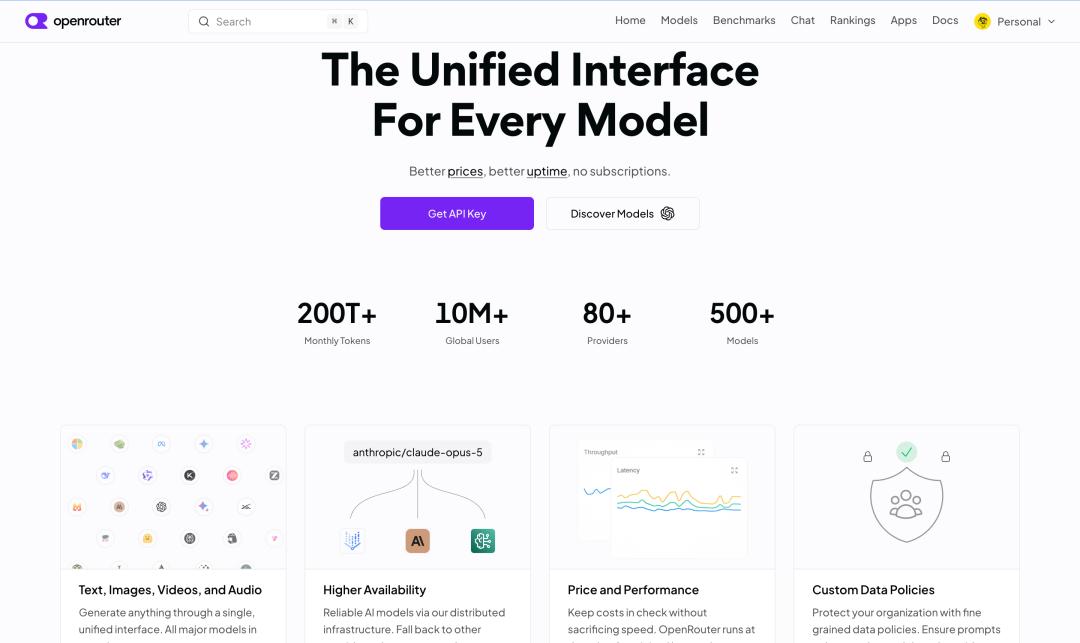
Latest updates show that payment giant Stripe has reached an acquisition agreement with AI model routing platform OpenRouter, with the transaction amount exceeding 7 billion US dollars.
For reference, when OpenRouter completed its $113 million Series B financing in May this year, its valuation was approximately 1.3 billion US dollars. In just a few months, its valuation has risen more than fivefold.
It should be noted that as of press time, Stripe has not officially announced the transaction, and a spokesperson responded that the company does not comment on market rumors. Therefore, the more accurate statement at present is still "according to reports from media including Bloomberg, the two parties have reached an agreement", and the specific transaction structure, payment method and final closing conditions have not been made public.
Even so, this potential deal is still one of the most noteworthy mergers and acquisitions in the AI industry this year.
This is because what Stripe values may not be an ordinary AI tool company, but a foundational platform that has the opportunity to control global model traffic, billing relationships and developer entry points.
OpenRouter does not develop models: yet it stands above all models
OpenRouter was founded in 2023. The problem it solves seems not complicated: it allows developers to call large models from different companies through a unified interface.
Without OpenRouter, an AI application company may need to separately access models from OpenAI, Anthropic, Google, Meta, DeepSeek, Alibaba Tongyi Qianwen, Moonshot AI and other parties, and separately manage account balances, API keys, call limits, price changes and data policies.
Once a certain model raises prices, service interruption or speed reduction occurs, developers also need to modify the code and re-adapt to another model.
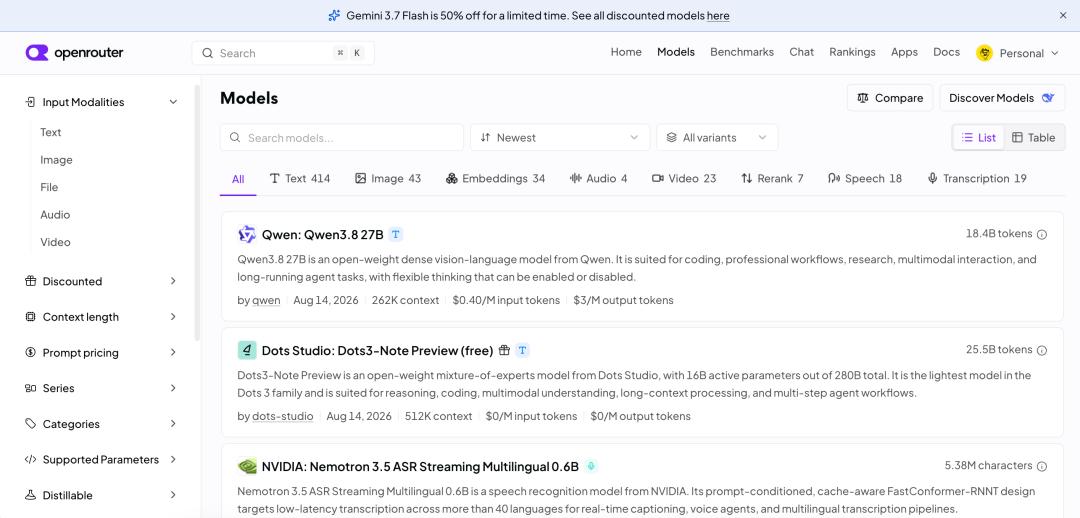
OpenRouter compresses these complex tasks into a single entry point. Developers only need to complete one access to switch between different models, and can also select models based on price, context length, first-token response latency, output speed and recent usage popularity.
For example, an AI office agent can use a low-cost small model to complete email classification, use a more capable model to handle contract review, use a long-context model to read full project documents, and automatically switch to a backup model when the main model is congested.
For users, it only completes one task; but in the background, there may have been dozens of model calls and multiple automatic switches.
According to the current display on OpenRouter's official website, its platform processes more than 200 trillion tokens per month, with over 10 million users, more than 80 model suppliers and over 500 models. Since these figures are disclosed by the company itself, the public still needs to treat them with caution; but if the statistical calibers are basically consistent, its growth rate is indeed very staggering. When Stripe introduced their cooperation in January this year, OpenRouter only had about 5 million developer users.
This is also where the real value of OpenRouter lies.
What it sells is not the intelligence of a certain model, but the ability for enterprises to choose, switch and settle among hundreds of types of intelligence.
What Stripe buys is not an API: but the "control layer" of the AI world
If you only regard Stripe as a payment company that collects credit card processing fees, it will be difficult to understand this transaction.
Over the past few years, Stripe has been emphasizing that it is building "economic infrastructure for the AI era". It not only handles subscriptions and payments for AI products such as ChatGPT, but also continuously expands into usage-based billing, agent payments, stablecoins and AI commercial agreements.
In 2025, Stripe and OpenAI jointly launched the Agentic Commerce Protocol, which allows AI agents to directly initiate purchases to merchants after obtaining user authorization. It also launched the Agentic Commerce Suite to help merchants open product catalogs, prices, inventory and checkout interfaces to different AI agents.
In January this year, Stripe completed the acquisition of usage-based billing company Metronome. Metronome is good at handling the complex pay-as-you-go model of AI products, and its customers include OpenAI, Anthropic and NVIDIA.
Connecting these actions, Stripe's strategy becomes clear.

In the traditional Internet, Stripe helps enterprises solve the problem of "how users pay"; in the AI era, it tries to further solve the problem of "what capabilities the agent calls, how many resources are consumed, and who should be paid".
And OpenRouter just fills in the most critical piece of the puzzle.
Stripe handles payment and billing, Metronome handles complex usage billing, and OpenRouter decides where model calls are allocated. If superimposed with the agent commercial agreement, Stripe will have the opportunity to run through the complete chain of an AI transaction:
The user puts forward a demand, the agent disassembles the task, OpenRouter selects the model, the model completes the inference, and Stripe records the token consumption, generates the bill and completes the payment.
In other words, Stripe no longer only processes the final capital flow, but begins to participate in the whole process of AI tasks from occurrence, execution to settlement.
This may be the fundamental reason why it is willing to pay a huge premium for OpenRouter.
The more models there are and the more chaotic the prices are, the more valuable the routing platform becomes
In the early stage of the development of large models, the industry generally believed that one or two super models would eventually take over most tasks.
If this judgment holds, the value of OpenRouter is actually very limited. Enterprises can directly access the most powerful model, and there is no need to add an intermediate layer.
But reality is moving in another direction.
Different models have their own advantages in tasks such as code, video, image, mathematics, search, long text, edge-side operation and tool calling; within the same model manufacturer, flagship version, fast version, lightweight version and inference version will also be provided. Chinese open source models are continuously entering the global market, and various industry-specific models and local deployment models are also increasing rapidly.
At the same time, the price system of large models is becoming more and more complex.

In addition to input and output tokens, enterprises also need to consider cache hit and miss, long context surcharges, batch processing discounts, peak-valley billing, inference intensity, tool calling costs, and price differences between different cloud service providers.
In this environment, model routing is no longer just a convenient feature for developers, but will gradually become the cost control system of AI applications.
An agent running inside an enterprise may perform hundreds of thousands or even millions of calls every day. Even if the average call cost is reduced by only 10%, it will eventually lead to a considerable profit difference.
When Stripe explained its cooperation with OpenRouter in January this year, it clearly pointed out that the inference cost of AI companies will fluctuate continuously with the price changes of different models. If enterprises do not adjust prices in time, they may lose competitiveness when costs fall, and their profits may be directly eroded when costs rise.
The cooperation method established by the two parties at that time was that OpenRouter was responsible for distributing model requests, and Stripe automatically tracked usage, applied the latest prices and completed billing processing.
In hindsight, that cooperation was more like a long-term business test conducted by both parties. Stripe first saw OpenRouter's transaction volume, user growth and billing complexity, and then decided to acquire the entire entry point.
Is $7 billion an expensive purchase?
From the perspective of traditional financial indicators, the price of more than 7 billion US dollars is not cheap.
OpenRouter was valued at about 1.3 billion US dollars in May this year, and the transaction price jumped more than fivefold after just a few months. It does not own the underlying models, and it also needs to pay fees to the manufacturers that actually provide inference services. The platform itself may face the problem of limited gross profit margin.

But what Stripe may be buying is not OpenRouter's current revenue, but its strategic position in the multi-model era.
The first point is developer distribution.
Once the application is integrated through OpenRouter, switching models, managing budgets, setting up backup suppliers and comparing model performance will all rely on the platform. As the business scale expands, the migration cost will gradually rise.
The second point is demand data.
OpenRouter can see which models are getting calls, what capabilities developers are willing to pay higher prices for, which tasks are most sensitive to latency, and which models lose traffic quickly after price increases. It may not be able to or should view users' specific prompts, but operational data such as model call volume, price sensitivity and task category alone have quite high commercial value.
The third point is the network effect of settlement.
More developers will attract more model manufacturers to access; the increase in the number of models will in turn attract more developers and enterprises to use. Stripe's capabilities in payment, taxation, risk control and cross-border settlement can further reduce the difficulty for OpenRouter to expand to different countries and enterprise markets.
The fourth point is strategic scarcity.
Excellent large models will continue to emerge, but there are not many neutral routing entry points that have formed scale and connect developers, model manufacturers and inference service providers at the same time. A large part of the premium paid by Stripe is for buying time and market position.
$7 billion seems expensive, but if OpenRouter eventually becomes a composite platform in the AI field similar to "app store plus cloud marketplace plus settlement network", this deal is not necessarily unexplainable.
This transaction also has obvious risks
One of OpenRouter's most important positioning before was to help developers reduce their dependence on a single model manufacturer. But after being acquired by Stripe, it itself will become a stronger platform dependency.
The first risk is neutrality.
Will OpenRouter prioritize recommending models with more favorable commercial terms and deeper cooperation with Stripe? Will the platform's leaderboards, default options and automatic routing rules unknowingly determine the traffic fate of different model manufacturers?
When a model entry point is involved in billing, settlement and distribution at the same time, "how to choose the best model" is no longer a purely technical issue, and may also be affected by commercial interests.
The second risk is a new single point of failure.
Enterprises originally used OpenRouter to avoid business interruptions caused by the downtime of a certain model company. But if a large number of model calls are completed through the same routing platform, OpenRouter's own failures, security vulnerabilities or policy changes may also affect a large number of AI applications.
The third risk is competition from cloud computing giants.
AWS, Microsoft Azure, Google Cloud and other cloud vendors are all providing multi-model platforms. Large enterprises may also choose to sign contracts directly with several core model manufacturers to obtain lower prices, clearer data policies and more stable service guarantees.
If only a few models remain leading in the future, or cloud vendors package model routing, billing and governance capabilities into existing enterprise services, the independent value of OpenRouter may be compressed.
The fourth risk is data and regulation.
The model routing platform is naturally in a sensitive position. Whether data such as finance, medical care, government affairs and enterprise code can be transmitted across regions, which models can be called, and whether prompts and outputs are recorded may all become the focus of regulation.
Once Stripe masters payment relationships, enterprise identities and model usage information at the same time, it will face stricter data isolation, transparency and antitrust review. There is no public evidence that Stripe will mix sensitive payment data with model content, but precisely because this combination has great potential value, the public will demand clearer governance commitments.
For Chinese large models, OpenRouter is both an overseas expansion channel and a new platform dependency
This transaction is also worthy of attention for Chinese AI companies.
In the past, when Chinese models entered overseas markets, in addition to capabilities and prices, they also needed to solve problems such as brand trust, API payment, developer documentation, service stability and global settlement. A unified platform like OpenRouter can significantly lower the threshold for overseas developers to try DeepSeek, Tongyi Qianwen, Kimi and other Chinese models.
Developers do not need to register accounts with Chinese manufacturers separately, nor do they need to rewrite the system. They only need to switch a name in the model list to test the performance of Chinese models.
This means that OpenRouter can become an important accelerator for the global distribution of Chinese open source models.
But the other side of the problem is that the global traffic of Chinese models may increasingly rely on overseas routing and settlement platforms. The platform decides which models enter the recommendation list, which regions can access, how to conduct compliance reviews, and also masters important data on the actual usage of the models.
Even if Chinese companies have excellent models, if they lack their own global developer entry points, cloud services and settlement systems, they may still stay in the position of upstream suppliers in the value chain: responsible for investing huge amounts of money in training models, while platforms closer to users master distribution, pricing and customer relationships.
Therefore, Stripe's acquisition of OpenRouter also raises a question for the domestic market: in addition to continuing to train more powerful large models, do Chinese enterprises also need to build a truly neutral AI foundational platform that is compatible with domestic and foreign models and can cover routing, evaluation, billing, compliance and global payment?
The real scarcity in the AI era may be the "right to choose"
Saying that the most valuable thing in the AI era may not be large models does not mean that models are no longer important.
Without top models, there would be no sufficiently powerful AI capabilities. The model is still the engine of the entire industry, and chips and data centers provide fuel.
But when there are more and more engines, prices are constantly changing, and different tasks require different capabilities, the person who decides which engine to use will also gain more and more power.