Mech-Mind has passed the listing hearing of the Hong Kong Stock Exchange, sprinting to become the first listed company in the embodied intelligence "eye-brain-hand" track.
On August 16, Mech-Mind passed the listing hearing of the Hong Kong Stock Exchange and released the post-hearing prospectus, officially entering the final sprint stage of its IPO.
If the listing proceeds smoothly, Mech-Mind is expected to become the "first listed enterprise of embodied intelligent eye-brain-hand" on the Hong Kong stock market.
Different from a large number of enterprises in the current market that focus on robot bodies, Mech-Mind does not manufacture complete robots, but concentrates its business on the core links that determine the intelligence level of robots: eye, brain and hand.
Among them, the "eye" is responsible for 3D visual perception, the "brain" is responsible for recognition, understanding, decision-making and motion planning, and the "hand" is responsible for completing grasping and fine operations. The three components jointly form a complete chain for robots from perceiving the environment and understanding tasks to executing actions, and can adapt to different robot bodies such as industrial robotic arms, dual-arm robots, and humanoid robots.
This development path also makes Mech-Mind a relatively special sample in the current boom of embodied intelligence.
Compared with enterprises that are still in the stage of technical verification and scenario exploration, Mech-Mind has taken the lead in crossing the stage of large-scale commercial implementation.
According to the prospectus, its products have been deployed more than 27,000 units in total around the world, sold to nearly 50 countries and regions, and served more than 100 Fortune Global 500 enterprises. Calculated by revenue in 2025, the company accounts for about 22.1% of the global market share in the "AI + 3D vision-guided non-special intelligent robot components" segment, ranking first.
As large models promote the evolution of robots from "automated equipment" to intelligent agents that can perceive, understand and execute tasks, the "eye-brain-hand" system is becoming an increasingly important layer in the embodied intelligence industrial chain.
Mech-Mind's sprint for Hong Kong stock listing this time also provides an observation window: whether a robot core component company that has achieved scaled and global revenue can further grow into a general intelligent platform in the era of embodied intelligence.
Focusing on the "eye-brain-hand" system, Mech-Mind enables robots to move towards general intelligence
Shao Tianlan, founder, chairman and CEO of Mech-Mind, graduated from Tsinghua University, then obtained a master's degree in robotics at the Technical University of Munich, and worked for many years in well-known German robotics enterprises. He returned to China in 2016 to found Mech-Mind, and was successively selected into lists such as Forbes China "30 Under 30" and Fortune "China 40 Under 40".
Different from most robotics enterprises, Mech-Mind does not produce complete robots, but provides standardized core intelligent components for robots - the "eye-brain-hand" system. The English name of the company, Mech-Mind, literally means "robot brain".
The "brain" is the core of this system, including the Mech-GPT multi-modal embodied large model, as well as robot vision, planning and deep learning software such as Mech-Vision, Mech-Viz and Mech-DLK.
Among them, Mech-GPT is responsible for natural language understanding and complex task planning, Mech-Vision and Mech-DLK undertake visual tasks such as recognition and positioning, and Mech-Viz is responsible for trajectory planning, collision detection and grasping planning. Through graphical, no-code and other methods, this software system lowers the deployment threshold of complex robot applications.
The "eye" refers to the Mech-Eye industrial 3D camera and supporting visual software, which is responsible for accurate spatial perception; the "hand" refers to the Mech-Hand five-finger dexterous hand, which is responsible for fine operations. The three components form a complete closed loop from perception and decision-making to execution.
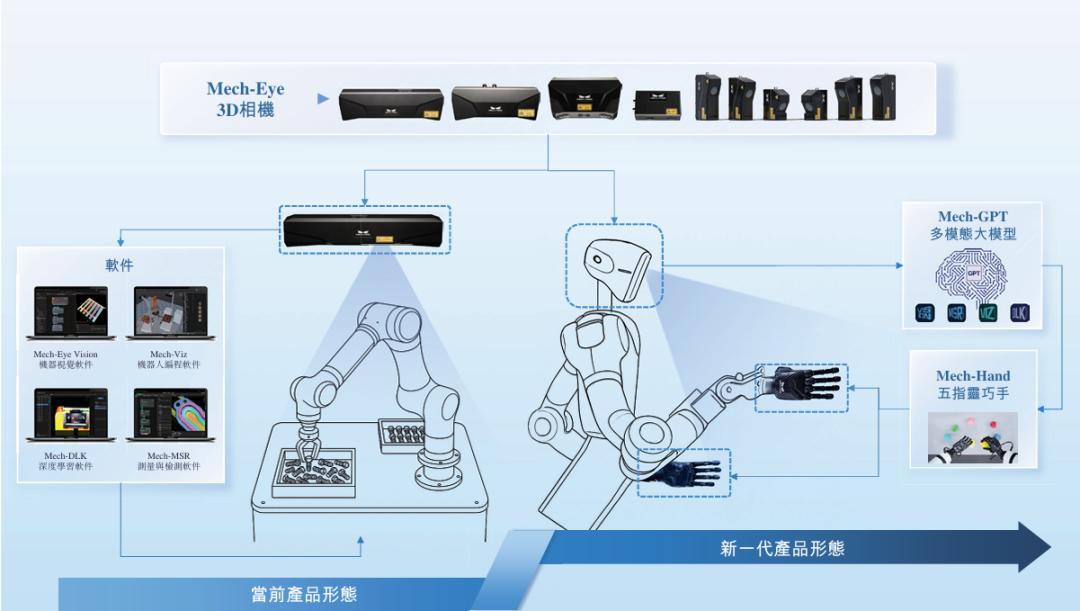
The most important feature of this product portfolio is universality.
The "eye-brain-hand" system is not bound to any specific robot body, and can adapt to different forms such as industrial robotic arms, dual-arm robots, and humanoid robots; the products are highly standardized and modular, support no-code deployment, and algorithm capabilities can be reused across industries. This means that when downstream customers switch industries or scenarios, they do not need to start custom development from scratch, the marginal cost of robot intelligence is greatly reduced, and large-scale replication becomes possible as a result.
At the 2026 World Artificial Intelligence Conference held in July this year, Mech-Mind systematically demonstrated the cross-industry, cross-scenario and cross-robot-form application capabilities of the "eye-brain-hand" system, including the debut of demonstrations such as dual humanoid robots collaborating on loading/unloading and material box handling, Mech-GPT large model human-robot interaction, and the new generation of multi-finger dexterous hands.
These demonstrations are not conceptual technical previews, but a concentrated presentation of the company's existing implementation capabilities.
The prospectus shows that as of the latest practicable date, Mech-Mind's products have been deployed more than 27,000 units in total around the world, applied to more than 50 typical scenarios in dozens of industries, handled more than 100,000 types of goods, and served more than 100 Fortune Global 500 enterprises, including CATL, BYD, Midea, Foxconn and others.
Customer stickiness is also continuously improving: the revenue contribution ratio of active customers from the previous year rose from 61% in 2023 to 78% in 2025, and reached 86% in the first quarter of 2026.
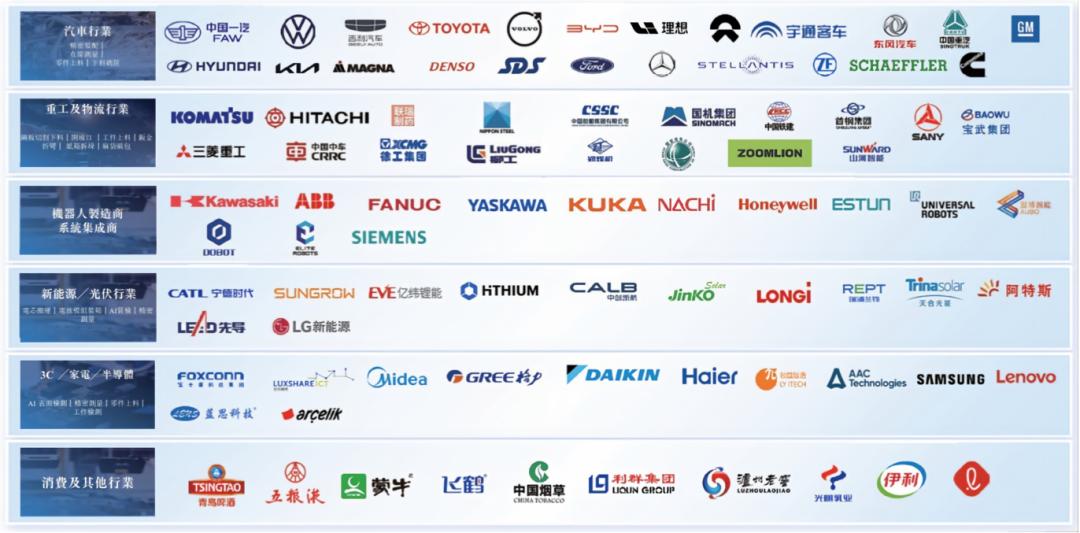
According to the report from CIC Consulting, calculated by revenue in 2025, Mech-Mind accounts for about 22.1% of the global market share in the "AI + 3D vision-guided non-special intelligent robot components" segment, ranking first; calculated by shipment volume, its global market share exceeds 27%, which is higher than the sum of the four largest competitors behind it. In addition, the company ranks first in market share in China, Japan and North America, and is among the market leaders in Southeast Asia, Europe and South Korea.
Starting from 3D vision, and gradually completing the layout of the "brain" and "hand" segments, Mech-Mind's product boundary is extending from industrial robot vision systems to complete robot intelligent capabilities. Whether this "eye-brain-hand" model can be established ultimately needs to be verified by commercial data.
With a CAGR of 88.5%, the "eye-brain-hand" system has become a large-scale business
According to the financial data disclosed in the prospectus, a clear improvement curve is outlined: revenue is growing rapidly, gross profit margin is continuously rising, losses are narrowing rapidly, and expenses are effectively diluted.
During the track record period, Mech-Mind achieved steady business and financial growth.
From 2023 to 2025, the company's revenue reached 180.8 million yuan, 268.8 million yuan and 388.8 million yuan respectively, with a CAGR of 46.6%; the gross profit margin during the period was 39.1%, 51.1% and 64.6% respectively; gross profit increased from 70.6 million yuan in 2023 to 251.1 million yuan in 2025, with a CAGR of 88.5%. Sustained revenue growth and significant improvement in gross profit margin have driven the overall profitability to keep rising.
The improvement on the profitability side is also intuitive: after excluding non-operating expenses such as options and listing expenses, the company's adjusted net loss narrowed rapidly from 334 million yuan in 2023 to 109 million yuan in 2025, narrowing by nearly 70% in three years; it further narrowed to 33.47 million yuan in the first quarter of 2026.

Another set of data is also noteworthy: in 2025, the company's operating loss was lower than its R&D investment in the same period - the operating loss was 109 million yuan, and the R&D expense was 113 million yuan; in the first quarter of 2026, the R&D expense was 38.46 million yuan, maintaining a high level of investment.
This means that while revenue grows and gross profit margin increases, Mech-Mind is still continuously investing in R&D. As losses gradually narrow, how far the company is from breaking even will also become an indicator worthy of attention after listing.
Expense control also reflects the scale effect. While revenue doubled, sales expenses barely grew in three years, and the sales expense ratio dropped from 103% to 43%. By the end of 2025, the company held cash and cash equivalents of about 352 million yuan.
Growing faster than the overall revenue is Mech-Mind's overseas business.
From 2023 to 2025, the company's overseas business revenue reached 58.6 million yuan, 97.7 million yuan and 195.5 million yuan respectively, with a CAGR of 82.7%, far higher than the overall revenue growth rate of the company in the same period; the proportion of overseas business revenue also increased significantly, reaching 32.4%, 36.4% and 50.3% respectively, and the overseas business gross profit accounted for more than half of the company's total gross profit during the reporting period.
At present, the company's products have been sold to nearly 50 countries and regions, and subsidiaries have been set up in Tokyo, Seoul, Chicago and Munich to support localized operations, occupying the largest market share in China, Japan and North America.
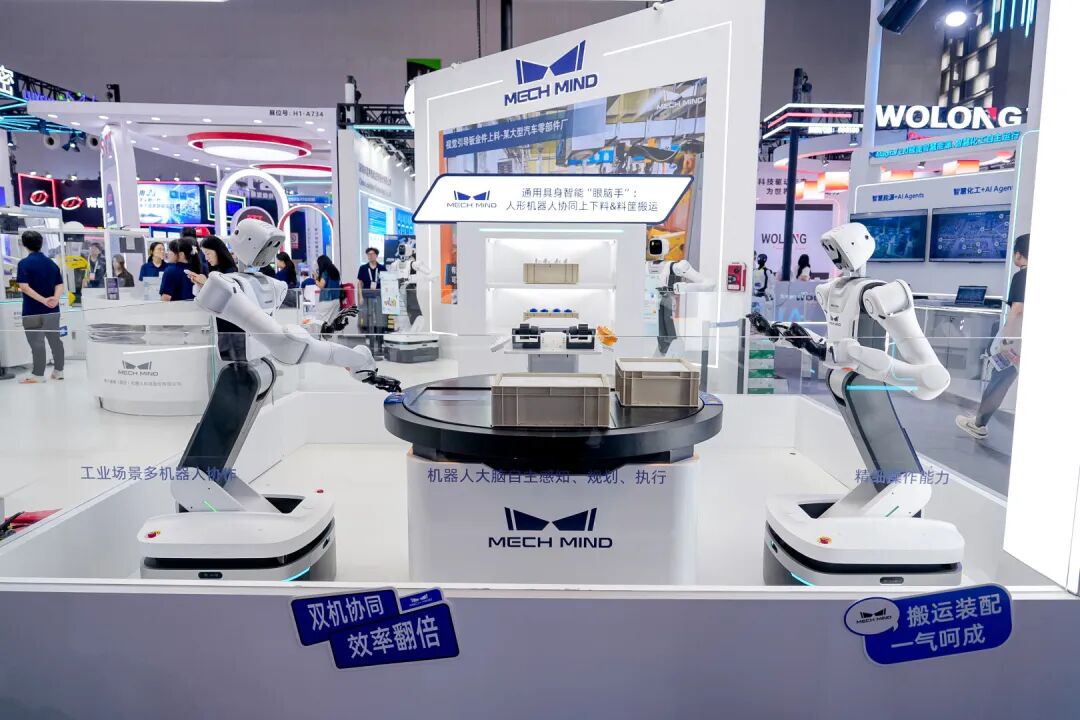
Apart from scaling and globalization, another highlight of Mech-Mind's IPO this time is how it plans to continue expanding this model.
Mech-Mind has commercialized intelligent robot solutions since 2019. According to data from CIC Consulting, the company is one of the first batch of enterprises in China to provide general 3D vision solutions for industrial robots.
CIC Consulting predicts that the CAGR of the industry's market size where the company is located will be 43.2% from 2025 to 2030, and 57.5% from 2030 to 2035, and the market size is expected to further expand to 1.025 trillion yuan in 2035.
The company stated that driven by the accelerated integration of 3D vision and AI technology, the growing demand for flexibility in the manufacturing industry, the popularization of "plug-and-play" deployment, and the transformation from dedicated systems to general intelligent agents, Mech-Mind has sufficient advantages to benefit from the huge potential of its industry.
Since its establishment, Mech-Mind's shareholder roster has gathered first-tier financial investors and industrial capital, including well-known institutions such as HSG, IDG Capital, Meituan, Qiming Venture Partners, and Source Code Capital.
According to the prospectus, the funds raised from this listing will be mainly used for product and technology R&D, enriching product portfolios and expanding application scenarios, expanding global business layout and accelerating commercialization, expanding production capacity, and supplementing working capital.
At present, Mech-Mind has realized large-scale deployment of general robots based on "L2-level robot intelligence" (advanced perception combined with complex motion capabilities), and is evolving towards L3-level capabilities that can understand natural language and perform multi-step tasks.
After landing on the capital market, this company named after "robot brain" will also face a more core question: whether the "eye-brain-hand" capabilities that have been verified by large-scale commercial implementation can continue to expand to more general embodied intelligence.
This article is from the WeChat Official Account "Youjie UnKnown", author: Shan Cha, editor: Qian Jiang, published with authorization from 36Kr.