Over the past seven months, U.S. open-source models have been copying China's homework.
Recently, Hugging Face released its latest report *State of Open-Source Models: 2026 Summer Observation Report*.
The report points out that since 2026, Chinese laboratories have continued to lead in the parameter scale of cutting-edge open models, while the focus of competition in the United States has gradually shifted from model labs such as Meta and Google to chip and infrastructure companies such as NVIDIA and AMD.
More notably, Chinese models are becoming an important base for the US's trillion-parameter large models. The report states that in the first seven months of this year, most of the open-source models with over 100 billion parameters released in the US were fine-tuned, quantized, format-converted or hardware-adapted based on Chinese models.
At the same time, although the number of models continues to grow rapidly, the models that are actually used by developers for a long time are still concentrated in a few repositories, and there is also a clear gap between model popularity and actual adoption.
In the first seven months of this year, the number of public model repositories on Hugging Face increased from 2.43 million to 2.96 million, the number of datasets exceeded 1 million, and Spaces (the platform for running AI applications online) increased to 1.44 million. However, 85.6% of the models have less than 200 lifetime downloads, and only 1.5% of the model repositories contribute 99.2% of the total downloads.
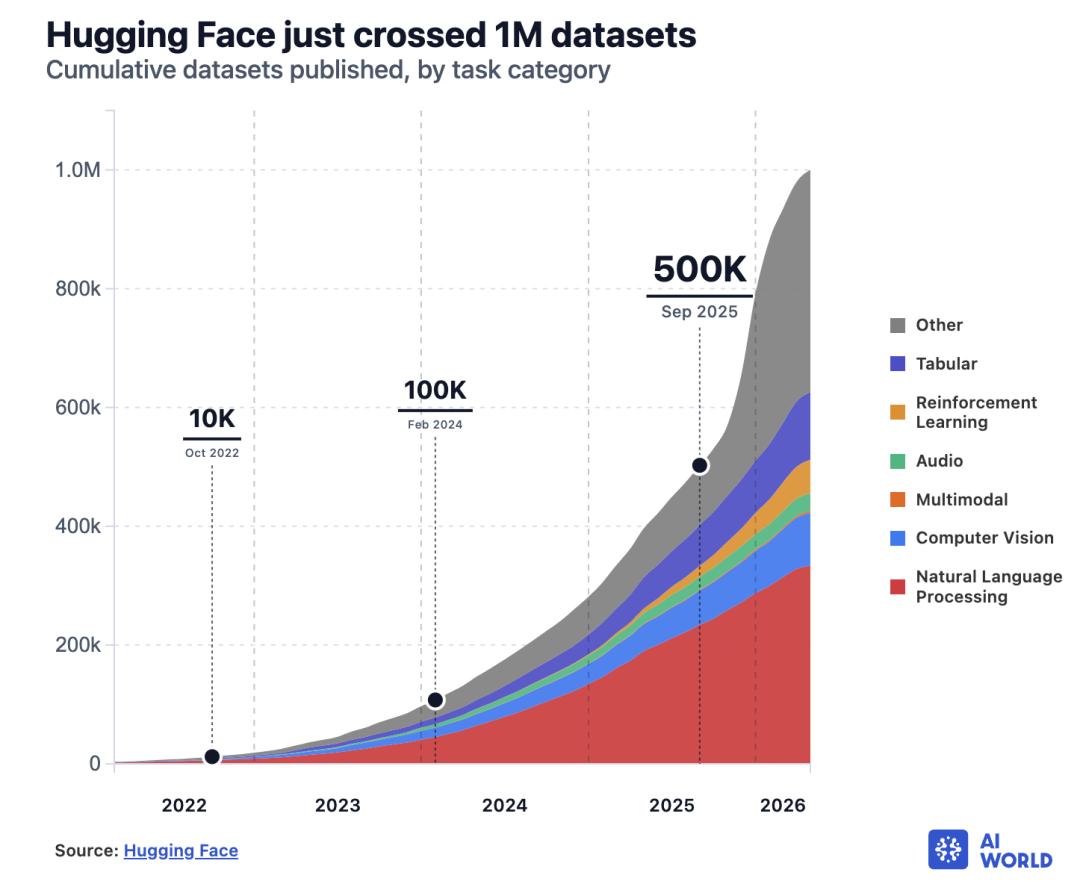
The number of datasets on Hugging Face continues to grow, exceeding 1 million in 2026
Only a very small part of the models actually enter the development process.
Cutting-edge models are constantly advancing to trillion-parameter scales, but actual downloads are still concentrated in small models: among models with known parameter scales, models with less than 1B (1 billion) parameters account for 83% of historical downloads, while models with more than 100 billion parameters account for only 1%.
01 Chinese Models Reach the Cutting Edge
In the first seven months of this year, the upper limit of the monthly parameter scale of China's open-source models ranged from 754 billion to 2.78 trillion. The upper limit of original models in the US was lower than 130 billion parameters for five months, with only exceptions being Nemotron 3 Ultra (561 billion parameters) released by NVIDIA in May and June, and Inkling from Thinking Machines Lab (952 billion parameters).
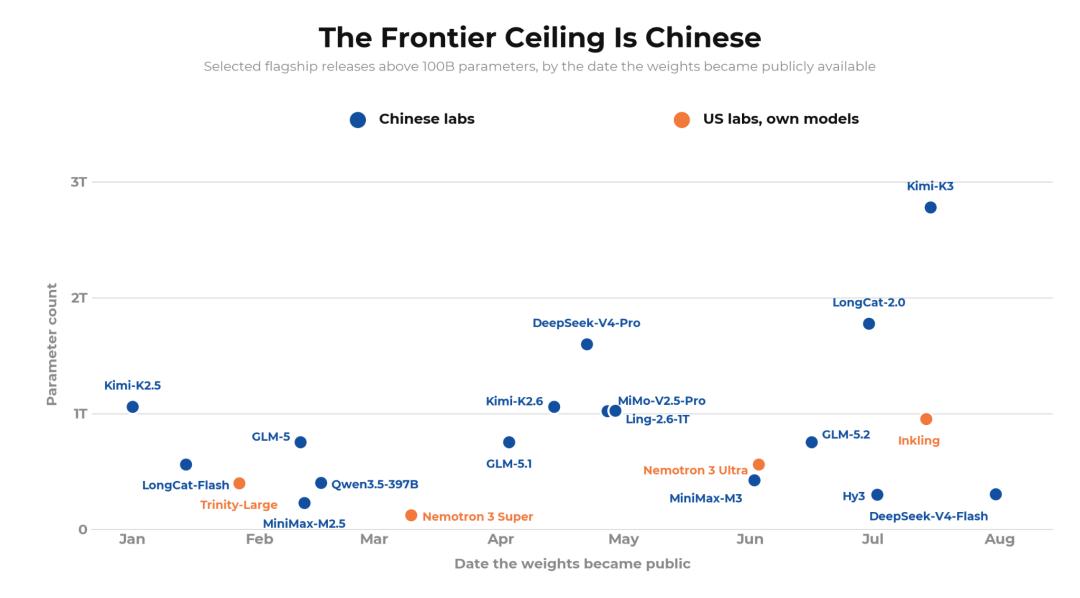
In the first seven months of 2026, the monthly maximum open-source model scale of Chinese laboratories has continuously led that of the United States
In addition, the model scale strategies of Chinese laboratories have also diverged.
New models from Moonshot AI, MiniMax, Xiaomi and Zhipu are mainly focused on larger scales. Alibaba's Qwen covers different parameter scales, forming another development path.
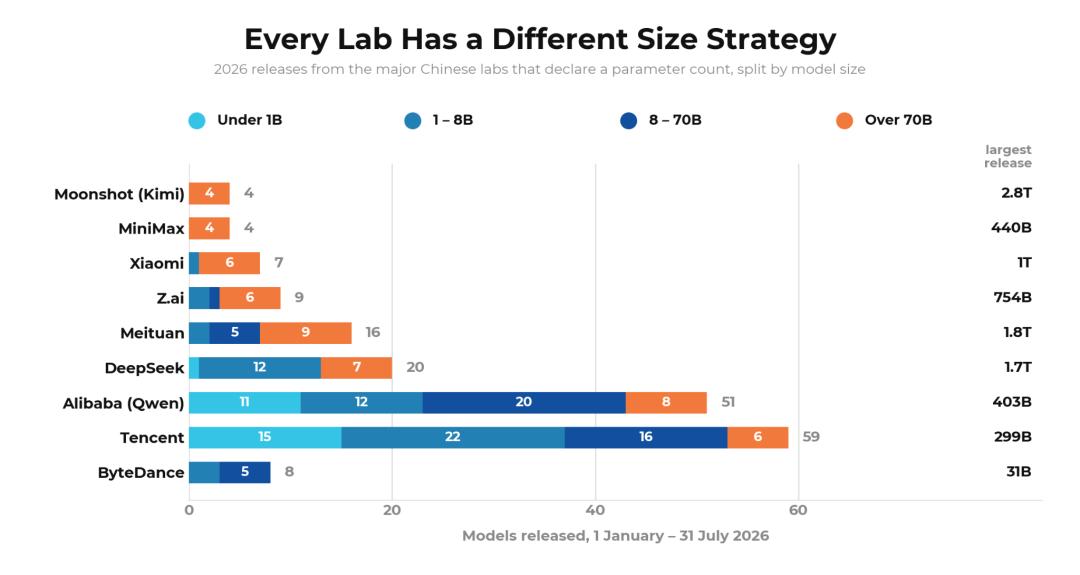
Every AI lab has a different model scale strategy
The report explains that this change is related to the evolution of model development methods. Large models themselves can hardly become a differentiated advantage, and the development of quantization tools enables large models to be deployed to local devices faster. There is no need for labs to first release small models and then gradually advance to larger scales.
At the same time, more and more of the 100-billion-parameter open models in the United States are not built from scratch. There is a limited number of original models of this scale in the US.
The main models listed in the report include Inkling from Thinking Machines Lab, NVIDIA's Nemotron 3 series, and Trinity-Large from Arcee AI. Although AMD has uploaded a large number of converted versions of super-large models, it has not released original base models of this scale in the same period.
This has led to a change in the role of US companies. The two companies that released the most new model repositories in 2026 are NVIDIA and AMD, with more than 200 each, far higher than other institutions.
Hugging Face believes that a large number of models released by NVIDIA and AMD are optimized around their own chips, and the models themselves are becoming a demonstration of hardware performance.
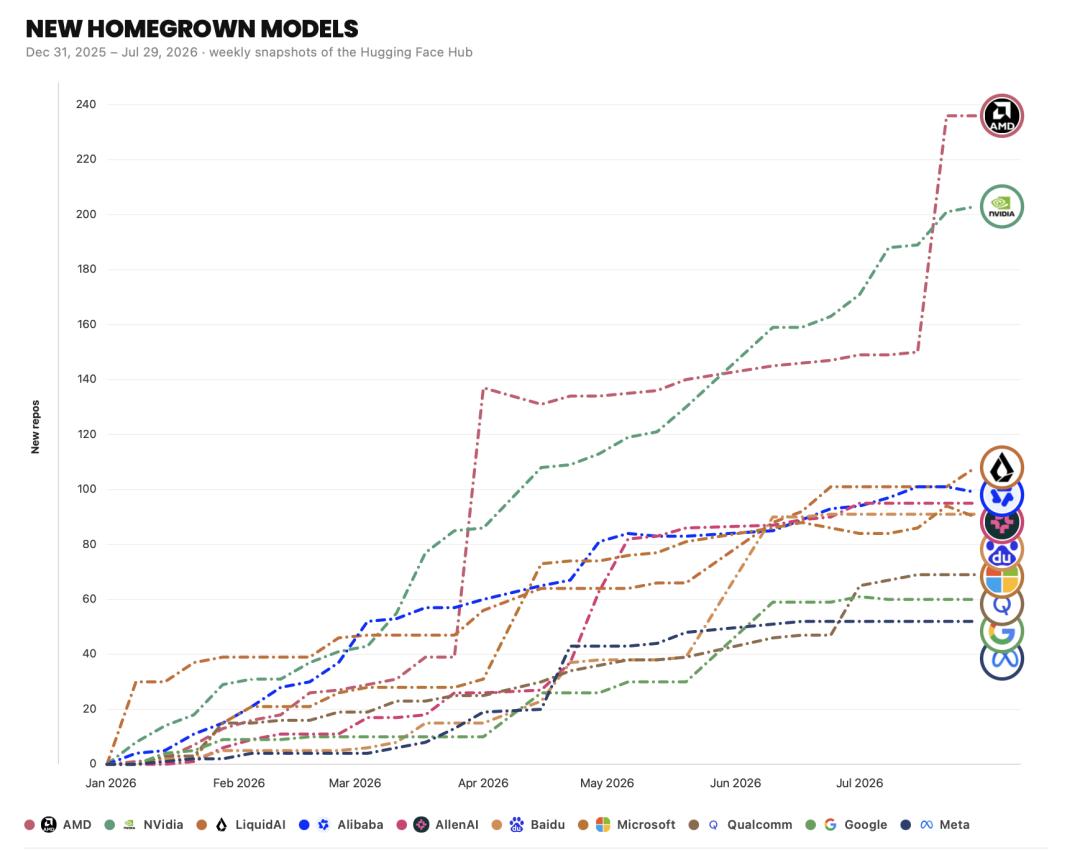
AMD and NVIDIA have become the two hardware manufacturers with the largest number of open-source model releases in the US this year
In contrast, Google and Meta's leading positions in the open-source model field in the past few years have declined. The main promoters of open-source models are expanding from traditional model labs to chip and infrastructure companies.
02 Large Models Are Popular, Small Models Are More Practical
The parameters of models keep increasing, but downloads have not shifted to large models accordingly.
Hugging Face's statistics show that only one of the top 25 models by downloads in 2026 overlaps with the top 25 models by likes. None of the models released in 2026 made it to the top 25 by downloads, and 13 of the top 25 models were released in 2022.
The general text embedding model all-MiniLM-L6-v2 was downloaded 1.55 billion times in the first seven months of this year, but only received 5156 likes. Kimi-K3 has roughly 60 downloads for every like it receives.
Hugging Face found that likes are more concentrated in the attention period after new models are released, while downloads mostly come from models that have already entered the development process. The amount of attention a model gets when it is released does not directly reflect its subsequent usage scale.
This difference is also reflected in model scales.
Among models with known parameter scales, models with less than 1B parameters account for 83% of historical downloads, while models with more than 100 billion parameters account for only 1%. The same is true in 2026, where downloads of models with more than 70 billion parameters only account for 3%.
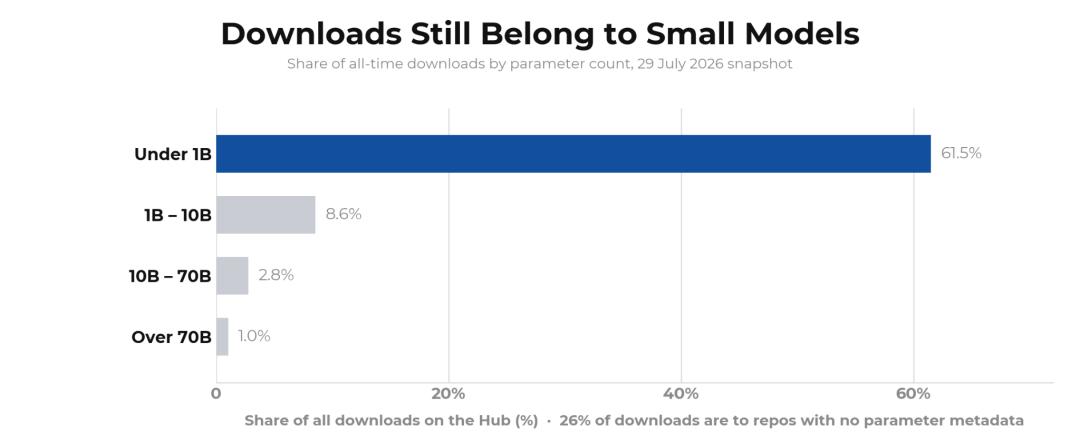
Models with smaller parameters remain the main force of downloads
The download structure of China's cutting-edge labs is significantly different from that of US institutions. Qwen has reached 2.045 billion downloads with its model family covering different scales.
Almost all of MiniMax's downloads this year come from models with over 70 billion parameters, followed by Moonshot AI at 88%, DeepSeek at 55%, and Zhipu at 39%. The downloads of Google, Microsoft and IBM Granite at this scale are almost zero, while NVIDIA and Meta account for 14% and 9% respectively.
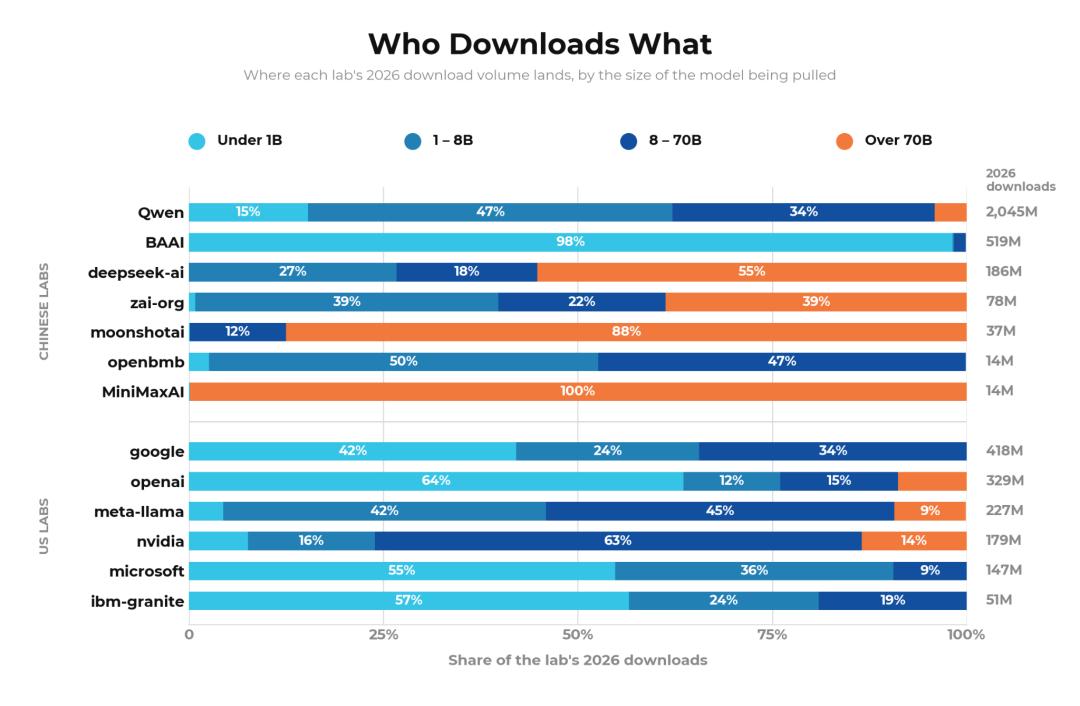
Alibaba's Qwen has become the open-source model series with the largest number of downloads
Cutting-edge models are getting larger and larger, but how to make these models actually run has become another problem.
In the Hugging Face snapshot of July 2026, GGUF builds of DeepSeek-V4-Flash with about 284 billion parameters and Kimi-K3 with about 2.8 trillion parameters have appeared.
GGUF is a model file format suitable for local operation. After quantization, the model can reduce the memory required for operation, and then be deployed to local devices with tools such as llama.cpp.
This enables super-large models to not rely entirely on the cloud. In the past, local operation of large models was mainly concentrated on models with several billion parameters. Today, developers can run larger Mixture-of-Experts models through multiple consumer-grade devices.
Tools around model operation are also growing rapidly. In the past seven months, the number of Hugging Face model repositories has increased by 21.5%, while repositories that explicitly use the gguf library have increased by 464%, Apple MLX by 148%, and LeRobot by 194%.
03 Competition Has Extended to the Ecosystem
After a model is open-sourced, the competition does not end. For publishers, a more important question is whether developers are willing to modify, deploy, and continue to develop based on the model.
The license is one of the important factors.
Among the 178 Chinese models with more than 20 billion parameters this year, 59% adopt the Apache 2.0 license, and 22% adopt the MIT license. Both licenses allow developers to modify, redistribute and use the models for commercial purposes without setting non-commercial restrictions.
DeepSeek and Zhipu even open-sourced models with 700 billion to 1.65 trillion parameters under the MIT license.
In contrast, the licensing methods for US models of the same scale are more scattered: 29% adopt Apache or MIT licenses, 41% use custom terms, and 30% have not clearly stated their licenses.
This means that large open models themselves are not the main direct source of revenue. After models are open-sourced for free, their commercial value needs to be realized more through APIs, cloud services, hardware and developer ecosystems.
The scale of the ecosystem has thus become another competitive indicator. Hugging Face data shows that there are more than 150,000 derivative models based on Qwen. In the first seven months of 2026, about 180 to 210 new derivative model repositories of Qwen are added every day.
This ecosystem effect also exists in the field of local operation. At present, not many of the top ten model families officially provide GGUF versions, but the community has produced a large number of local operation versions around these models. Taking Qwen as an example, its monthly GGUF downloads are about 39.6 million, nearly twice that of Gemma and more than five times that of Llama.
Another growing variable is agents. Hugging Face first disclosed agent access data in July this year: Claude Code accounts for 44.4%, down from 67.8% in April. Codex rose from 10.4% to 20.8%. At the same time, nearly a quarter of the traffic comes from unidentified tools, and more than a dozen new client identifiers appeared between April and July.
This shows that agents are becoming a new category of users on Hugging Face. They can already search for models, download datasets, run tasks and call applications through tools, and the entry point for model usage is expanding from manual operation to AI agents.
04 Meta and NVIDIA Re-enter the Competition
The leading position of Chinese laboratories in the field of open-source models has also forced US companies to readjust their strategies.
On August 10, Meta released Muse Glimmer, with weights open-sourced under the Apache 2.0 license. One day later, NVIDIA launched Nemotron 3.5 Lightning. Both models have about 30 billion parameters, with a focus on local deployment and agent workloads.

Meta's Muse Glimmer is designed for local agents, programming and function calling, and its quantized version can be compressed to less than 20GB.
NVIDIA's Nemotron 3.5 Lightning adopts a Mixture-of-Experts architecture, and is equipped with the open-source routing library NeMo Switchyard, which allows different tasks to call different models. NVIDIA hopes that enterprises can use multiple models and schedule them according to cost, speed and capability.
Meta's return is particularly noteworthy. In the past two years, Chinese companies have released open-source models at a significantly faster pace, and Meta's Llama is no longer the only mainstream choice for developers.
The significance of Muse Glimmer is not just adding a new model, but that Meta has put developers and local deployment back at the center of its open-source strategy. Previous data also shows that Chinese open-source models have taken a clear advantage in token consumption on OpenRouter.
This competition will eventually come down to a more specific question: who can make it more convenient for developers to download, modify, deploy and use models for a long time.
From the current situation, Chinese laboratories have taken the lead in cutting-edge model research and ecosystem construction, and US companies are re-entering the battlefield. The parameter scale of models is still important, but what determines the long-term position is increasingly whether the model can be integrated into real workflows.
This will further accelerate the change speed of the open-source model market.
This article is from the WeChat official account Tencent Tech, author: Worth Paying Attention To, published with authorization from 36Kr.