36Kr Exclusive: Tsinghua-Peking University team working on digital inkjet printing of industrial functional coatings raises hundreds of millions of yuan in financing from 5Y Capital, Xiaomi, NIO Capital and other investors
This article is about 4000 words, with an estimated reading time of 8 minutes
Author | Qiao Yujie
Editor | Yuan Silai
36Kr learned that Shifang Technology, an enterprise focused on digital inkjet printing technology for functional coatings in industrial scenarios has completed two consecutive rounds of financing. From the Series B round to the final close of this Series B+ round, the total financing amount is nearly 300 million yuan. Fivey Capital, Creation Venture Partners, Cowin Venture, leading industrial strategic investment institutions Hengxu Capital, Xiaomi Group, NIO Capital have jointly participated in the investment, with many existing shareholders making follow-on investments simultaneously.
Founded in 2020, Shifang Technology is dedicated to providing the industry with core components and system solutions for high-precision, high-viscosity, micron-level functional coating digital inkjet printing. The company has globally launched the first functional coating UV inkjet printing engine, which is widely used in new energy, PCB, automotive and other industrial fields.
In the field of new energy batteries, the traditional cell insulation mainly relies on the coating film process. Although it is mature and lightweight, under the trend of larger-sized cells, problems such as declining coating film yield, interface aging, and bulging failure have become increasingly prominent. Although the UV spraying process that emerged in recent years has improved some pain points, it still faces the limitations of high overall cost caused by complex masking procedures, poor edge accuracy, low material utilization and other issues.
Against this background, UV inkjet printing is becoming an important direction for the upgrading of cell insulation coating technology. By precisely ejecting materials onto the surface of the workpiece through the printhead, and then forming a coating through photocuring, more refined coating control can be achieved. Compared with traditional processes, UV inkjet printing can improve yield, reduce material waste, greatly reduce equipment investment costs, and achieve more flexible coating processing according to performance requirements.
One of the core advantages of Shifang Technology lies in its full-stack independent R&D capability around the core components of the printing engine, which realizes independent and controllable core technologies. Through self-developed control boards, ink supply systems, software algorithms and other modules, it forms a complete technical system stack covering hardware, software, fluid control and material adaptation.
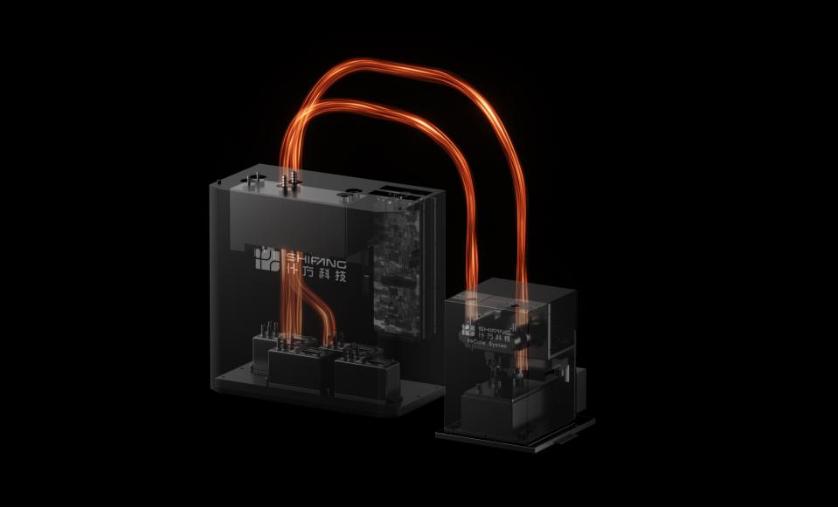
Product Overview (Source/Enterprise)
The difficulty of industrial functional coating printing is not only "ejecting the material out", but also the systematic collaboration among materials, equipment and processes. To this end, Shifang Technology has built the Praxis Functional Coating Laboratory, focusing on new process development, new material adaptation, printing effect verification and film forming performance testing, helping customers complete the whole process from material verification to mass production introduction.
At present, the company has cooperated with more than 50 domestic and foreign material enterprises, and its related material systems have entered the supply system of many leading battery enterprises. For customers with existing ink systems, Shifang Technology can also complete the adaptation verification between material properties, printing process, coating performance and printing system through the laboratory. Provide customers with a full-link solution from printing engine to process adaptation and verification, and then to mass production implementation.
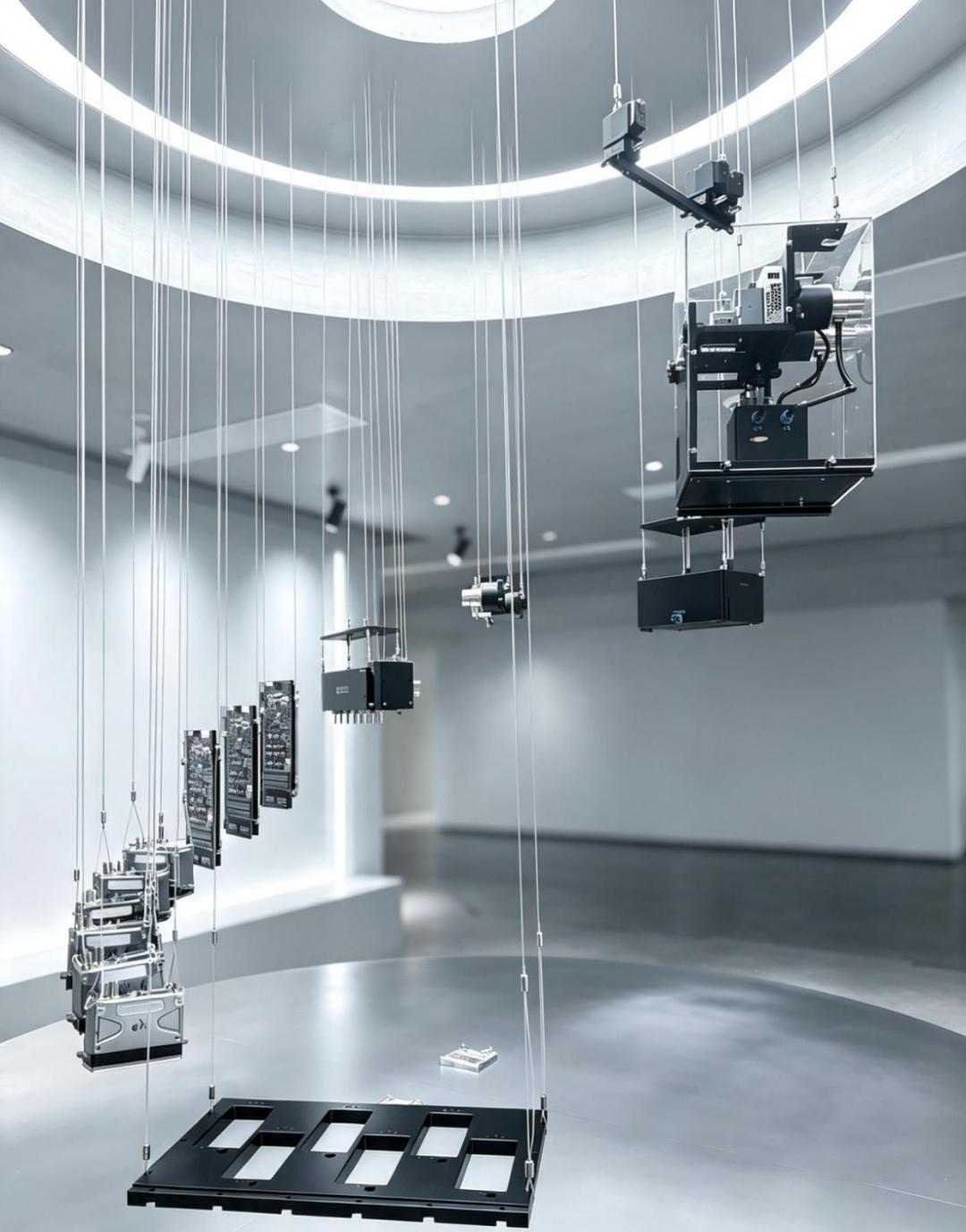
Display of Core Product Components (Source/Enterprise)
Around the differentiated needs of different industrial scenarios, Shifang Technology has launched two major product series — the XF series high-tempo high-viscosity functional coating printing engine and the P series high-precision functional coating printing engine. The XF series is mainly oriented to large-dose, high-speed production application scenarios, with a maximum single-point ink droplet of 160pL, a maximum single-pass printing thickness of 120μm, focusing on high-viscosity thick coating and high-tempo printing requirements in the fields of new energy cell insulation coating, perovskite functional layer and other fields; the P series is aimed at small ink volume, high-precision scenarios, with a minimum ink droplet of 3pL, the thinnest printing thickness of 1μm, which is suitable for coating printing in high-precision fields such as PCBA conformal coating, solid-state battery glue frame, and semiconductors.
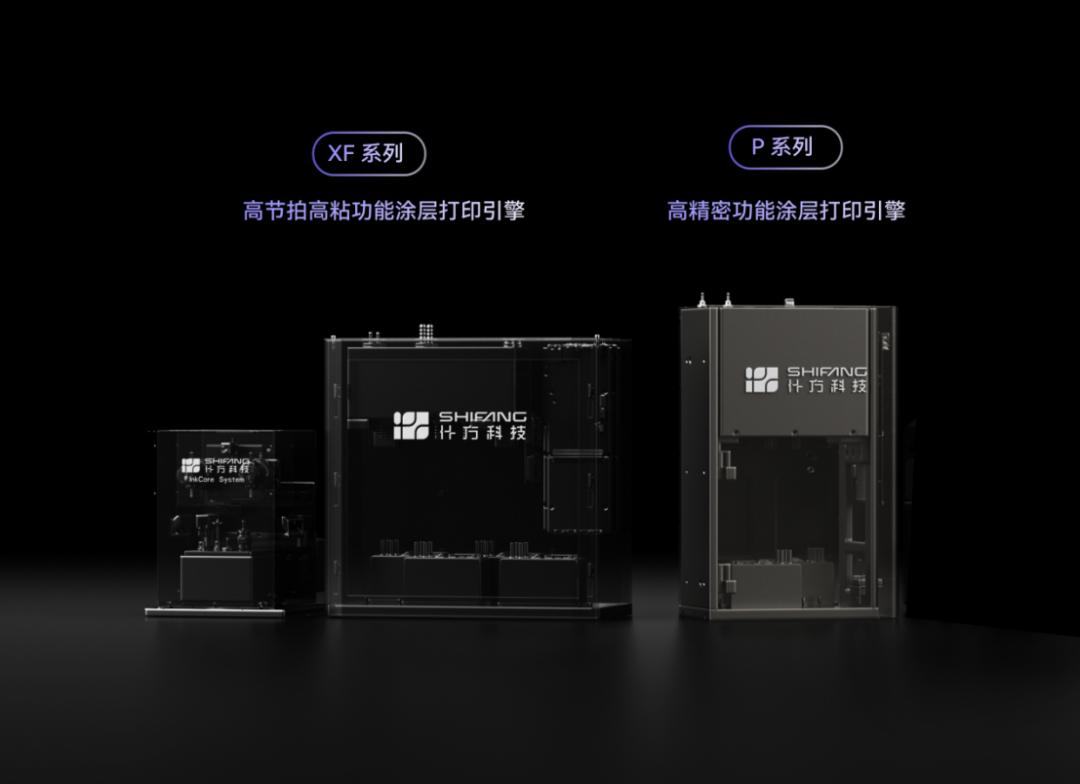
Product Series (Source/Enterprise)
In terms of commercialization, new energy batteries are currently the largest application market for Shifang Technology. The company has served more than 5 leading battery enterprises, and the total number of cells processed with insulation coating through Shifang Technology's printing engine has exceeded 5 million. Among the mass production projects that have been implemented, based on self-developed software and hardware, the company has realized multiple printing methods including top spraying, side spraying and multi-angle spraying, which are compatible with all types of cells of prismatic, cylindrical and blade types. The first pass yield exceeds 98%, the material utilization rate exceeds 99%, and the maximum production rhythm of the production line reaches 56PPM, meeting the strict requirements of energy storage/power battery manufacturing for coating performance, consistency and mass production efficiency.
In addition, with the accelerated industrialization of solid-state batteries, higher requirements are put forward for insulation and sealing structures, and the technical value of digital inkjet printing has also extended to the solid-state battery glue frame scenario, which can solve the problems of low efficiency and poor precision control of traditional processes. At present, Shifang has cooperated with many leading battery enterprises to carry out joint process verification.
At the same time, PCBA conformal coating is becoming the company's second growth curve. At present, the industry still mainly adopts traditional processes such as atomizing air spraying and needle dispensing, with single-point ink volume at the nanoliter level, which requires manual masking and path planning, and is difficult to meet the production requirements of higher precision and higher efficiency. Shifang Technology's P series printing engine can achieve picoliter-level ink droplet control. Higher granularity also means more refined coating control: within the range of 1-50μm, the thickness accuracy can be controlled at ±10% of the target value, and different thicknesses in different regions can be formed in one pass. In addition, it supports the import of graphic template files or photo-generated templates, realizing digital automatic avoidance of forbidden coating areas, eliminating the masking and path planning procedures, and the production efficiency is more than 10 times higher than that of traditional processes.
In terms of team, the proportion of master's and doctorate degree holders in the company exceeds 35%, and the R&D proportion exceeds 80%. The core R&D team is composed of doctors and masters from universities such as Tsinghua University, Peking University, Xi'an Jiaotong University, and Harbin Institute of Technology. The company has obtained more than 100 independent invention patents, covering key fields such as inkjet printing technology, ink droplet observation system, ink path control technology, and automation optimization algorithm.
The following is an excerpt from the exchange between 36Kr and the founding team of Shifang Technology:
36Kr: It is very difficult for functional materials to meet printing requirements. How does Shifang Technology solve this problem?
Founding Team: In fact, in the field of functional coatings, if the problems can be solved by printing, the advantages will be more obvious compared with traditional processes. The biggest advantage is that materials can be maximally utilized and printed on demand.
But most functional materials are difficult to print, because once functionality is involved, such as conductivity, insulation, corrosion resistance, etc., the material formula will become very complex. Printing itself has very high requirements for materials, with a very narrow process window, and the material system and printing process must be highly matched, which makes the matter very difficult. Therefore, we choose to do this together with the world's top material enterprises. China's material supply chain has cultivated a group of material suppliers with high-level scientific research capabilities in the past ten years. We have realized the matching of various materials and printing processes through technical guidance and output of formula adjustment suggestions.
Material manufacturers are also very willing to cooperate, because the printing process can help increase the value of materials. For example, for the same material, traditional spraying may cause a lot of loss, and maybe 30% of the material is not utilized in the end; but with printing, 99% of the material can be accurately dropped to the target position, with very little waste. In this way, the material itself can reflect higher value.
36Kr: When different industries introduce digital inkjet printing technology, such as new energy, PCB, consumer electronics, do they need a lot of customization for printheads, software, materials and other aspects? How to solve the problem of technology reuse?
Founding Team: There are indeed many differences in the application requirements of printing in different industries, but our understanding of reuse can be divided into technology reuse and material reuse.
Our methodology is more about testing the underlying logic of experience through engineering thinking methods, and upgrading these experiences to more transferable know-how. Therefore, when facing new application scenarios and problems, the reusability of technology is actually very high. Moreover, the commonalities of the requirements for functional coating preparation in different fields and different products are actually very high. To put it simply, they almost focus on several very straightforward requirements: uniform thickness, neat edges, and accurate position. After in-depth understanding and mastery of these requirements through research on various fluid characteristics, matching of printhead control, and control of the landing, wetting and spreading process of materials on substrates, we can solve problems in multiple scenarios at the same time.
In terms of material reuse, there is the possibility of cross-scenario reuse of inkjet printing materials in different industries. When we break down the BOM, we find that the core components are standardized hardware such as printheads, ink paths, and boards. Because we are making core functional systems, there are not many customization requirements for the smallest unit. At present, our BOM reuse rate can reach about 70%, and it can even reach more than 80% in the future.
36Kr: Why do you now focus on printing components instead of complete machines and equipment?
Founding Team: On the one hand, we see that the opportunities for printing components are very large. Printing is a platform-based technology with high difficulty and great market imagination, but there was no systematic solution in the industry before. Equipment manufacturers have strong equipment control capabilities but lack printing process accumulation, while material manufacturers have no clear direction guidance for formula R&D. The supply and demand sides cannot form effective collaboration, and neither of the two parties has sufficient know-how for printing, resulting in poor printing effect. There is a gap in the middle for companies that can make standardized printing components, and we fill the industry-wide blank of system-level printing engines, with no mature implementation cases at home and abroad.
On the other hand is the choice of industrial timing. We believe that it has reached the golden window period for laying out the printing engine track. Entering the market 10 years earlier, there was no supporting materials and equipment, and the related investment would only end up as cannon fodder for the industry. China's new energy equipment industry has achieved global leadership in 5-10 years, and the current supporting maturity of the printing track is sufficient to support technology implementation. Our downstream has grown into a large enough application scenario, so that the printing engine business can be implemented by tackling each independent large scenario one by one, giving priority to covering precision engineering scenarios with long-term rigid demand, without the need to cut into small-volume scenarios sporadically.
Messages from Shareholders
Kai Liu, Partner at Fivey Capital, said: From our first meeting to continuous follow-on investment, our judgment on Shifang has never changed: this is a team that starts from first principles, they have refined technologies in all links into commercial barriers, and gradually developed into a platform-based technology company. We have witnessed Shifang turn UV inkjet printing from a "good idea" into a standard process on leading cell production lines in just two years, and now it is gradually migrating to new scenarios such as PCB. Teams that understand both technology and business and evolve faster than the industry are very scarce in China's manufacturing industry. Fivey is willing to continuously accompany such teams to challenge the limits in the no-man's land of technology!
Wei Zhou, Founding Managing Partner of Creation Venture Partners, said: We highly recognize Shifang Technology's full-stack independent R&D and engineering capabilities in the field of digital inkjet printing for industrial functional coatings. Focusing on mass production scenarios such as new energy cell insulation coatings, the team has built systematic capabilities from printing engines, ink supply systems to industrial software, and completed production line verification. We are optimistic about its long-term value in promoting the digital and intelligent upgrading of industrial coating processes.
Yiwei Zhang, Partner of Cowin Venture, said: Shifang Intelligent Manufacturing cuts in from the core process links, and builds technical barriers with the integrated self-developed capability of software and hardware. On the one hand, it quickly establishes industry benchmarks through mass production verification by leading customers, on the other hand, it continuously accumulates process data and material formulas, laying a solid foundation for subsequent expansion to more cell process links. We are optimistic about the team's profound accumulation in the field of precision manufacturing and pragmatic commercialization rhythm, and look forward to Shifang Intelligent Manufacturing becoming a key force in the field of lithium battery manufacturing equipment.
Hengxu Capital: Shifang Technology is a typical platform-based technology company. It redefines the production method of industrial functional coatings with its original self-developed UV inkjet printing engine, bringing the traditional coating process into the era of precision digital inkjet printing. This technology spans scenarios such as lithium batteries and PCBs, corresponding to a hundred-billion-level incremental market, and is on the eve of the explosion from 1 to 10. AI is reshaping every link of the manufacturing industry, and the digital upgrading of industrial functional coatings has just kicked off. We are long-term optimistic about Shifang Technology's ability and potential to lead this track.
Xiaomi Group: Xiaomi continues to lay out platform-based hard technology enterprises with underlying original technologies and multi-scenario implementation potential. Shifang Technology's self-developed standardized printing engine module for digital inkjet printing innovates the traditional industrial coating manufacturing mode, and the technology can expand to multiple tracks such as new energy batteries, PCBs, perovskite photovoltaics, and automotive coatings. The company's core team has interdisciplinary industrialization composite capabilities. At present, the demand for industrial digital inkjet printing is strong, and we are very optimistic about the long-term development potential of Shifang Technology.
NIO Capital: We have long focused on technological innovation and advanced manufacturing upgrading of the new energy industry chain. With industrial digital inkjet printing as the core, Shifang Technology provides an innovative solution for battery insulation coating that has the advantages of safety, production efficiency and cost. We especially value the team's profound industrial experience, interdisciplinary technical capabilities and execution. With the improvement of battery safety standards and the evolution of industrial manufacturing towards digitization and flexibility, digital inkjet printing is expected to accelerate the replacement of traditional processes and further expand to broad scenarios such as PCB and photovoltaics.