OpenAI ramps up its speed by 16 times, GPT-5.6 Multi-Agent V2 is officially launched, and 741 rounds of extreme heavy-load conversations can be opened in 1 second
OpenAI has rolled out one blockbuster update after another!
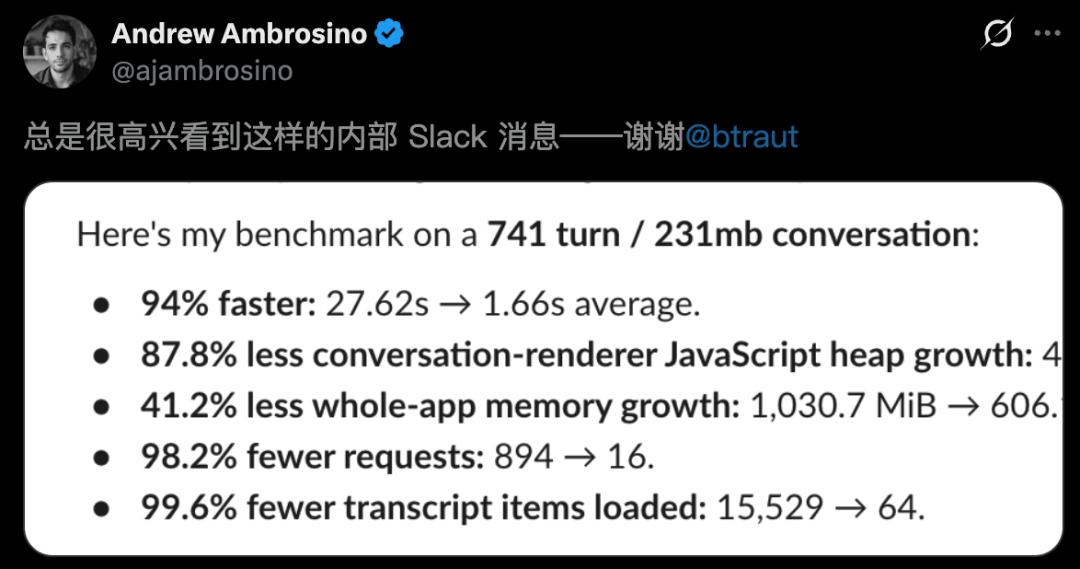
Today (August 16), an internal Slack message from OpenAI was leaked, showing that ChatGPT is set to usher in an "epic" full-scale performance overhaul.

According to hardcore test data, the front-end performance improvement of ChatGPT this time is so significant that it is almost "unreal":
The application loading speed has soared by 94% directly, the heap memory growth has decreased by 87.8%, and the overall memory usage has been cut by 41.2%.
The number of network requests has plummeted by 98.2%, and the loading time of conversation history has also been reduced by a full 99.6%.
Almost at the same time, Codex launched the GPT-5.6 "Multi-Agent v2" version.
The main Agent can now automatically delegate different subtasks to different models, and each sub-Agent can be independently set with its own reasoning intensity.
Greg Brockman, President of OpenAI, said, "We are moving towards the goal of saying goodbye to manual model selection."

It has to be said that OpenAI's this two-pronged move —
directly eliminates the tedious "waiting" and "selection" for users, enabling ChatGPT to truly deliver an extremely fast, seamless and smooth interactive experience.
ChatGPT Gets Full Overhaul, Loading Speed Surges by 94%
Many people don't know that this major performance upgrade of ChatGPT is actually a key milestone after the departure of Scott Gray, the "king of programming".
For a long time, when people use ChatGPT, their biggest fear is that long conversations will get more and more laggy, and even the web page will crash directly.
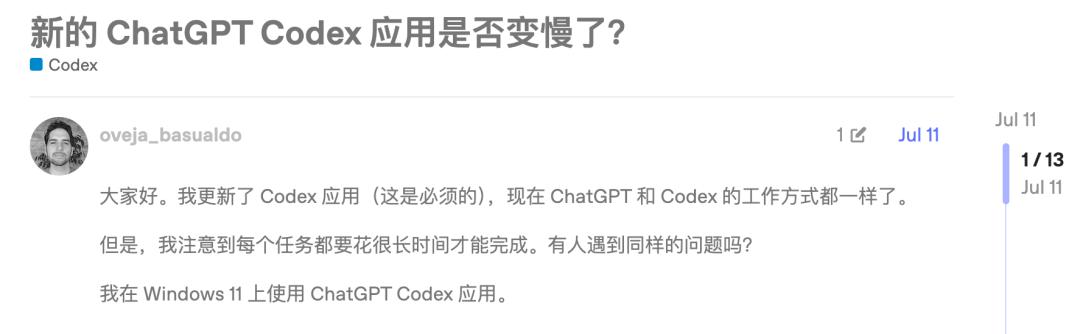
On the official OpenAI forum, someone even posted a question asking "Is the new version of Codex getting slower?", which got a flood of agreeing replies below.
This time, the internal Slack screenshot shared by Andrew Ambrosino, head of Codex, directly laid all the cards on the table:
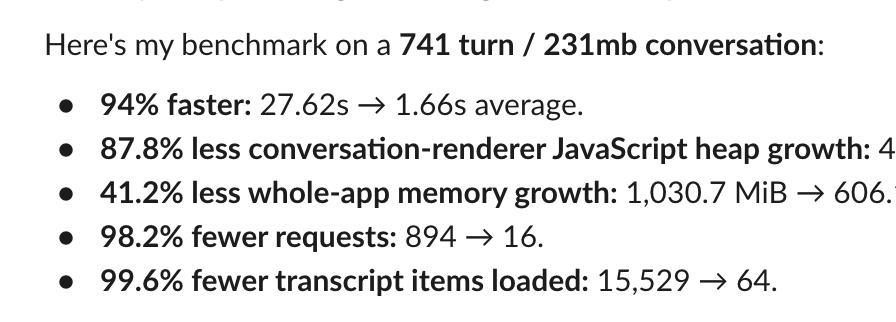
The test subject they used internally was a "monster-level" conversation with a full 741 rounds of interaction and a size of 231MB!

This sounds like an extreme sample, but it is the daily norm in the Agent era.
In the past, conversations were just chat records that ended after dozens of rounds; now for a slightly more complex task, letting it read code, run tests, and verify after modification, hundreds of rounds will be easily consumed.
For such a high-intensity conversation, the average opening time has now dropped from 27.62 seconds to 1.66 seconds.
The memory growth of the entire application has been reduced from 1030.7 MiB to 606 MiB;
The number of network requests required to open a conversation has been cut from 894 to 16; the number of session entries that need to be loaded has dropped from 15,529 to 64.
This is a major front-end optimization from OpenAI targeting ultra-long ChatGPT conversations.
In two words, Extremely Smooth
What kind of changes can it bring exactly?
Simply put, chat records spanning several months will open much faster.
Developers who frequently run hundreds of tool calls in heavy Codex sessions will find that the interface is significantly more responsive, and the memory usage of the device has also decreased accordingly.
Switching back to an ultra-long old conversation is no longer as laborious as "loading a save file from a dying PS3".

The clever part is that ChatGPT no longer has to load and render all historical records as soon as you open a conversation.
It can store most of the content and only load the small part that people actually need at the moment.
For the same conversation, a large number of unnecessary operations are eliminated.
For people who are used to working with ultra-long AI conversations, this is the kind of infrastructure upgrade that sounds boring, but can greatly improve the product experience.
Multi-Agent v2 Fully Launched, No Need to Manually Select GPT Models
Just this week, OpenAI has quietly updated ChatGPT.
It was not until today that OpenAI engineer Eric Provencher officially announced: Multi-Agent v2 is now fully available.

The core highlight is intelligent task allocation.
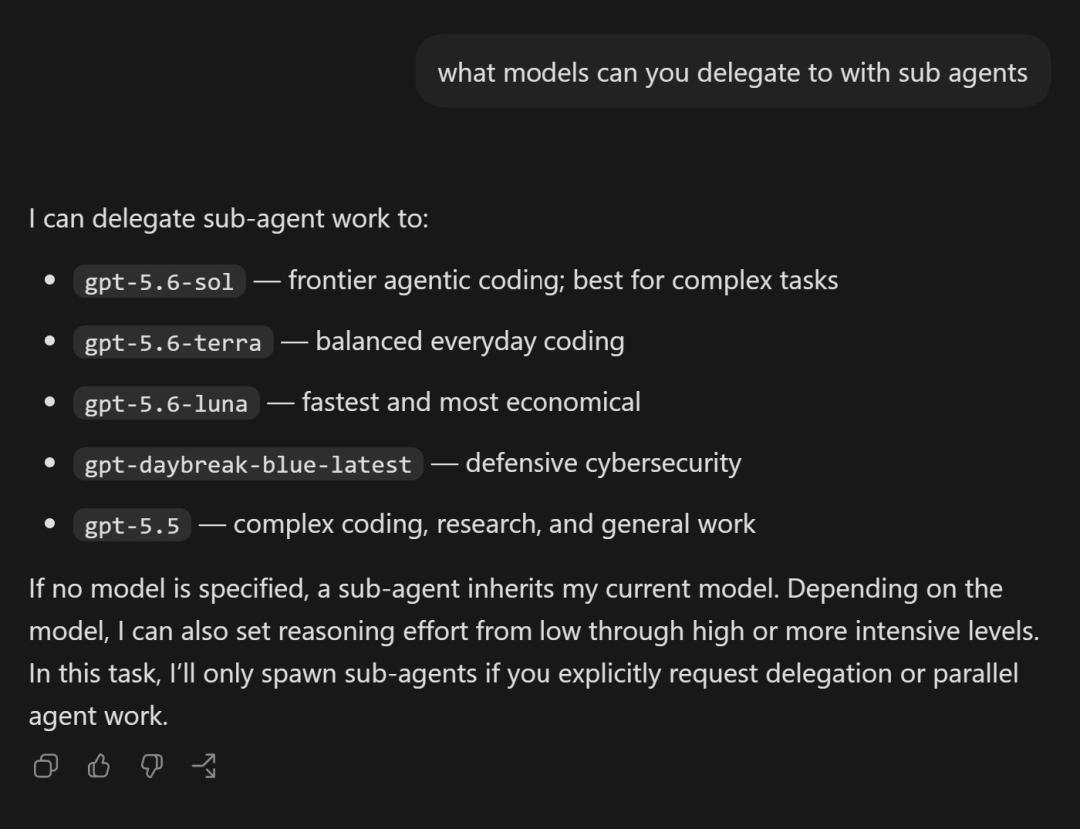
The main Agent can automatically delegate subtasks to any supported model, including Luna, and each sub-Agent supports independent configuration of reasoning intensity.
Now the full lineup available for ChatGPT/Codex is as follows —
GPT-5.6 Sol: The most powerful, for complex agentic coding
GPT-5.6 Terra: The main model for daily programming
GPT-5.6 Luna: The fastest and most cost-effective
Daybreak: Dedicated to cybersecurity use cases
GPT-5.5: For complex programming, research and general tasks
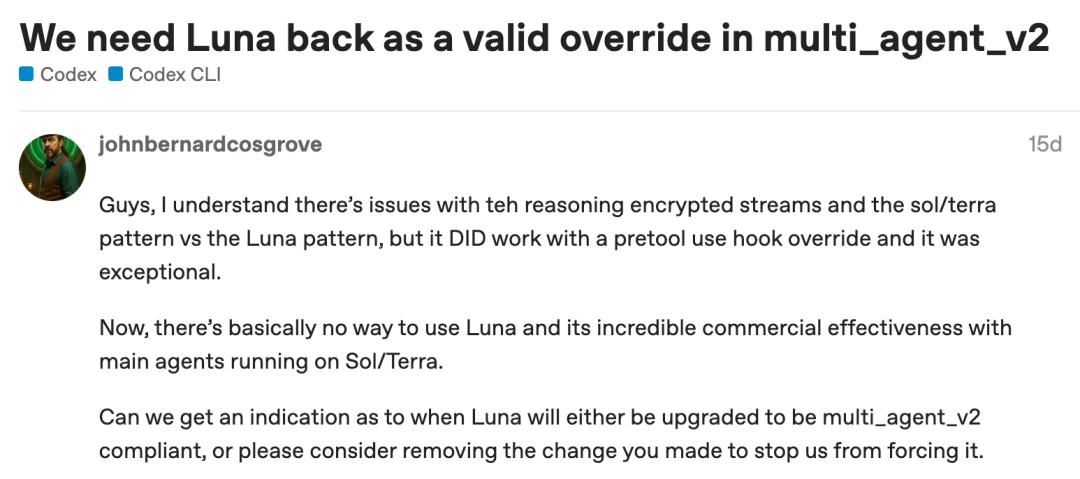
In fact, three weeks ago, in Codex's model list, Sol and Terra were marked as multi_agent_v2, while the most cost-effective Luna was marked as v1.
The result was that when the main Agent tried to assign tasks to Luna, the system directly returned an "unknown model" error.
Developers have opened at least two issues on GitHub for this problem.
There is a post on the official OpenAI forum titled "Give Us Back Luna", the poster said that he previously used a hook to forcibly bypass the restriction to use Luna, and the effect was surprisingly good, but now this workaround has been blocked.
In the past, people needed to manually select models, but in the future, the Agent system will automatically split tasks, execute them in parallel and summarize the results, turning models into internal computing resources.
For complex tasks, only 20% of the steps require the most powerful model, and the rest can be assigned to more cost-effective models.
In this way, the reasoning cost can be greatly reduced, accelerating the transformation of ChatGPT from a chat tool to a workflow platform.
ChatGPT Evolves In Place, The Fully Automated Monster Is Coming
The front end has cleared the "historical baggage", and the back end has enabled "intelligent distribution".
This set of underlying combined punches from OpenAI not only completely bid farewell to the laggy era of ChatGPT, but also announced to the entire industry that:
Large language models are accelerating their evolution from "chat tools" to real "fully automated workflow platforms".
You no longer need to worry about choosing the right model to balance costs, nor do you need to wait for hundreds of rounds of monster-level conversations to load slowly.
You only need to assign complex tasks to it, and the rest of the automatic task decomposition, model scheduling and ultra-fast rendering will all be handled by the system.

The era of ultimate smoothness belonging to Agents has truly arrived.
Facing such a "seamless" and powerful ChatGPT, is your productivity ready to take off?
References:
https://x.com/Ananth7e/status/2088490421676863782?s=20
https://x.com/ajambrosino/status/2088401536057827344?s=20
https://x.com/gdb/status/2088658133971509640
This article is from the WeChat official account "AI Era", author: Taozi, published by 36Kr with authorization.