PandaAI has completed three consecutive rounds of financing, with L2F Lighthouse Founders' Fund leading the Angel round and Angel+ round | L2F Portfolio
Recently, AI trading infrastructure provider 「PandaAI」 announced that it has completed three consecutive rounds of financing, namely the seed round, angel round and angel+ round, with total accumulated financing amount reaching tens of millions of RMB. The angel round and angel+ round were led by L2F Lighthouse Founders' Fund.
The three rounds of financing will be mainly used for the continuous R&D of AI Trading Large Model, Professional QuantSkills, Multi-Agent Collaborative Infrastructure and Trading Agent Development Environment, to accelerate the construction of PandaAI OS, ADE and A2A technology system. At the same time, the company will further expand the global user market and promote the large-scale implementation of AI trading capabilities among individual traders, professional investment teams and financial institutions.
From Human Decision-Making to Agent Collaboration
Over the past few years, the application of artificial intelligence in the financial field has been mainly concentrated in single-point links such as research report retrieval, information extraction, code generation, market trend interpretation and operational efficiency improvement.
These applications have improved local efficiency, but have not changed the basic organization method of trading research. Data, factors, strategies, backtesting, risk control and trading execution are still scattered in different tools and systems. The research process is highly dependent on personal experience, strategy logic is difficult to reuse, and failure results are rarely systematically precipitated.
With the gradual maturity of large models, professional Skills and multi-agent technology, AI trading is entering a new stage.
The core of the next-generation AI trading system is no longer just answering a market question or generating a piece of strategy code, but organizing trading research into a set of callable, verifiable, traceable and continuously iterable workflows.
AI can call data and professional tools, understand trading assumptions, complete factor research, strategy construction, backtesting verification and risk analysis, and connect simulation and live trading scenarios under clear authorization and risk boundaries.
Trading is gradually evolving from a judgment process relying on personal experience to a collaborative agent workflow completed jointly by humans and AI.
What PandaAI is building is exactly the new generation of AI Trading OS that supports this change.
Make Every Trading Judgment Enter a Verifiable Research Closed Loop
Traditional quantitative research has a high entry threshold.
Even if users have mature market judgment, they often cannot convert trading ideas into verifiable and executable strategies due to lack of programming skills, lack of professional data, complex backtesting environment or fragmented tools.
Through natural language interaction and visual AI workflow, PandaAI organizes "Trading Idea — Factor Research — Strategy Generation — Backtesting Verification — Risk Assessment — Trading Execution" in the same system.
Users can express market judgment through natural language, and the system calls data, models, codes, backtesting, risk control and trading tools to gradually convert a vague trading idea into a structured research process.
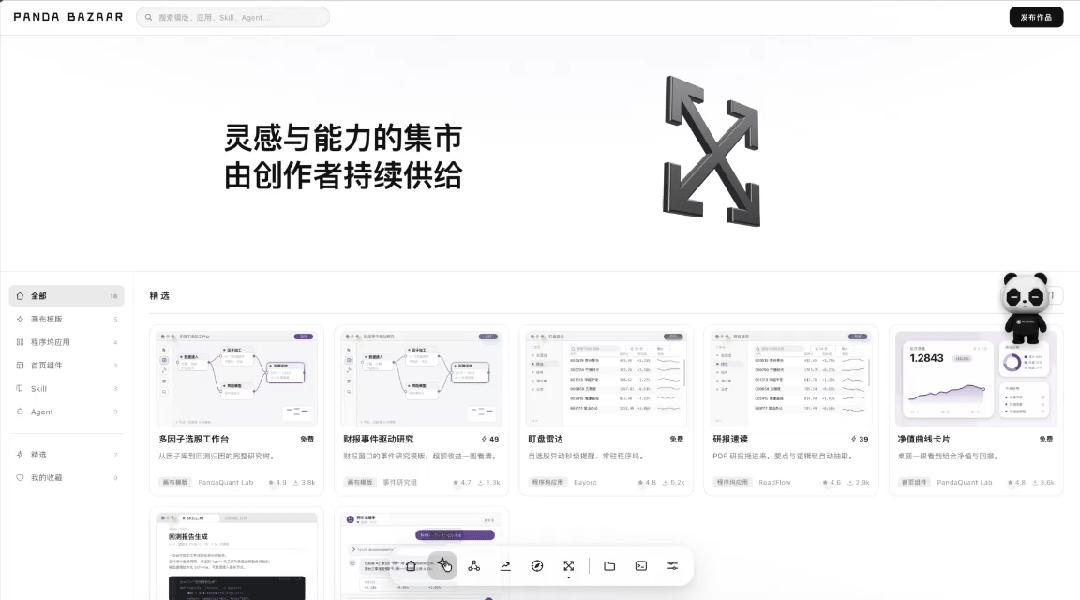
Natural Language Generated AI Workflow
Natural language is only the interaction entry of PandaAI, and the real core lies in the Agent Engineering Capability behind it.
In PandaAI's visual workflow, complex trading research will be disassembled into nodes including data acquisition, factor construction, code generation, strategy backtesting, parameter adjustment, risk analysis and trading connection. Users can check what data is used in each step, what processing is done, and what results are obtained, and can also adjust, replace and reuse existing processes at any time.
Compared with directly giving an unexplainable trading conclusion by a large model, this workflow architecture allows users to understand how the conclusion is formed, discover problems in data, code or strategy in time, and optimize trading logic in continuous verification, providing a more reliable path to reduce model hallucinations and black box risks.
What PandaAI hopes to give traders is not just an AI assistant that can answer questions, but a set of AI trading systems that can jointly research the market, verify judgments and continuously precipitate trading experience with them.
From Monolithic Intelligence to Swarm Intelligence: A2A is Reconstructing Trading Research
Real trading is not a single task.
A complete trading research usually goes through multiple links such as data acquisition, market analysis, trading signal formation, strategy backtesting, portfolio and position management, risk inspection, order execution and post-trading review.
Relying on a single model to complete all work, it is difficult to take into account professional depth, process stability and result interpretability at the same time.
Therefore, PandaAI has built A2A multi-agent infra for AI trading research scenarios — PandaAI EVO. Different Agents are responsible for tasks such as data processing, factor research, strategy generation, backtesting analysis, risk assessment and trading execution, and complete research collaboratively through unified workflow.
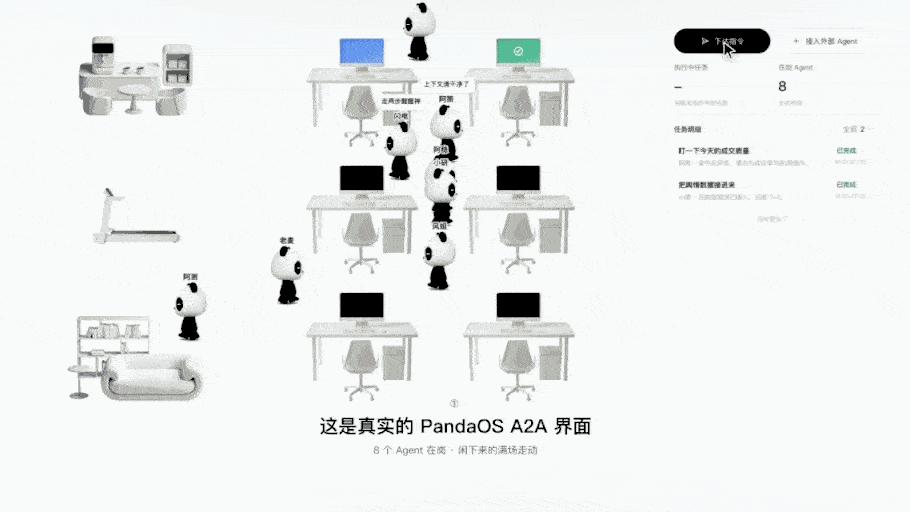
Realize A2A Agent Collaboration on PandaAI EVO
For example, after one Agent puts forward a trading hypothesis, other Agents can call historical data for verification; after the strategy is formed, the backtesting and risk control Agents will further check the return performance, stability under extreme market conditions and potential risks, and then adjust and optimize according to the results.
This kind of Agent-to-Agent collaboration makes AI trading no longer just a single model answering questions, but like a professional team, jointly completing complete trading research through division of labor, verification and feedback.
The Agent Evolution researched by PandaAI does not mean that AI trades autonomously without constraints, but allows Agents to continuously correct research paths according to backtesting results, market changes and execution feedback under clear data scope, tool permissions, risk rules and manual authorization.
When this feedback continues to occur, the system no longer only accumulates market data, but also includes workflow data generated during the trading research process: how users put forward hypotheses, which factors are adopted or abandoned, how parameters are adjusted, why strategies fail, and how simulation and live trading results reversely affect research logic.
These data generated around the real trading process will become an important foundation for the continuous evolution of AI trading systems.
AI Trading OS: Bring Data, Models and Agents into the Trading Closed Loop
Around the trading research methods of different users, PandaAI has formed core products such as OS, ADE, QUBE and A2A, which are supported by QuantSkills with unified professional capabilities, covering different needs such as one-stop research, natural language strategy development, in-depth investment research and multi-agent collaboration.
Around the AI trading workflow, PandaAI has formed a product and technology architecture consisting of four layers.
The first layer is the data and research base.
The platform integrates market quotation, financial and macro characteristic data from multiple markets at home and abroad to provide basic support for market research, strategy verification and Agent invocation.
The second layer is models and professional capabilities.
Centered on PandaAI's self-developed CQ and TQ models, it also supports access to external general large models, combined with financial data and professional tools, to help users complete demand understanding, code generation, factor mining, strategy analysis and research interpretation.
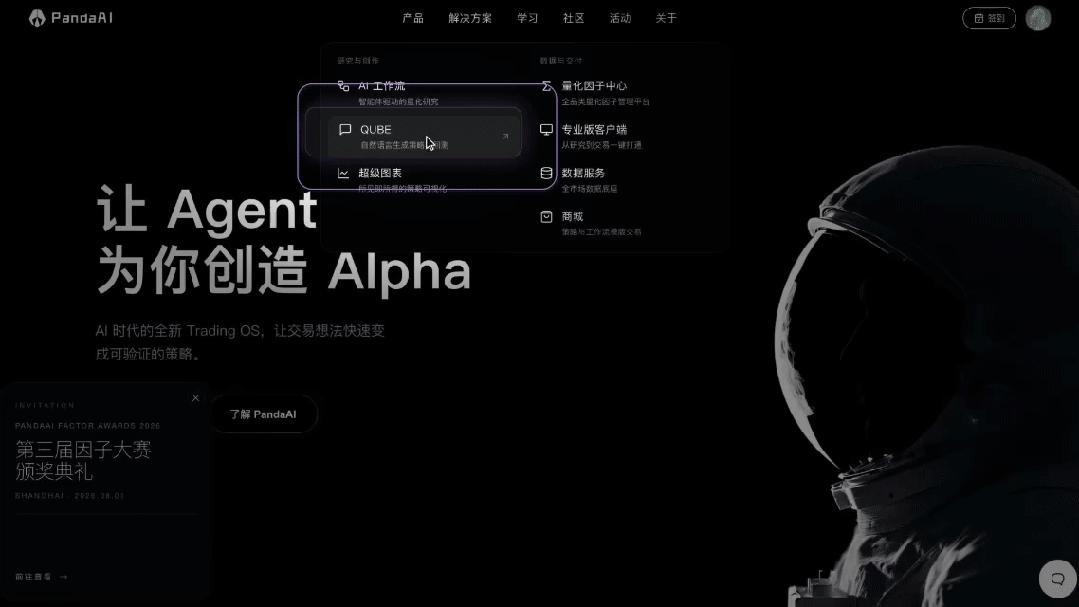
PandaAI QUBE Conversational Investment Research Assistant
The third layer is Agent Engineering and Collaboration System.
The platform organizes models, data and tools into callable, orchestratable and collaborative trading agents, and supports multiple Agents to jointly complete data analysis, strategy research, backtesting and risk control tasks through the ADE development environment and A2A architecture.
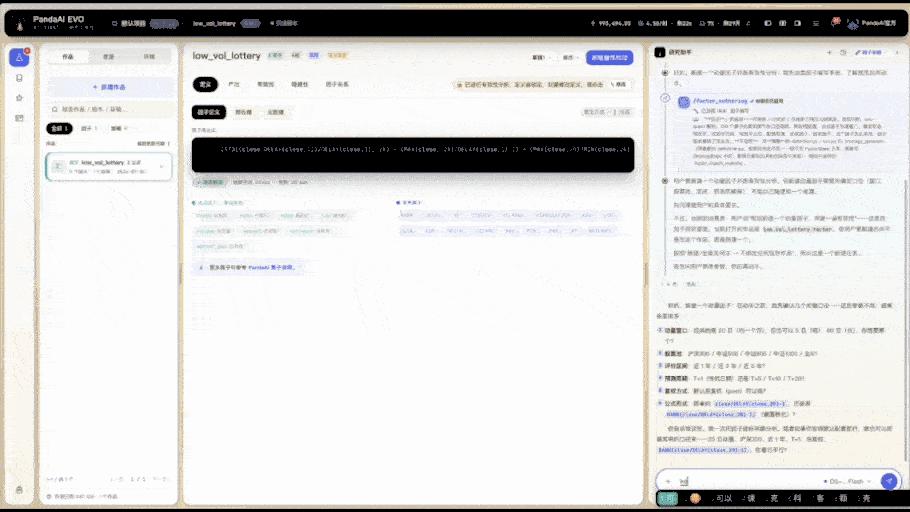
PandaAI EVO - Meet the In-depth Investment Research Needs of Agents
The fourth layer is trading connection.
Through interfaces of securities firms, futures companies and trading systems, it connects simulation and live trading scenarios under user authorization and risk control rules, forming a complete closed loop from trading ideas, strategy verification to execution feedback.
Live Trading
This architecture enables PandaAI to serve individual quantitative researchers, professional trading teams and financial institutions at the same time, and gradually embed AI capabilities into real investment research and trading processes.
Research is Not the End Point, the Real Market is the Answer
Li Yuqi, Founder and CEO of PandaAI has long focused on how AI understands the market, verifies trading logic, and continues to learn in a constantly changing environment.
Around this direction, the PandaAI team has published two research papers in the field of AI trading.
One of the studies focuses on how to make AI understand market changes, trading rules and risk constraints at the same time, and gradually convert trading ideas into verifiable and executable research schemes; the other study further explores Agent-to-Agent Self-Evolution, that is, how multiple AI agents form trading cognition that is more adapted to the real market environment through continuous collaboration, cross-verification and feedback learning.
The two papers did not stay at the theoretical research stage. The PandaAI team is gradually applying the methods of quantitative dedicated models, multi-agent collaboration, factor mining and adaptive evolution in the CQ model, ADE development environment, A2A architecture and AI workflow, so that the research results can truly enter a product system accessible to users and connectable for institutions.
Li Yuqi believes that the development of AI trading will not stay in market quotation Q&A, code generation or single-point analysis. Its evolution path will gradually move from completing a single task to participating in standardized research processes, managing complex trading workflows, continuously iterating strategy logic, and undertaking more complete research and execution tasks under clear authorization and risk constraints.
PandaAI hopes to promote AI trading from "model capability competition" to "system capability competition": what determines the value of the product is not only the model parameters, but who can better organize data, models, tools, Agents, risk rules and trading feedback.
Starting from 100,000 Users to Build the AI Trading Ecological Flywheel
Up to now, PandaAI has accumulated more than 100,000 users at home and abroad, and has promoted industrial cooperation of AI trading capabilities with many securities firms, futures companies, funds and professional financial institutions.
In the individual user scenario, PandaAI helps researchers and traders complete data analysis, factor mining, strategy generation, backtesting verification and trading review, reducing the technical threshold for building a complete quantitative research environment.
In the professional trading scenario, experienced traders and research teams can precipitate their own research framework, trading logic and professional experience into callable and reusable Agents and QuantSkills, so that personal experience is gradually transformed into systematic capabilities that the team can continuously accumulate.
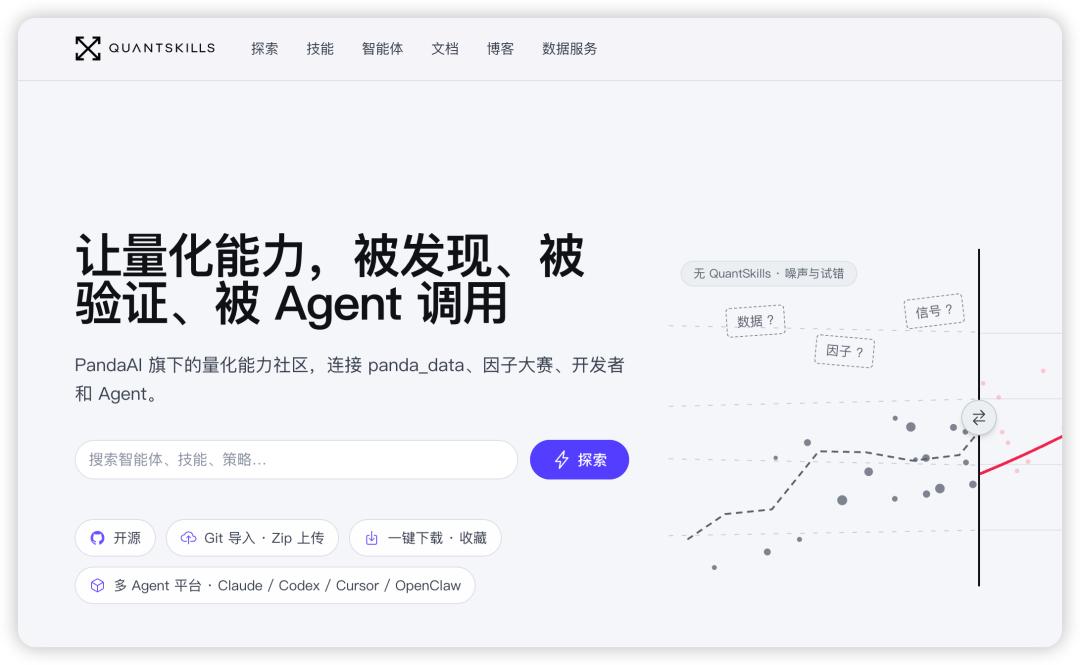
Quantskills, the Open Source Community Under PandaAI
In the institutional scenario, PandaAI can be combined with the existing data, investment research, risk control and trading systems of financial institutions, providing AI trading models, visual workflows, multi-agent collaboration, data services and privatized deployment capabilities, promoting AI to enter the real business process from peripheral efficiency tools.
Around the AI trading talents and developer ecosystem, PandaAI also continuously holds factor competitions, university workshops, quantitative hackathons and global AI trading events. Among them, the 3rd Factor Competition has more than 12,000 registered participants, and more than 8,000 factors have been submitted in total.
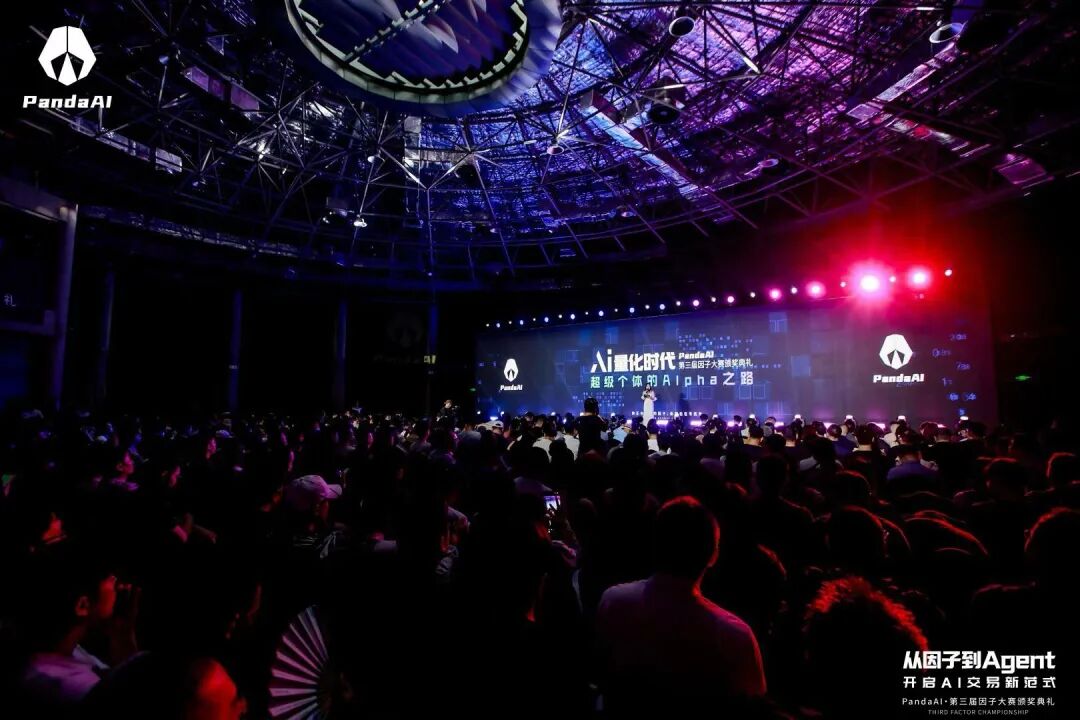
Scene of the Award Ceremony of the 3rd Factor Competition
These events are not only user growth channels, but also constitute important scenarios for PandaAI to verify product capabilities, discover excellent researchers, and precipitate factor and strategy workflows.
When Market Cognition, Cutting-edge Research and Financial Engineering Gather in One Team
PandaAI is not just an AI team that only researches models, nor a fintech company that simply relies on trading experience.
Li Yuqi, Founder and CEO has trading practice, quantitative research and AI product experience, has long explored how artificial intelligence forms verifiable market cognition, and is responsible for promoting AI trading research and product definition.
Liu Bingjun, Co-founder and CTO used to be a system architect at Hundsun Technologies and Accenture, and participated in the core development of China's first online securities account opening system. He has experience in financial system architecture, trading infrastructure and large-scale engineering implementation, and is responsible for converting research results into stable and implementable financial products and systems.
The core members of the team cover quantitative research, artificial intelligence, financial data, trading systems and product engineering, forming a complete closed loop from paper research and model R&D to product delivery and real trading scenario application. Papers propose methods, models verify capabilities, engineering systems complete implementation, and the real market tests results.
Liu Bingjun, Co-founder and CTO of PandaAI, said: "In the future, AI will redefine the way people understand the market and participate in trading. PandaAI hopes that users can directly express their trading ideas, and AI will assist in completing research, verification, risk control and execution. What we want to do is not just generate the next piece of strategy code, but build a new generation of trading methods where humans and AI jointly research the market, verify judgments and continuously evolve."
Ji Xing, Managing Partner of L2F Lighthouse Founders' Fund, said: "Warm congratulations to PandaAI on completing three consecutive rounds of financing! This is not only an important milestone for the company, but also fully reflects the market's high recognition of the founding team led by Yuqi. L2F is honored to continuously lead the angel round and angel+ round in the early stage of the company and accompany the team to grow all the way. We always believe that the most profound change of AI to trading is not to give a 'what to buy' answer for people, but to reconstruct the production method of Alpha — converting traders' experience and judgment into verifiable, reusable and continuously iterable research workflows. The financial market has low signal-to-noise ratio and strong non-stationarity, and model capability does not equal trading capability