The world's largest large model intermediary has been sold for 47.1 billion yuan.
Zhidx News, August 17: According to a recent report by Bloomberg, the US fintech company Stripe has reached an acquisition agreement with top-tier large model hub OpenRouter, with the acquisition price exceeding 7 billion USD (approximately 47.192 billion RMB).
Calculated based on currently publicly available transactions, this over 7 billion USD acquisition is expected to set a new record for the M&A amount of AI model routing platforms. People familiar with the matter disclosed that the final price of this acquisition may change. Stripe and OpenRouter have declined to comment on requests from foreign media.
OpenRouter is the largest large model API aggregation gateway (commonly known as "large model broker") in the hosted SaaS form for global developers. Compared with other players in the same track such as Together AI, Cloudflare AI Gateway, and Requesty.ai, OpenRouter ranks at the leading level in this niche segment in terms of token throughput, number of accessed models, and scale of global developers, and has now become a weathervane for observing the actual usage of large models worldwide.
The platform's popularity is growing day by day. In May this year, OpenRouter announced that its weekly token processing volume skyrocketed to 5 times the previous level, reaching 25 trillion. Based on this estimate, its monthly token processing volume can reach 100 trillion. In accordance with the current growth rate, the company believes that the total token processing volume for the whole year is expected to exceed 1 quadrillion, and can serve more than 8 million developers.
Founded in 2023 by Alex Atallah and Louis Vichy, OpenRouter is headquartered in New York, USA. Its CEO Alex Atallah previously co-founded OpenSea, the world's largest NFT platform, and exited before the bubble burst before shifting to the AI track.
The company's main business is to help customers select different AI models to perform different tasks according to their own needs and budgets, which can be regarded as a model router or model aggregation platform for enterprises and developers.
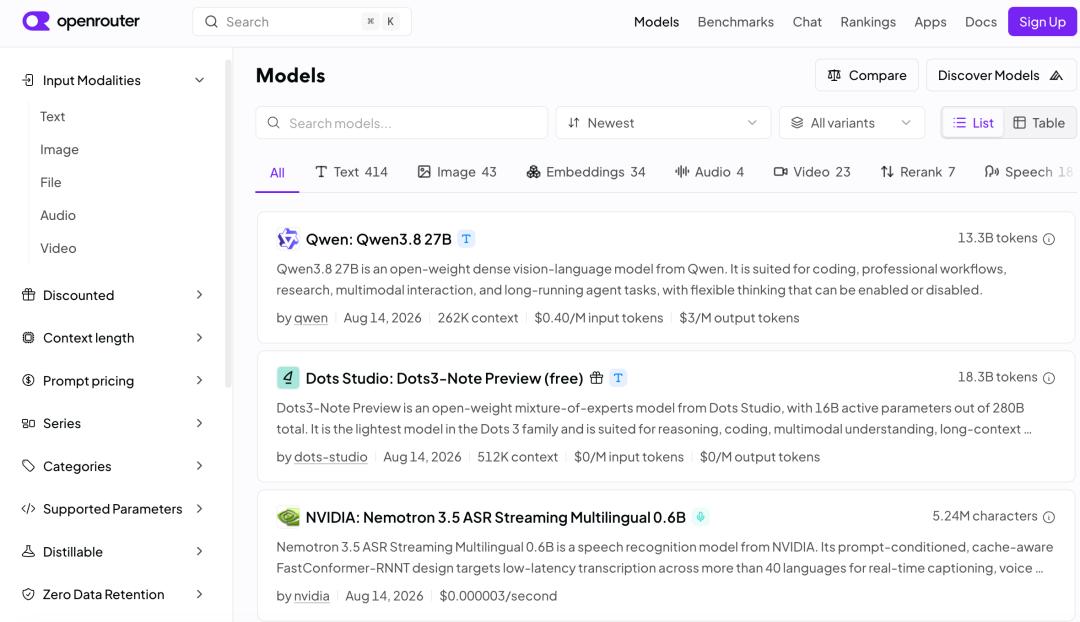
Homepage of OpenRouter platform
The total amount of OpenRouter's three rounds of financing has exceeded 150 million USD (approximately 1.011 billion RMB). In June 2025, the company announced that it had raised 40 million USD (approximately 270 million RMB) in seed and Series A financing; the latest round was in May this year, when OpenRouter announced the completion of 113 million USD (approximately 762 million RMB) in Series B financing, with a post-money valuation reaching 1.3 billion USD (approximately 8.764 billion RMB).
a16z, CapitalG under Google, NVentures under NVIDIA, the investment department of Databricks are all among its investors.
At that time, Alex Atallah, founder and CEO of OpenRouter, described OpenRouter as the Stripe in the AI field.
Stripe is a financial giant: enterprises only need to access its unified entry to complete all payment collection businesses, while OpenRouter's platform can provide enterprises with a variety of models, preventing them from being locked in by a single AI model supplier.
In January this year, OpenRouter and Stripe announced a cooperation, under which OpenRouter uses Stripe Invoicing to issue bills and collect payments from customers under flexible terms, uses Stripe Tax to automatically complete global tax calculation and collection, and uses Radar for Risk Platform to fine-tune fraud controls and manage risk performance through the Stripe management platform.
According to official information from OpenRouter, its platform has accessed more than 400 large language models, covering large model series of domestic and foreign enterprises such as OpenAI, Anthropic, Google, Alibaba, ByteDance and others. Developers and enterprises only need a set of API interfaces from OpenRouter to call, compare and switch AI models from different manufacturers at the same time, without docking with each manufacturer separately.
The commercial value of this model lies in two points: first, it helps enterprises compare options across multiple vendors, and automatically selects the most cost-effective model under different task scenarios; second, it provides failover capability, which automatically switches to standby services when a certain model service goes down or is rate-limited, to ensure business continuity. For small and medium-sized developers who do not want to be bound by a certain AI giant but do not have the ability to build their own model routing, this is equivalent to an extra layer of security.
OpenRouter's business model is mainly to charge service fees to enterprise customers using its platform, or to profit by charging platform service fees on top of model call costs.
Therefore, the main growth source of this startup is developers who are trying to use different models when integrating intelligent functions into software, a process that requires infrastructure support capable of running across different providers and data sources.
Conclusion: Behind the rise of OpenRouter, developers are breaking away from reliance on a single model
The rise of OpenRouter is related to the industry's growing attention to AI costs. A large number of open source models with outstanding cost performance are sufficient to cover most business needs of users, so enterprises no longer need to blindly rely on expensive top-tier closed-source models.
The development trend of this startup means that neither startups nor large enterprises will select a certain model as the long-term standard, and this trend may give birth to a super model aggregation manufacturer that occupies a leading position in the industry. Enterprises do not intend to be locked in by a single model supplier as they used to be bound by various SaaS service providers. The era of multi-model parallelism has arrived.
This article is from the WeChat official account "Zhidx" (ID: zhidxc om), Author: Cheng Qian, Editor: Li Shuiqing, Published with authorization from 36Kr.