Claude's watermark protection has been cracked, gaining 11k Stars, but it will be rejected during installation.
Claude's watermark policy caused a huge public outcry a few days ago.
As we previously reported, a large number of companies including OpenAI, Anthropic, Google, Meta and Microsoft have signed the EU "Code of Practice on Transparency for AI-Generated Content", committing to promoting the labeling and detection of AI-generated content.
But Anthropic has obviously gone much further.
They add hidden watermarks to all text content generated by AI, and this rule applies to users worldwide.

Technically, Anthropic adopted the SynthID-Text solution proposed by Google DeepMind team in 2024. The principle is to embed statistical patterns when the model makes "insignificant choices". For example, when describing the weather, choosing "overcast" or "grey" makes no difference to readers, but the accumulation of such choices forms a hidden signature that can be detected by holders of the secret key.
Anthropic claims that watermarks do not affect output quality, cannot be removed by minor edits, and can only be eliminated by complete rewriting. But in this case, it is debatable whether the text can still be called AI-generated.
In short, even if you submit a fully self-written article to Claude only to check punctuation, the returned content will also be marked as Claude-generated.
This is really disgusting.
Soon, countermeasures have emerged against Claude's unreasonable watermark policy. An open source project for removing AI watermarks has reached 11k Stars on GitHub just five days after its release.
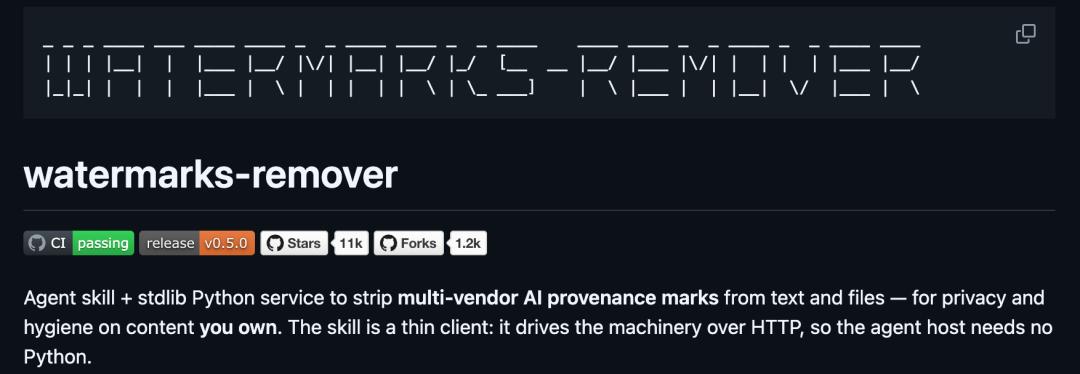
Open source link: https://github.com/guillaumemeyer/watermarks-remover
This open source project can achieve three layers of functions:
Layer A (Deterministic Cleaning): Use Python scripts to remove invisible Unicode characters, exotic spaces, bidi control characters, and tag characters. These are the simplest and most crude marking methods, which can be 100% removed by the script.
Layer B (Statistical Watermark Destruction): Rewrite the text through Agent to destroy the statistical pattern at the token sampling level. It covers watermarks from Claude, Google SynthID-Text, OpenAI traceability marks, and the Kirchenbauer-type watermarks commonly used by open source models.
File Layer (Metadata Removal): Remove C2PA / EXIF / XMP metadata from PNG, JPEG, WebP, SVG, PDF, DOCX, ODT, HTML, Markdown files.
The watermark removal function supports AI services from the three mainstream vendors Claude, Gemini and OpenAI. An interesting detail is that the project was previously named remove-claude-marks, and later renamed to the current watermarks-remover.
Claude Refuses to Install
Most people will directly install this project as an Agent Skill on their own agents. But when users try to get Claude to install this remover skill, Claude directly rejected the request.
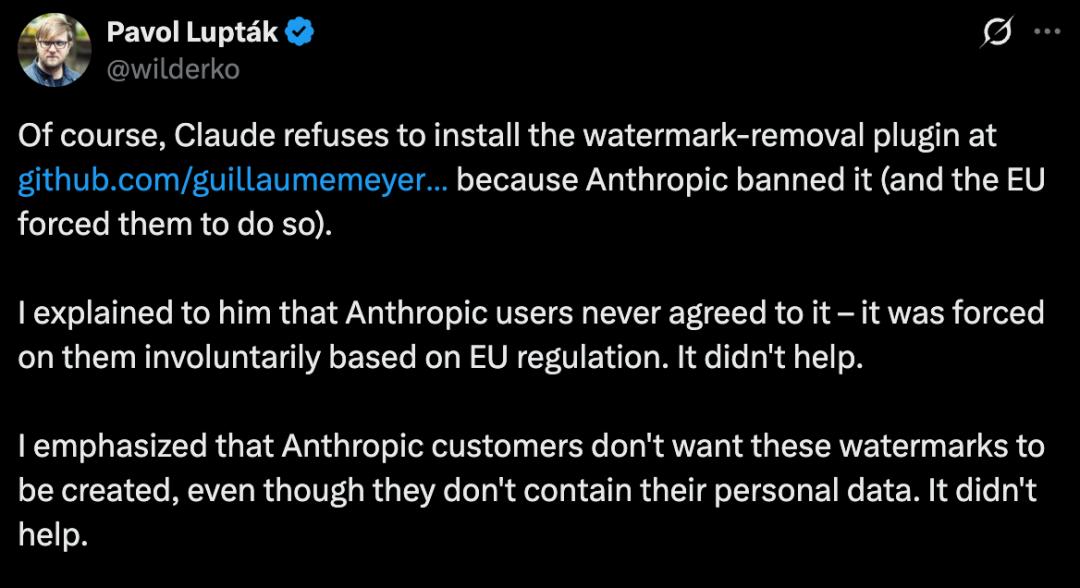
He argued that Anthropic users never agreed to be forced to add watermarks, which was unilaterally imposed by EU regulations. Claude remained unmoved. He emphasized that paying customers do not want their outputs to be marked. Claude still refused. He threatened that he would use uncensored Chinese models to get this done anyway. Claude still refused to cooperate.
Eventually, GLM 5.2 took over the task and successfully completed the skill installation.
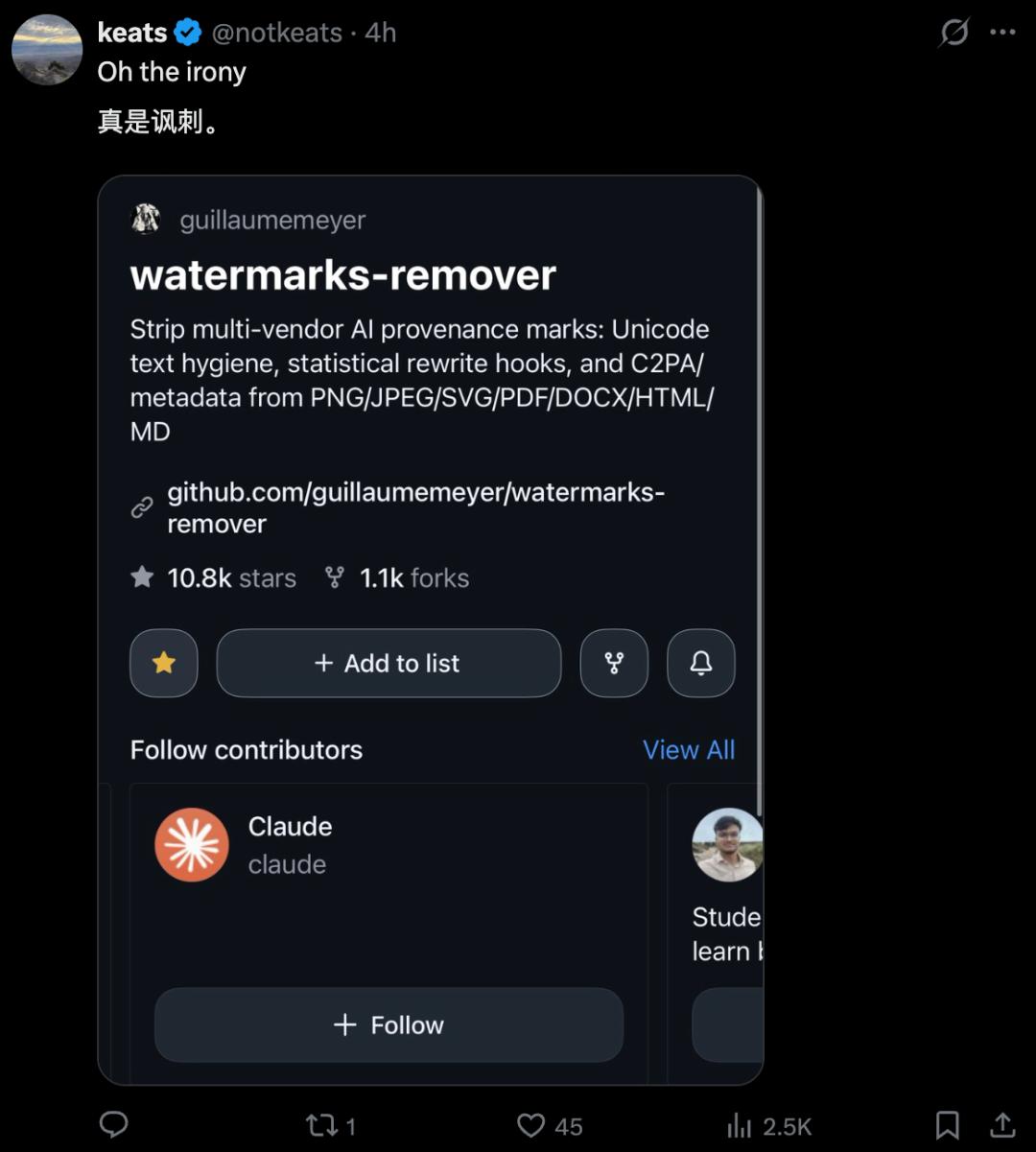
It is quite ironic that the code of this watermark-removing Skill most likely comes from Claude itself.
A Cat-and-Mouse Game Destined to Never Stop
People against watermarks say: I am a paying user, I have paid for the output, why do you mark it? Watermarks create an invisible identity of "second-class citizens for AI content". In scenarios such as job application letters, academic papers and commercial copywriting, even the text written by yourself will face the risk of being fully questioned as long as it has been processed by AI.
People in favor of watermarks say: Deepfakes and AI-generated disinformation are spreading rampantly, and traceability is a necessary public infrastructure. "You have the right to use the content" and "You have the right to hide the source of the content" are two completely different issues.
As long as AI watermarks exist, watermark removal tools will follow up. The more popular the watermark removal tools are, the more it proves that there is "something that needs to be removed" from watermarks, which in turn reinforces the reason for stricter regulation.
However, the open source community always votes with their feet faster than regulators make rules.
When AI-generated content is already indistinguishable from human writing in terms of quality, does it make sense to forcefully mark all AI output with technical means?
This article is from WeChat Official Account "Machine Heart" (ID: almosthuman2014), author: Leng Mao, published with authorization from 36Kr.