World records have been repeatedly set, a series of exquisite jewelry items have been successfully transacted one after another at jewelry auctions in the first half of 2026, and the collection insights behind those "sky-high prices"
Recently, as international auction houses including Christie's, Sotheby's, Poly Auction Hong Kong, and Phillips have successively released their first-half performance reports, the global art market has presented a long-lost prosperous picture. The gavel strikes at major auction venues come one after another, with a series of top-grade jadeite, large-carat fancy colored gemstones, and 20th-century vintage high-jewelry pieces appearing in turn, and multiple world auction records for segmented categories have been set one after another. Behind these sky-high transaction prices that keep breaking records, it is not merely the lavish spending of collectors, but also a profound iteration of the entire logic of jewelry collecting. Through the transaction data of the auction market in the first half of 2026, we can fully glimpse the value code of the current high-end jewelry market.
In the field of jewelry auctions, jadeite necklaces have always occupied the position of the "jewel in the crown". At Christie's Hong Kong Magnificent Jewels and Jadeite auction, the leading lot was a "Peerless Lustre" jadeite bead necklace, which was finally sold for a remarkable HK$200.2 million after multiple rounds of bidding, becoming the top transaction in Asian spring auctions this year.
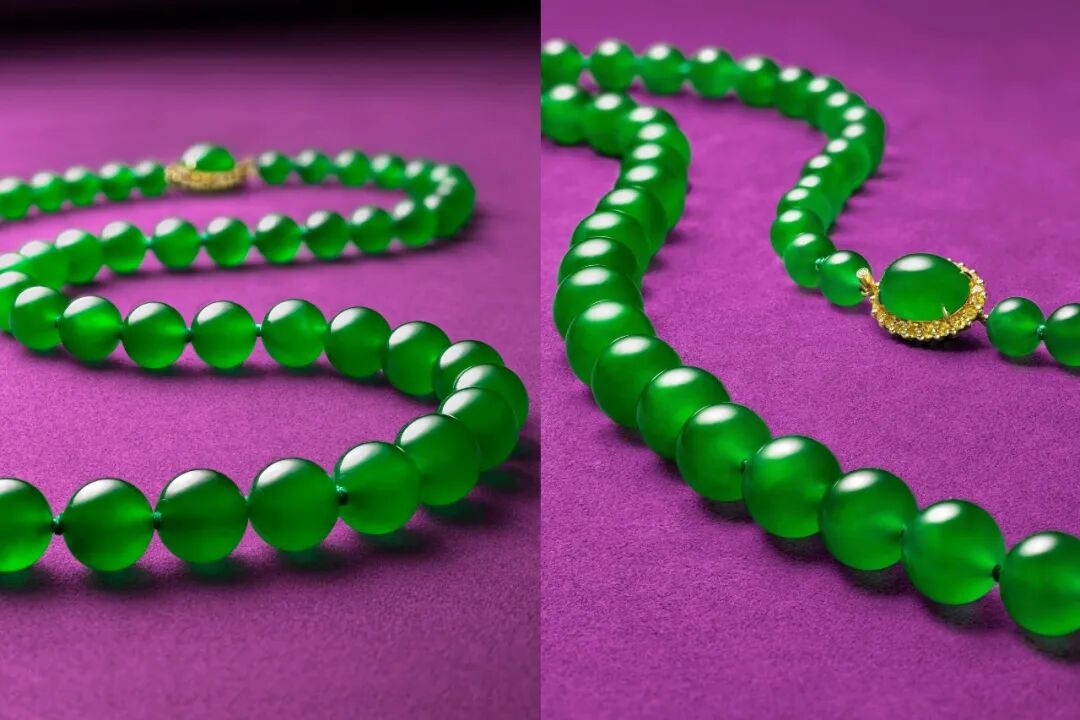
"Peerless Lustre" natural jadeite bead necklace adorned with diamonds and rubies; Transaction price: HK$200.2 million; The top transaction in Asian spring auctions in 2026, also the most expensive jadeite jewelry in the global market for more than a decade. Image source: Christie's WeChat Official Account
The rarity of "Peerless Lustre" lies in its ultimate sense of balance and unity. Jadeite bead necklaces cause extremely high material loss: it is necessary to select raw materials with highly consistent texture, water head, tone and texture from a huge amount of rough stones, so as to polish a complete whole bead necklace. This necklace consists of 61 jadeite beads in total, with diameters ranging from 8.8mm to 13.7mm. Each bead has undergone strict selection, with rich, uniform and vivid color, fine and warm jade texture, presenting a unified and integrated visual effect. The necklace is also inlaid with a huge jadeite cabochon measuring approximately 11.7×15.0×7.1mm, supplemented by fancy colored diamonds and gold inlays, complementing each other perfectly.
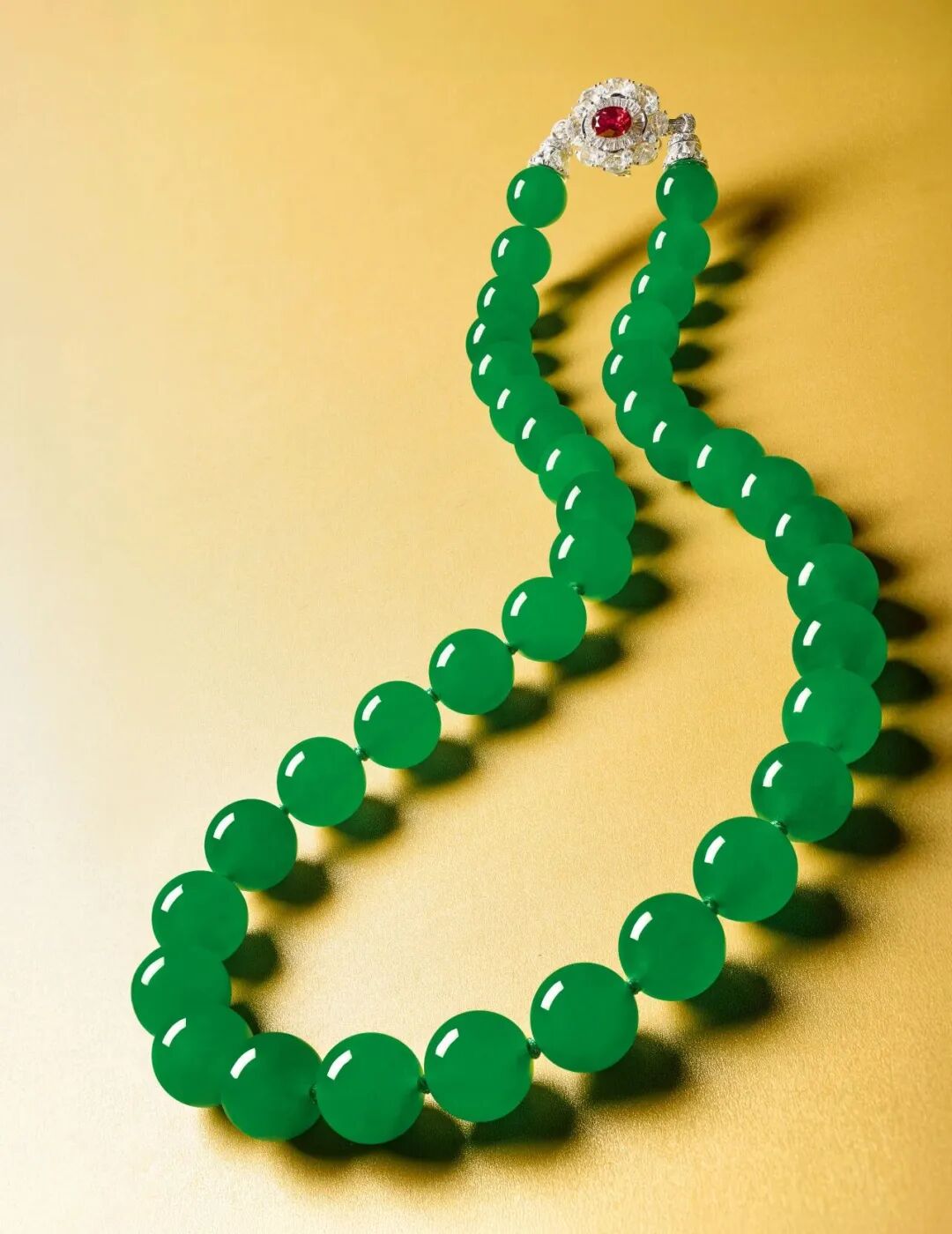
Natural full-green jadeite bead necklace adorned with diamonds and rubies "Jade Radiance"; Transaction price: HK$14.4 million; Image source: Poly Auction Hong Kong WeChat Official Account
At Poly Auction Hong Kong 2026 Spring Auctions, a "Jade Radiance" natural jadeite bead necklace adorned with rubies and diamonds was sold for HK$14.4 million. Each jadeite bead on the necklace is round and plump, with the maximum diameter reaching 14.5mm, presenting a powerful and imposing presence. The jade texture is warm and glossy as coagulated fat, with clear and translucent luster, restrained glow and vivid charm. What is more rare is that the tone of the whole string of jadeite beads is uniform and soft, the color transition is natural and seamless, and the visual effect is highly unified. Rubies and diamonds are exquisitely inlaid at the clasp, arranged in a well-proportioned and ingenious way, just like a touch of bright red amid all green, bursting with vivid and bright luster on the calm and warm emerald background, playing a perfect finishing role without being ostentatious or overwhelming. Since ancient times, jadeite bead necklaces have been regarded as the rarest form in jade craftsmanship, because their material selection is extremely strict, only large rough stones can be used, and those with consistent quality and color are even rarer than phoenix feathers and unicorn horns.
Prior to this, only two jadeite necklaces had ever crossed the HK$100 million threshold. The first one was a jadeite bead necklace from Tiancheng International Auction in 2012, strung with 23 full-green beads with diameters ranging from 17.35mm to 20.71mm, with a transaction price of HK$106 million, making it the first jadeite piece to exceed HK$100 million in transaction value. The second one was the Mdivani jadeite bead necklace from Sotheby's Hong Kong in 2014, once owned by socialite Barbara Hutton, strung with 27 beads with diameters ranging from 15.40mm to 19.20mm, with an Art Deco style clasp set with rubies and diamonds designed by Cartier. It is a top-tier treasure with first-class performance in color, water head, quality, brand, design and provenance, with a record transaction price of HK$214 million, and is now owned by Cartier. The successful sale of Peerless Lustre this time officially makes it join this top auction hall, continuing the myth of jadeite.
Looking at the global auction market, jadeite firmly occupies the throne of hard currency. After a hundred years of market precipitation and testing, the overall trend of jadeite has steadily risen in all rounds of economic cycles, and it has become an important category for global collectors to hedge market risks and allocate assets. In the field of jewelry collecting, jadeite is even a dual symbol of status style and aesthetic taste. Its unique warm jade texture and profound oriental charm also endow it with distinct characteristics different from diamonds and colored gemstones. As celebrity collectors continue to enter the market and wealthy families hold jadeite pieces for generations, the market demand for high-end jadeite continues to rise, which has long gone beyond the definition of ordinary jewelry and evolved into an asset carrier integrating the triple values of wearing and appreciation, art collection and family inheritance.
However, in recent years, the supply of high-quality jadeite has become increasingly scarce. In 2026, the supply side ushered in a historic inflection point: Myanmar officially implemented a jadeite export quota system, and the annual supply of high-end rough stones plummeted by 30%. Compared with rings or pendants, jadeite bead necklaces have almost picky requirements for rough stones — they must have extremely high consistency and no obvious flaws. This rare attribute that "can be encountered but not sought" undoubtedly makes it still show strong downside resistance and appreciation potential amid economic fluctuations.
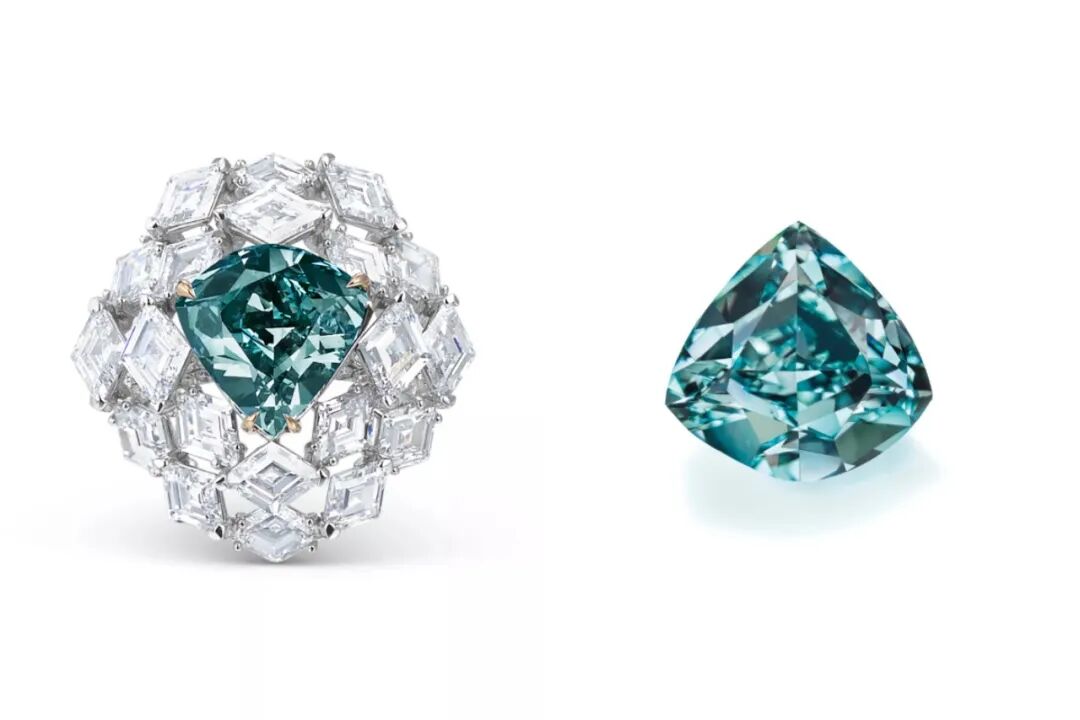
"The Ocean Dream" 5.5-carat Fancy Vivid Blue-Green Diamond; Transaction price: 13.5675 million Swiss francs; Image source: Christie's official website
A rare 5.5-carat triangular cut Fancy Vivid Blue-Green diamond named "The Ocean Dream" appeared at Christie's Geneva Magnificent Jewels Spring Auction, and the final transaction price reached 13.5675 million Swiss francs (about 17.36 million US dollars), setting a new record for the highest transaction price of blue-green diamonds.
Christie's revealed that this diamond named "The Ocean Dream" is the largest Fancy Vivid Blue-Green diamond ever certified by the GIA (Gemological Institute of America) since its establishment in 1931. It is identified by GIA as a Type Ia diamond, reaching the Fancy Vivid Blue-Green color grade and SI1 clarity, with a modified triangular brilliant cut, presenting clear and vivid blue-green fire like sea water, hence the name. As the main stone of a ring, this diamond is surrounded by rhombus-cut diamonds, echoing the kite-shaped main stone form.
This blue-green diamond is the largest Fancy Vivid grade blue-green diamond ever to appear in the public auction market, and its rough stone is derived from a 11.70-carat rough diamond unearthed in Central Africa in the 1990s. According to the introduction, diamonds with such color and size are extremely rare. What is particularly precious is that this diamond belongs to Type Ia, one of the purest types of natural gemstones. Max Fawcett, Global Head of Christie's Jewellery, said that the Smithsonian Institution has listed this diamond as one of the eight rarest diamonds in the world.
It is reported that "The Ocean Dream" first appeared at Christie's Geneva Auction in 2014, with a transaction price of 7.8 million Swiss francs. This auction marks its return to the auction house for the second public auction. After 20 minutes of fierce bidding from three bidders, this blue-green diamond was finally sold for 13.5675 million Swiss francs (about 17.36 million US dollars) including commission, far exceeding the upper estimate of 10 million Swiss francs, setting a new world auction record for blue-green diamonds in one stroke.
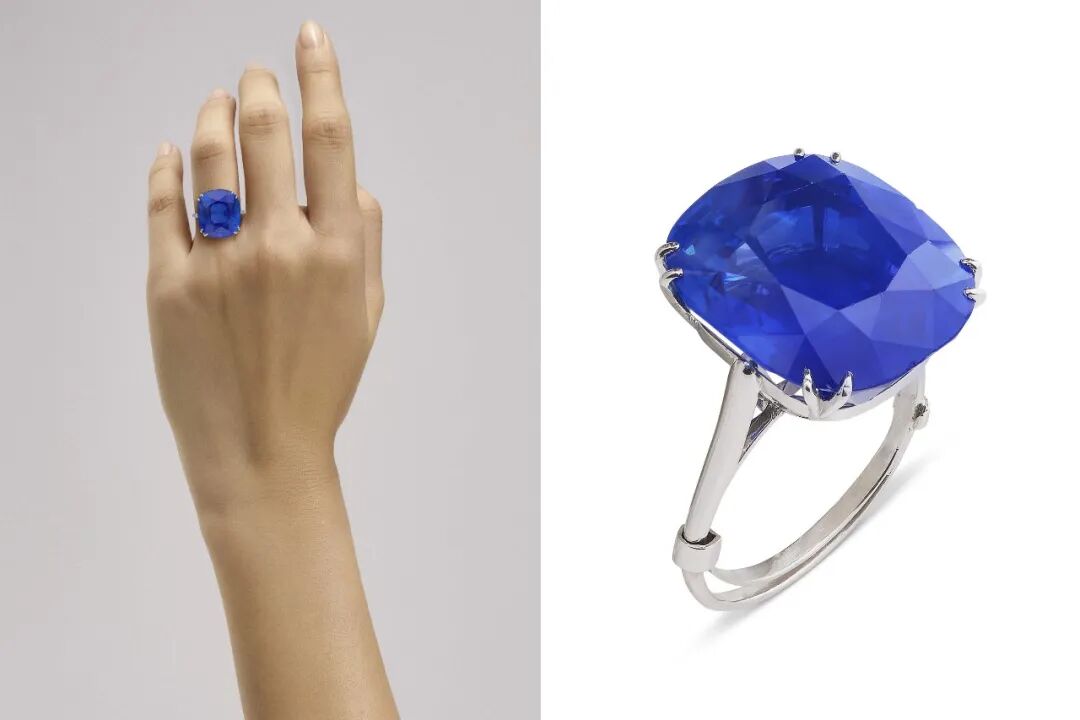
22.28-carat Kashmir Royal Blue Sapphire Ring (Chaumet); Transaction price: 2.744 million Swiss francs; Image source: Christie's official website
An extremely rare 22.28-carat cushion-shaped unheated Kashmir sapphire, with the iconic velvety blue color of its origin, set in a four-prong ring designed by Chaumet, was finally sold for 2.744 million Swiss francs at Christie's Geneva Spring Auction.
Top-grade Kashmir sapphires have deep and rich tones, shining brightly under any light source. This unique color blends seamlessly with the velvety soft luster, creating a highly recognizable iconic style for sapphires from this origin. The famous velvety texture of Kashmir sapphires comes from the diffuse scattering effect of light by the fine parallel filamentous inclusions inside the gem, which is also the core distinguishing feature between it and sapphires from other origins.
What are the key points for collecting Kashmir sapphires? Belinda YU, a specialist in Christie's Jewellery department, once suggested that collectors should carefully study the Comments column of the gem certificate to confirm the origin information of the gem, and verify that the gem has no heat treatment record, which is an important benchmark for determining the value of natural sapphires. In addition, if the certificate rates the sapphire's color as "Royal Blue" or "Cornflower Blue", both are highly sought-after high-quality sapphire tones in the market, and the value of the gem will increase significantly accordingly.
If the collection budget is limited, should collectors prioritize larger size or focus on gem color? Belinda YU pointed out that one should not blindly chase large carat weight. Instead of buying a sapphire with considerable carat weight but light color and dense inclusions, it is better to choose a Royal Blue sapphire with smaller size but rich color and excellent clarity. The overall quality of the gem is far more important than its weight. In the secondary market such as auction houses, the advantages of buying Kashmir sapphires are also obvious: auction houses strictly screen each gem to be auctioned to ensure that the gem is accompanied by a certificate issued by a world-renowned appraisal institution.
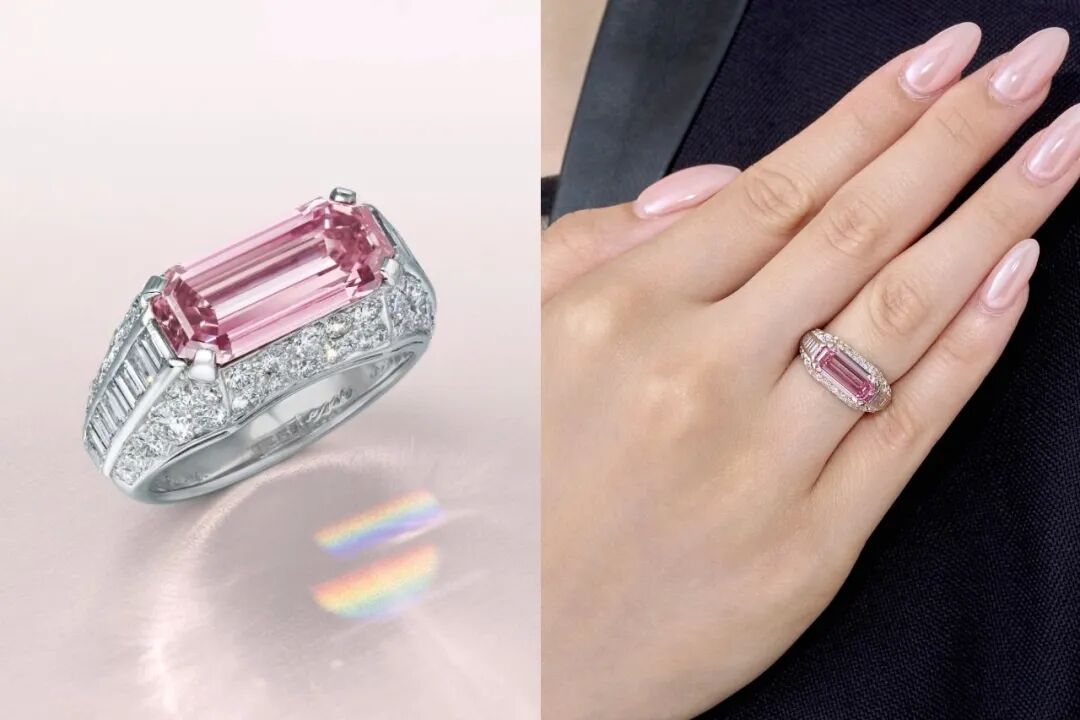
3.17-carat rectangular Fancy Vivid Pink / VS1 Potential Type IIa diamond "Trombino" ring; Image source: Christie's WeChat Official Account
At Christie's Hong Kong Magnificent Jewels auction this year, a 3.17-carat rectangular Fancy Vivid Pink diamond "Trombino" ring designed by Bulgari triggered fierce competition among global collectors as soon as it was released, and was finally sold for HK$25.51 million.
The main stone of this ring is authoritatively certified by GIA, reaching the highest grade of fancy colored diamonds, Fancy Vivid Pink, with pure tone, no secondary hues such as orange or purple, full and bright color saturation, showing warm and strong rose luster under natural light. The diamond adopts a rectangular step cut, with neat and precise cutting, wide and complete table, maximally retaining the natural color of the pink diamond, with rich and delicate layers of fire, combining retro charm and modern grand presence. Its clarity grade is VS1, with only extremely trace natural inclusions inside, appearing flawless to the naked eye; it belongs to the rare Type IIa diamond, with top-level crystal purity.
With the permanent closure of the Argyle pink diamond mine, the circulation of high-quality Fancy Vivid pink diamonds has decreased year by year, and pure pink Fancy Vivid loose stones over 3 carats are even rarer targets in the auction market. According to Christie's jewelry specialists, this diamond has outstanding balanced performance in the four dimensions of color, weight, clarity and cut, making it a rare investment-grade pink diamond collection in recent spring auctions, and also setting a new price reference benchmark for the high-end fancy colored diamond market.
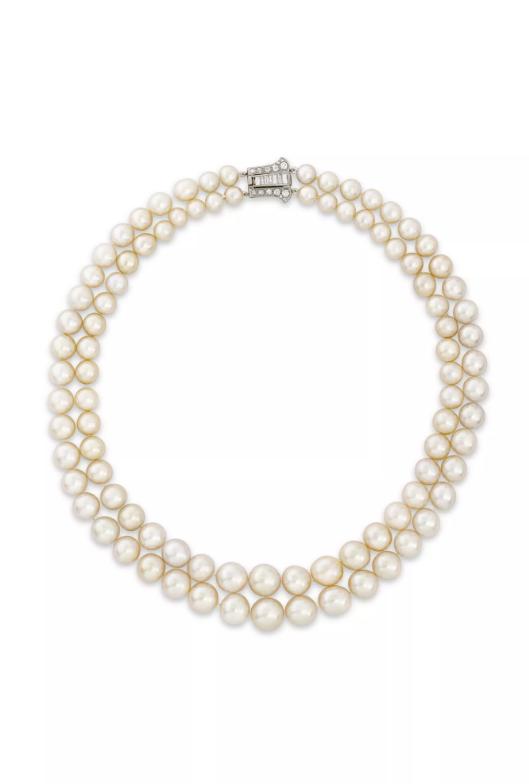
Double-row natural pearl and diamond necklace; Transaction price: 4.147 million Swiss francs; Image source: Christie's official website
At Christie's "Magnificent Jewels" special auction held in Geneva this year, a double-row natural pearl and diamond necklace became the second most expensive lot of the auction, sold for 4.147 million Swiss francs, more than 3 times the highest estimate of 1.2 million Swiss francs. This is a double-row natural pearl necklace, composed of 91 natural seawater pearls and 1 natural freshwater pearl, with a platinum clasp inlaid with old mine and baguette-cut diamonds, showing a typical Art Deco style.
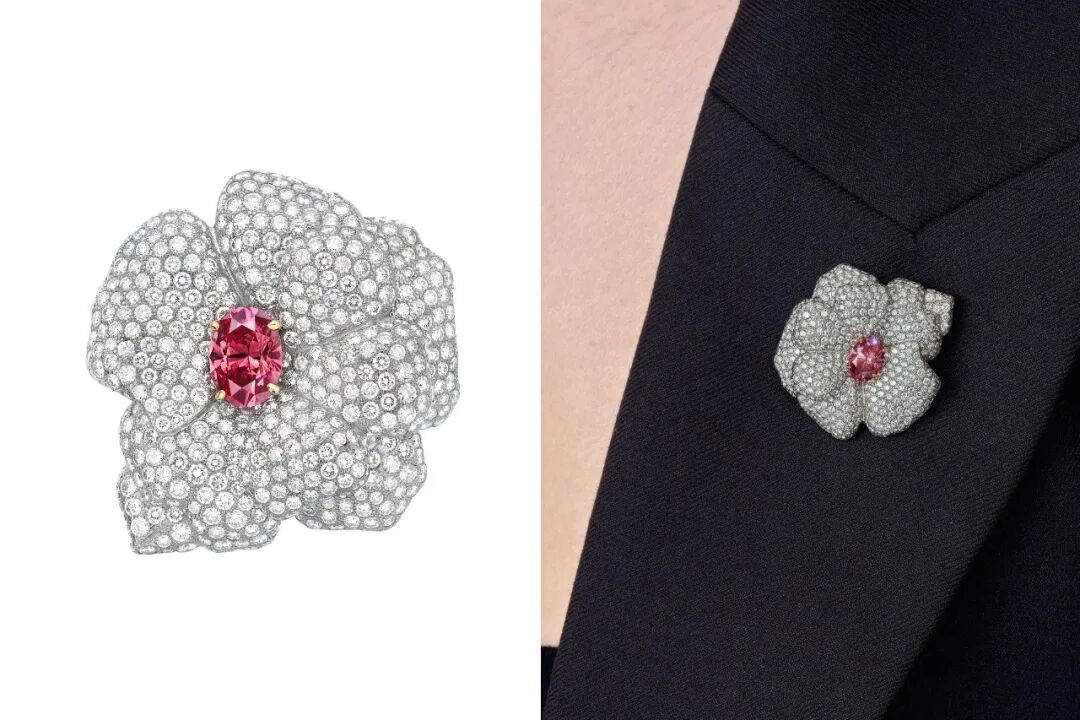
1.78-carat oval Fancy Purplish Red SI2 Type IIa diamond brooch; Image source: Christie's WeChat Official Account
At Christie's Hong Kong auction, an extremely rare red diamond also attracted much attention. It is a 1.78-carat oval Fancy Purplish Red SI2 Type IIa diamond brooch, sold for HK$39.54 million.