Exclusive from 36Kr: Sci-Tech Innovation Board Listed Company Invests in Brain-Computer Interface, Weiling Medical Raises Over 100 Million Yuan in Financing
By LIU Lingguo, HU Xiangyun
Edited by HAI Ruojing
36Kr exclusively learned that Weiling Medical, an enterprise focusing on medical brain-computer interface (BCI), has recently completed a financing of more than RMB 100 million. This round of financing is led by Junzhong Capital, with Innotek (688253.SH) as the core industrial investor of the fund. The raised funds will be mainly used to promote the clinical verification of core implantable BCI products, accelerate the registration and declaration process of medical devices, improve the construction of manufacturing system, and continuously expand the layout of clinical applications in the field of neurological function repair. Previously, Weiling Medical has received support from many first-tier investment institutions including Gaorong Capital, Life Park Venture Capital, CDH Investments, Lihe Sci-Tech and others.
Founded in 2019, Weiling Medical is a BCI enterprise that 36Kr has been continuously tracking. "Make all brain diseases in the world treatable" is a sentence posted on the wall of Weiling's headquarters. This vision focusing on serious medical scenarios seems less attractive than the concept of "human-computer interaction" on the currently fast-developing BCI track.
The dedication to treating brain diseases is strongly related to the academic resume and scientific training of founder LI Xiaojian. Over the past 20 years, LI Xiaojian's research has been centered on brain function analysis and intervention treatment for brain diseases.
After graduating with a doctorate from the Institute of Biophysics, Chinese Academy of Sciences, LI Xiaojian worked at the Medical College of Georgia and the Feinberg School of Medicine of Northwestern University in the United States for nearly 10 years. After returning to China, he joined the Shenzhen Institute of Advanced Technology, Chinese Academy of Sciences to carry out research and development of BCI technology. He is now a dual-appointed professor at the Guangdong-Hong Kong-Macao Greater Bay Area Center for Brain Science and Brain-Inspired Intelligence of Southern Medical University and Zhujiang Hospital.
Recently, LI Xiaojian sparked heated discussions in the industry for his bold and frank remarks about investors. In his view, everyone has their own understanding of the market prospect of BCI, which is completely reasonable. "Some people are optimistic about the imagination space of human-computer interaction, while others focus on the potential of consumer-grade applications." But it is necessary to guard against "only focusing on the distant future while ignoring the current risks and dilemmas".
It has been 50 years since the BCI technology came into being, and the real advancement of clinical research has only taken place in recent years. "Practically do a good job in serious medical scenarios first" and consolidate technical accumulation is the better choice in LI Xiaojian's mind.
From this perspective, the feasible path he found is: since the damage exists in the brain, repair the brain first. "Patients with brain injury often lose or partially lose the ability to control their limbs due to damaged nerves and ineffective transmission of nerve signals. But if the patient's brain can generate motor intentions normally, we can actually repair the damaged neural pathways through BCI technology to realize the remodeling of the brain network."
In LI Xiaojian's view, the "brain" is the unshakable core of BCI technology, and the "machine" serves the brain. By guiding the remodeling process of the brain network, it can not only repair brain damage, but also explore and improve the potential of the brain.
For example, for patients with impaired motor function caused by brain injuries such as stroke and traumatic brain injury, "regaining the ability to control their native limbs can bring more direct benefits to patients"; for patients with excessive nerve damage and limited repair space, a collaborative solution combining partial function repair and partial function replacement can be considered.
Weiling Medical's technical system covering the whole process of neurological function recovery is summarized by LI Xiaojian as "diagnosis before treatment, integration of repair and replacement". "Several teams around the world have built this 'gun' of BCI, and the key problem now is: where is the target?"
Accurate diagnosis and treatment of brain diseases, as well as protection and repair of cranial nerves, are the most urgent clinical demands at present in his opinion, and also the starting point for BCI to prove its exact clinical value.
Repairing Nerves,
A Systematic Project of "Remodeling"
"Repairing nerves" sounds a bit mysterious at first glance, and its underlying scientific basis is the neural plasticity of the brain. It needs to be clarified that the "repair" here does not mean to "resurrect" the necrotic nerve tissue, but to use the implantable BCI to help the remaining neural circuits of patients reorganize and form functional compensation through BCI training.
LI Xiaojian summarizes this process as "network reorganization, circuit remodeling and function reconstruction" of the nervous system: after brain injury, the original neural network will reorganize, BCI training can guide the compensatory remodeling of damaged circuits, and finally new circuits realize the reconstruction of native functions. In this process, BCI plays the role of a "coach", and the neurons in the circuit are "athletes". The BCI trains the remaining neurons to learn to compensate for the damaged neurons and reconnect the interrupted neural circuits.
Weiling Medical's systematic capability in fully implantable BCI is not only reflected in a certain medical device for specific indications, but further extended to a clinical platform for implantable BCI.
Its hardware part consists of electronic implants, in-vitro controllers, neurostimulators, exoskeletons and other effector assistive devices, which are powered wirelessly and transmit cortical EEG signals.
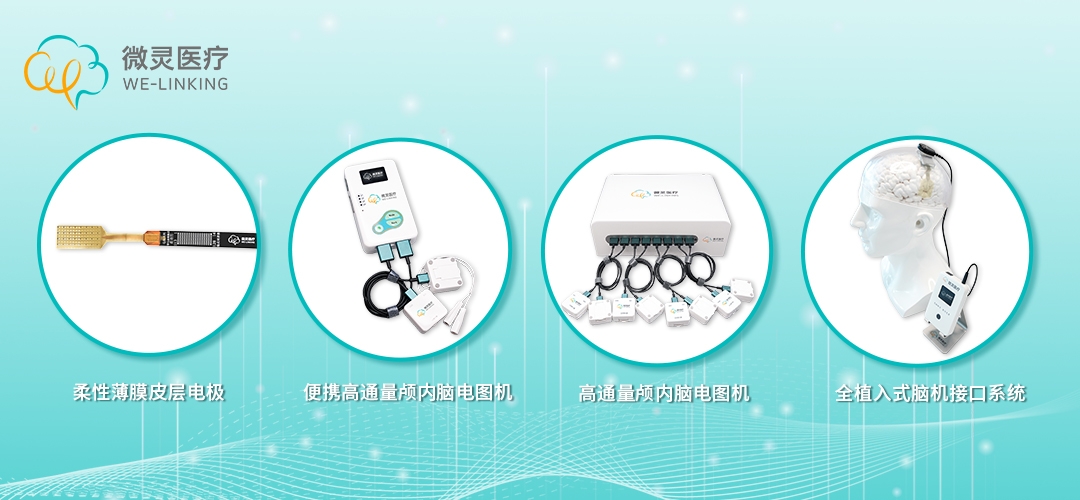
Schematic diagram of Weiling Medical's product matrix
Among them, the flexible thin-film cortical electrode is the "antenna" of this system that is close to the brain. According to the introduction, the flexible electrode of Weiling is about 10 microns thick, and a single piece covers a length and width of several centimeters. The electrode is laid on the surface of the cerebral cortex without penetrating into the brain tissue, which can collect neural activities in different brain regions in a large range. LI Xiaojian said that technical parameters such as the morphology of the electrode sheet, the spacing and size of contacts, as well as the implantation position and cycle are all determined by the specific clinical problems to be solved.
As a result, the BCI customization platform provides flexible adjustment space for exploring BCI therapies for different indications, allowing the treatment plan to "vary from disease to disease". "The appearance of the equipment may look similar, but the target areas of the intracerebral circuits placed are different, the electrode morphology will also be different; including the function of the chip, the configuration of acquisition and stimulation channels are also different." said LI Xiaojian.
It is understood that the customized version of the implantable BCI system for nerve repair in patients with severe brain injury has launched IIT (Investigator Initiated Trial) research. In mid-June this year, a hospital in Guangdong completed the implantation surgery of this BCI implant.
LI Xiaojian introduced that the subject patient fell into a coma due to brainstem hemorrhage a year and a half ago. After rescue, his consciousness gradually became clear, but he developed "locked-in syndrome" due to brainstem injury, and has regressed to a minimally conscious state. Patients with locked-in syndrome are also described as "conscious prisoners": although the patients are fully conscious, their whole body is limp, unable to speak or move, and only their eyeballs can move slightly. "Perhaps only BCI can help him."
After receiving the BCI implantation surgery, the patient underwent about a week of difficult BCI training and recovered to a conscious "locked-in state"; after another four weeks of implantable BCI treatment, the patient's left upper limb has been improved from a completely limp state to being able to independently lift the forearm, easily lift the wrist and complete multiple gestures, and can pinch light and small objects. In the next stage, the patient is expected to use a remote control handle to have mild interaction with the outside world.
"From the perspective of patient benefit, we must first make a breakthrough in the locked-in state, so that he can have simple communication with his family. Restoring the mobility of one hand first is critical to the patient's benefit, and turning off the BCI system will not affect the continued use, because the hand is controlled by himself." LI Xiaojian said.
The reason for starting with the highly difficult "in-situ BCI function reconstruction" is mainly based on the consideration: "We have profound theoretical foundation and technical support. We first verify the safety and effectiveness in severe cases with the most urgent needs and the most difficult treatment conditions, and then it will be more comfortable to deal with indications with less severe injury." In particular, patients with critical and severe illnesses have more urgent demand for new therapies, and from an ethical point of view, it is easier to obtain support for carrying out clinical trials.
Based on this, Weiling is currently focusing its resources on more defined central nervous system diseases and patient groups. It is understood that the company plans to continue to expand clinical research trials to further cover a wider range of brain disease types.
Reading the Boundary of Brain Function,
Assisting Doctors in Precise Decision-Making
If repair means reconstructing the signal pathway after nerve damage, is it possible to find and preserve the nerve function before it is lost due to diseases?
At present, another important research topic of Weiling Medical is "how to identify and protect key brain functional areas before the nerve function is damaged". In response to this clinical demand, the company has launched a series of auxiliary diagnostic products for brain function protection, which consists of flexible thin-film cortical electrodes, high-throughput intracranial electroencephalograph and intelligent decoding software.
Among them, the flexible thin-film cortical electrode array can be attached to the surface of the patient's cerebral cortex to collect high-throughput neuroelectrophysiological signals with a spatial resolution of sub-millimeter level. It has been verified by hundreds of clinical experiments and has entered the Class III medical device registration stage.
The supporting high-throughput intracranial electroencephalograph is specially designed for neurosurgery and can be used with analysis software in auxiliary diagnostic scenarios.
For neurological functional diseases such as epilepsy, Parkinson's disease, depression, and consciousness disorders, this system can effectively make up for the limitations of traditional imaging examinations such as CT and MRI. "Imaging observes the structure of the brain, while BCI technology locates the functional areas of the brain." LI Xiaojian said.
Taking epilepsy as an example, the abnormal discharge of the epileptogenic focus has dynamic characteristics. Traditional imaging is often difficult to fully present the origin of abnormal discharge and the signal transmission path, while BCI technology can continuously collect and analyze the neuroelectric signals of different brain regions, providing a basis for the precise localization of the epileptogenic focus.
For organic lesions such as brain tumors and cerebral hemorrhage, Weiling Medical's products can assist doctors in distinguishing the positional relationship between the lesions and important brain functional areas, and alleviate the practical contradiction between "maximizing lesion resection" and "maximizing brain function preservation" in clinical practice.
LI Xiaojian introduced that tumor invasion may crowd out the original functional areas, and brain functions such as language and movement may migrate to adjacent areas for compensation, resulting in the interlacing of lesions and important functional areas, which makes doctors easy to accidentally injure key functional areas when resecting the lesions, increasing the risk of postoperative functional defects such as aphasia and paralysis.
In response to this, Weiling's solution is to attach flexible thin-film electrodes on the surface of the cerebral cortex to collect and decode EEG signals in real time, so as to realize the mapping of brain functional areas with millimeter-level spatial resolution, provide functional navigation reference for neurosurgery, and assist doctors in precise operations.
Simply put, it is to directly read the neural activity in the patient's brain and "draw" out the functional areas. In the state of "intraoperative awakening", the patient completes tasks such as limb movement and language according to instructions, and the system analyzes and presents the functional areas in real time to assist doctors in precise operations.
The reason for choosing to attach the electrodes to the surface of the cerebral cortex is also to "draw" this functional map as completely as possible. In the auxiliary diagnostic scenario, the primary task is to see clearly the distribution of multiple functional areas such as language and movement, and the millimeter-level spatial resolution can meet the clinical needs. The way of attaching to the surface of the cerebral cortex can not only reduce damage, but also achieve a large area of signal coverage.
In terms of commercialization, in the direction of auxiliary diagnosis for brain protection, Weiling Medical's intracranial high-throughput electroencephalograph and multiple supporting cortical thin-film electrode arrays are in the registration stage, and are expected to be approved for marketing one after another in the next 1-2 years; in the direction of brain injury repair and brain disease treatment, Weiling Medical's fully implantable BCI system will continue to promote multi-center clinical trials and launch clinical exploration for a wide range of indications.