12 leading AI giants are competing for the next-generation content industry
If the AI entertainment and cultural industry in 2024 was still competing on "who can generate a more stunning video", by 2026, the core of competition has shifted to: who can turn randomly generated 10-second clips into stable, controllable content products that can generate sustainable revenue.
This change is extremely significant.
The cultural and entertainment industry has never lacked new tools, and what is truly scarce is a complete closed-loop of production: there needs to be models in the upstream, the midstream can complete scripts, characters, storyboards, frames, sound and editing, and the downstream needs to connect to short videos, short dramas, games, advertisements, films and television, and even overseas applications, to finally find paying users.
Along this industrial chain, internet giants such as ByteDance, Kuaishou, Alibaba, Tencent and Baidu, industrial companies such as 360 and SenseTime, as well as model and application enterprises such as MiniMax, Zhipu AI, StepFun, Kunlun Tech and PixVerse have taken completely different paths.
The competition in the AIGC entertainment industry has thus entered the real deep-water zone.
Ecosystems of Internet Giants
ByteDance is currently the closest to the "full industrial chain play".
On the model side, ByteDance has formed the Seedream image model, the Seedance video model and multi-modal capabilities including music and speech; on the product side, it owns Doubao, Jimeng AI and CapCut; on the content side, it also controls traffic and IP entrances such as Douyin, TikTok, Fanqie Novel and Hongguo Short Drama.
Seedance 2.0, released in February 2026, further adopts a unified architecture for joint audio and video generation, supports text, image, audio and video inputs, emphasizes complex motion, camera scheduling and native audio-video synchronization, and its target scenarios have shifted from "generating a nice-looking video" to advertising, film and television special effects, game animation and short drama production. The recently released Seedance 2.5 has achieved even greater upgrades.
ByteDance's biggest advantage is not just its model ranking, but its ability to integrate AI into the content consumption closed-loop: Fanqie Novel provides stories, AI completes visualization, CapCut is responsible for post-production, Douyin and Hongguo complete distribution, and user behavior data in turn guides topic selection and production. For other companies, AI video is a new business; for ByteDance, it may become the infrastructure for rebuilding the entire content supply system.
Kuaishou has taken another more focused and clearer path — building Kling AI into an independent global creative production platform.
As of the first quarter of 2026, Kling AI's single-quarter revenue exceeded 650 million yuan, a year-on-year increase of more than 300%, and its annualized revenue run rate in March was close to 500 million US dollars. Kling also participated in the virtual scene and special effects production of the TV drama Taiping Era. This means that for the first time, AI video no longer only has stories about traffic, users and financing, but has begun to have quantifiable commercial revenue and professional production cases.

The significance of Kling lies in proving that model capabilities can be directly packaged and sold in the form of subscriptions, points, APIs and enterprise services. Kuaishou's own short video ecosystem, advertising clients and creator network also provide natural seed users for the model. Compared with ByteDance's "large ecosystem collaboration", Kuaishou is more like concentrating resources to build Kling into an AI business that can be accounted for independently.

Alibaba builds image and video creation capabilities around Tongyi Wanxiang. Wanxiang 2.6 already supports reference video generation, multi-person dialogue, multi-lens narrative, storyboard control and native sound, with a single generation duration of up to 15 seconds, which is clearly oriented to professional film, television and advertising scenarios. Wan2.7-Video is specially designed for creative freedom.

But Alibaba's real bargaining chips are Alibaba Cloud, Youku, Damai, Taobao & Tmall Advertising and its huge merchant system. Wanxiang can not only serve film and television production, but also mass-produce product videos, brand advertisements and live streaming materials. Alibaba's investment in PixVerse shows that it will not only bet on internal models, but also actively absorb outstanding external video generation teams, forming a three-line layout of "self-developed models, cloud computing power, and industrial investment".
Tencent's advantages in entertainment are more concentrated in games and IP. Hunyuan not only lays out images and videos, but also continuously strengthens 3D model and world model capabilities; Tencent Games has also launched the Hunyuan Game Visual Generation Platform, the GiiNEX game AI engine, and the AI game creation platform "Codename Craft". Among them, Hunyuan 3D can already generate editable 3D assets through text, images and multi-view inputs, and further extend to spatial content with physical collision and character roaming capabilities.

Most film and television content is linear, while games require models to understand 3D space, character actions and player feedback. What Tencent is doing is not just using AI to reduce art costs, but trying to let AI participate in game asset generation, level building, NPC interaction and UGC creation. What it is competing for is a "generable, interactive digital world".
Baidu's entry point is more inclined to enterprise-level video generation and search marketing. MuseSteamer started from image-to-video generation, then upgraded to integrated audio and video generation, covering environmental sound effects, character voices and multi-person dialogues, and extended to long video production; enterprise customers can call related capabilities through the Qianfan platform.
Baidu lacks a Douyin-style content community and a Tencent-style game empire, but it has search, digital humans, advertising clients and intelligent cloud. It is more likely to realize value first in marketing videos, knowledge content, digital human broadcasts and enterprise creative materials.

Model Startups and Industrial Enterprises Competing for "Content Factories"
While internet giants compete on ecosystems, the second type of players are looking for sharp enough industrial breakthrough points.
360 has chosen AI comic dramas. The "Nano Comic Drama Assembly Line" launched in early 2026 integrates script decomposition, character assets, intelligent storyboarding, frame generation and post-synthesis into the same production process, and connects to external models including Seedance 2.0. 360's announced goal is to reduce the production time of each episode to 30 minutes to 1 hour, and increase the success rate of material generation to over 90%.
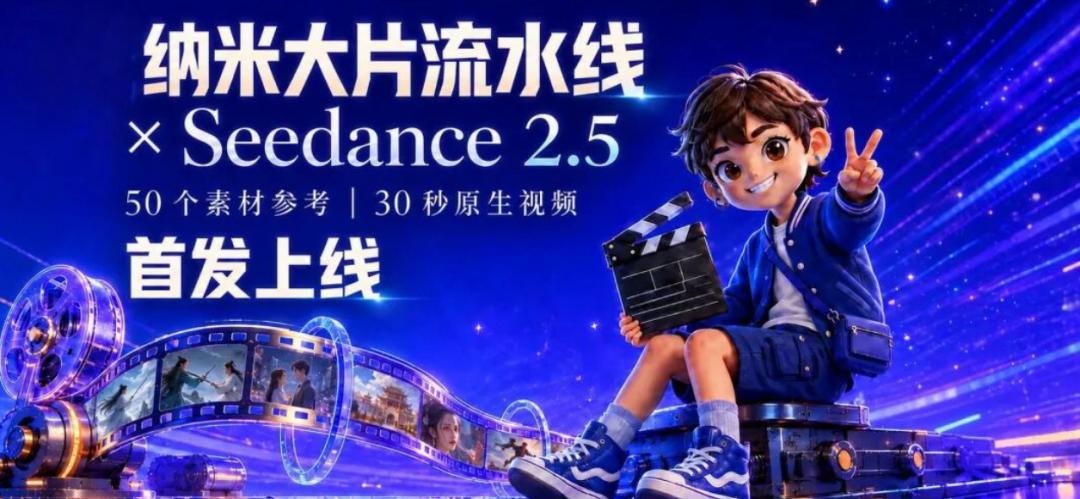
This path is very representative: 360 does not need to rank first in every video model indicator, but by scheduling different models, solidifying workflows and managing character consistency, it turns unstable "random draws" into a deliverable production line. The model determines the upper limit of a single shot, and the assembly line determines how many episodes a studio can produce in a day.
SenseTime's Seko is also evolving in a similar direction. Seko does not only generate videos, but covers story creation, storyboarding, character setting, camera organization and finished film delivery. By July 2026, its official disclosed creator users exceeded 1 million, serving 1500 enterprise clients. SenseTime combines its accumulated visual AI capabilities with Agents, trying to upgrade from a tool to an "AI video dream factory".

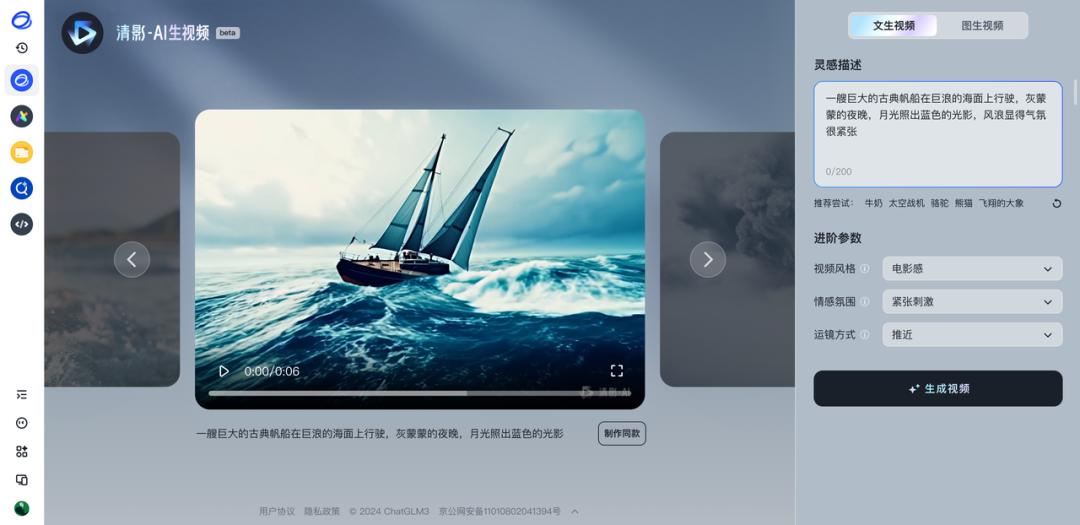
Zhipu AI entered the video generation market relatively early through "Qingying", and Qingying 2.0 upgraded its capabilities to 10 seconds, 4K, 60 frames and added sound effects, directly reaching users within Zhipu Qingyan. The feature of Zhipu AI is that general large models, agents and video models run in parallel: it can not only generate shots, but also use language models to complete creativity, scripts and prompt organization. However, in the entertainment track, Zhipu AI is more like a underlying capability provider at present, and there is still a certain distance from a strong content platform and a mature commercial closed-loop.
StepFun also attaches great importance to the multi-modal base. Its 30-billion-parameter Step-Video-T2V is open source under the relatively loose MIT license, and Step-Audio covers speech, emotion, dialects, singing and role-playing; the open platform further directs its capabilities to IP interactive games, web novel creation and audio and video production.

Open source can rapidly expand the developer ecosystem, but it also means that StepFun needs to answer a question: when the model can be freely deployed by other enterprises, where does the value finally stay — at the model company, the cloud service provider, or the application platform that owns the users?
MiniMax has given an answer: directly operate AI-native products for global users. Conch AI is responsible for video, MiniMax Audio provides speech, the Music model covers music, and Starfield explores AI roles and companionship. In 2025, MiniMax's revenue reached 79 million US dollars, a year-on-year increase of 158.9%, and more than 70% of its revenue came from overseas; by the end of the year, it had served more than 236 million users, 214,000 enterprise clients and developers in total.

MiniMax has proved that Chinese companies can charge directly overseas relying on video, speech, music and virtual roles. But at the same time, it faces the most intractable copyright issues in the global entertainment market: model training data, well-known character generation and user secondary creation may all turn into legal costs. The more successful globalization is, the earlier compliance pressure will come.
Kunlun Tech's layout is closer to an AI entertainment group. Its SkyReels is oriented to AI short drama creation, Mureka focuses on AI music, and DramaWave directly enters the overseas short drama content consumption market. In 2025, Kunlun Tech clearly disclosed in its annual report that SkyReels-V1 was trained with film and television data, and combined with a character analysis system to enhance performance and lens generation.

This means that Kunlun Tech is betting on both "production tools" and "content platforms": models generate short dramas and music, applications are responsible for acquiring overseas users, and then monetize through subscriptions, advertisements or paid content. Its challenge is also very straightforward — models, content and distribution are all heavy-investment businesses. Whether the three fronts can form synergy instead of mutual consumption will determine the success or failure of this strategy.
PixVerse is the representative of vertical AI video startups. Its PixVerse