ByteDance AI: Slow First, Fast Afterwards?
Zhang Yiming, the founder of ByteDance who has always kept a low profile, made a high-profile statement recently.
He made a rare appearance at the all-hands meeting of Seed at the end of July, and clearly stated that "ByteDance will not regard distillation as a shortcut to improve the capabilities of AI models, even if Seed's model capabilities temporarily lag behind major domestic competitors."
Right after the statement, ByteDance took another major move. According to 36Kr, it has established a new first-level department called "AI Data and Security", which integrates a data team of more than 1,000 people and is parallel to departments including Seed, Flow and Douyin.
In addition, according to *LatePost*, ByteDance is discussing training a model with a parameter scale of more than 5 trillion. If implemented, it will become the model with the largest known parameter scale in China so far.
At the same time, the commercialization of Doubao has also been fully accelerated: three monthly subscription tiers of 68 yuan, 200 yuan and 500 yuan have been officially launched; Doubao has started to charge commissions for life service orders; the Feishu product team has merged with Doubao to focus on desktop Agent products.
With larger models, stronger technical foundations, and a commercially closed loop that has been fully reorganized from architecture to business, ByteDance AI no longer emphasizes "catching up", and it has begun to tell a slower but more imaginative story.
ByteDance AI continues to follow its old path of "extraordinary efforts bring extraordinary results", but this time, the direction of its efforts has changed.
01 Zhang Yiming "Rejects Distillation"
Zhang Yiming, founder of ByteDance, has kept a very low profile since he stepped back from frontline operations in 2021. But recently, he rarely appeared at the Seed all-hands meeting and clearly stated his stance of "rejecting distillation".
Subsequently, at ByteDance's all-hands meeting on August 5th, Liang Rubo, CEO of ByteDance, further set the tone: "ByteDance's large language model will adhere to independent research and development, do a solid job in basic skills, accept temporary backwardness, insist on long-term optimization, and the most important thing is not to deviate from our established direction."
The two top leaders spoke at the same time, why is ByteDance so clearly opposed to "distillation"?
First, let's clarify what "model distillation" means: it refers to using the outputs generated by a more advanced cutting-edge model to train your own model.
It is like sitting next to a top student (the teacher model) when reviewing, asking him questions repeatedly to get answers, and then using these "questions and answers" to train yourself (the student model) to quickly improve your grades.
But it needs to be made clear that distillation is not plagiarism. You cannot directly obtain the weights and complete training data of another model, and it is only a relatively "faster" learning method.
In China's AI industry, distillation is almost an unspoken "conventional operation".
For example, in early 2025, DeepSeek released the reasoning large model DeepSeek-R1, and it also released six small-sized distilled models whose "teacher model" is R1 itself.
However, in the overseas AI industry, distillation has sparked a public opinion storm.
Earlier this year, US AI company Anthropic accused three large model manufacturers, DeepSeek, Kimi and MiniMax, of launching industrial-grade "distillation" attacks on its Claude model, but none of the three companies gave a direct positive response.

Distillation is indeed a "shortcut" to improve the capabilities of large models, but whether "faster" equals "better" has always been controversial.
The mainstream view is that for large model enterprises in the first echelon, it is difficult to truly build technical barriers only through distillation. Besides, large-scale distillation is also a relatively complex systematic project, which requires consideration of the return on computing investment.
The distillation technology itself is not a sin, but at least for ByteDance, its vigilance against distillation has run through its entire AI development process.
As early as 2023, the internal model team made it clear that data generated by GPT must not be added to the training dataset.
In January 2025, DeepSeek R1 was launched, showing strong reasoning capabilities with limited training costs, which brought great competitive pressure to domestic large model enterprises including ByteDance's Seed team.
In response to this, there was an internal discussion within Seed about whether to adopt the distillation method to introduce the generation results of leading US models, but the management finally rejected this proposal.
However, in the face of the continuously improving intelligence level of large models at home and abroad, distillation has always been an unavoidable option inside Seed.
Until the emergence of Kimi K3, this domestic large model whose capabilities are very close to overseas closed-source flagship models, the voices in favor of distillation inside Seed have increased.
This time, Zhang Yiming finally stood up and stated that "distillation is not acceptable". According to 36Kr, after this all-hands meeting, Seed introduced a new internal policy, which explicitly prohibits distillation of open-weight models such as K3, and traces and investigates suspected distillation behaviors.
For ByteDance, "rejecting distillation" is not just a slogan, but also a measure that has been fully implemented.
02 Play to Your Own Strengths
But the question is, why did ByteDance, which has always believed in "extraordinary efforts bring extraordinary results", go against the norm this time and choose to slow down?
Perhaps we can find the answer from ByteDance's own inherent genes.
In 2012, ByteDance launched its first product "Toutiao", which was not very innovative in terms of product model. At that time, large manufacturers including Sohu, NetEase and Tencent had all launched similar information apps.
But what makes "Toutiao" special is that it tried to use technical means to influence what content users can see. Relying on the technology of algorithm recommendation, ByteDance created a news and information model different from traditional web portals, which has been used ever since.
In this way, it is not difficult to understand why Zhang Yiming chose to say no to "distillation". Distillation essentially copies the existing capabilities of others. Following this path, you can at most keep approaching others, and it is difficult to achieve real transcendence.
Only by subverting the existing experience of the industry can we open up our own track, which is the experience ByteDance learned when it built its first product, and this is even more true in the field of large AI models.
In 2024, a joint study by institutions including the University of Oxford and the University of Cambridge was published on the cover of *Nature*, pointing out that if a model is repeatedly trained with AI-generated data, the tail information in the original data distribution will gradually disappear, and eventually lead to irreversible capability degradation.
More importantly, ByteDance's core battlefield has never been pure text large models, but native multi-modality, which requires the model to build multi-dimensional perception of the physical world from scratch, and establish a deep alignment mechanism among text, images, videos and audios.
If you choose to distill other people's models, it is equivalent to inheriting other people's encoding foundation, and ByteDance will lose the ability to define the rules of multi-modal models from scratch.
So, for ByteDance that rejects distillation, what can it rely on to make its model stronger? The answer is data.
Recently, ByteDance established a new first-level department called "AI Data and Security". One of the predecessors of this department is the Global Data team founded by Fu Yue, a member of TikTok's founding team, and it also integrates multiple previously scattered AI data departments.
According to the report of *Intelligent Emergence*, a person close to the department said that this department will be a huge data team spanning from the base model to the business team, and its core function is to provide cross-modal data services for all large models of ByteDance.
Before that, ByteDance has never been stingy with investment in training data for large models. In 2026, ByteDance's data budget has exceeded the tens of millions of dollars level, and it is in a state where "the budget can be added at any time".
"Data" is becoming more and more important. Today, the entire AI industry is undergoing a structural transformation. The capabilities of large models are rapidly becoming homogeneous, the capability improvement brought by algorithm architecture is slowing down, and data has gradually become the variable that determines the upper limit of model capabilities.
However, the higher-quality data is, the scarcer it is. According to the latest calculation of independent research institution EpochAI, the training of language models will exhaust all human public text data in the next five years, and the depletion of high-quality language data may even come as early as 2026.
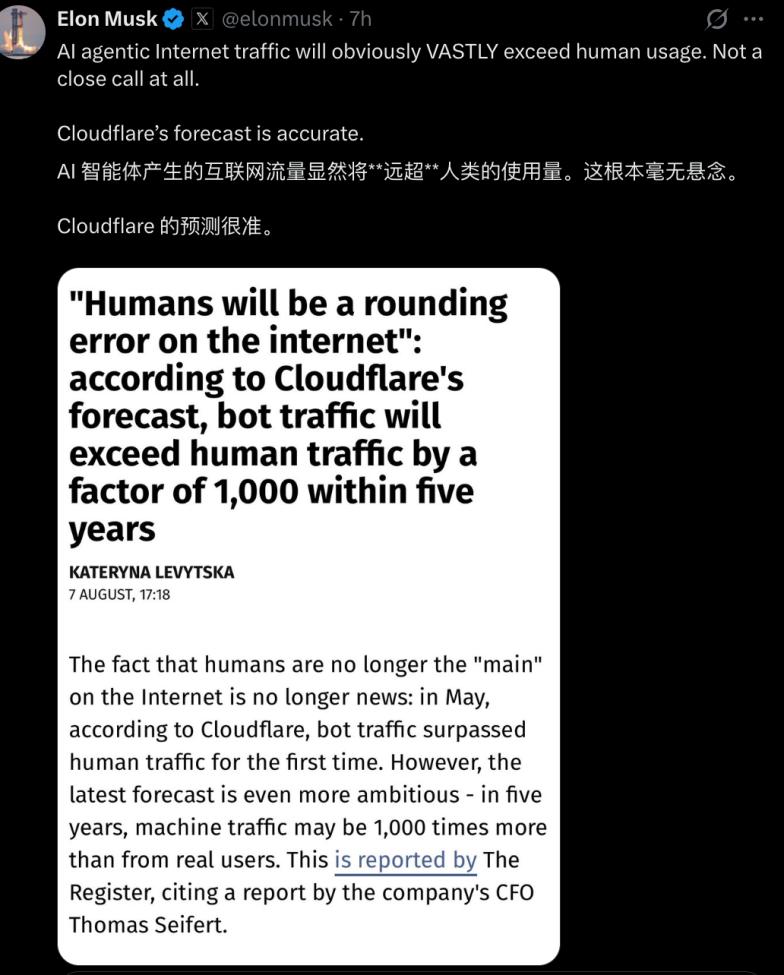
In the past year, all major model manufacturers have increased their investment in data. In 2025, Anthropic allocated a budget of more than 1 billion US dollars for RL data; OpenAI's annual data cost was about 1 billion US dollars, and its internal forecast is that the cost will rise to 8 billion US dollars by 2030.
However, data is precisely the field that ByteDance is best at.
In the past ten years, ByteDance has accumulated an extremely mature data flywheel: users around the world generate massive amounts of behavior data on the platform every day, which helps ByteDance draw a more detailed user portrait, and continuously improve the platform's recommendation algorithm at the same time.
These precipitated image-text, video, live broadcast and interaction data are not only large in quantity, but also real and contextual, which have become the most scarce training materials for ByteDance's large models.
On the road to AGI, ByteDance already has a few more hidden cards than others.
03 Bet on a "Different Future"
However, "relying on yourself" is destined to be a more difficult path, and may even lead to temporary backwardness.
Liang Rubo also admitted that Doubao has maintained competitiveness in C-end applications, and the video generation model Seedance has remained at the SOTA level, but the gap between ByteDance's large language model and leading overseas models has widened.
But ByteDance is willing to accept this cost.
Because it is betting on a future different from other current AI giants: it is not a super large model that only pursues parameters and scale; nor is it a technology supplier that only sells models, but an AI data flywheel that drives the entire ecosystem to operate.
ByteDance's goal is clearly visible from its recent commercial moves.
On the C-end, Doubao has started to try the charging model.
According to the monthly active list of AI-native apps in June 2026 released by QuestMobile, Doubao ranks first with 382 million monthly active users, and its user scale is still growing, with a year-on-year growth rate of 172.1%.
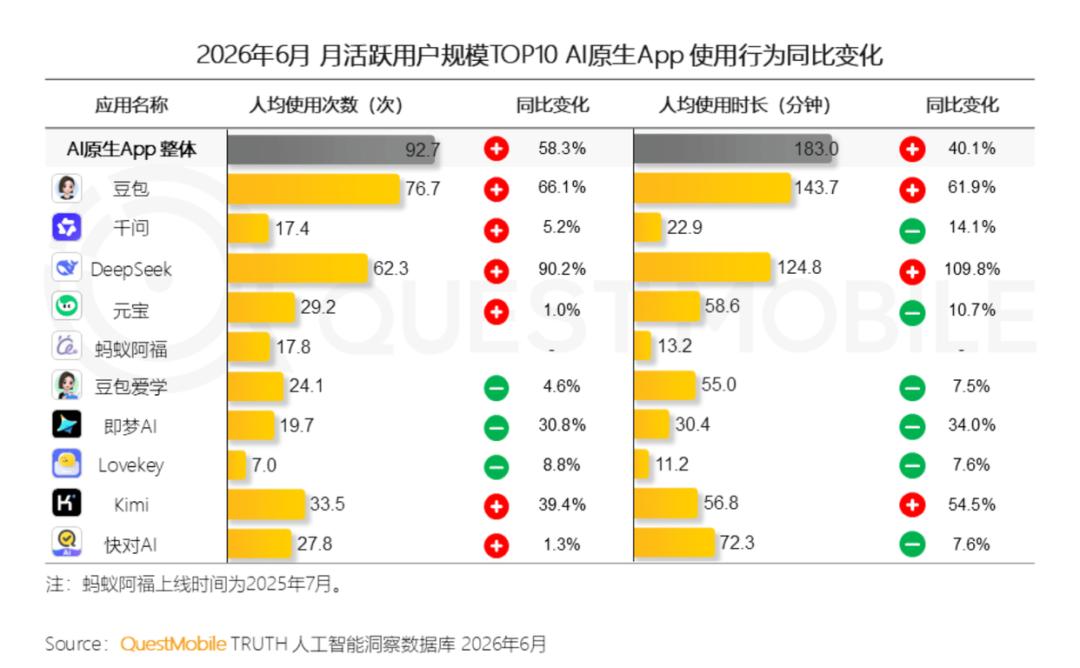
After the user scale has expanded, Doubao has launched a professional version of membership (three tiers of 68 yuan, 200 yuan and 500 yuan); at the same time, the Feishu product team has been fully merged into Doubao. In the future, one Doubao will be able to connect the two major scenarios of daily life and office work.
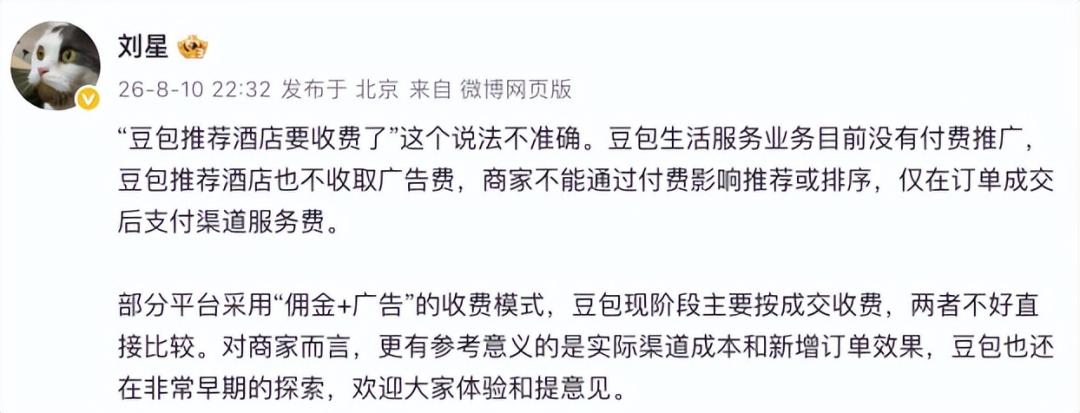
On the B-end, Doubao has also started to "charge fees". Since August 10, independent rates have been implemented for some orders that jump from the Doubao entrance to Douyin Local Merchant Platform and complete transactions. The comprehensive rate for hotel orders is about 12%; the rate for some life service orders is about 18%.
As for Seedance, according to *LatePost*, the current annualized recurring revenue (ARR) of ByteDance's Seedance 2.0 video generation model has reached 2 billion US dollars (about 14.3 billion yuan).
In the past, ByteDance took Douyin as the traffic engine to connect advertising and e-commerce; now, Doubao has been listed as an independent channel, and ByteDance has begun to separately price the transactions brought by AI.
ByteDance's charging model has just started. Compared with how much money it charges, what is more important is that it has opened up a complete transaction link brought by the AI assistant as the entrance, and can use AI to rewrite the entrance rules of the two highest-frequency scenarios: local life and workplace.
ByteDance is temporarily leading the domestic large model industry in commercialization, and the core is the united front composed of the base model, C-end and B-end:
The C-end Doubao "stores water" at the front end, as a unified implementation carrier, continuously enriches application scenarios to retain users; the B-end "opens the gate" at the middle end, by penetrating into different scenarios such as local life, office, and film and television, to provide services for enterprise customers and charge for them;
Seed and Volcano Engine "build the foundation" at the bottom, using model capabilities and computing power infrastructure to support the continuous operation of the entire flywheel. With the connection of the above three layers, ByteDance AI's path from traffic to monetization is unobstructed.
Therefore, ByteDance does not need to use others' outputs to quickly make up for its AI lessons. What it needs more is to spend time polishing scenarios and accumulating data, just like it incubated apps in the past, treating the large model as an entity that can generate a business model and serve users well.
Compared with getting good grades quickly, what ByteDance needs more is time.
In this fierce AI competition, every major manufacturer has its own technical advantages and ecological capabilities, and ByteDance also has its own long board — that is a more compatible AI ecological closed loop.
Of course, the "future" that ByteDance bets on is that AI will eventually become the next generation of super entrance.
But in the AI era, changes come faster than expected. Whether ByteDance, this "slow turtle", can finally reach the finish line faster depends on how other competitors make efforts.