Just now, all the details of Claude's text watermark have been fully disclosed, and the official detection tool is about to be launched.
Just now, Anthropic officially published a post explaining how Claude's text watermark works.
According to the official statement, to meet the EU's requirements for machine-readable marking of AI-generated content, Anthropic finally adopted the SynthID-Text route from Google DeepMind. Since there is still no reliable regional differentiation solution, this watermark will be directly applied to all Claude users worldwide after its launch.
As for how the watermark is added, whether it can be removed, whether polishing human-written articles with Claude counts as watermarked, whether code will be affected, how translation works, and how detection will be implemented in the future... Well, Anthropic has basically answered all these key concerns that everyone cares about this time.
Anthropic is trying to repeatedly reassure everyone: relax, the watermark has almost no practical impact on Claude.
But after reading the whole text, what is hard to evaluate are the multiple qualifiers piled up when the blog describes the impact of text watermarks: "roughly the same", "no statistically significant difference", "negligible impact", "negligible speed impact"...
Almost no impact is ultimately not equal to absolutely no impact. Even if it is difficult to observe obvious quality differences in current benchmark tests, it is hard to assert that this impact can be completely ignored across all tasks, all text lengths and long-term usage scenarios.
Especially after the watermark is officially integrated into Claude's daily generation process, whether it will sacrifice a little generation quality in some scenarios and ultimately affect user experience is still a big question mark.
Finally, the translation of the original post is attached, enjoy it~
How Claude's Text Watermark Works
Text generated by future Claude models will contain watermarks.
This mechanism can be used to assess the likelihood that Claude was involved in writing a piece of text. To comply with the EU AI Act, we are implementing this change together with several other major AI providers.
In this article, we will answer some of our most frequently asked questions, including how the watermark method we chose works, whether it will affect Claude's output, and why we are making this change.
The brief summary is as follows:
The watermark method we use will not affect the quality or content of Claude's output in practical use;
Watermarked text is indistinguishable from non-watermarked text to readers;
No extra content or hidden characters are added to the text;
The watermark does not consume extra Tokens, so it will not increase usage costs;
The watermark does not carry any identity information and cannot be traced back to a specific person, organization or chat history;
The watermark is not a unique mechanism exclusive to Claude. Starting from August 2, the EU requires AI providers serving its market to mark AI-generated content. Other major model developers have also signed the same and will implement their respective watermark solutions.
What Is a Watermark?
Large language models like Claude work by generating one word at a time.
Each time the model decides the next word, it selects from a set of possible candidate words, and finally picks the most reasonable or highest-probability one based on the preceding text.
For example, take the sentence: "The weather is very cold today, and..."
The next word is almost impossible to be "sweet".
But it is very likely to be "overcast" or "gloomy".
In most cases, which of these two words the model finally chooses makes little difference to readers, because the overall meaning of the sentence remains largely the same.
In such scenarios, the specific choice is usually determined by a random number.
Watermarks take advantage of these inconsequential choices.
There are many such choices that appear repeatedly in a piece of generated text, through which the watermark leaves a certain pattern in Claude's responses.
This pattern is imperceptible to readers, but can be detected by anyone who holds the corresponding key.
After the watermark is enabled, the choices made by the model are still random, but the source of randomness has changed.
The model will no longer use an arbitrary random number generator to select the next word, but use the key and the previous few words to determine which word to choose.
In other words, the words Claude selects are still random, but now people can check this sequence of words to determine whether it matches the choices Claude would make when using that key.
If it matches, the probability that this piece of text was generated by Claude can be calculated.
It needs to be emphasized that this does not mean the model will always prefer to choose "overcast" or "gloomy" from now on.
Just like when there is no watermark, based on the preceding words, it may choose "overcast" in one sentence and "gloomy" in the next.
The watermark mechanism will not force Claude to choose words that it would not have considered at all originally.
For example, it will not make Claude suddenly use a rare synonym for "overcast and gloomy" like "nubilous", which Claude would almost certainly not use under normal circumstances.
How Will the Watermark Affect Claude's Output?
The watermark will not affect the quality of Claude's output.
For readers, responses with watermarks are indistinguishable from responses without watermarks.
In this regard, AI watermarks are very different from traditional watermarks on banknotes, other physical objects and some digital documents, which are usually directly visible to the naked eye.
In internal tests, we found no evidence that the watermark affects the content, level of creativity or readability of Claude's text.
In the SynthID-Text paper introducing the technology we use, Google DeepMind specifically tested this impact.
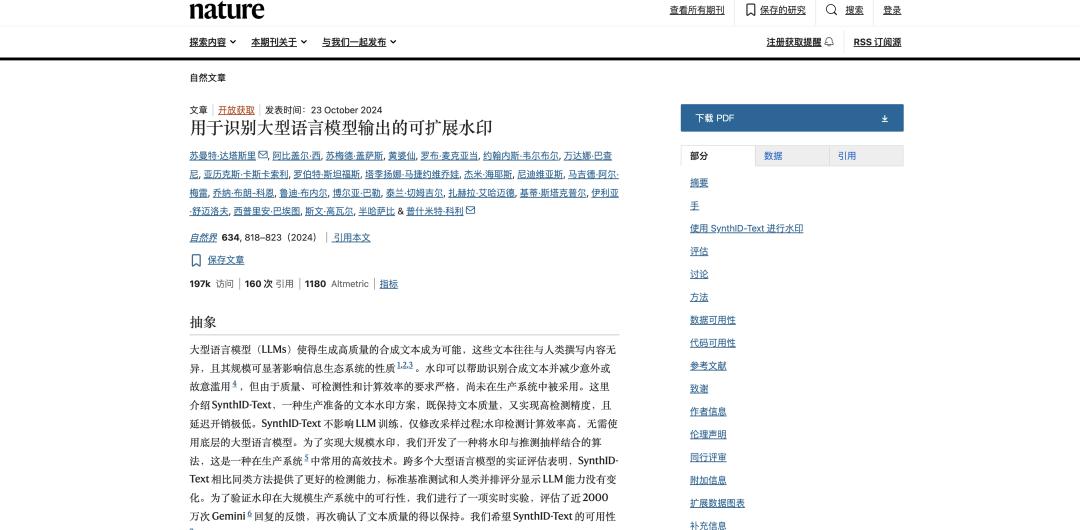
🔗 https://www.nature.com/articles/s41586-024-08025-4
They let a group of Gemini users use the watermark-enabled model, then compare the upvote and downvote ratings given by users.
The results show that there is no statistically significant difference between it and the model without watermarks.
In another controlled study, human raters compared watermarked and non-watermarked responses side by side, and found no difference in quality.
This can be analogized to a game like Monopoly.
Each turn, players move a random number of squares on the board based on the result of rolling dice.
Suppose instead of getting randomness by rolling dice, we use a book that records the digits of the pi number π.
We first randomly select one digit as the starting point.
For example, start from the 1,012,845th digit after the decimal point, which happens to be 6.
From here on, each player will then use the subsequent digits of π as their "dice roll result" for each turn.
From a practical point of view, these moves are still random.
For players, and even for the outcome of the entire game, it makes no difference whether the randomness comes from π or from the dice rolled each turn.
But after the game ends, if we can see the full sequence of all moves and know the exact value of π, we can determine whether the game was likely to use π to decide the moves.
In a sense, this game using π is "watermarked".
The same logic applies to the text generated by Claude.
The watermark will not change the meaning of the text itself, nor will it change the experience of readers when reading it.
But if you want to determine after the fact whether a piece of text is likely to be generated by Claude, the watermark can help complete this detection.
Which specific watermark method do you use?
Claude's text watermark adopts a version of the SynthID-Text method published by Google DeepMind in a 2024 Nature paper.
It belongs to a series of related methods.
This series of methods can be traced back to a solution proposed by Scott Aaronson in 2022.
They all follow the same design principle introduced earlier: the watermark only changes the source of randomness the model uses when choosing between multiple candidate words.
There are also some limitations to the effectiveness of watermarks.
With our key, the only question we can answer is: "How likely is this text to be partially written by Claude?"
It cannot confirm that the text was written by a human.
Nor can it determine that the text was written by another AI.
Even if another AI also uses a watermark, it will have a different key, and may even use a completely different watermark technology.
Watermark detection does not work well when the text sample is very short.
Because there are fewer word choices in short text, there is less information available for judgment.
As the length of the text increases, our confidence in judging whether Claude was involved in generating it also increases.
In fact-heavy text, watermarks are usually sparser.
Because this type of text has fewer optional words, forcing changes to choices may reduce factual accuracy.
For example, this sentence: "Isaac Newton's most famous work is called Philosophiæ Naturalis Principia Mathematica..."
If you have already written "Principia", whether the next word is "Mathematica" is very important, because it is the only correct answer.
Therefore, there is no room for the watermark to function at such positions.
The same logic applies to proofreading.
If you give Claude an article and ask it to only modify the grammar and punctuation without changing anything else, the watermark can only exist in a small number of modified places.
These modifications may be too few to be detected.
What if Claude only proofreads or edits text written by humans?
The watermark only acts on the words selected by Claude itself.
When Claude proofreads a piece of text written by a human, the content it returns usually only goes through minor edits.
Since almost all the words in it come from the original author, there is barely any space for the watermark to attach, or there may be no space at all.
Whether Claude's involvement can be detected specifically depends on the length of the text and the extent of modifications Claude made to it.
These modifications may sometimes be insufficient for Claude's involvement to be detected.
The more content Claude writes, the more word choices it needs to make, and the more space the watermark can exist.
What About Code?
As mentioned earlier, AI watermarks take advantage of choices where two different words are equally appropriate and the model can choose between them.
If a position requires an exact output, that is, there is no room for choice, and replacing the word will lead to factual errors or make the code unrunnable, the watermark will not be applied here.
For example, after the model has written "2 + 2 =", the next Token has a very clear best choice.
If the model is solving this arithmetic problem, there is no answer that is as correct as "4".
Therefore, the watermark will not exert any "slight nudge" here.
For the same reason, code must remain precise in most scenarios, so it usually contains far fewer watermarks than other types of text.
However, in some places within the code where there is indeed room for arbitrary choices, the watermark can still function.
For example, the wording in code comments.
But by definition, the impact of this mechanism on the actual generated code itself will be minimal.
What Does This Mean for Users?
Will the watermark make the model slower or more expensive?
No.
The impact of the watermark on model speed is negligible.
Since it does not generate extra Tokens, neither the model's service cost nor the user's usage price will change.
Can the watermark be traced back to me or my organization?
No.
The watermark targets Claude and its outputs.
It will not identify any information related to specific users.
Neither the watermark itself nor the corresponding key contains information that allows anyone to restore the user's identity, the user's organization, or the user's chat history with Claude.
Why Add Watermarks to Claude's Output?
We implement watermarks to comply with the EU AI Act.
In July 2026, Anthropic, together with several other major AI model providers and a total of about 190 signatories, jointly signed the EU .
This code requires AI system providers to use certain methods to "mark" AI-generated text.
When the watermark is launched, we will apply it uniformly across the globe.
The reason is that currently we do not have a sufficiently durable and reliable way to limit the scope of watermark usage by different regions.
However, we will continue to evaluate different solutions and announce updates when new progress is made.
Other Questions
How can I check if a piece of text was written by Claude?
We will soon launch a watermark detection API.
The specific implementation details are still being finalized.
What About Images and Other Files?
When Claude generates files in supported formats, such as .png, .jpg or .svg, it will attach a content credential to the file's metadata.
It is a small piece of cryptographically signed information that indicates that the file was created or processed by Claude.
This uses an open industry standard called C2PA.
Camera manufacturers and photo editing software also use the same standard to record the source of images.
Any tool that supports C2PA can read this information.
We will also provide our own detection tool, where users can directly upload files for inspection.
This metadata tag is very different from a watermark.
The content of the file itself will not change in any way, and the information will not be embedded or hidden in the content.
Just like text watermarks, this credential only indicates that Claude was involved in generating or processing this file, and does not contain any identity identification information.
Can't others bypass the watermark by modifying the text?
To a certain extent, yes.
Minor edits may not completely remove the watermark.
If every word is replaced and the text is completely rewritten, the watermark will be removed.
Of course, in the latter case, there is room for discussion about whether this text can still be called "AI-generated".
What Exactly Can a Watermark Prove?
The watermark can only determine whether Claude was likely involved in this piece of content at a certain stage.
It cannot distinguish between "this content was written by Claude" and "this content was heavily edited by Claude".
Will Translations Also Have Watermarks?
Yes.
Translations generated by Claude will contain watermarks, because in this case every word is selected by Claude.
What About Older Versions of the Claude Model?
EU law sets a transition period for Anthropic