Incubated by the University of Science and Technology of China, China's only enterprise dedicated to developing complete general-purpose optical quantum computing systems has closed a financing round of over 100 million yuan, in an exclusive scoop from 36Kr.

Source / Enterprise
This article is about 2200 words, with an estimated reading time of 5 minutes
Author | Ou Xue
Editor | Yuan Silai
36Kr has learned that Hefei Silicozen Chip Technology Co., Ltd. (hereinafter referred to as "Silicozen Chip") has recently completed a financing of over 100 million yuan. This round of financing is co-led by Weihao Venture Capital and Gomtec (002655), with follow-on investments from institutions including Huace Film & TV (300133), Suzhou Venture Capital, Suzhou Financial Holding, and Chuangling Capital. The raised funds will be mainly used for the R&D of 10,000-bit dedicated optical computing clusters and general-purpose quantum computing chip sets.
Silicozen Chip was founded in Hefei in 2020, and its core technology originates from the Key Laboratory of Quantum Information of the Chinese Academy of Sciences led by Academician Guo Guangcan of the University of Science and Technology of China. The company was co-founded by three co-founders: Chen Wei, Changjiang Scholar of the Ministry of Education and Executive Director of the Department of Optics and Optical Engineering of the University of Science and Technology of China; Ren Xifeng, National Outstanding Youth Fund recipient and Deputy Director of the Key Laboratory of Quantum Information of the Chinese Academy of Sciences; and Ding Yuyang, a PhD graduate of the University of Science and Technology of China who has been engaged in the R&D of optical quantum chips during his doctoral period. The core team has more than 20 years of technical accumulation in the field of integrated optical quantum, all coming from the team of Academician Guo Guangcan of the University of Science and Technology of China.
At present, Silicozen Chip has built a complete technical layout covering core optical quantum devices to complete machine systems. Ding Yuyang, General Manager of Silicozen Chip, said that the original intention of the company's establishment is to "realize the practical application of three technologies including quantum cryptography, quantum measurement and quantum computing based on optical quantum chip technology".
In terms of specific product implementation, Silicozen has taken two clear commercialization paths.
In the direction of quantum computing, in November 2025, Silicozen released a general-purpose programmable quantum computer based on silicon photonic integrated chips at the Quantum Technology Industry Conference, which can be accessed through the cloud platform. This complete machine is the only optical quantum computing machine in China that can run general quantum algorithms.
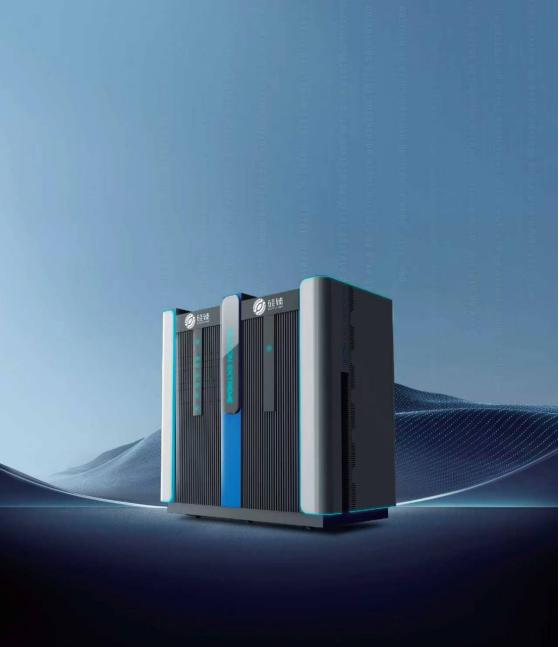
General-purpose programmable quantum computer based on silicon photonic integrated chips (Source / Enterprise)
In addition, the company has completed internal verification of 5000-bit level equipment in the field of dedicated optical computing. Compared with similar optical fiber solutions, the chip integration solution has absolute advantages in cost and performance. Ding Yuyang revealed that the product is expected to be launched and put on the market by the end of this year.
It is worth noting that Silicozen has recently made key breakthroughs in the field of general-purpose optical quantum computing. The company, in cooperation with the Key Laboratory of Quantum Information of the University of Science and Technology of China, has for the first time realized the stable generation of 4-photon 16-qubit GHZ state and single-photon 4-qubit cluster state on chip, which is the largest scale entangled state demonstrated on optical quantum chips at present. The team also demonstrated the Grover search algorithm on this platform, with an average recognition probability of 98.7%.
In the direction of quantum security, the QRNG-10 quantum random number generator chip independently developed by Silicozen is the first millimeter-level QRNG chip in China. Based on the principle of quantum amplified spontaneous emission, it is also the first QRNG chip in China that has passed the evaluation of the Commercial Cryptography Testing Center of the State Cryptography Administration.
According to Ding Yuyang, the chip has received orders for about 200,000 pieces, and its cumulative shipment volume ranks among the top of quantum technology-related single products. In terms of customer expansion, the chip has been integrated into SIM cards, and the product is also compatible with smart terminals such as State Grid electric meter encryption chips and home cameras. Ding Yuyang predicts that with the introduction of relevant national standards for anti-quantum cryptography, the annual shipment volume of QRNG chips can reach the level of millions of pieces.
In terms of commercialization rhythm, Silicozen has clear short-term, medium-term and long-term strategies: in the short term, it achieves self-sufficiency through QRNG chips, which has verified the business model and realized continuous repurchase; in the medium term, the 10,000-bit dedicated optical computing equipment will contribute revenue; in the long term, it aims at million-bit general-purpose optical quantum computers, and it is the only quantum computing enterprise in China that directly benchmarks PsiQuantum and Xanadu.
The following is the edited interview between 36Kr and Ding Yuyang, General Manager of Silicozen Chip:
36Kr: The market generally pays attention to the number of qubits, while the index of fidelity is often ignored. How does Silicozen view the relationship between the two?
Ding Yuyang: The number of qubits is definitely what we pursue, but fidelity is equally critical. Fidelity can be understood as the quality of qubits — if the single-qubit fidelity is 99.9%, it means there is an error rate of 0.1%. When 10 qubits are combined, the correct rate is 0.999 to the power of 10. The more qubits there are, the more exponentially the impact brought by fidelity will be amplified.
Therefore, our logic is: the number and quality of qubits should be promoted simultaneously, and neither can be dispensed with. Increasing the number of qubits is the ultimate goal of all quantum computing tracks, but fidelity determines whether these qubits are truly usable.
36Kr: Compared with other technical routes, what is the core advantage of optical quantum computing?
Ding Yuyang: There are mainly two points. First, our team has been engaged in optical quantum research from the very beginning, with more than 20 years of accumulation. Second, optical quantum computing is a route that can clearly explain "how to expand from 4 qubits to the level of millions of qubits".
The physical size of other routes may reach the limit after a single device reaches a certain number of qubits. Only optical quantum can be directly transmitted through optical fibers at room temperature. All other routes eventually need to convert signals into light for transmission, and cannot bypass our technology.
36Kr: From the perspective of the industry, what problems does Silicozen still need to solve to achieve million-bit quantum computing?
Ding Yuyang: This is not a scientific research problem, but an engineering problem. We are a chip design company, and we need to find wafer fabs that can meet the requirements of optical quantum chips in terms of loss and process to cooperate in depth, and jointly develop customized processes. This requires a large number of engineering iterations, working with fabs to polish processes, adjust parameters, and verify repeatedly. That is why we introduce industrial capital in this round of financing. Technology alone is not enough, and in-depth collaboration with the manufacturing side is required to truly realize the landing of million-bit quantum computing.
Views of Investors:
Lu Zhengyang from Weihao Venture Capital: This investment in Silicozen is based on the long-term commercialization potential of the optical quantum computing track. The enterprise is deeply engaged in the silicon photonic quantum route. Its equipment supports operation at normal temperature and pressure, and is compatible with mature CMOS silicon photonic production lines. Compared with superconducting and ion trap solutions, it has considerable mass production cost advantages and superior industrialization prospects. The core team of the company originates from the Key Laboratory of Quantum Information of the University of Science and Technology of China, with both top scientific research accumulation and chip implementation experience. It is a scarce enterprise in China that can realize the full-link independent R&D of general-purpose optical quantum computers, and has built deep technical barriers. Silicozen has now launched the first 4-bit general-purpose programmable optical quantum computer equipped with silicon photonic integrated chips in China, and has simultaneously laid out the mainstream technical architectures of KLM and MBQC, overcoming core technologies such as high-dimensional photon coding and kilometer-level distributed quantum interconnection. It has solid first-mover advantages and high growth certainty.
Wang Shuai from Chuangling Capital: As the leader of future industries, quantum technology is the track we think is most worthy of attention in at least the next 5-10 years. Investing in quantum technology now is equivalent to investing in artificial intelligence and computing power industry 5 years ago. After systematically sorting out and contacting relevant targets in the quantum industry, Chuangling Capital believes that Silicozen Chip is the most representative optical quantum target, and also the most noteworthy cost-effective target at present. In particular, the recent progress of Silicozen Chip in MBQC technology marks that Silicozen has become the first optical quantum computing enterprise in China to realize the construction of large-scale graph states on chip, which makes the R&D and implementation of million-qubit optical quantum computers practically feasible, and also marks that Silicozen is expected to be among the world-class optical quantum enterprises in the future.