Tencent's surprise counterattack in the AI sector
At the start of the year, the market was still questioning why Tencent was moving slowly and not being aggressive enough in its actions on models and computing power; by the second-quarter earnings report, the question had shifted to why Tencent dares to spend so much on AI?
On August 12, Tencent released its 2026 second-quarter financial report. The company recorded revenue of 2047.85 billion yuan for the quarter, up 11% year on year; under Non-International Financial Reporting Standards (Non-IFRS), net profit attributable to shareholders was 684.15 billion yuan, representing a 9% year-on-year increase.
The most noteworthy point is that Tencent's Q2 capital expenditure reached 527.84 billion yuan, up 176% year on year and 65% quarter on quarter. Capital expenditure payments in the same period hit 59.3 billion yuan. With a net cash flow of 52.7 billion yuan generated from operating activities, plus payments for media content and lease liabilities, Tencent's free cash flow turned negative 13.8 billion yuan in the single quarter.
This sum of money mainly flows to the Hy (Hunyuan) model upgrade, WorkBuddy and CodeBuddy inference, WeChat AI, and the AI capability building of more Tencent products.
Market concerns are concentrated on the high uncertainty of return on investment for AI inputs.
But when broken down, this is not an open-ended check. Tencent prioritizes allocating computing power to models and Agents first, then verifies returns through product growth; if returns fall short of expectations, the investment pace can be adjusted, and the large amount of already-purchased infrastructure can still be leased out through Tencent Cloud, forming a downside protection layer.
By the Agent stage in 2026, Tencent no longer only has models in its hand of cards.
Tencent, which seemed rather slow at the start of the year, has finally made a strong comeback at the AI game table.
AI Investment with a Clear Exit Path
When broken down, Tencent's AI bill is not a blind bet at all.
The first priority is given to computing power. In the coming months, the top destination of Tencent's capital expenditure will still be training larger and more powerful Hy models; inference will come next, providing computing power for Hy and other models running behind WorkBuddy. After meeting the needs of models and its own applications, the remaining computing resources will go to Tencent Cloud for GPU leasing and MaaS.
Behind this priority ranking is, on the one hand, related to Tencent's judgment on the value of AI.
Directly leasing out GPUs can generate revenue faster, but Tencent still chooses to reserve computing power for models and applications first. This is because once model capabilities and Agent products can achieve scale, tokens, subscriptions and subsequent services will all bring higher long-term value.
On the other hand, positive signals have already emerged in the AI business.
On the model side, after the official launch of Hy3, the average daily token usage across all channels increased by about 7 times compared with the Preview version;
On the Agent side, WorkBuddy delivers more direct returns. At present, the gross profit margin of paid users and model services has reached a level comparable to the overall gross profit margin of Tencent Cloud.
Sustained growth in core businesses such as games and advertising further provides cash flow support for Tencent's long-term AI investment. If new AI products including Hy, Yuanbao, CodeBuddy, WorkBuddy and Xiaowei are temporarily "deducted" from the financial statements, Tencent's Non-IFRS operating profit in Q2 reached 86.1 billion yuan, up 19% year on year.
Tencent has also left a fallback option for this bill. According to the management's calculation at the earnings call, under current computing power demand, directly leasing computing resources to third parties can already cover depreciation and generate profits; part of the computing power prepaid and purchased several months ago can even achieve a profit margin of more than 30% if sold under current market conditions.
This round of investment by Tencent is at least not a high-stakes bet with only a single outcome. It not only has upside space for returns from applications and models, but also has downside protection at the infrastructure level.
More Cards in Hand
From an industry perspective, the 2026 AI competition is no longer a standalone battle for models.
In 2024 and 2025, almost all global large model companies spared no effort to improve model capabilities. In 2024, OpenAI launched o1, investing more inference computing power in complex problems, hoping that the model can conduct longer reasoning before giving answers; in 2025, when Google released Gemini 2.5 Pro, it still took "the smartest model", inference capability and leading performance in multiple benchmarks as its core highlights.
Entering 2026, such gaps still exist but are narrowing rapidly. According to the *2026 AI Index* released by Stanford University, as of March this year, the top models from the four companies Anthropic, xAI, Google and OpenAI are all within a 25-point range in Arena Elo scores.
Cutting-edge models are constantly getting stronger, but the leading players are getting increasingly crowded, and the marginal significance of simply chasing benchmark scores is declining.
This also means that the evaluation criteria for 2026 AI competition are changing.
In the past Chatbot era, the core concern of one interaction was "how well the question is answered"; in the Agent era, AI starts to take over a longer task chain, and completing tasks stably becomes more critical.
What tasks an Agent can ultimately complete depends not only on the model, but also on a complete set of system capabilities beyond the model: how the Harness disassembles and orchestrates tasks, whether the Context remains effective in dozens or even hundreds of steps, whether tools are called correctly, whether errors can be recovered, and whether it can connect to enough software, data and services.
This is exactly where Tencent starts to have more cards in its hand.
If we only look at models, Hy is facing a highly crowded competition. But after entering the Agent stage, Tencent has Agents that are stepping into real working environments on one end, and its underlying models on the other end. Two-way feedback signals that were not obvious before have begun to emerge between the two.
The Agent side has already reached a certain scale. According to data from Analysys, in June 2026, the combined monthly visits of 17 mainstream domestic desktop AI-native office agents exceeded 60 million times, among which WorkBuddy recorded 20.97 million visits, ranking first and exceeding the sum of the second and third places.
Behind the 20 million-level visits are a large number of real office tasks, as well as a feedback mechanism that continuously exposes the shortcomings of Agents. Problems that benchmarks can hardly cover, such as unreasonable task disassembly, insufficient context, incorrect calls of tools and models, failed steps, and whether users finally accept the results, will all be revealed in real execution, and drive continuous optimization of Harness in task orchestration, context management, tool calling and failure recovery.
Moreover, under the premise of compliance authorization and privacy protection, effective feedback precipitated from real tasks can also provide input for the continuous iteration of Hy.
At this point, WorkBuddy and Hy have formed a Co-design Loop. Real tasks polish the Agent first, and then further feed back to the model; after the stronger model is re-integrated into the product, it pushes WorkBuddy to the boundary of more complex tasks, and new tasks will continue to generate the next round of feedback.
In the future, the competitiveness of Tencent AI will also depend on how fast this flywheel of "real tasks - product feedback - Harness/model iteration - more real tasks" can spin.
Buying the Next Round of Growth Opportunities
This change has begun to reshape the competition of office Agents.
After WorkBuddy took the lead at the phased stage, major domestic tech giants have successively increased their investment in desktop office Agents. On the surface, everyone is competing for users and usage duration, but what is more important is the Agentic Trajectory left after Agents enter real work.
A complete Trajectory includes not only state observation, intermediate reasoning, tool calling and environmental feedback, but also the entire task execution process such as error correction, which truly records how a piece of work is completed.
The industry is forming an increasingly clear consensus: real workflows that can continuously generate high-quality process feedback are becoming a scarcer data asset.
SpaceX's acquisition plan for Cursor is a typical case.
In June this year, SpaceX announced that it would acquire Anysphere, the parent company of Cursor, in a $60 billion all-stock transaction. Morgan Stanley believes that Cursor has accumulated real developer usage data covering 50,000 enterprises and 64% of Fortune 500 companies. This data asset can provide stronger model iteration feedback for SpaceX and xAI in the enterprise AI competition.
In the same period, Claude launched Claude Tag which directly integrates into Slack. It stays in the channel like a team member, reads authorized context, connects tools and code libraries, accepts tasks and follows up continuously.
However, to get a large number of users to continuously hand over tasks to Agents, a product experience that is low-threshold, stable and natural is still required.
This is exactly what Tencent is good at. From QQ, WeChat to Tencent Meeting, one thing Tencent has repeatedly done in the past is to hide complex technologies behind interactions that users barely perceive, and gradually build products into high-frequency infrastructure by reducing usage costs, optimizing experiences and extending usage cycles.
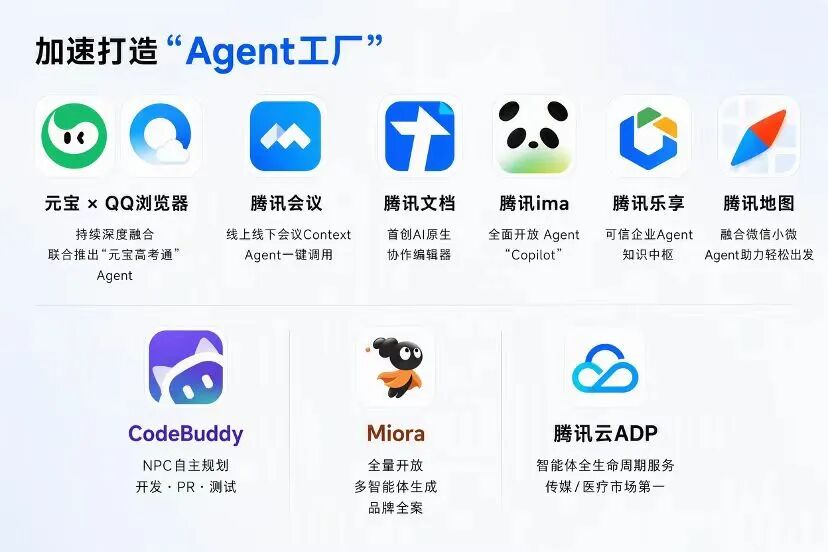
The "Human-AI Co-writing" feature recently launched by WorkBuddy and Tencent Docs fully reflects Tencent's idea of developing AI products: identify real pain points in high-frequency scenarios, and embed capabilities into the workflow.
In "Human-AI Co-writing", users do not need to copy content to the AI dialog box first and then move the generated results back to the document. Instead, in Tencent Docs or local files, users can directly select a piece of content, ask the AI to rewrite it in place using natural language, and the results will be written to the original file immediately. It also supports reading comments, and collaborative editing of the same document by multiple users and AI.
This type of function does not necessarily rely on the most extreme model parameters, but it targets the most frequent, trivial and efficiency-impacting links in office scenarios. Every time users avoid copying and pasting or switching windows, it means that AI is more likely to be used every day, which can bring sustained high growth and high retention.
WorkBuddy has achieved phased user scale. Tencent's heavy investment at this stage is essentially seizing the window period when the Agent competition has not yet solidified: let more ordinary users hand over real tasks to Agents as quickly as possible, and run the cycle between models, products, tasks and feedback.
In the future, if this cycle further expands to different scenarios including Yuanbao, Xiaowei, WeCom, Tencent Meeting, Tencent will also obtain a product network covering more real tasks.
What Tencent wants to buy is the opportunity before the next round of growth is fully determined.
This article is from the WeChat Official Account "All-weather Tech" (ID: iawtmt), authored by All-weather Tech, and published with authorization from 36Kr.