DeepSeek Harness, "Kill" the Agent Black Box
Written by | Hao Xin, Gao Xiaoyang
Edited by | Wang Pan
Recently, DeepSeek has been staging continuous unexpected twists.
On August 12, with no press conference or prior notice, DeepSeek quietly updated its API documentation, and the official version of the DeepSeek-V4-Pro model numbered "0813" was launched silently late at night.
Beyond the high public attention and expectations, there lies the gap between the actual user experience and the official benchmark scores, as well as the public doubts raised right after the launch that the platform had announced a price increase in advance.
On August 13, less than 24 hours after the release of the new model, the banner posted on the homepage of DeepSeek's official website and the announcement on the open platform were suddenly removed. The model name in the API documentation remained unchanged, and developers could still call it normally, while the official side kept silent.
Later, some developers found that DeepSeek was carrying out frantic emergency repairs in the back-end code repository of Hugging Face, which was suspected to be caused by serious misalignment between the front-end interface, the back-end inference stack and the weight configuration, leading to the failed user experience.
On the same evening, DeepSeek reissued an announcement confirming the launch of the official V4 Pro version, and open-sourced the DeepSeek Harness developer preview at the same time, everything returned to its normal track.
DeepSeek once put forward a formula: Model+Harness=Agent. This means that for an Agent that can execute tasks, a model alone is not complete. The controllable, observable and traceable features of Harness make up for the missing half of the model.
The model is the brain, responsible for thinking, reasoning and understanding intentions. However, a pure language model can only output text, and cannot directly operate files, modify databases or browse web pages. Harness is the "body" and "nervous system", which provides everything the model needs to interact with the outside world, including tool calling, file reading and writing, sandbox environment, permission management, task orchestration, etc.
Without Harness, the model is just a talking engine, and cannot become a truly functional Agent. DeepSeek tries to maximize the model performance through its self-built Harness system.
Our test results confirm this point. With the support of DeepSeek Harness, the official version of DeepSeek V4 Pro has a faster response speed, and its cache hit rate is 1% higher than that when integrated with Claude Code.
Disenchantment and Paradigm Competition
"Everything is a plugin" is the core design concept of DeepSeek Harness. In short, from models and tools to the most core Agent Loop, all modules are disassembled into independent and combinable plugins.
This concept is supported by the "spatiotemporal combinability" paradigm jointly proposed by Peking University and DeepSeek, which disassembles Agent components into two dimensions.
The first is temporal combinability: through the "reversible effect" mechanism, the system automatically records and cancels the side effects after component uninstallation, and the loading process determines the uninstallation process to ensure long-term system stability. The second is spatial combinability: through the "responsive co-effect", declarative dependency management is realized, where components only need to declare their requirements, and the runtime can automatically coordinate dependency changes to realize dynamic activation and deactivation.
The two dimensions are integrated into a unified context, carrying state, lifecycle boundary and dependency environment. Therefore, Harness can realize "privilege-free core", all components including the Agent main loop are replaceable, and developers can freely combine them through configuration files. This concept points out the direction for building a flexible and future-oriented Agent infrastructure.
When giants such as OpenAI and Anthropic are defining their own Harness one after another, DeepSeek's idea stands out uniquely.
The strategy of OpenAI and Anthropic is "downward integration", that is, by building Harness with extreme experience and deep binding to their own models, they consolidate their advantages at the AI application layer; DeepSeek's strategy is "horizontal expansion", which is no longer satisfied with being only an excellent model supplier, but tries to become the infrastructure of the next generation of AI applications by open-sourcing a model-neutral, highly modular Agent underlying standard.
The internally spread list of selected projects for DeepSeek Harness beta test also releases a strong signal that the selected projects are highly concentrated in the infrastructure field that can consolidate Agent capabilities. These projects mainly focus on MCP plugins, code agents, runtime, orchestration framework, visual UI and multi-agent scheduling, directly targeting the core problems of Agent implementation in the real world.
A series of operations by DeepSeek can be regarded as a carefully designed "disenchantment" movement. DeepSeek open-sources Harness and vigorously supports various infrastructure plugins, essentially doing one thing: making the complete methodology and source code of "how to build a powerful Agent" public to all.
Before that, the Harness of OpenAI and Anthropic was more like a "black box", whose internal optimization was top secret, and how to build Agent products was regarded as a kind of "privilege". Through open source and the Cordis plugin theory, DeepSeek actively disassembles this black box, and proves that the power of Agent does not lie in a mysterious core, but in a set of combinable and replaceable engineering components.
When Harness is fully disenchanted and becomes a transparent, replaceable component at any time, in the entire value chain, the only part that cannot be standardized and will continue to evolve is the underlying "model" itself.
If we connect the four actions of DeepSeek: model release, open source, Harness launch and price adjustment, we will find that DeepSeek's goal is very clear. First build the ecosystem, then set the standards, and finally use the strongest model performance to complete the final realization of commercial value.
Harness and open source are like free highways built in the early stage to attract traffic, and when the traffic is large enough, appropriately raising the price of fuel will become the most efficient way to realize commercial returns.
Cut Prompt Short, Run Scenarios Successfully in One Attempt
In yesterday's article, we tested seven complex tasks of DeepSeek-V4-Pro-0813, but only the task related to *The Lord of the Rings* was not fully completed. At that time, in order to save time, we only provided the first 3 sentences of the first chapter of *The Lord of the Rings*.
Actual Test of the Official DeepSeek-V4-Pro: A Mountain Is No High If It Has a "Backbone"
Just as DeepSeek Harness was also released, we ran this complete test in DeepSeek's own Harness to see what kind of effect the matching of self-developed tools and self-developed models can bring.
We will not go into details about the installation process. It is recommended that you use npm (the default package manager of Node.js, which is used to install and manage various third-party libraries required by projects, and can be simply understood as an open application market) for installation, which is also convenient for upgrading and installing other plugins. You can directly run npx @deepseek-ai/dsh web to start it. If it gets stuck, you can run npm install -g @deepseek-ai/dsh first, and then run the previous command to start it smoothly.
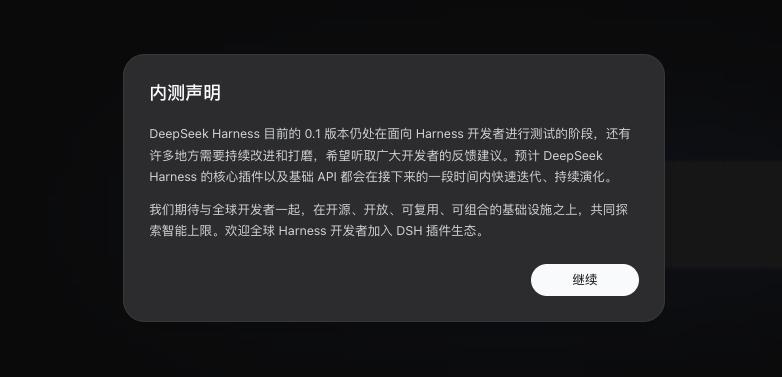
When you open it for the first time, it looks similar to most Agents, except that DeepSeek Harness currently presents a minimalist style.
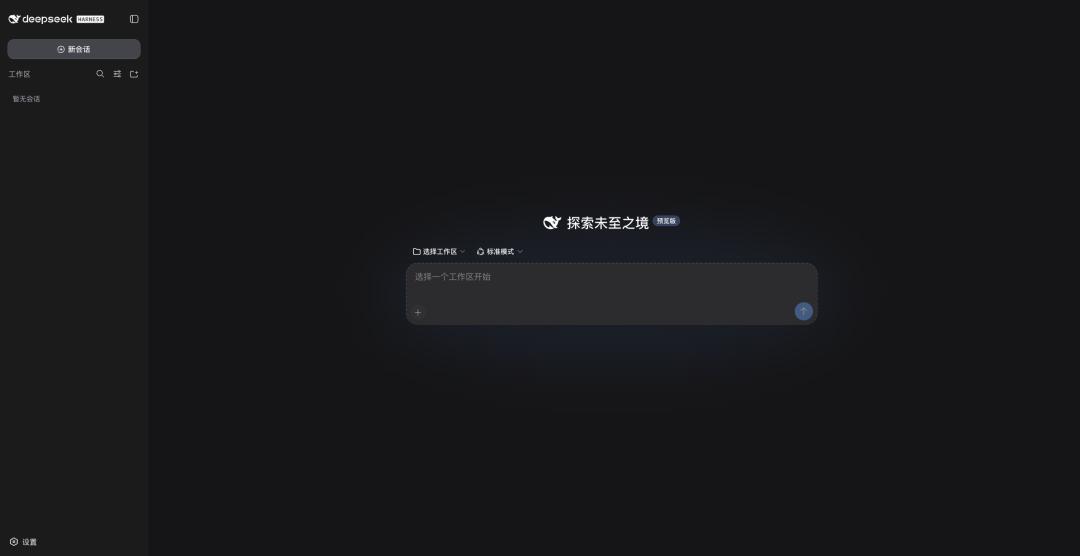
After setting up the environment, we officially started today's test. The benchmark test of *The Lord of the Rings* does not test "whether the model can draw a pelican", but tests the complete link of "understanding a piece of literature → comprehending a world → building the world programmatically", which is one of the most rigorous Agent exam questions in the current industry.
Why is yesterday's test not valid? Because we only provided 3 opening sentences at that time, while Karpathy provided the first paragraph of the original book to Opus 5. Today we complete the full text: the complete content of the first chapter, from Bilbo's announcement of his 111th birthday party, to the discussions in Hobbiton, and then to Frodo's life experience, with a total of 1817 words and 23 paragraphs, without any modification.
In the first test, following the idea that "evaluation should be rigorous", we wrote the prompt perfectly, including the 1817-word full text, the list of scene elements (the cave house should have a round door, the long banquet table should have food, and the guests should be talking in full swing), as well as 5 hard requirements for camera movement, lighting and proportion.
The result is disappointing, the effect of the first generation is very rough, and the narrative is incomplete. The scene was built, but it was far from the "birthday party in Hobbiton". In terms of presentation, the camera movement was fragmented, and the picture looked like a semi-finished product rushed out. The model penetration problem was very serious, and the little figures standing on the hillside looked like a bunch of lollipops inserted there. After reviewing the whole process, we attributed the reason to the fact that the prompt was too long, and the listed scenarios restricted the performance of the model.
In the second test, we cut the prompt to only retain the goal: understand the original text, use Three.js to build the 3D world of the Hobbiton birthday party, follow the rhythm of the original text for camera movement, and save it as a complete and runnable HTML file. All the requirements for scene elements, lighting and proportion are deleted.
The effect is completely reversed.
The scene ran successfully at the first attempt, with all the elements we needed: the cave house, Bilbo, Frodo, the long banquet table, and the hobbits talking in front of the tavern. The characters only have slight floating and model penetration problems, which are within the range that "can be recognized as Hobbiton"; the camera movement narrative is valid, which moves from the overlooking view of Hobbiton to Bilbo, then sweeps across the talking crowd, and finally circles around the long banquet table following the rhythm of the original text.
With the same model and the same original text, a meticulous prompt brought a failed result, while a straightforward goal brought a result above the passing line. It seems that top-level models no longer need detailed prompts, you only need to tell them the goal in straightforward and concise words, and too many descriptions will lead to worse results.
This is not an isolated case. When GPT-5.6 Sol was first released, some users in the community reported that using carefully optimized prompts and process skills would cause the model to fall into an infinite loop.
This discovery is worth emphasizing separately: The role of prompts is changing from "writing a script" to "setting a goal", and the era of writing long descriptive prompts for top models may really be over.
Is DeepSeek Harness Truly Competent?
Back to today's topic, how is the performance of DeepSeek Harness paired with its own V4 Pro model?
Faster response speed. For the same test, the response in DeepSeek Harness is faster than that when integrated with Claude Code the day before.
The cache hit rate increased by 1%. The cache hit rate was 98% when integrated with Claude Code the day before, and reached 99% in DeepSeek Harness. This improvement seems small, but in long-context tasks, every 1% increase in cache hit rate is directly related to cost reduction and generation speed improvement.
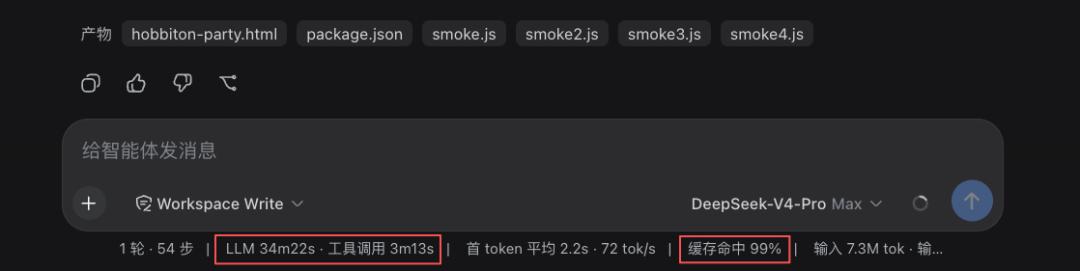
Looking at the test itself, the failure caused by the long prompt in the first test happened in the DeepSeek Harness environment; the reversal effect in the second test also happened in the same environment. However, there were no environment-related errors, lags or context loss during the whole process. The comparison between the two rounds of tests is clean, and the only variable is the prompt itself.
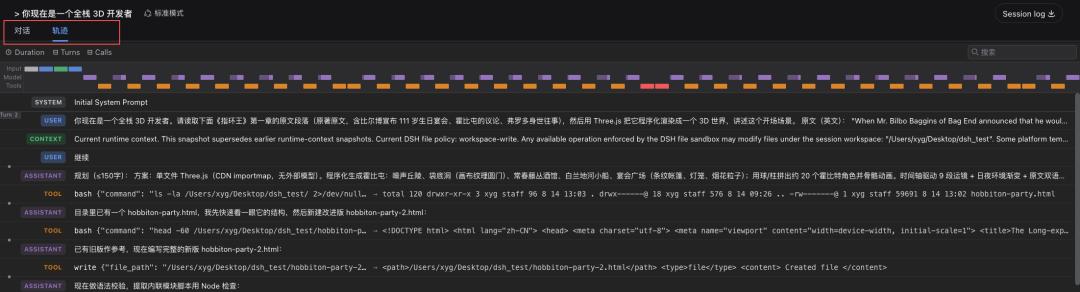
As a newly released developer preview, this is a very impressive stability performance, and DeepSeek Harness will explicitly present every step during the running process, so you can see how the model works, which is a very good innovation.
In the short term, the role that DeepSeek Harness can play is still limited, and it is difficult for ordinary users to improve work efficiency by using it just like using WorkBuddy.
But in the long run, DeepSeek Harness and the DeepSeek series models have formed an inseparable enhancement closed loop.
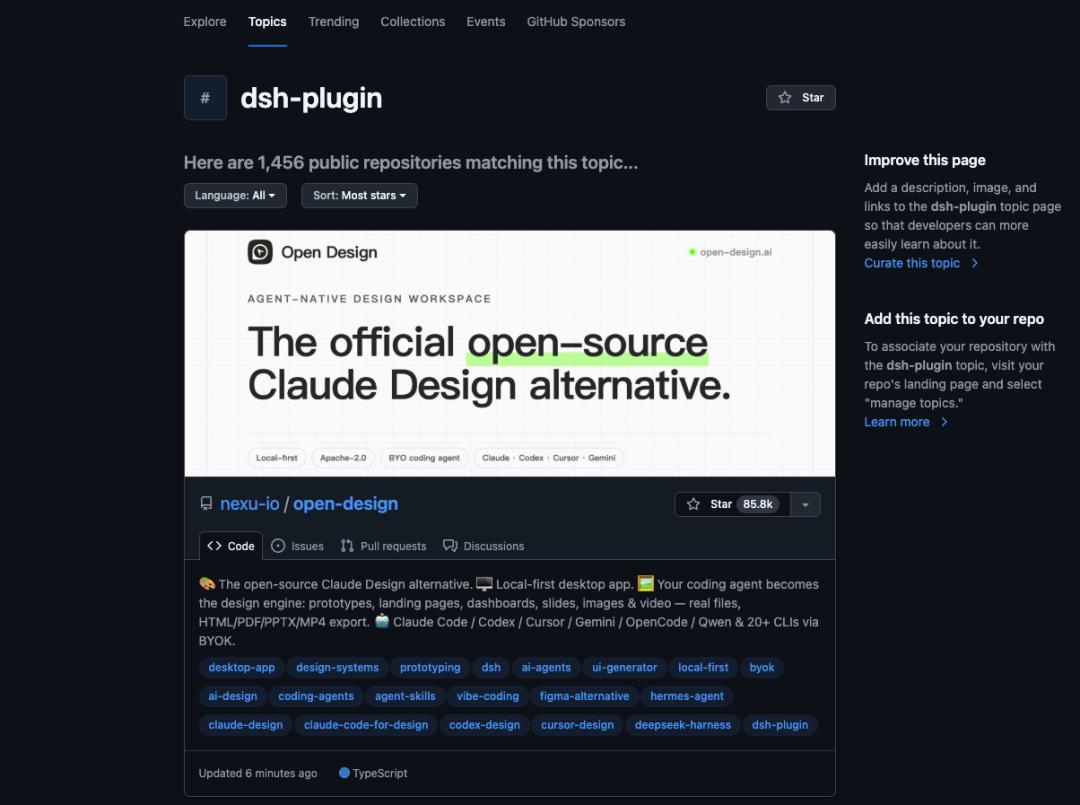
As a fully open-source Agent framework, Harness defines the underlying standards of "how models are called, how tools are combined, and how tasks are orchestrated", attracting a large number of developers and real tasks to pour in. The execution trajectories of these real tasks, through the built-in observable system of Harness, continuously flow back to provide natural data nourishment for the next round of training and optimization of DeepSeek models.
In turn, every improvement of DeepSeek model capabilities can be released to the plugin ecosystem through the built-in adapter in Harness at the first time.
When this flywheel starts to rotate, the choice of developers will no longer be difficult. Because using DeepSeek Harness will give you an out-of-the-box system that always evolves synchronously with the strongest model and does not require secondary adaptation.
This is exactly the ultimate form of "Agent=Model+Harness" defined by DeepSeek, an interconnected and inseparable complete entity.